Pitch decks are refined, investor meetings are scheduled, and conversations around startup funding India dominate entrepreneurial circles. The assumption is simple: if you want to build a large company, you need external capital. Over the last decade, countless startups have followed this path, raising money from angel investors India, partnering with venture capital firms india, and participating in startup accelerator programs india to fuel growth.
But one of India’s biggest startup success stories chose a completely different route.
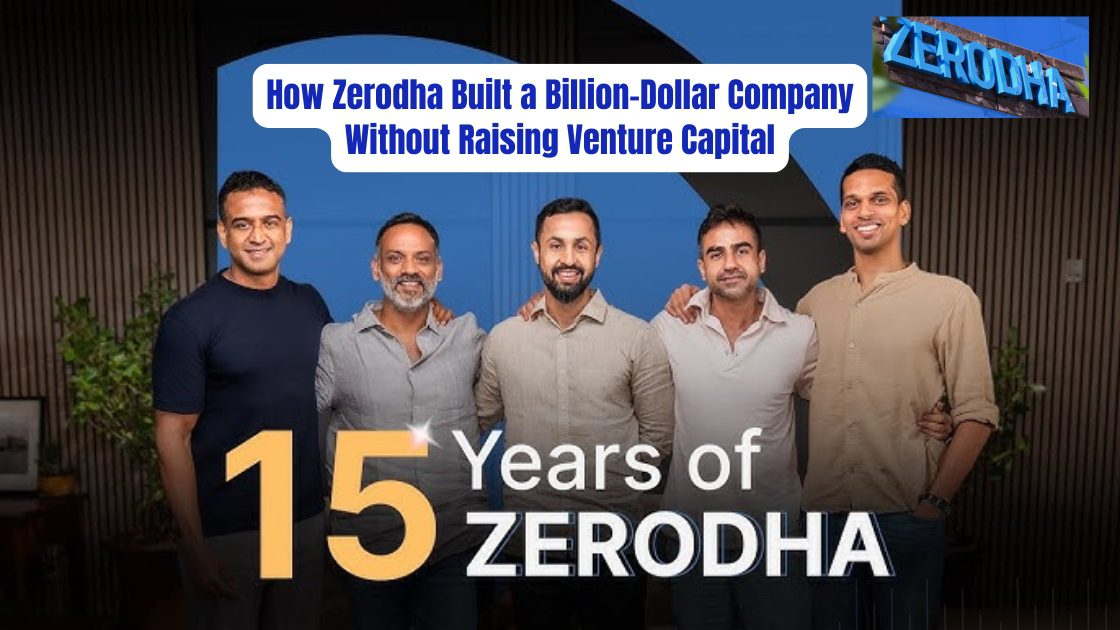
Zerodha, India’s largest stock brokerage platform, built a billion-dollar business without raising venture capital. Founded by brothers Nithin and Nikhil Kamath in 2010, the company disrupted an industry, attracted millions of customers, and achieved remarkable scale while remaining bootstrapped.
At a time when founders were competing for startup funding opportunities and chasing valuations, Zerodha focused on something far less glamorous, building a profitable business. Its journey offers valuable lessons for entrepreneurs navigating today’s competitive startup landscape.
Before becoming one of India’s most respected entrepreneurs, Nithin Kamath was a trader.
Unlike many founders who identify opportunities through market research, Kamath discovered his opportunity through experience. Years spent trading in the stock market exposed him to a recurring problem faced by retail investors.
Investing was expensive.
Brokerage fees were high, trading platforms were often complex, and market participation felt inaccessible for many ordinary Indians.
Kamath believed investing should not be limited to experienced traders or wealthy individuals.
That belief became the foundation of Zerodha.
Together with his brother Nikhil Kamath, he launched the company with a mission to make investing simpler, more affordable, and more accessible.
The vision sounded straightforward.
Executing it was far more challenging.
The Brokerage Industry Was Ready for Change When Zerodha entered the market, India’s brokerage industry was dominated by established players with traditional pricing models.
For investors making frequent trades, costs could quickly add up.
At the same time, internet adoption was increasing, technology was reshaping consumer behavior, and a new generation of investors was emerging.
The opportunity was clear.
By leveraging technology and offering lower brokerage costs, Zerodha could create a compelling alternative to traditional firms.
Rather than trying to compete through massive marketing campaigns, the company focused on delivering a better customer experience.
This approach would later become one of the most important drivers of its growth. Why Zerodha Said No to Venture Capital One of the most fascinating aspects of Zerodha’s journey is its decision to remain bootstrapped.
In today’s startup ecosystem, many founders begin exploring seed funding for startups india almost immediately after launching. Investor networks, incubators, and accelerators are often viewed as essential parts of the entrepreneurial journey.
The Kamath brothers saw things differently.
They believed external funding could create pressure to prioritize rapid growth over long-term sustainability. By remaining independent, they could make decisions based on customer needs rather than investor expectations.
This decision was particularly unusual because the company operated in a sector where technology investments, customer acquisition, and scaling typically require significant capital.
While many entrepreneurs pursued early stage funding india, Zerodha focused on building a business that generated enough revenue to fund its own growth.
The company chose profits over fundraising.
In hindsight, that decision became one of its greatest competitive advantages.
Building a Business Through Profitability
Bootstrapping is often romanticized, but it comes with challenges. Without external funding, every business decision matters. Marketing budgets must be carefully managed.
Hiring decisions become more deliberate. Growth often happens at a slower pace. For Zerodha, this constraint created discipline. The company could not afford to spend recklessly.Every investment needed a clear purpose.
Instead of relying on capital from startup investor network india groups or institutional investors, Zerodha relied on customer revenue.As more investors joined the platform, the business generated cash flow.
That cash flow was reinvested into improving technology, expanding services, and strengthening customer support.
Over time, this created a sustainable growth cycle. Unlike many startups that depend on continuous fundraising, Zerodha was able to scale through its own earnings.
For founders exploring startup funding without investors, Zerodha demonstrates that profitability can sometimes be the most reliable source of capital.
The Power of Product and Customer Trust
Many startups spend heavily on customer acquisition. Zerodha took a different approach.
Its growth was driven primarily by product quality and customer trust.
Investors who experienced lower costs and a simpler trading platform often recommended the service to friends and colleagues. Word-of-mouth became a powerful acquisition channel.
This organic growth strategy reduced the need for expensive marketing campaigns and helped the company maintain healthy margins. It also reinforced an important principle of startup growth strategies.
A great product can become a company’s strongest marketing asset.
For entrepreneurs focused on customer acquisition strategies, Zerodha’s journey highlights the value of solving genuine customer problems before scaling aggressively.
Technology as a Growth Enabler
Technology played a central role in Zerodha’s success.
The company invested heavily in creating intuitive trading platforms, analytical tools, and educational resources for investors.
Its flagship platform, Kite, became popular among both beginner and experienced traders because of its simplicity and functionality.
By embracing technology early, Zerodha was able to operate efficiently while serving a rapidly growing customer base.
This focus on innovation mirrors what many modern founders are achieving through ai tools for startups, ai productivity tools, and ai automation for startups today. Technology is not merely a support function.
It can become a competitive advantage when used effectively.
Beyond Zerodha: Supporting the Next Generation of Founders After achieving success, Nithin Kamath turned his attention toward supporting other entrepreneurs.
Through Rainmatter, Zerodha launched an initiative focused on backing startups across fintech, sustainability, health, and climate sectors.
Rainmatter provides more than capital.
It offers mentorship, strategic guidance, and access to valuable networks.
This reflects a broader truth about entrepreneurship.
While startup grants in India, government schemes for startups, and startup funding opportunities are valuable resources, founders often need knowledge and connections just as much as they need money.
Strong communities can play a critical role in helping entrepreneurs navigate challenges and accelerate growth.
Platforms that foster a startup community India, encourage founder networking India, and strengthen the broader startup ecosystem India help create opportunities that funding alone cannot provide.
What Founders Can Learn from Zerodha
Zerodha’s story is not an argument against fundraising. Many successful startups have benefited from working with investors, joining startup incubators india, or participating in startup accelerator programs india. The lesson is more nuanced.
Funding should support a strong business model rather than compensate for a weak one.
The company’s journey demonstrates the importance of: Solving a real problem. Building customer trust. Prioritizing profitability. Leveraging technology effectively.
Developing sustainable growth systems. These principles remain relevant regardless of industry or business size.
Conclusion
In an era where startup success is often measured by funding announcements and valuations, Zerodha offers a different perspective. The company built one of India’s most successful fintech businesses without venture capital, proving that profitability, customer trust, and disciplined execution can be powerful growth engines.
For founders exploring startup funding India, researching startup fundraising guide resources, or evaluating different growth paths, Zerodha’s journey serves as a reminder that there is no single blueprint for success. Sometimes the most effective strategy is not raising more capital.
It is building a business strong enough to thrive without it.
Did Zerodha raise venture capital funding?
No. Zerodha is one of India's largest bootstrapped startups and achieved significant scale without venture capital investment.
Why is Zerodha considered a startup success story?
The company disrupted India's brokerage industry by making investing more affordable and accessible while maintaining profitability.
Can startups grow without investors?
Yes. While many founders pursue startup funding opportunities, Zerodha demonstrates that profitable businesses can also achieve substantial growth independently.
What role do startup communities play in growth?
A strong startup founder community, startup founders network India, and entrepreneur community India can provide mentorship, partnerships, and learning opportunities that accelerate growth
What can founders learn from Zerodha?
The company's success highlights the importance of customer focus, profitability, disciplined execution, and long-term thinking.
Learn 5 effective return policy strategies that help increase repeat customers, improve customer trust, and…
Digital Startup India is more than a community — it’s an infrastructure for trust, growth, and opportunity, built to help you discover, connect, collaborate, and scale efficiently.