


Flipkart Food Delivery vs Zomato & Swiggy: What Changes
Table of Contents
For most of the last decade, ordering food online in India meant choosing between two apps. That assumption is now being tested from an unexpected direction.
In late July 2026, Flipkart Group CEO Kalyan Krishnamurthy confirmed that the Walmart-owned company will enter online food delivery “in the coming weeks.” The market reacted immediately — Eternal (formerly Zomato) slipped around 3% and Swiggy fell about 5% on the news. Two listed companies that had spent years convincing investors the category was settled lost a combined chunk of market value on an announcement that contained almost no operational detail.
That reaction is the story. Not because Flipkart has a better food app — nobody has seen it yet — but because of what Flipkart already owns before it writes a single line of code. This is the distribution-eats-differentiation playbook, and understanding it explains far more about quick commerce India 2026 than any feature comparison ever will.
Moneycontrol / Entrackr for the launch confirmation
What we actually know about Flipkart food delivery
The confirmed details are deliberately thin, which itself signals the strategy:
- Pilot first, scale later. Flipkart will start small — most reporting points to Bengaluru — gather feedback, refine, then expand. It is the same sequence the company used for Flipkart Minutes.
- Hybrid access. Krishnamurthy indicated food will be orderable inside the main Flipkart app, with a standalone app also under evaluation.
- Deep ONDC integration. Sources told Entrackr the offering will lean heavily on the government-backed Open Network for Digital Commerce.
- Ecosystem, not standalone bet. Food joins Myntra (fashion), Cleartrip (travel), super.money (fintech) and Flipkart Minutes (quick commerce) under one group umbrella.
Broader rollout is expected somewhere between late 2026 and early 2027, entirely conditional on pilot performance.
Why now: quick commerce broke the moat first
Flipkart is not walking into a stable duopoly. It is walking into a category that quick commerce already destabilised.
India’s quick commerce sector reached roughly ₹64,000 crore (about $7.6 billion) in gross order value in FY25 — more than double the prior year. By January 2026 the segment was clocking around ₹11,000 crore of GMV in a single month across roughly 7.8 million daily orders, per Redseer. Bernstein estimates more than 6,000 dark stores now operate nationally.
Reuters or HSBC for the take-rate comparison
Then the q-commerce players pointed that infrastructure at hot food. Zepto launched Zepto Café. Blinkit followed with Bistro. Both promised meals in ten minutes rather than thirty to forty-five. Swiggy found itself defending its original business against products built on the same logistics logic as its own Instamart.
Rapido arrived next. Its food app Ownly piloted in three Bengaluru neighbourhoods in August 2025, went citywide by March 2026, and reportedly onboarded around 20,000 restaurant partners in Bengaluru alone with plans for ten cities. Its pitch: zero commission for restaurants, a flat delivery fee for customers, and menu prices roughly 15% below the incumbents.
The reason all of this lands is take rates. Eternal’s sits at about 24.4% and Swiggy’s at 21.9%, against Meituan’s 16.1% in China, per HSBC. India’s food delivery leaders monetise more aggressively than almost anyone globally. That is a profitable position and a vulnerable one at the same time — it leaves an enormous price umbrella for anyone willing to operate underneath it.
The distribution-eats-differentiation playbook, explained
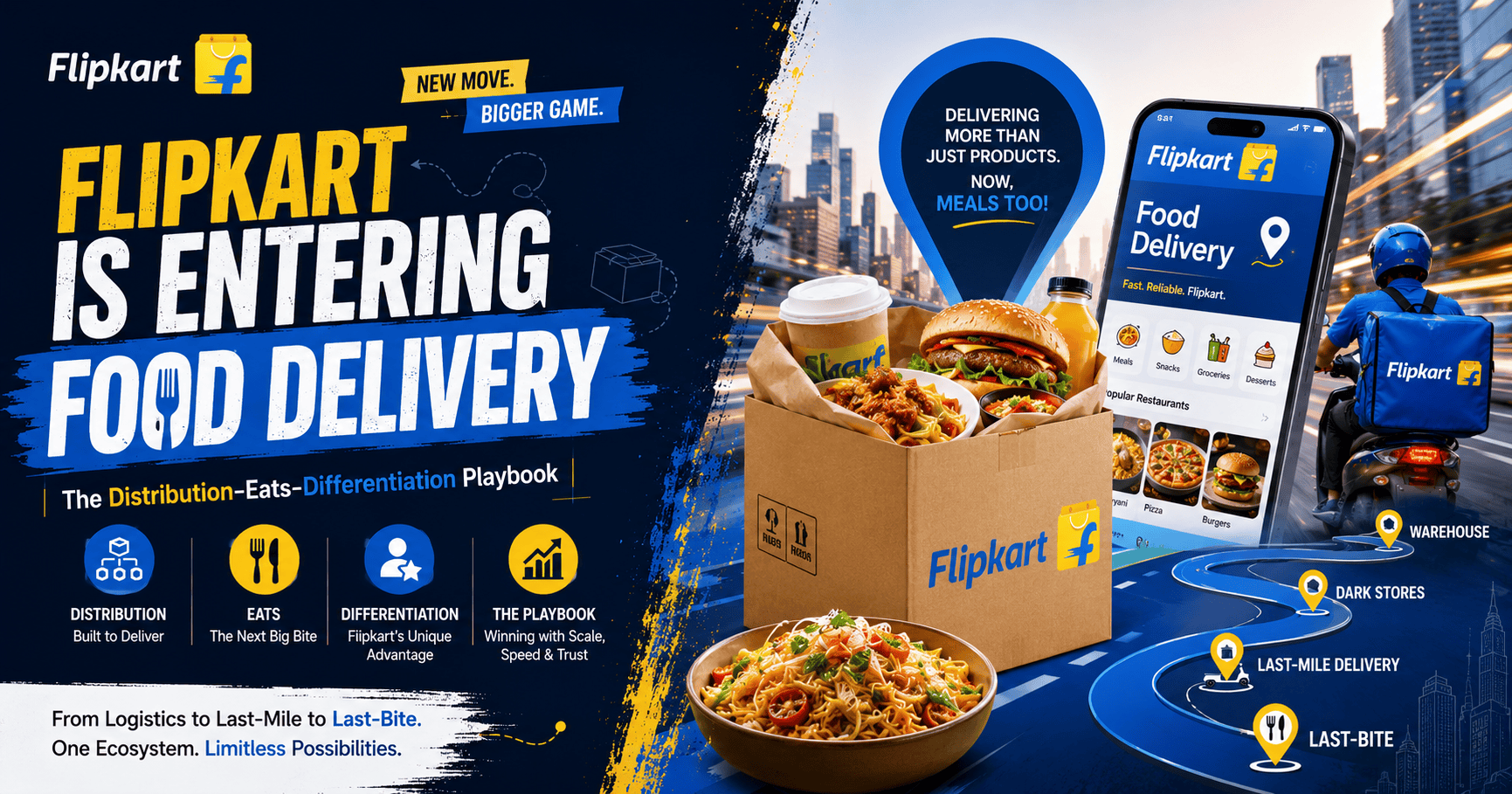
Here is the thesis in one line: when a category’s product experience converges, the winner is decided by who already owns cheap access to demand and supply — not by who builds the better app.
Food delivery in India has converged. Search, cart, live tracking, ratings, coupons, subscription tiers — every serious player has all of it. There is no meaningful feature a new entrant can build that an incumbent cannot copy in a quarter. Differentiation at the product layer has essentially expired.
What has not converged is distribution. And that is where Flipkart’s position is genuinely unusual.
flipkart-food-delivery-in-market-entry
Demand-side: an audience it doesn’t have to buy
Flipkart doesn’t need a customer acquisition campaign to put food in front of hundreds of millions of Indians. It needs a tab. The marginal cost of showing a food delivery entry point to an existing Flipkart shopper is close to zero — a cost line that has historically been the single largest reason food delivery startups burned capital.
Flipkart Minutes has already proved this transfer works. It crossed 1,000+ micro-fulfilment centres across 130 cities in under two years, has been adding roughly 100 dark stores a month through 2026, and reports Tier 2 and Tier 3 demand up 42x year on year with Gen Z making up 40% of its base. That is not a startup’s growth curve. That is a distribution asset being re-pointed.
Supply-side: ONDC as a shortcut around the hardest part
Building a restaurant network is the genuinely slow part of food delivery. Swiggy and Zomato spent years and enormous capital doing it city by city, contract by contract.
ONDC changes the shape of that problem. As an open, interoperable network, it lets a buyer-side app plug into restaurants and logistics providers already listed on the network rather than signing each one individually. Flipkart’s reported “deep integration” is the tell — it is trying to skip the multi-year supply build that protected the incumbents.
Whether ONDC can deliver reliable fulfilment at scale is the open question, and it is a real one. But strategically, this is what the playbook looks like: don’t out-innovate the incumbent, out-flank the thing that made them expensive to copy.
Logistics: partial overlap, not a free pass
This is where honest analysis matters. Flipkart’s supply chain is superb at parcels — predictable, non-perishable, batchable, tolerant of a few hours’ variance. Hot food is none of those things. A biryani has a fifteen-minute quality window and zero tolerance for a re-attempt. Flipkart Minutes narrows the gap considerably, but perishable-hot is a genuinely different operating discipline from perishable-cold or dry goods.
Flipkart vs Zomato Swiggy: where the fight actually happens
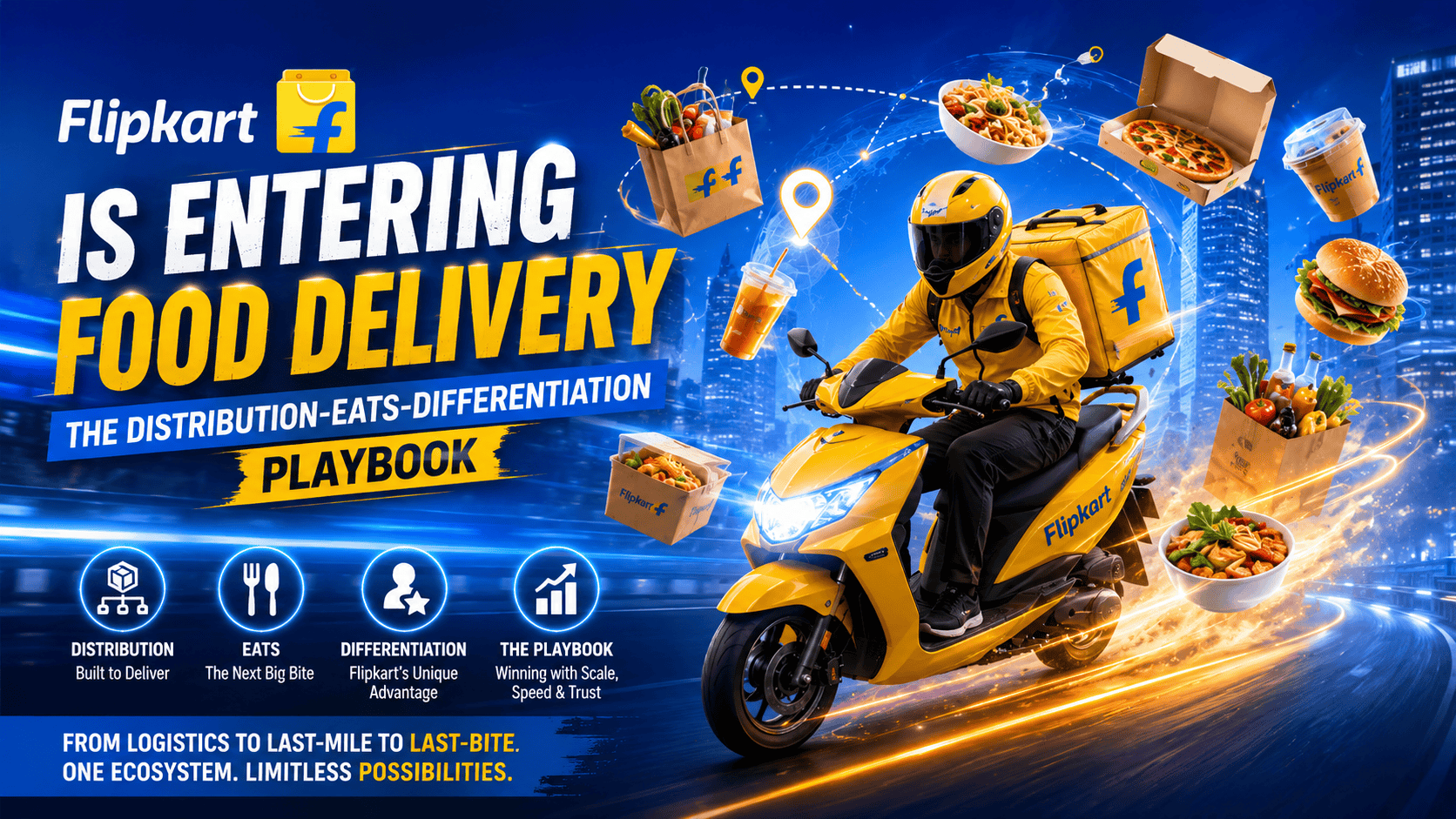
The flipkart vs zomato swiggy framing suggests a head-on collision. It probably isn’t one — at least not initially.
Building Customer Loyalty for Your D2C Brand on a Small Budget
Swiggy and Eternal are still growing solidly. In Q4 FY26, Eternal’s food delivery net order value came in around ₹9,757 crore, up 18.8% year on year, while Swiggy’s food delivery GOV reached roughly ₹9,005 crore, up 22.6% — Swiggy’s strongest growth in nearly four years, with monthly transacting users at 18.3 million. These are not businesses in decline.
flipkart-food-delivery-market-entry
The realistic near-term contest is over three narrower things:
- The price-sensitive order. Rapido’s Ownly, Swiggy’s budget experiment Toing, and any low-take-rate Flipkart offering all target the same customer — the one who currently cooks or orders offline because app prices carry a 15–30% premium. This is market expansion more than market share theft.
- Restaurant commission expectations. Even a modest credible alternative gives restaurants leverage. Take rates that high are only defensible without alternatives.
- Tier 2 and Tier 3 India. Flipkart’s structural advantage is deepest exactly where incumbent food delivery density is thinnest.
One important constraint cuts against everyone: a flat 18% GST now applies to online food deliveries, which meaningfully compresses how much of an edge pure price competition can buy.
The graveyard argument, taken seriously
Distribution advantages have failed in this exact category before. Amazon launched Amazon Food in 2020 with arguably the strongest logistics network in the country and shut it down by December 2022. Uber sold Uber Eats India to Zomato in 2020. Ola exited food delivery too.
The counter is that all three ran during a period when incumbents had normal take rates, no open network alternative existed, and there was no established ten-minute delivery behaviour to piggyback on. The conditions in 2026 are materially different. That doesn’t guarantee a different outcome — it just means the precedent is weaker than it looks.
What to watch over the next 12 months
If you’re tracking this space, the signals that actually matter:
- The commission number. Whatever take rate Flipkart launches with is the entire strategic statement.
- Whether it lives inside the main app. A dedicated app means it’s being run as a business. A tab means it’s being run as a retention lever for the ecosystem.
- ONDC fulfilment reliability, not ONDC listing counts.
- Incumbent response. Defensive discounting would signal the threat is being taken seriously; silence would signal the opposite.
- Tier 2/3 order density, which is where the distribution thesis either proves out or doesn’t.
The takeaway
Flipkart food delivery is not a bet on building a better food app. It’s a bet that the food app stopped being the hard part — and that in Indian quick commerce in 2026, whoever already owns the customer, the network and the last mile gets to enter almost any adjacent category at a fraction of the historical cost.
Social Media Marketing on a Limited Budget: What Actually Works
If that thesis holds, the interesting question isn’t whether Flipkart beats Swiggy and Zomato. It’s how many other categories get re-opened by the same logic.
Related Posts

August 2, 2026
9 Surprising Fastest-Growing Industries to Watch
Learn 5 effective return policy strategies that help increase repeat customers, improve customer trust, and…

August 1, 2026
13 Powerful Business Trends Defining the Next Decade
Learn 5 effective return policy strategies that help increase repeat customers, improve customer trust, and…