


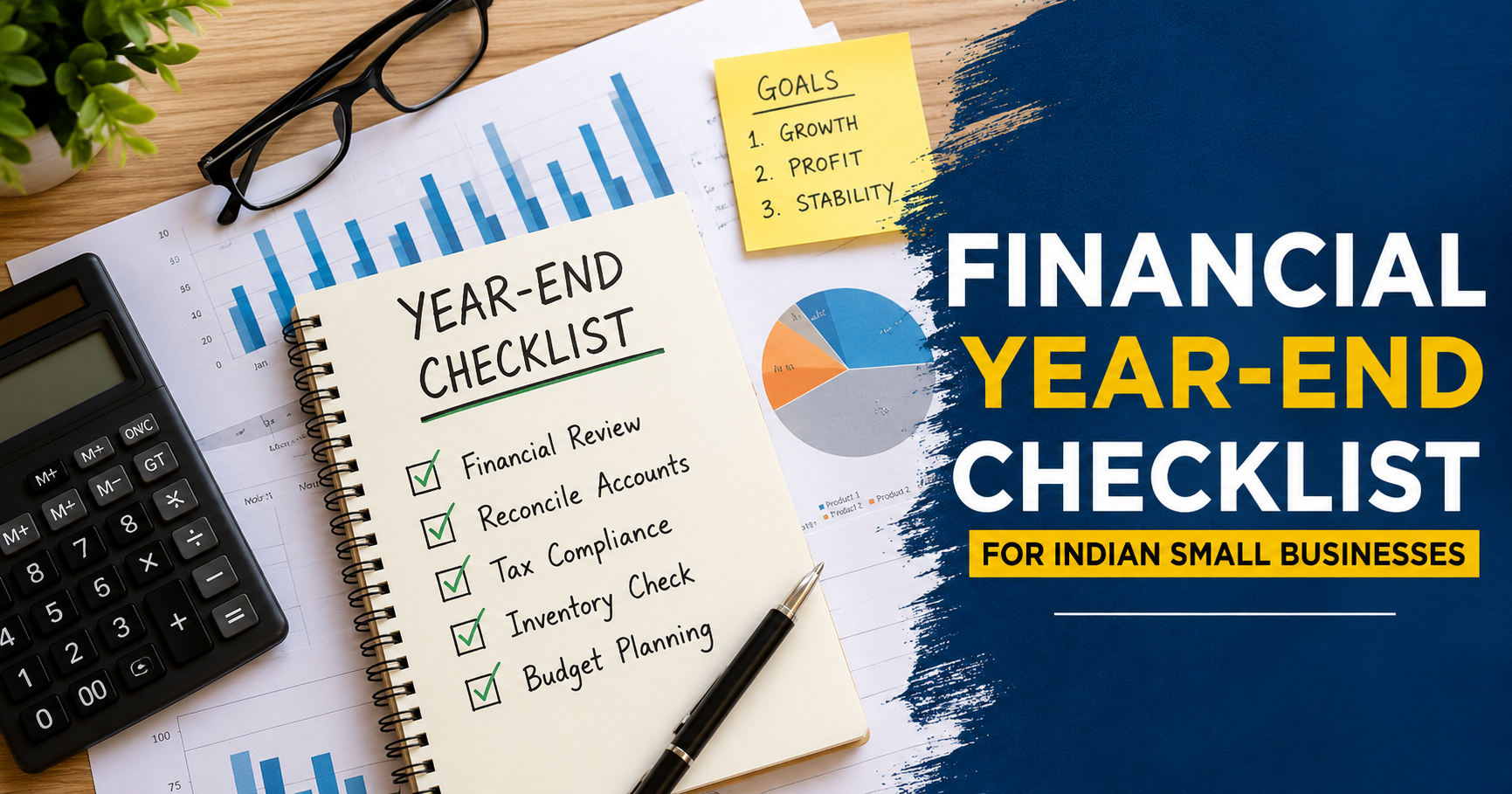
Financial Year-End Checklist for Indian Small Businesses
Table of Contents
-
Financial Year-End Checklist for Indian Small Businesses
- Introduction
- Why is it that a Financial Year-End Checklist is important?
- When Should Indian Small Businesses Start Year-End Planning?
- Organize All Financial Records Before Closing the Books
- GST Reconciliation: Ensure Your Tax Records Match
- Review Tax Compliance Before the Financial Year Ends
- Reconcile Bank Accounts and Cash Transactions
- Follow Up on Outstanding Receivables and Payables
- Conduct an Inventory Verification
- Review Fixed Assets and Business Investments
- Analyse Business Expenses for Better Financial Planning
- Review Overall Business Performance
- Conclusion
Introduction
The financial year’s end is a lot more than a calendar date. For Indian small businesses, it is a chance to check financial wellness, compliance, and get ready for future sustainable growth in the upcoming year. From retail stores to eCommerce sites, consultancies to start-ups, the end of the year can be a time that can save you time and money – and, most importantly – avoid compliance issues.
Many business owners wait until the end of the year to run their books, and find they never had all their invoices, there were unmatched transactions or they didn’t have all their tax records. These little things can result in bigger issues such as filing delays, penalties, inaccurate financial records and poor business decisions.
A financial checklist for the end of the year helps the business owner to keep his/her business organized. Rather than skimping on paperwork in the last few weeks, you can go through accounts and check financial records, catch up on past payments and feel confident for the upcoming financial year.
We will outline all the critical steps small businesses in India must take before closing up before you end up with an inaccurate, non-compliant, and unprepared set of finances when it’s time to close.
Why is it that a Financial Year-End Checklist is important?
Except for taxes, financial management is not just getting paid on time. It’s a matter of recognizing the performance of your business for the last year and determining ways to improve it.
Having a solid year-end checklist provides businesses with the following:
• Carry out accurate financial records during the year.
• Minimize the risk of tax mistakes and penalties for compliance.
• Locate unpaid customer invoices and outstanding payments to vendors/creditors.
• Make budgeting for the coming fiscal year better.
• Decide on investment and expansion decisions based on information.
• Increase investor, lender and financial institution trust.
Consider it to be an annual business health check-up. Taking the time for a thorough financial check-up can reveal any weaknesses that otherwise might go undetected, just as regular medical checkups do.
For instance, let’s say you’re a digital marketing company and you discover that there are some unpaid client bills that you haven’t gotten for a year. This allows the business to get those payments back before the books are closed, which will help improve their cash flow, and set them up for a new financial year with a healthier financial position.
When Should Indian Small Businesses Start Year-End Planning?
A major blunder by businesses is to wait till the last few weeks of March to arrange their finances.
Rather, it’s best to start planning at the end of the year at least two to three months before the end of the financial year. Early starts provide ample time to make sure financial records are correct, to speak with accountants, to reconcile financial records, and to make sure financial records don’t show that there are discrepancies when they are due to be submitted.
Create a Monthly Financial Review Habit
Instead of relying on a review every year, it’s better to have a routine each month to review finances. This way, it is much easier to shut down the year-end as financial records will be updated all year long.
Here are some examples of things that can be reviewed monthly:
• Keeping a record of any business costs.
• Matching bank transactions.
• Making invoices and receipts up to date.
• Monitoring cash flow.
• Reviewing tax liabilities.
• Inquiries regarding unpaid customer due.
By following these steps regularly, the financial year-end process is not so stressful and highly accurate.
Involve the Right People Early
A financial plan shouldn’t be the sole responsibility of one person. Business owners, accountants, finance managers and even department heads should give their contribution as required.
For example, the sales team could check if any payments from customers are still pending; the procurement department could check to see if any payments have been received from suppliers; and the finance team could check the books and generate financial statements. The earlier the collaboration that is done, the less confusion there will be at the last moment and a better work will be done towards the desired objective.
Organize All Financial Records Before Closing the Books
Complete and well organised records are key to a successful year end process. Losing documents can delay the accounting process, and can also cause problems with compliance when filing taxes or in case of audit.
Prior to financial statement preparation, make sure that all financial documents are up-to-date and readily available.
Gather All Income/Expense Records
For each business transaction there should be appropriate supporting documentation.
Gather all:
• Sales invoices
• Purchase bills
• Payment receipts
• Vendor invoices
• Expense vouchers
• Credit notes
• Debit notes
• Digital payment records
• Cash transaction records
Companies that have electronic files all year tend to finish the year-end accounting much quicker than companies that are needing to put the finishing touches on their paper files.
The boutique clothing store, for instance, would be able to easily access files when they were required during tax filing time by placing monthly invoices into cloud folders, which would lower mistakes and conserve valuable time.
Check Bank Statements of the business.
Bank statements will give you an independent record of your finances. Match all of the transactions in your accounting system with the bank statement.
Make special note of:
• Duplicate transactions
• Missing deposits
• Unrecorded bank charges
• Loan repayments
• Interest credits
• Payment reversals
• Failed online transactions
If they’re not addressed, then the mismatches, even if they’re minor, can cause inaccuracies in your financial statements.
Organize Digital and Digital Storage-documents
Records are created in a variety of systems for modern businesses such as email, accounting software, cloud storage, payment gateways and paper invoices.
Establish a uniform filing system which classifies documents according to:
• Financial year
• Month
• Vendor or customer
• Expense category
• Tax documents
• Payroll records
• Bank statements
Your filing system will be easy to follow and more likely to become a huge advantage during year-end accounting or in the event of an audit or financial review in the future.
Please check Supporting Documents for Accuracy
After all records are gathered, take some time to check that all records have the appropriate information. Verify invoice numbers, customer names, GST details, payment dates and amounts of transactions. Just a small error can result in confusion or issues when reconciling or filing taxes.
Check the documents for missing items or incorrect data before the end of the financial year and correct any missing or incorrect data. If you take corrective action early, you will avoid any undue delays and will keep your books in line with your business activities.
An example of this could be a small manufacturing business finding a supplier invoice with the incorrect amount invoiced. Amending the error before finalising accounts prevents an error from causing a discrepancy in the expense report and GST calculations in the future.

GST Reconciliation: Ensure Your Tax Records Match
Once your financial records are organized, the next priority is reconciling your GST data. GST reconciliation is one of the most important year-end activities because it helps identify mismatches before they become costly compliance issues.
Businesses often generate hundreds or even thousands of invoices throughout the financial year. Even if day-to-day bookkeeping appears accurate, discrepancies can arise due to incorrect GST rates, duplicate invoices, delayed uploads, or clerical errors. Reconciling your records ensures that the sales and purchase data maintained in your accounting system aligns with the information reported in GST returns.
Compare Sales and Purchase Records
Start by reviewing all outward and inward supplies recorded during the financial year. Every sales invoice should match your GST filings, while purchase invoices should correspond with the input tax credit claimed.
For example, suppose a software development company issued an invoice worth ₹1,20,000 in March but accidentally omitted it from its GST return. Detecting this mismatch during year-end reconciliation allows the business to make the necessary corrections before it leads to notices or penalties.
Verify Input Tax Credit (ITC)
Input Tax Credit is one of the biggest financial advantages available to GST-registered businesses. However, claiming incorrect or unsupported credits can result in disputes with tax authorities.
Review all eligible purchases and confirm that suppliers have correctly filed their GST returns. If certain invoices are missing or contain incorrect GST details, contact the supplier immediately so that the issue can be resolved before filing future returns.
Businesses that routinely verify ITC throughout the year often avoid unnecessary tax outflows and maintain healthier cash flow.
Review Tax Compliance Before the Financial Year Ends
A successful financial year-end involves much more than balancing income and expenses. It also requires ensuring that every statutory obligation has been fulfilled according to the applicable regulations.
Incomplete compliance can lead to interest charges, penalties, or prolonged scrutiny from tax authorities. Taking time to review your obligations before closing the books provides peace of mind and helps maintain a clean compliance record.
Check Income Tax Obligations
Review your estimated taxable income and compare it with taxes already paid during the year. If advance tax payments are insufficient, calculate any remaining liability so appropriate action can be taken within the prescribed timelines.
Many small businesses underestimate their annual profits and only realize additional tax liabilities during return preparation. Performing this review early prevents unexpected financial pressure later.

Confirm TDS Compliance
If your business deducts Tax Deducted at Source (TDS) on salaries, professional services, rent, contractor payments, or other eligible transactions, ensure that every deduction has been deposited within the required deadlines.
Also verify that quarterly TDS returns have been filed correctly and that corresponding certificates have been issued wherever applicable.
For instance, if a marketing agency regularly hires freelance designers, it should confirm that all applicable TDS deductions have been deposited and accurately reflected in statutory filings before closing the financial year.
Reconcile Bank Accounts and Cash Transactions
Bank reconciliation is often overlooked by small businesses, yet it serves as one of the most effective ways to identify accounting errors.
A reconciliation compares your internal accounting records with actual bank statements, helping you detect transactions that may have been missed, duplicated, or recorded incorrectly.
Match Every Transaction Carefully
Go through each bank account maintained by your business and compare deposits, withdrawals, bank charges, loan repayments, interest credits, and online transfers against your accounting software.
Occasionally, payments may appear in bank statements but remain unrecorded internally due to timing differences or manual errors. Resolving these discrepancies ensures your financial statements accurately represent your cash position.
For example, an online retailer may discover that a payment gateway settlement reached the bank account but was never recorded in the books. Correcting such omissions improves reporting accuracy before year-end.
Review Petty Cash Records
Businesses that maintain cash transactions should verify that petty cash balances match supporting receipts.
Small day-to-day expenses may seem insignificant individually, but collectively they can materially impact expense reporting if documentation is incomplete. Reviewing these records before closing the books strengthens financial transparency.
Follow Up on Outstanding Receivables and Payables
Cash flow is the lifeline of every small business. Before ending the financial year, it is essential to understand exactly how much money is expected from customers and how much remains payable to vendors.
Ignoring outstanding balances can distort your financial position and create unnecessary cash flow challenges in the new financial year.
Review Customer Receivables
Prepare a detailed review of unpaid customer invoices and identify accounts that require immediate follow-up.
Some invoices may simply require payment reminders, while others may need direct communication to resolve disputes or clarify billing concerns. Recovering outstanding payments before year-end strengthens liquidity and improves the accuracy of your financial statements.
Imagine a consulting firm with several clients whose invoices have been pending for more than sixty days. By contacting those clients before closing the books, the firm may recover substantial revenue that would otherwise remain outstanding.
Verify Vendor Payables
Review supplier invoices and ensure that every legitimate liability has been recorded.
Delayed vendor payments may affect supplier relationships and could also result in additional charges or disruptions to future procurement. Verifying outstanding obligations allows businesses to plan payments strategically while maintaining healthy working relationships.

Conduct an Inventory Verification
For businesses dealing with physical products, inventory is one of the largest assets reflected in financial statements. An inaccurate inventory count can significantly distort both profitability and tax calculations.
A year-end inventory verification confirms that recorded stock matches the actual quantity available.
Perform a Physical Stock Check
Count inventory across warehouses, retail outlets, or storage facilities and compare the results with inventory management records.
During this exercise, businesses often identify damaged goods, obsolete products, misplaced inventory, or recording errors that accumulated throughout the year.
For example, a home décor retailer may discover that several discontinued products remain listed as active inventory despite being unsellable. Identifying such items enables more realistic valuation and better purchasing decisions for the upcoming year.
Update Inventory Valuation
After verifying quantities, review the valuation method being followed to ensure consistency with accounting standards.
Inventory should reflect its actual value rather than outdated estimates. Updating valuations provides a more accurate picture of business profitability and helps management make informed decisions regarding pricing and procurement.
Review Fixed Assets and Business Investments
Over the course of a financial year, businesses often purchase computers, machinery, furniture, office equipment, or vehicles. These assets require periodic review to ensure accounting records remain accurate.
Year-end provides an excellent opportunity to verify asset registers and evaluate whether all acquisitions, disposals, and depreciation calculations have been recorded correctly.
Verify Asset Records
Compare your fixed asset register with the actual assets owned by the business. Ensure that newly acquired equipment has been recorded properly and that disposed or obsolete assets have been removed where necessary.
This review also helps identify assets that may require repairs, upgrades, or replacement during the next financial year.
Review Depreciation
Depreciation reflects the gradual reduction in the value of business assets over time. Reviewing depreciation calculations ensures financial statements present a realistic picture of asset values.
For example, if a design studio purchased high-performance computers during the year, depreciation should be calculated according to applicable accounting principles before preparing year-end financial reports.
Analyse Business Expenses for Better Financial Planning
Year-end is not only about compliance; it is also an opportunity to understand where your money has been spent.
A detailed expense review often uncovers unnecessary subscriptions, duplicate services, inefficient operational costs, or spending patterns that can be optimized.
Instead of simply recording expenses, evaluate whether each cost contributed meaningful value to the business. This exercise supports better budgeting decisions for the upcoming financial year and helps improve profitability without compromising operational efficiency.
For instance, a startup may realize it is paying for multiple software subscriptions that perform similar functions. Consolidating those tools into a single platform can reduce recurring expenses while maintaining productivity.
Likewise, reviewing travel, marketing, utility, and administrative expenses may reveal opportunities to negotiate better vendor contracts or adopt more cost-effective solutions.
By treating expense analysis as a strategic exercise rather than an accounting formality, small businesses can enter the new financial year with greater financial discipline and a stronger foundation for sustainable growth.
Review Overall Business Performance
Closing the financial year is the perfect time to step back and evaluate how your business performed over the past twelve months. Beyond profits and losses, assess whether you achieved your revenue targets, managed expenses effectively, and maintained healthy cash flow. Reviewing key financial reports such as the profit and loss statement, balance sheet, and cash flow statement provides valuable insights into your business’s strengths and areas for improvement.
For example, if your revenue increased but profit margins declined, it may indicate rising operational costs that need attention in the coming year.
Set Financial Goals for the New Financial Year
Once the books are closed, use the insights gained to prepare for the next financial year. Set realistic financial goals based on your business performance rather than assumptions. These goals could include increasing sales, reducing operational costs, improving cash flow, expanding into new markets, or investing in technology.
A clear financial roadmap helps business owners make informed decisions and measure progress throughout the year.
Prepare a Budget and Cash Flow Plan
A well-planned budget acts as a financial guide for the year ahead. Estimate expected income, recurring expenses, tax obligations, and planned investments to avoid unexpected financial pressure.
Cash flow planning is equally important. Even profitable businesses can face challenges if cash inflows and outflows are not managed properly. Maintaining a cash reserve for emergencies and seasonal fluctuations helps ensure smooth business operations.
Common Financial Year-End Mistakes to Avoid
Many small businesses face avoidable issues because they postpone financial tasks until the last minute. Delayed bookkeeping, missing invoices, incorrect GST records, ignoring outstanding receivables, and failing to reconcile bank accounts can all lead to inaccurate financial statements and compliance problems.
Reviewing your finances regularly throughout the year makes the year-end closing process far simpler and helps reduce costly errors.
Conclusion
A financial year-end checklist is more than a compliance requirement—it’s an opportunity to strengthen your business. By organizing financial records, reviewing tax obligations, reconciling accounts, verifying inventory, and planning for the future, small businesses can start the new financial year with greater confidence and financial clarity.
Rather than treating year-end as a stressful deadline, view it as a strategic exercise that helps improve decision-making, streamline operations, and support long-term growth. A little preparation today can save significant time, money, and effort in the months ahead.
Faq’s

Is your business ready for the financial year-end? Follow this checklist today to stay compliant, avoid costly mistakes, and start the new financial year with confidence.
Why is a financial year-end checklist important?
It helps ensure accurate financial records, tax compliance, and better planning for the next financial year.
When should small businesses start year-end planning?
Ideally, businesses should begin preparing two to three months before the financial year ends.
What documents should be reviewed before closing the financial year?
Review invoices, receipts, bank statements, GST records, payroll documents, and financial reports.
Why is GST reconciliation necessary?
It helps identify mismatches in tax records and ensures accurate GST filings.
How often should businesses reconcile their accounts?
Monthly reconciliation is recommended to avoid last-minute errors at year-end.