



FSSAI News: Regulator Bans Dabur’s ‘
Table of Contents
- FSSAI News: Regulator Bans Dabur's '
- What exactly did FSSAI prohibit?
- Why the regulator escalated
- Dabur's response: compliance, but not concession
- The bigger picture: FSSAI's war on label language
- What food businesses should take away
- This article is based on reporting available as of August 5, 2026. Figures and regulatory positions may change as the matter develops.
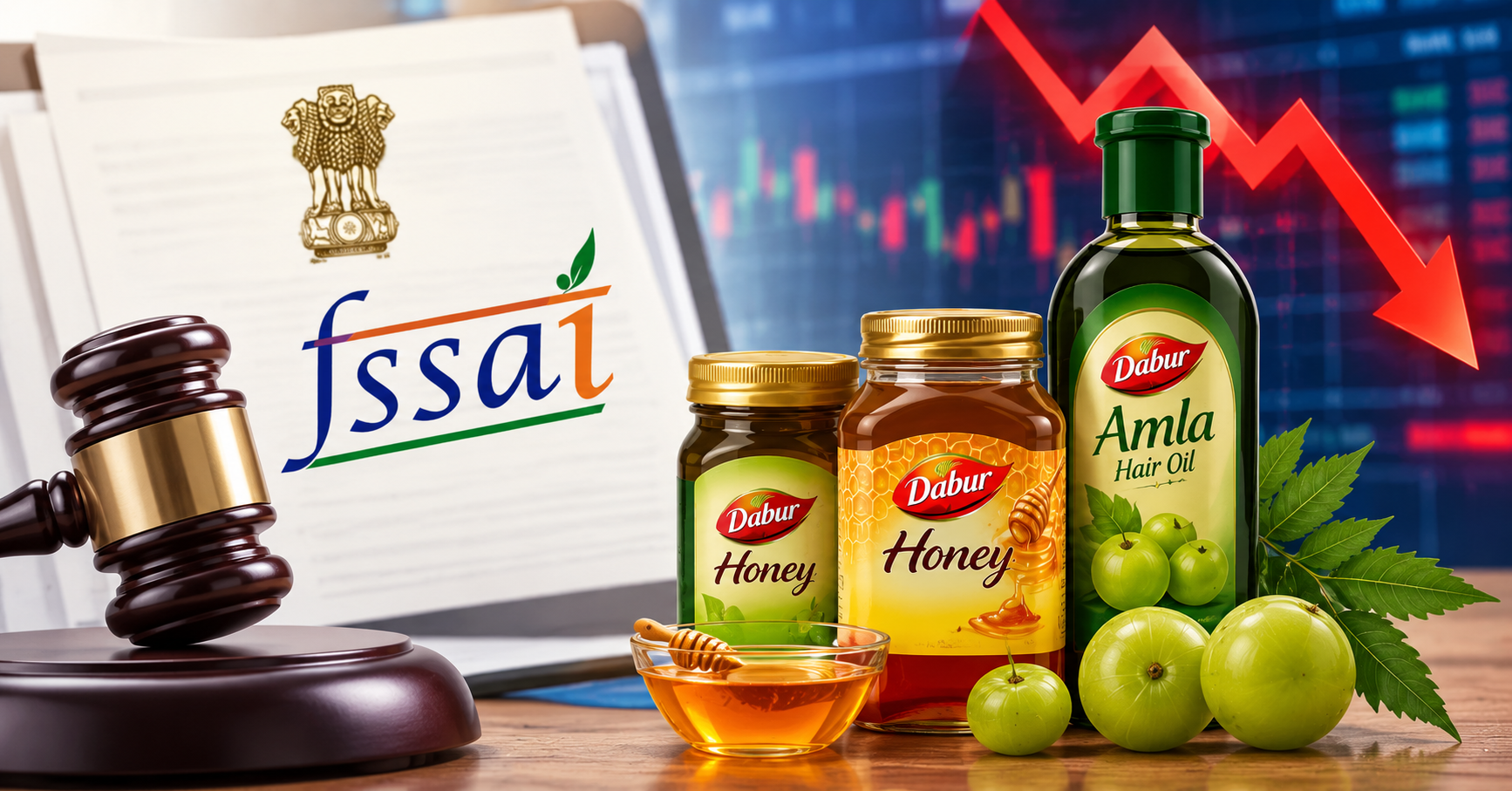
India’s food regulator has taken one of its most visible enforcement actions yet against a major FMCG company. On August 3, 2026, the Food Safety and Standards Authority of India (FSSAI) issued a prohibition order directing Dabur India Ltd to immediately stop selling a range of food products carrying “100%” claims on its website and packaging.
The market reacted the next morning. Dabur India shares slipped as much as 4.6% to ₹406.10 on the NSE on August 4, brushing close to their 52-week low of ₹401.05. On the BSE, the stock traded around ₹414.60, down over 2% at one point during the session.
For anyone tracking FSSAI news, this is a significant escalation — not because the rule is new, but because the regulator named a household brand publicly rather than settling the matter through a private notice.
What exactly did FSSAI prohibit?
The order covers Dabur food products marketed with absolute claims such as:
- 100% Natural
- 100% Pure
- 100% Purity Guaranteed
- 100% Organic
- 100% Tender Coconut Water
The products named include Dabur honey, cow ghee, apple cider vinegar, virgin coconut oil, sesame oil, coconut water and coconut milk — everyday pantry items that sit at the premium end of their categories precisely because of purity positioning.
FSSAI’s reasoning is straightforward: claims of this kind are ambiguous, cannot be objectively verified, and are therefore likely to mislead consumers. That places them in breach of the Food Safety and Standards (Advertising and Claims) Regulations, 2018, which contains no provision permitting a blanket “100%” claim on food.
Two additional violations flagged
Beyond the “100%” wording, the regulator raised two specific issues:
- Jaivik Bharat logo without endorsement. Dabur Himalayan Organic Apple Cider Vinegar and Dabur Organic Honey were found displaying the Jaivik Bharat organic logo without a valid FSSAI organic endorsement.
- Purity claim on a compound food. Dabur Hommade Coconut Milk carried a “100% Purity” claim. Because coconut milk of this type is a compound food, such a claim is not permitted under existing rules.
FSSAI has directed the company to halt sales of the identified products — and any other item carrying similar claims — and to submit an Action Taken Report (ATR) within 15 days.
Why the regulator escalated
This was not a first warning. According to FSSAI, an earlier notice had already asked Dabur to discontinue the claims, but the regulator says no satisfactory corrective action followed. That failure to comply is what converted a notice into a prohibition order.
Dabur’s version of the timeline differs on a key detail. In its clarification to the NSE and BSE, the company said FSSAI had issued a notice on April 8, 2026 alleging use of the phrase “100% Pure” on one product, and that Dabur responded at the time explaining the product in question did not carry that claim.
Dabur’s response: compliance, but not concession
Dabur told the exchanges it “stands by the purity and highest standards of quality of its products and does not make any misleading claims.” Its key points:
- The prohibitory order was received on the evening of August 3.
- Label transitions away from “100%” wording had already been initiated before the order.
- The dispute concerns interpretation of product descriptions only — not quality, safety or standards.
- Any business impact would be limited to the specific food products covered.
- The company is seeking legal advice and is exploring its options while continuing to engage with the regulator.
That last point matters for investors. A narrow labelling dispute confined to a slice of the foods portfolio is a very different risk profile from a product-safety finding — and the market’s roughly 4% reaction suggests traders read it closer to the former, against an already weak backdrop. Dabur stock has fallen over 20% in the past year.
FSSAI News: Regulator Bans Dabur’s ‘
The bigger picture: FSSAI’s war on label language
The Dabur order is not an isolated event. It is the sharpest edge of a crackdown that has been building for over two years.
- June 2024: FSSAI directed all Food Business Operators (FBOs) to remove “100% fruit juice” claims from reconstituted juices, giving companies until September 1, 2024 to exhaust pre-printed packaging.
- May 2026: The regulator issued a broader directive telling food companies not to use “100%”, “100% Pure”, “100% Natural” and similar expressions on labels, packaging or promotional material where they could mislead consumers.
- Through 2026: Words like healthy, natural, fresh, 100% and no added sugar have quietly started disappearing from packs across the market. Brands including The Whole Truth, Marico and MasterChow have all faced scrutiny over claim language, with some voluntarily reworking wording — one replaced “no added sugar” with a description of the actual sweetener used.
The legal backbone is the Food Safety and Standards (Labelling and Display) Regulations, 2020, which prohibits labels that are false, misleading or deceptive, or that create an erroneous impression about a product, and requires labels to reflect the true nature of the food.
What has changed is the enforcement style. Over the past year FSSAI has increasingly named companies on its own social media channels instead of handling matters quietly — a deliberately public form of pressure that now carries share-price consequences.
What food businesses should take away
If you operate in packaged foods, three practical lessons come out of this FSSAI news cycle:
- Absolute claims are indefensible by design. “100%” cannot be verified against a test method, which is exactly why the regulator treats it as inherently misleading. Substantiable, specific claims survive scrutiny; superlatives do not.
- Organic logos require valid endorsement. Displaying the Jaivik Bharat mark without current certification is a standalone violation, independent of any wording issue.
- Respond substantively to the first notice. The prohibition order exists because FSSAI concluded the earlier notice went unaddressed. A documented, product-by-product corrective plan is cheaper than a public order.
This article is based on reporting available as of August 5, 2026. Figures and regulatory positions may change as the matter develops.
Related Posts

August 6, 2026
7 Critical SEO Trends Every Business Must Master
Learn 5 effective return policy strategies that help increase repeat customers, improve customer trust, and…

August 5, 2026
Anthropic Just Hired for India — Here’s What It Means for Startups Using Claude AI
Learn 5 effective return policy strategies that help increase repeat customers, improve customer trust, and…