

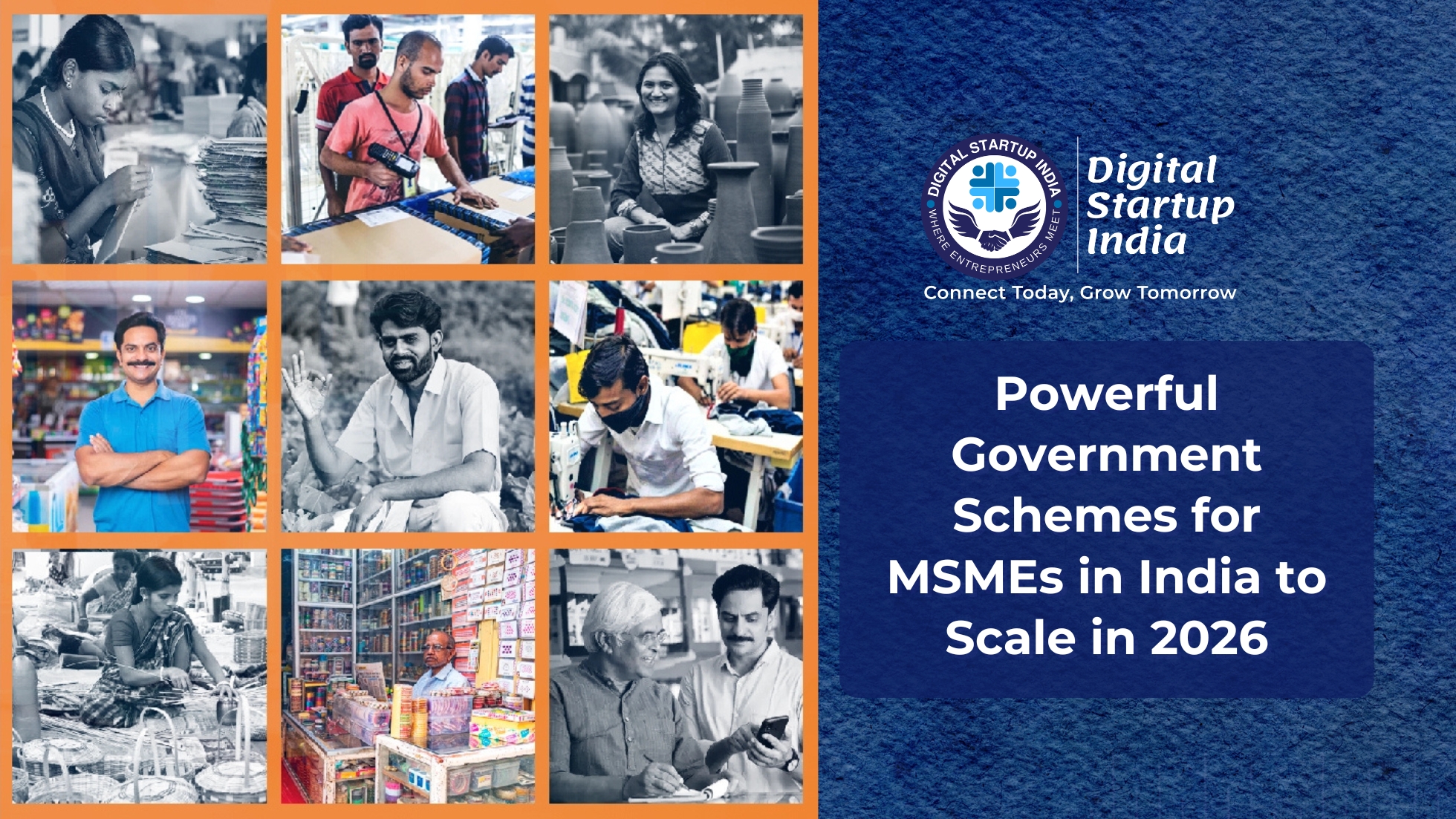
7 Powerful Government Schemes for MSMEs in India to Scale in 2026
Table of Contents
-
7 Powerful Government Schemes for MSMEs in India to Scale in 2026
- 1. Pradhan Mantri Mudra Yojana (PMMY): The Entry-Level Lifeline
- 2. CGTMSE: Secure Collateral-Free Loans up to ₹5 Crore
- 3. PMEGP: Grab Up to 35% Subsidy on New Projects
- Key Benefits in 2026:
- 4. PM Vishwakarma: Empowering Traditional Artisans
- 5. MSME Champions 2.0: From Local to Global
- 6. SIDBI Make in India Loan for Enterprises (SMILE)
- 7. Export Promotion & TReDS: Solving the Liquidity Crisis
- Comparison of Top Government Schemes for MSMEs in India (2026)
- Importance of MSMEs in India
- How to Apply for Government Schemes for MSMEs in India
- Introduction to Government Support to MSMEs.
-
Best Government Programs in MSMEs in India.
- Credit Guarantee Fund Trust Micro and small enterprises (CGTMSE)
- Startup India Scheme
- Stand-Up India Scheme
- MSME Udyam Registration
- Employment Generation Programme (PMEGP) by the Prime Minister.
- Technology Upgradation Fund Scheme (TUFS).
- Promotion and Development of Markets Scheme (MPDA)
- ZED Certification Scheme
- SIDBI Make in India Soft Loan Fund (SMILE).
- MSME Schemes Eligibility.
- How to Apply for MSME Schemes
- Challenges Faced by MSMEs
- Ways of Making the most out of Government Schemes.
- Future of MSMEs in India
- Conclusion
Government Schemes for MSMEs in India have become the backbone of the nation’s “Atmanirbhar Bharat” vision. As of March 2026, the Ministry of Micro, Small, and Medium Enterprises has introduced groundbreaking updates to ensure that small business owners, artisans, and tech startups have the capital and infrastructure they need to compete globally.
The MSME sector contributes nearly 30% to India’s GDP and 45% of its exports. However, the journey from a small workshop to a global powerhouse is often stalled by a lack of credit. This is where the latest Government Schemes for MSMEs in India bridge the gap, offering everything from interest subventions to equity infusions.
Alt Text: Infographic showing the impact of Government Schemes for MSMEs in India on business growth.
Taxation for Startups: A Practical Guide for Indian Entrepreneurs
1. Pradhan Mantri Mudra Yojana (PMMY): The Entry-Level Lifeline
When discussing Government Schemes for MSMEs in India, the Mudra loan remains the most accessible starting point. In the 2026 fiscal year, the loan limits and categories have been refined to support micro-enterprises.
Shishu: Loans up to ₹50,000 for budding entrepreneurs.
Kishore: Loans from ₹50,001 to ₹5 lakh for established small units.
Tarun: Loans from ₹5 lakh to ₹10 lakh for expansion.
Tarun Plus (New 2026 Update): Now offering up to ₹20 lakh for high-performing micro-units that have successfully repaid previous cycles.
Why it matters: These loans are collateral-free, meaning you don’t need to pledge your house or land to get the capital.
2. CGTMSE: Secure Collateral-Free Loans up to ₹5 Crore
The Credit Guarantee Fund Trust for Micro and Small Enterprises (CGTMSE) is perhaps the most significant of all Government Schemes for MSMEs in India for those needing high-value credit.
As per the latest 2026 updates, the guarantee cover has been enhanced:
Loan Limit: Increased to ₹5 crore for eligible MSMEs.
Guarantee Cover: Up to 85% for micro-enterprises and women-led businesses.
Hybrid Security: Borrowers can now provide partial collateral, and the remaining unsecured portion is covered by the trust.
Alt Text: Diagram explaining how Government Schemes for MSMEs in India like CGTMSE provide collateral-free credit.
For more official details on eligibility, you can visit the Official MSME Ministry Portal (NoFollow).
3. PMEGP: Grab Up to 35% Subsidy on New Projects
The Prime Minister’s Employment Generation Programme (PMEGP) is the gold standard for Government Schemes for MSMEs in India focused on job creation.
Key Benefits in 2026:
Project Cost: Up to ₹50 lakh for manufacturing and ₹20 lakh for services.
Subsidy: 15% to 25% for urban areas and a massive 35% for rural entrepreneurs.
Focus Areas: Special preference is given to SC/ST, women, and entrepreneurs in the North East Region (NER).
If you are setting up a new unit in 2026, this is the most cost-effective way to reduce your initial capital expenditure through direct government grants.
4. PM Vishwakarma: Empowering Traditional Artisans
Launched to support the 18 traditional trades (like carpenters, potters, and blacksmiths), the PM Vishwakarma scheme is a specialized addition to the list of Government Schemes for MSMEs in India.
Skill Training: Daily stipend of ₹500 during training.
Toolkit Incentive: An e-voucher of ₹15,000 to buy modern equipment.
Credit Support: Collateral-free loans of ₹3 lakh at a concessional interest rate of just 5%.
This scheme ensures that India’s rich artisanal heritage is modernized through technology and easy finance.
5. MSME Champions 2.0: From Local to Global
The MSME Champions Scheme has been revamped into a more digital-first initiative. This is one of the Government Schemes for MSMEs in India that doesn’t just look at money but at “Competitiveness.”
ZED Certification (Zero Defect Zero Effect): Helps manufacturers reduce waste and improve quality. ZED-certified units receive higher interest subventions on loans.
MSME Innovative: Provides grants for incubation, design, and IPR (Intellectual Property Rights) protection.
Lean Manufacturing: Assists units in implementing lean techniques to reduce costs and increase productivity.
6. SIDBI Make in India Loan for Enterprises (SMILE)
Managed by SIDBI, the SMILE scheme focuses on the “Make in India” initiative. It is among the Government Schemes for MSMEs in India tailored for modernization and expansion.
Soft Loans: Offers loans on quasi-equity terms.
Long Tenure: Repayment periods of up to 10 years with a 3-year moratorium.
Focus: New enterprises in the manufacturing and service sectors, as well as existing units undergoing technology upgrades.
For a deeper dive into financial tools, check out our guide on MSME Udyam Registration Benefits (Internal Link).
7. Export Promotion & TReDS: Solving the Liquidity Crisis
Late payments are the biggest threat to small businesses. The government has prioritized the TReDS (Trade Receivables Discounting System) platform to ensure MSMEs get paid on time.
Additionally, the RELIEF Scheme (2026) was recently launched to provide credit insurance for MSME exporters facing global supply chain disruptions. These Government Schemes for MSMEs in India ensure that your cash flow remains healthy even when dealing with large corporates or international buyers.
Check the RBI TReDS Guidelines (NoFollow) to see how you can discount your invoices.
Your First 100 Days After DPIIT Recognition: What to Do Next?
Comparison of Top Government Schemes for MSMEs in India (2026)
| Scheme Name | Max Loan/Project Cost | Key Benefit | Target Audience |
| PMMY (Mudra) | ₹20 Lakh | No Collateral | Micro-units & Startups |
| CGTMSE | ₹5 Crore | Government Guarantee | Small & Medium Units |
| PMEGP | ₹50 Lakh | 35% Margin Subsidy | New Entrepreneurs |
| PM Vishwakarma | ₹3 Lakh | 5% Concessional Interest | Traditional Artisans |
| SMILE | Sector Dependent | Soft Loan/Quasi-equity | Modernization |
The economy of India comprises the Micro, Small and Medium Enterprises (MSMEs). These are not mere small enterprises that work in solitude; they are in fact an engine that propels employment, innovation and inclusive growth throughout the county. From the old-fashioned artisans and local producers to the new start-ups and service providers, MSMEs are a part and parcel of the development story in India.
Entrepreneurship in India has been on a booming trend throughout the years. Nevertheless, it is not simple to create and maintain a small business. Some of the major obstacles that entrepreneurs are likely to encounter include insufficient capital, inadequate technological access, competition in the market, and regulations. The Indian government has introduced several programs that will support MSMEs at all levels to overcome these barriers and enable business, that is, to empower businesses.
https://digitalstartupindia.com/category/startup-india-government-schemes/
These government interventions on MSMEs offer financial support, skills building, infrastructure and avenues of market access. As an entrepreneur starting a company, a small business owner, or as a person considering building a company, these schemes can allow you to unlock incredible opportunities of growth.
Through this detailed guide, we shall discuss the best government schemes on MSMEs in India, their benefits, eligibility requirements and how their schemes can be applied. We shall also explain how these plans can be used to turn your business around and make it one of the successes in the long-run.
Importance of MSMEs in India
MSMEs are important in the development of the Indian economy. They are regarded as the pillars of industrial growth and the major source of the GDP, exports, and the way to get a job. In a nation such as India where so many individuals reside in the villages and semi-urban regions, MSMEs provide a path between the economical prospects and local skills.
The fact that MSMEs create jobs cheaply is one of their greatest strengths. MSMEs are able to generate employment at relatively low levels of capital unlike large corporations which need heavy investments. This renders them very crucial towards curbing unemployment and enhancing standards of living.
Moreover, MSMEs also have a major contribution towards the exports of India. A large number of small businesses produce products which are exported to the world, thereby making India gain foreign exchange and becoming stronger in the global markets. They also facilitate equal growth of regions in that they establish operations in the small towns and rural regions.
Even though they are very important, there are several challenges that MSMEs may encounter. Some of the common problems include limited financial resources, ignorance of the policies and inability to obtain credit. That is why MSME schemes in India are indispensable–it is a supportive system that is required in order to make these businesses expand and compete successfully.
The Rationality of Government Support of MSMEs.
In spite of their influence, MSMEs tend to be in trouble with:
Limited access to credit
High competition
Insufficient knowledge on policies.
Regulatory challenges
This is where the government plans on MSMEs come in.
How to Apply for Government Schemes for MSMEs in India
Navigating Government Schemes for MSMEs in India has become significantly easier thanks to the Udyam Portal and the JanSamarth Portal.
Register on Udyam: This is the first step. Without an Udyam Registration number, you cannot access most subsidies.
Prepare a Project Report: Especially for PMEGP and CGTMSE, a viable business plan is mandatory.
Apply via JanSamarth: This “one-stop-shop” allows you to apply for multiple credit-linked Government Schemes for MSMEs in India through a single digital application.
Verification: Expect a visit from a nodal agency or bank official to verify your premises and documents.
Introduction to Government Support to MSMEs.
The Indian government has launched a massive program to assist MSMEs. These programs are meant to deal with the significant threats that the small businesses are exposed to and equip them with the necessary resources to develop.
Financial assistance is one of the major forms of help. Various programmes have collateral free loans, subsidies and guarantees of credit to make sure that businesses are not denied funds on unreasonable risks. This is especially advantageous to start ups and small-scale entrepreneurs who might lack great financial support.
The other significant support is skill development. The government undertakes training and workshops to enable the business people to enhance their business skills, market trends and embrace modern practices. This does not only make them increase their capabilities but also their chances of success.
Another major area of focus is technology support. As the world is rapidly going digital, companies must embrace the use of modern technologies to remain competitive. Technology upgrade assistance is offered through government schemes and this allows MSMEs to enhance productivity and efficiency.
Another market access is also essential. There are numerous Indian government business programs that assist MSMEs to take part in trade fairs, exhibitions and export programs. This will enable them to increase their reach and reach new customers.
Altogether, these programs provide a powerful ecosystem that helps MSMEs at all levels, starting with the startup and continued growth.
Best Government Programs in MSMEs in India.
India has several small business schemes in India, which are aimed at addressing various needs of business. Let’s explore them in detail.
Pradhan Mantri Mudra Yojana, (PMMY).
One of the most popular programs of small businesses is Pradhan Mantri Mudra Yojana. It offers financial assistance to non-corporate non-farm businesses to start up or to develop their businesses.
In this scheme there are three types of loans namely, Shishu, Kishor and Tarun. These groups vary according to the level of the business and the capital that is needed. The scheme is not collateral based hence it is very affordable to small entrepreneurs.
The greatest strength of Mudra Yojana is that it will promote entrepreneurship on the ground level. It can be a start-up of a small shop, or of a business based on service, or a manufacturing unit, but this scheme can offer the initial finances.
Credit Guarantee Fund Trust Micro and small enterprises (CGTMSE)
CGTMSE scheme is important towards enhancing access to credit by MSMEs. It offers credit insurance to financial institutions and banks and mitigates the risk that financial institutions take when they advance credit to small businesses.
This implies that business people will be able to borrow funds without collaterals. The scheme is particularly effective in the case of new businesses which do not necessarily have assets in their disposal to provide security.
CGTMSE is also making the lenders less risky, thus making the banks offer more loans to the MSMEs, which enhances economic growth and development of businesses.
Startup India Scheme
Startup India Scheme is an initiative with a flagship to enhance innovation and entrepreneurship. It is among the most influential start up initiatives in India.
The scheme has several advantages consisting of tax exemptions, hassle free registration, and access to funds. It also supports it by the use of incubators, mentorship programs as well as networking opportunities.
In case of startups, this program is their launchpad as they are successful in their initial difficulties and grow their business successfully.
Stand-Up India Scheme
Stand-Up India is aimed at encouraging entrepreneurship amongst women and SC/ST. It offers loans of between10 lakh and 1 crore to establish new businesses.
The scheme is meant to level the playing field and promote inclusivity when it comes to being an entrepreneur. The way that it assists the underrepresented groups contributes to the creation of a more inclusive and diverse business ecosystem.
MSME Udyam Registration
Udyam Registration is an important process to any MSME. It is an easy online procedure that gives formal accolades to companies.
After registration, businesses are entitled to a range of benefits of MSME registration, such as subsidies, simplified loan issuance, and non- late payment security.
This is a registration entry point to various government schemes and any entrepreneur should first start with this registration.
Employment Generation Programme (PMEGP) by the Prime Minister.
PMEGP is a credit based subsidy program to provide job opportunities. It has financial support which helps in establishing new business ventures both in the rural and urban places.
The scheme subsidizes project costs and this will lighten the financial load of the entrepreneurs. It is especially useful to those people that do not have enough capital to start their own business but are willing to do it.
Technology Upgradation Fund Scheme (TUFS).
Technology is crucial in the development of businesses. TUFS offers funding on the modernization of technology in MSMEs.
Modern technologies allow businesses to be more productive, cost-effective, and able to compete at the international level.
Promotion and Development of Markets Scheme (MPDA)
MPDA is geared towards assisting MSMEs to increase their market coverage. It offers assistance on how to be involved in exhibitions, trade fairs as well as promotional activities.
This plan is particularly effective in those cases when an enterprise wants to become more visible and find new clients.
ZED Certification Scheme
The Zero Defect Zero Effect (ZED) initiative advocates quality production and sustainability to the environment.
Companies that embrace this certification will be able to enhance the quality of their products and be at an advantage in the market.
SIDBI Make in India Soft Loan Fund (SMILE).
SMILE offers soft loans to the MSMEs particularly in the manufacturing industry. It also has lenient repayment conditions hence is easy to manage finances by the businesses.
MSME Schemes Eligibility.
The eligibility of these schemes also differs, although some of the general requirements are registered business, valid documentation, and a meet of the MSME requirements.
Udyam Registration is compulsory in most of the schemes, and it is a necessary process to benefit.

How to Apply for MSME Schemes
The process of MSME scheme application is quite systematized. First, business people should enroll their business in Udyam. They will then be required to select the right scheme according to their needs.
Once the scheme is picked, applicants need to prepare the documents that are required such as identity proof, business details, and business financial records. The applications may be typically done online in official portals or by means of banks.
After submitting the application, it is possible to follow up and make sure the application has been documented correctly to have a higher probability of being approved.
Challenges Faced by MSMEs
The presence of schemes notwithstanding, a number of MSMEs experience difficulties in availing themselves of the schemes. The problem of ignorance is one of the greatest. Some business owners just do not know the opportunities which can be offered to them.
Complicated procedures and documentation requirements may also put off businesses. Also, the process is complicated by delays in approval and low digital literacy.
Ways of Making the most out of Government Schemes.
In order to maximize the use of financial assistance on MSMEs, businesses ought to keep abreast with the latest scheme and changes. It is necessary to keep adequate records of documentation and financial records.
Professional advice provided by experts is also beneficial in the complicated processes. When applications are done via digital platforms they can save time and enhance efficiency.
A combination of several schemes can offer a full package, including financial support, training, and market penetration.

Future of MSMEs in India
MSMEs in India have a bright future. As the number of people who are digital, governments increase their assistance, and the number of startups rises, MSMEs stand in good positions to grow.
In the process of turning India into a global economic powerhouse, MSMEs will be instrumental in facilitating innovation and opportunities.
Conclusion
Indian MSMEs have come to realise that government schemes have become a life line. They give the required assistance to get through the obstacles and attain sustainable development.
Learning to exploit these schemes, entrepreneurs are able to open the door to new opportunities and create successful businesses. Such projects not only favor particular companies but also have an overall positive effect on the economy.

Empowering India’s Entrepreneurs Through AI-Driven Education and Innovation.
Faq’s
What are the MSME schemes in India?
Government programs which give financial, technical and marketing aid to small enterprises.
What is the most appropriate scheme for MSMEs?
Some of the most popular ones include Mudra Yojana and CGTMSE.
How can I register as an MSME?
Using Udyam Registration online portal.
Are MSMEs loans without collaterals?
Yes, under such schemes as CGTMSE.
What are the benefits of registration of MSME?
Availability of loans, government subsidies, and government support.