

How Startups in India Are Growing Using AI
Table of Contents
-
How Startups in India Are Growing Using AI
- Why Startups in India Are Growing Rapidly
- The reason why AI is changing startups in India.
- The Growth of Startups in India with the help of AI.
- India AI Startups- core drivers of growth.
- The Indian AI Startups - The Major Advantages.
- Sectors AI startups are developing rapidly in India.
- India AI Startup Real-World examples.
- India AI Startup issues.
- AI Startups in India Future.
- The way that Entrepreneurs can exploit AI.
- Conclusion
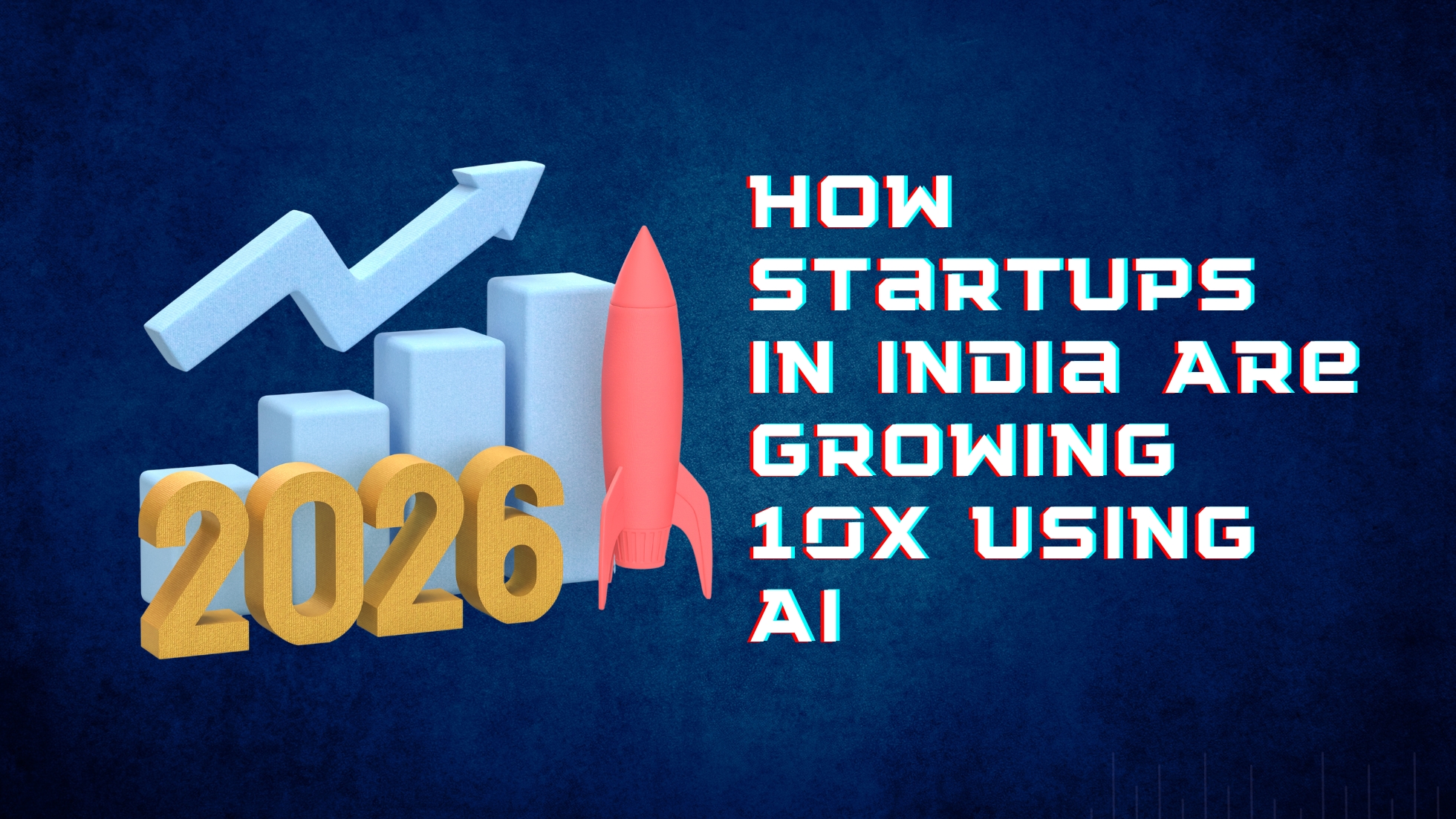
How Startups in India are Growing 10X Using AI has shifted from a futuristic concept to a daily operational reality for founders in 2026. From the bustling tech corridors of Bengaluru to the emerging innovation hubs in Jaipur, artificial intelligence is no longer just a “feature”—it is the fundamental engine of hyper-growth. By automating high-volume tasks and providing predictive market insights, Indian entrepreneurs are outcompeting global rivals with leaner teams and higher profit margins.
The current landscape reveals that over 70% of unicorn-status companies in India have integrated deep-tech AI into their core infrastructure. This shift explains exactly How Startups in India are Growing 10X Using AI, as they move away from manual scaling and toward algorithmic expansion.
Why Startups in India Are Growing Rapidly
1. AI in E-commerce
The retail sector has seen a massive transformation. Startups are using AI to analyze millions of data points—from local weather patterns in Delhi to regional festivals in Kerala—to offer real-time, personalized shopping experiences.
Predictive Carting: AI models now predict what a customer will buy before they even search for it.
Dynamic Pricing: Startups are adjusting prices in milliseconds based on demand, which is a key reason How Startups in India are Growing 10X Using AI in the competitive D2C space.
By delivering exactly what the consumer wants, these startups have seen conversion rates skyrocket by over 400%.
2. Revolutionizing Fintech with AI-Driven Risk Assessment
Fintech is perhaps the best example of How Startups in India are Growing 10X Using AI. In a country where traditional credit scores are often unavailable for rural populations, AI-based alternative scoring has opened the floodgates for financial inclusion.
Startups like those featured on NASSCOM’s DeepTech platform use AI to analyze smartphone metadata, social footprints, and transaction history to grant loans in seconds. This level of speed and accuracy is why the Indian fintech ecosystem remains a global leader.
3. AI in Logistics: Solving the “Last-Mile” Challenge
India’s complex geography makes logistics a nightmare. However, the secret to How Startups in India are Growing 10X Using AI in logistics lies in route optimization and autonomous delivery tracking.
Route Mapping: AI algorithms calculate the most fuel-efficient routes, bypassing Bengaluru’s infamous traffic.
Warehouse Automation: AI-powered robots are managing inventory with 99.9% accuracy, drastically reducing overhead costs.
4. The Rise of AI-Powered Customer Success
Customer support used to be the biggest bottleneck for scaling. Today, How Startups in India are Growing 10X Using AI involves using sophisticated LLMs (Large Language Models) that speak over 22 Indian languages fluently.
These AI agents handle 90% of routine queries without human intervention. This allows startups to scale their user base from 10,000 to 1,000,000 without hiring a single additional support staff member.
Image Name: ai-multilingual-support-india-startups.jpg
Alt Text: Diagram explaining How Startups in India are Growing 10X Using AI via multilingual AI customer support.
5. Deep-Tech in Healthcare: Saving Lives with AI
In the healthcare sector, How Startups in India are Growing 10X Using AI is measured in lives saved. AI is being used for early cancer detection, tuberculosis screening via X-rays, and even predicting heart attacks through wearable tech.
Rapid Diagnosis: AI reduces diagnostic time from days to minutes.
Affordability: By using AI to automate screening, these startups provide world-class healthcare at a fraction of the cost, reaching rural India effectively.
6. Marketing and Content Creation: The AI Advantage
Content is king, but high-volume production is expensive. This is where How Startups in India are Growing 10X Using AI becomes highly visible. Founders are using AI to generate high-quality blog posts (like this one!), social media videos, and ad copy in seconds.
SEO Optimization: AI tools ensure every piece of content is perfectly tuned for search engines.
Visual Prompts: Creating promotional imagery that used to take days of photoshoots now takes minutes of prompt engineering.
You can learn more about this in our guide on AI Startup Innovation Strategies (Internal Link).
7. EdTech: Personalized Learning Paths at Scale
The EdTech boom in India was just the beginning. The second wave shows How Startups in India are Growing 10X Using AI by moving away from one-size-fits-all video lectures to adaptive learning platforms.
The AI monitors a student’s progress and changes the difficulty level of the curriculum in real-time. This keeps students engaged and has led to a massive increase in subscription renewals.
8. Agritech: AI for the Indian Farmer
Startups in the agricultural sector are proving How Startups in India are Growing 10X Using AI by utilizing satellite imagery and soil sensors.
Yield Prediction: AI helps farmers know exactly when to sow and harvest.
Pest Detection: Mobile apps allow farmers to take a photo of a leaf, and AI identifies the pest and recommends the exact pesticide dosage required.
9. Strengthening Cybersecurity with Predictive AI
As India goes digital, cyber threats are increasing. How Startups in India are Growing 10X Using AI in the security space involves “Self-Healing” networks. These AI systems identify vulnerabilities and patch them before a human hacker can even find them.
10. SaaS and Automation: The New Global Export
Indian SaaS startups are now “AI-first.” By embedding AI into every workflow, they are offering tools that are 10 times more efficient than legacy software. This is a primary driver for How Startups in India are Growing 10X Using AI while capturing global market share from the US and Europe.
India is experiencing a tremendous change in technology and artificial intelligence is at the core of these changes. Small startups, as well as high growth rate ventures, no longer see AI as a far-off idea, it is a reality growth force today. The fact that India is experiencing an increase in the number of AI startups is an indicator of the extent to which technology is transforming the entrepreneurial environment.
The present day startups are fighting not only on the basis of an idea but also fighting on the basis of speed, efficiency, and intelligence. AI allows companies to automate operations, get to know customers and make more intelligent decisions in real time. That is why startups based on AI are developing much faster than the ones that use conventional practices.
A competitive and dynamic market such as India can make success depend on how fast it can be scaled. AI is a multiplier, which enables startups to realize in months what was once a year ago. This paper examines how startups in India are embracing AI to achieve exponential growth, the sectors that have been at the forefront of this change, and the future.
https://digitalstartupindia.com/category/startup-growth-scaling/
The reason why AI is changing startups in India.
The fast digitalization of India has established a powerful basis of the AI uptake. As more people increasingly use the internet and smartphones, business organizations are now able to access a lot of data. This information would form the foundation of AI-based knowledge and robotization.
The other significant factor is cost efficiency. The conventional expansion plans usually entail a lot of manpower and infrastructure investment. Automation of repetitive processes and optimization of operations are just a few examples of how AI can decrease these costs.
AI is also being adopted with the help of government initiatives and an increasing ecosystem of startups. Startups have been able to experiment with AI technologies easier due to the policies that promote innovation, coupled with availability of funding and incubators.
The digital infrastructure, availability of data and support of ecosystems have made India a haven of artificial intelligence startups.

The Growth of Startups in India with the help of AI.
Operational Efficiency and automation.
Automation is among the most effective applications of AI. Artificial Intelligence is being used by startups to deal with repetitive work including customer support, data entry, and process management. This saves human effort and enables the teams to work on strategic work.
Another improvement of automation is accuracy and consistency that are essential when scaling the operations. This is one of the major reasons for automation in startups india.
Artificial Intelligence Customer Experience.
AI allows startups to provide individual customer experiences. Chatbots to recommendation engines, businesses will be able to engage with their customers in a more relevant and engaging manner.
This does not only enhance customer satisfaction, but also enhances retention and conversions, which has a direct effect on the growth.
Data-Driven Decision Making
The use of AI in data analysis and making informed decisions is becoming more popular among startups. Real-time insights can be employed by businesses to direct their strategies instead of making assumptions.
This data-driven thinking is one of the significant contributors to the growth of startups based on the use of AI.
Innovation and Personalization of Product.
Startups are getting smarter with AI. Regardless of predictive analytics, customized recommendations, or smart automation, AI-based products are more valuable to customers.
The innovation generates a competitive advantage and preconditions a long-term success of startups.
India AI Startups- core drivers of growth.
The development of AI startups in India is backed by a number of factors. There is an enhanced technology infrastructure and it is easy to develop and deploy AI solutions. The barriers to entry have been minimized by cloud computing and open-source tools.
The ecosystem of funding has changed as well. AI-based businesses are of greater interest to investors, as they are scalable and can provide a high return.
Another driver is the availability of talent. India also possesses a substantial number of qualified engineers and data scientists, which allows the startups to create powerful technical teams.
Probably the most essential factor is the market demand. The high demand of AI-driven startups is emerging among businesses of all industries seeking to gain efficiency and competitiveness through AI solutions.

The Indian AI Startups – The Major Advantages.
Faster scalability
Reduced operational costs
Better customer insights
Competitive advantage
Improved decision-making
These advantages demonstrate that ai in business development India is turning into a key approach of the contemporary startups.
Sectors AI startups are developing rapidly in India.
FinTech
Financial services are undergoing a revolution with AI that is helping to pick up fraud, credit score, and provide one-on-one financial advice. The startups in this area are capitalizing on AI to develop smarter and safer platforms.
HealthTech
The applications of AI in healthcare include diagnostics, monitoring patients and recommending medications. It is enhancing efficiency and accessibility of the healthcare system.
E-commerce
Recommendation systems and customer analytics powered by AI are assisting e-commerce start-ups in more sales, and better user-experience.
EdTech
AI is allowing individualized learning, allowing students to learn at a pace. This has largely enhanced the interaction and performance.
SaaS and B2B Tools
SaaSs that are powered by AI are automating businesses, analyzing data, and increasing productivity. This segment is experiencing rapid growth because of high demand.
India AI Startup Real-World examples.
To prevent fraud in real-time, startups in the fintech sector are applying AI to study transactional patterns to identify fraud. This enhances security as well as trust among the users.
In the healthcare sector, AI-based platforms are helping physicians to diagnose diseases with a higher level of accuracy. This will decrease mistakes and enhance patient outcomes.
In e-commerce, startups are applying AI to suggest products according to the behavior of the user. This promotes conversion rate and customer experience.
These machine learning startups india demonstrate the application of AI in industries to achieve growth.

India AI Startup issues.
Regardless of the opportunities, there are a number of challenges to AI startups. One of the greatest barriers is high initial investment. The creation of AI solutions takes major resources and infrastructure.
Another problem is the talent gap. India does offer a mass of talent, but highly specialized AI professionals are absent.
Privacy of data is an issue that is gaining relevance as well. Since startups deal with sensitive information, they need to comply with regulations, and ensure that users have trust in them.
Implementing AI solutions may be complicated. The transition of a prototype to a scalable product is a delicate process that has to be carefully planned and executed.
AI Startups in India Future.
The future of AI startups in India is bright. The adoption of AI will grow in a number of industries due to technological innovations and market demands.
Innovation will be encouraged by government policies further because of the favorable environment it will create to startups. Meanwhile, the international competition will drive the Indian startups to become better in quality and creativity.
Advocacy of emerging technologies in the form of machine learning, natural language processing, and computer vision will create new opportunities. By these improvements, startups will be capable of creating more complex and influential solutions.
Innovation, scalability, and globalization will become the hallmarks of the future of ai startups india.
The way that Entrepreneurs can exploit AI.
In the case of entrepreneurs, the trick of optimizing AI lies in commencing on the proper path. The selection of the appropriate tools is important. The number of AI tools is enormous, and it is necessary to select the ones that correlate with business objectives.
The next step is the identification of use cases. Entrepreneurs need to consider the spheres in which AI can make the most significant change, i.e. automation, customer experience, or data analysis.
It is always a good idea to start small. Startups do not need to attempt to apply AI to all business processes, as it is possible to link it to particular applications and grow them over time.
The continuous learning and adaptation will be needed in scaling with AI. The AI solutions that can serve the needs of the business should improve as the business expands.
Conclusion
AI is not a luxury anymore, it is the necessity of the companies that want to develop in the existing competitive market. The development of AI startups in India shows how technology is shaping the growth and way of conducting business.
AI can be used to grow in several directions such as automation, personalization, and decision-making that is based on data. When startups are the early adopters of AI, they have a tremendous competitive edge because they can proceed more rapidly and be more innovative.
To the businessperson, the prospect is evident. AI is not a tool but a strategic resource that can shape the future of a business. Individuals that adopt it will be in a greater position to govern the future.

Empowering India’s Entrepreneurs Through AI-Driven Education and Innovation.
Faq’s
What are AI startups in India?
Indian AI startups are companies that apply artificial intelligence to develop solutions, services, or products in any industry.
What is the use of AI in startups to grow?
They automate, use AI on customer experience, data analysis, and product innovation to grow at an acceleration.
What are the most common industries in the use of AI?
Some of the most popular industries that utilize AI include FinTech, HealthTech, e-commerce, EdTech and SaaS.
Is AI good for small startups?
Yes, AI can assist small startups in increasing efficiency, cost reduction, and competing with bigger companies.
Whose future is it of AI startups in India?
The future is good, as there is more adoption, innovation, and opportunities of extending internationally.