Categories
Recent Posts






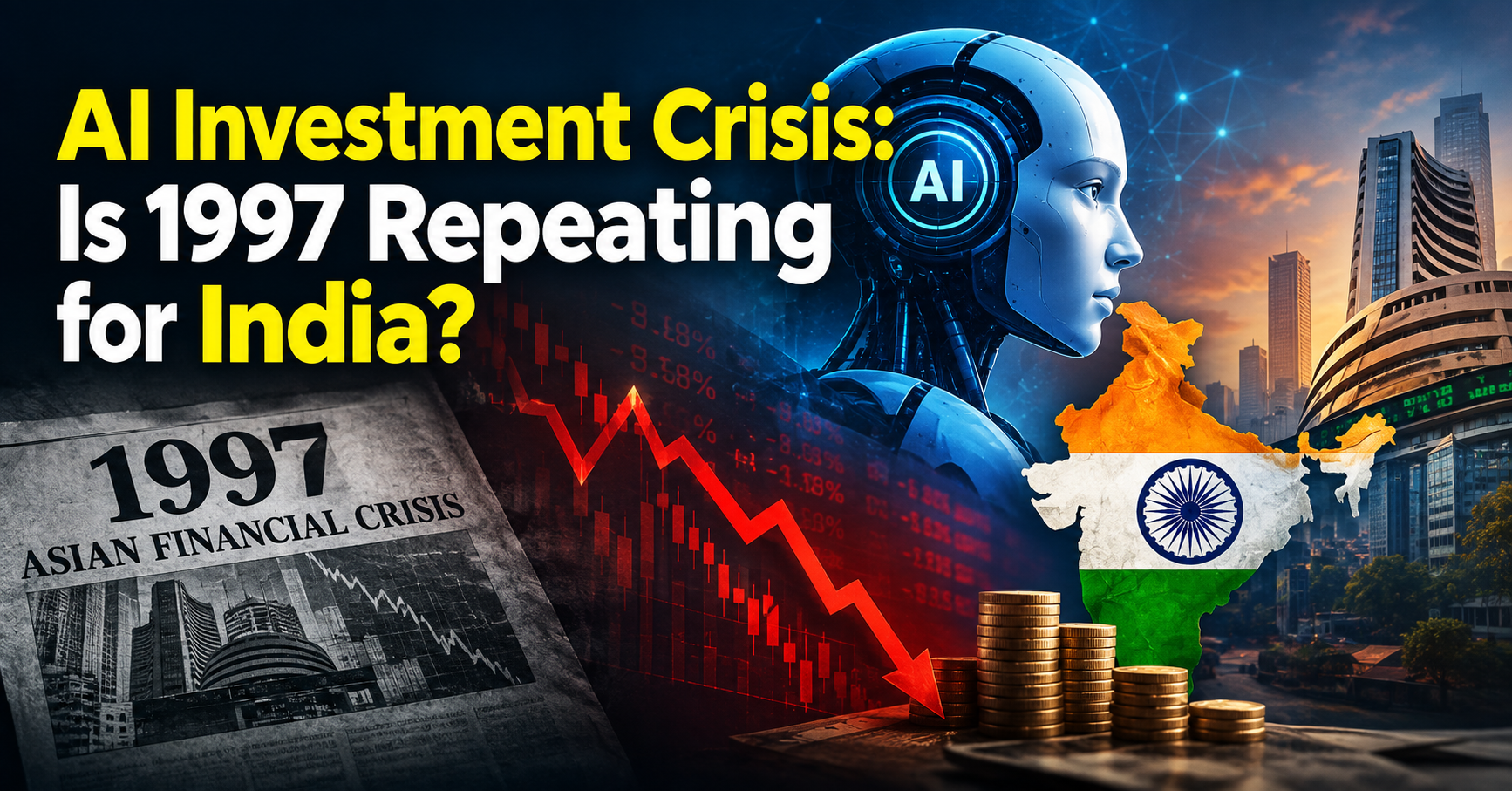
Table of Contents
AI Investment Crisis: Is 1997 Repeating for India?
If you run a business in India, you've probably heard some version of this warning before: "a big financial crisis is coming." Usually, you nod, close the tab, and get back to work. Fair enough — these warnings come and go.
But this one is worth five minutes of your time. Because HSBC's Chief Economist, Fredrik Neumann, isn't talking about a repeat of 2008 or a routine market correction. He's talking about something that looks a lot like the 1997 Asian Financial Crisis — except this time, the trigger isn't broken banks. It's the sheer amount of money the US is pouring into AI infrastructure.
For founders and business owners, that distinction matters. Let's break down what's actually being said, why it echoes 1997, and — more importantly — what it could mean for your startup, your funding, and your costs over the next year.
What Is HSBC's Warning About? (The Quick Version)
In a note dated August 31, Neumann laid out a case that today's Asian economies are showing warning signs similar to those seen right before the 1997 crisis:
- US Treasury bond yields are climbing sharply
- The Japanese yen has weakened dramatically
- Investors are extremely excited about one big technology theme
Back then, the theme was the internet. Today, it's AI.
His core point: the crisis, if it comes, won't start with bank failures like it did in 1997. It'll start with a slowdown in AI infrastructure spending by US tech giants — and that slowdown will hit Asia's export-driven economies, India included, through falling orders for chips and electronics.
Why Economists Are Drawing a Line Back to 1997
Rising US Treasury Yields, Then and Now
Before the 1997 crisis, the US 10-year Treasury yield jumped from around 5% (late 1993) to nearly 8% (late 1994), and stayed near 7% by early 1997. Today, yields have climbed about 80 basis points since February, to roughly 4.79% — a sharp move up from the historic lows of around 0.5% seen in August 2020.
Why should you care about a US bond number? Because Treasury yields set the tone for global borrowing costs. When they rise, capital gets more expensive everywhere — including for Indian startups raising money from foreign investors.
A Weakening Yen — History Repeating?
Between 1995 and 1997, the Japanese yen fell nearly 55% against the dollar. Sound familiar? From January 2021 to July this year, the yen slid from about 103 to 163 per dollar — a drop of around 57%, prompting the US and Japan to step in and stabilize it.
A weak yen makes Japanese exports cheaper and puts pressure on other Asian currencies, including the rupee, to stay competitive. That's a currency ripple effect founders in import-heavy or export-facing businesses should keep an eye on.
Then It Was the Internet. Now It's AI.
In the mid-1990s, investor excitement centered on the internet. Today, it's AI. Big tech companies — Amazon, Microsoft, Alphabet, Meta — are spending enormous sums on AI infrastructure and data centers. If that spending slows down because borrowing gets too expensive, the effects will ripple outward fast.
This Time, the Risk Isn't Banks — It's AI Spending
Here's the key difference Neumann highlights, and it's an important one:
In 1997, Asian economies were heavily dependent on foreign capital, running large current account deficits with weak banking systems. When rates rose, foreign money fled overnight, currency pegs snapped, and banks collapsed across Thailand, South Korea, and beyond.
Today, many Asian economies — including India — are net capital exporters with large foreign exchange reserves. The banking-system risk that defined 1997 simply isn't the same today.
Instead, the risk is a demand-side shock. South Korea, Japan, Taiwan, and Singapore's manufacturing hubs are deeply tied to electronics and semiconductor exports feeding US tech companies. If AI spending slows, it won't show up as panic on a trading floor — it'll show up quietly in shrinking order books at chipmakers and electronics manufacturers.
Why This Should Matter to Indian Founders and Entrepreneurs
You might be thinking: this is a US-Japan-Korea story, why does it concern an Indian startup? Here's where it gets relevant.
1. Semiconductor and Deep-Tech Startups
India has been actively building out its semiconductor and electronics manufacturing ecosystem. If global AI infrastructure spending slows, demand for chips and components softens globally — and that includes orders that Indian semiconductor and hardware startups are counting on.
2. Funding and Venture Capital Flows
A lot of venture capital flowing into Indian startups is priced off global capital costs. When US Treasury yields rise, the cost of capital rises everywhere. Investors get more selective, valuations get more conservative, and "growth at any cost" pitches get harder to sell. If you're raising a round in the next 6–12 months, expect more scrutiny on unit economics, not less.
3. Currency and Import Cost Risk
A volatile yen and pressure on Asian currencies can push the rupee around too. If your startup imports hardware, components, or software licenses priced in dollars, currency swings directly affect your costs and margins.
4. AI-Dependent Business Models
If you've built products layered on top of expensive third-party AI infrastructure (cloud GPUs, foundation model APIs), a pullback in that spending cycle could eventually affect pricing, availability, or the pace of innovation you're relying on from bigger platforms.
Is India Actually Safer Than in 1997?
Yes — in the ways that mattered most last time. India today holds substantial foreign exchange reserves and isn't nearly as dependent on short-term foreign capital as it was in the 1990s. The banking system is also on considerably firmer footing.
But "safer from a banking collapse" doesn't mean "immune to a slowdown." The new vulnerability Neumann points to is quieter and less dramatic — a gradual softening in export demand rather than a sudden currency panic. That kind of slowdown creeps into P&L statements before it makes headlines.
What Should Indian Entrepreneurs and Founders Do Now?
You don't need to panic. You do need to plan sensibly. A few practical moves worth considering:
- Stress-test your runway. Model what happens if fundraising takes longer or valuations come in lower than expected over the next 12 months.
- Watch your cost of capital. If you're planning debt or a raise, rising global rates mean it's worth locking in terms sooner rather than later.
- Diversify revenue geography. Heavy reliance on US enterprise clients or US-linked capital adds exposure to this exact risk. A broader customer base cushions the blow.
- Hedge currency exposure if you import hardware, pay for cloud infrastructure in dollars, or have dollar-denominated costs.
- Keep unit economics tight. Investors are already leaning more conservative; startups with clear paths to profitability will have an easier time raising.
- Track AI infrastructure spending trends, especially if your business depends on chips, cloud compute, or AI APIs — a slowdown at the top of that chain eventually reaches everyone downstream.
The Bottom Line
HSBC's warning isn't a prediction that a crisis is guaranteed — it's a reminder that the ingredients look familiar, even if the recipe has changed. In 1997, weak banks and short-term foreign debt lit the fuse. Today, the fuse (if there is one) runs through AI infrastructure spending and its ripple effects on Asia's export economies.
For Indian founders, the smart move isn't to panic about a headline — it's to build a business that can absorb a slower funding environment and a bumpier global capital market, just in case. Hope for the best, but plan your runway like the caution flags are real.