Categories
Recent Posts


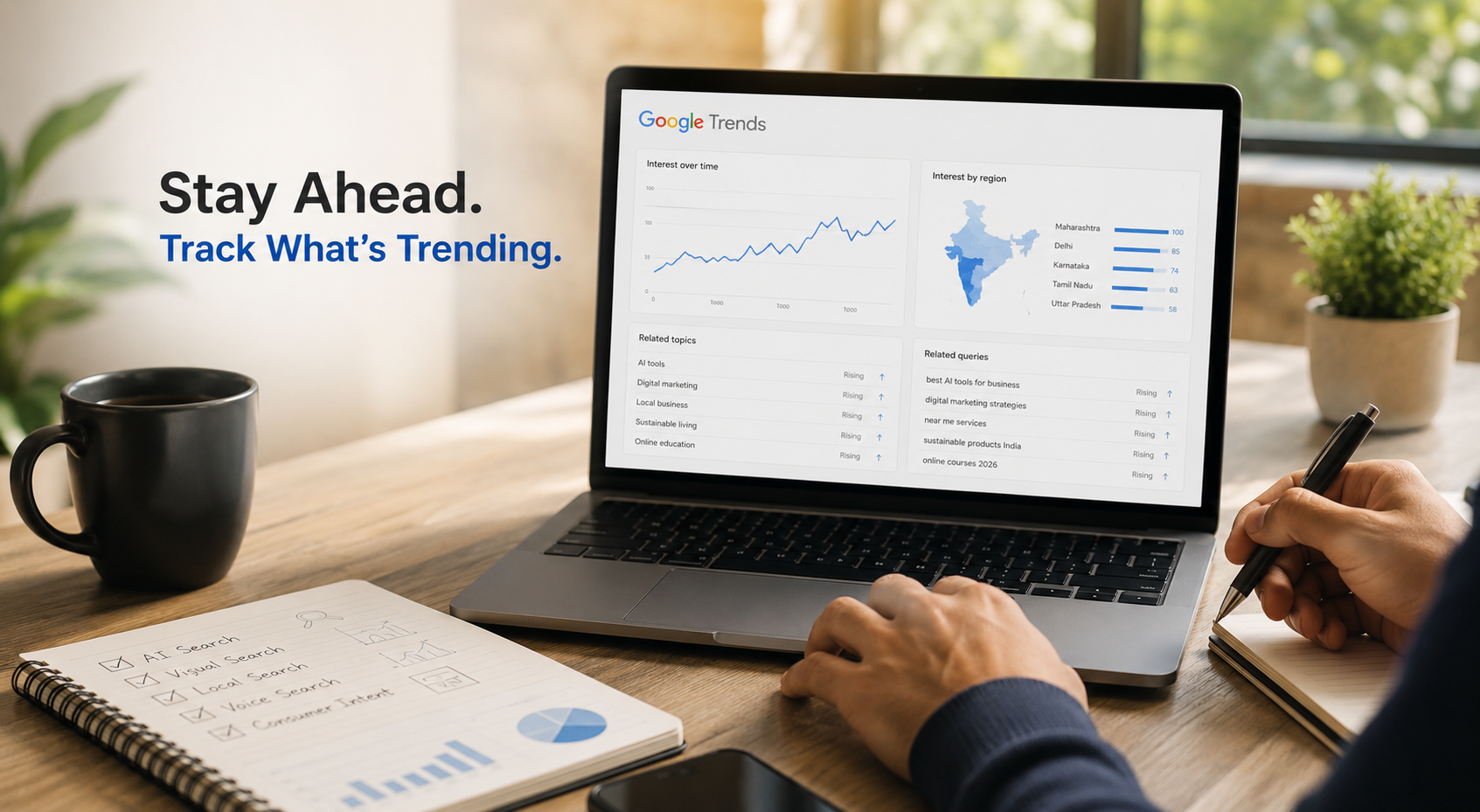
Table of Contents
Introduction
Google isn't simply a search engine to many Indian businesses. It can be the initial step in the customer's shopping process.
Someone searching for a doctor, restaurant, software product, coaching institute, property, a clothing brand or a local service can start by searching Google for the information. What they are looking for, how they ask the question and the information they are looking for can tell a lot about changing behaviors.
That is why it can be advantageous for business owners to use Google Trends.
Search behaviour can be used to uncover new hot topics, seasonal demand, regional preferences and shifts in searcher behaviour, rather than guess.
There are a few key search trends that businesses should consider when developing their marketing plans for the second half of the year.
The key is that you don't pursue all the keywords that are viral. Rather, the business owners must seek search patterns which have direct links to their customer base, products or services.
1. AI Search Is Changing How Customers Find Information
The change in search that is most happening is the change from a short search term to longer, more conversational search terms.
Users are becoming more at ease in posing specific questions to Google instead of performing multiple separate queries.Users are getting easier to pose questions to Google in detail, instead of making multiple separate queries.
For instance, when a customer is looking for ‘best restaurant Chandigarh’, he may end up searching for ‘best family restaurant in Chandigarh with vegetarian food under ₹1500’ instead.
The second search gives us a much better indication of what the person wants to do.
It includes details of where, who, what and how much food they like and are willing to pay for. A business owner would benefit from this type of search much more as it will provide him/her with a better understanding of what the customer needs.
Google has also rolled out more AI-powered search features in India, such as AI Mode. Google has shared that early users of its AI Mode in India were posting queries that were much longer, compared to standard searches.
This shift impacts businesses in that they must start to work beyond the level of single keywords.
Create Content Around Real Customer Questions
When creating content, focus on what customers are asking in their queries.
A business site must respond to a few inquiries that customers inevitably query beforehand they reach a decision.
A healthcare website should do more than just come up with a list of services. It can describe who a service is for and what it entails, as well as outline what customers can expect from a service and when they might need to seek professional advice.
Likewise, a software firm can describe the kind of business its product is geared towards, the price of its software, various alternatives, and how it can be put in place.
This kind of informative and question-based content can help a business be more visible when people utilize conversational search.
The aim should not be to produce content merely for the sake of it because AI search is the current trend.
The aim should be to make the information so clear and informative that the business itself should become a customer source for people who have a problem to solve.
2. Visual Search Is Becoming More Important
Searching doesn't have to be limited to entering words into a search box.
Images are now the way that people can find a product, identify objects and find similar images. That's an increasingly fascinating opportunity that businesses are looking at when it comes to visual search.
Google Lens has a special significance in India. Google has earlier said that it has seen a higher user base of Google Lens in India month-on-month compared to any other country in the world.
This gives opportunities to companies that have businesses in the industries which are visual.
Any retail company looking to enhance their visual content and boost its discoverability can benefit from this process.A wide range of fashion retailers, jewellery stores, furniture retailers, restaurants, beauty brands, automobile companies, and even home décor businesses can benefit from this process.
Product Images Should Do More Than Look Good
For many companies, photos will be uploaded without any consideration for the descriptions that will be attached.
The image file called IMG1234.jpg doesn't provide much context.
A descriptive title, like modern-six-seater-dining-table.jpg, provides a lot more information about the image.
Alt text should also be descriptive, and concise, and should accurately describe the image without being overly wordy.
A product page might include quality photos of the product from various perspectives, as well as descriptions of the material it is made from, the size, colour and how it is used for an online furniture business.
This will allow customers to get an idea of what the product is, in addition to giving search engines some context.
Images can also be used to make helpful guides.
A room makeover example can be published by an interior designer. For a fashion company, it may be possible to develop outfit ideas. A restaurant might give a tour of their favorite menu items. Images could be used in a jewellery store to explain about different jewellery styles.
It's about creating images that are used not just as a part of the overall customer experience, but rather as an element of that experience.
3. Local business is still critical to "near me" searches
If your company relies on people coming to your physical store, local search is undoubtedly among the most beneficial places to keep track of.
Individuals don't look for the most effective business in the nation.
They look for something that they can find nearby.
A person could look up a dentist close to me, gym close to me, restaurant close to me or AC repair service close to me.
They can be especially useful as they may be a clear sign of an 'at the moment' or high purchase intention.
If somebody is looking for the best dentist, it is possible that they are still researching.
People looking for a "dentist near me open today" are probably a step closer to making a decision.
Local Businesses Need Stronger Search Visibility
For businesses that rely on local customers, it's important to ensure that their Google Business Profile is accurate and up-to-date.
Business Hours, Phone Numbers, Location, Web information and Business categories should be properly maintained.
Reviews also are important factors that influence potential customers to form an opinion about a local business.
But, that's not all local SEO must have.
The web site ought to additionally clearly state where the enterprise functions.
For instance, a medical practice serving Ambala must have useful information, which logically would put them in place, and their service area.
A Chandigarh restaurant can build pages or content on their menu, location, dining experience and nearby searches related to their offerings.
The goal here is NOT to use the name of the city as a subject in each sentence.
It is to clearly define to the search engines and the customers what business does and where it is located.
4. Multilingual and Voice Search Are Growing Opportunities
India's search behaviour cannot be understood through English alone.
Millions of people use Hindi and regional languages when searching for information. Many users also switch between English and their local language depending on the situation.
This becomes even more important with voice search.
When people type, they often use short phrases.
When they speak, their searches tend to sound more like natural conversations.
Instead of typing "best restaurant Ambala," someone using voice search might ask, "Ambala mein family ke liye accha restaurant kaunsa hai?"
That difference matters for content creators and business owners.
Businesses Should Understand How Customers Actually Speak
A business may describe its service using formal industry terminology, while customers may use much simpler language.
For example, a medical clinic may describe a service using a clinical term, while a patient may search using a common description of the problem.
The same happens in finance, education, technology, real estate and almost every other industry.
Businesses should therefore research the actual language their customers use.
For companies serving regional audiences, bilingual or multilingual content can also make information easier to understand.
However, simply translating English content word-for-word may not always work.
Good multilingual content should sound natural to the people who are actually going to read or hear it.
5. Customers Are Using Search to Compare Before Buying
Another important search trend is the growing use of Google for decision-making.
Customers are no longer searching only to find a definition or basic piece of information.
They are using search to compare products, services, prices, features and alternatives.
For example, someone may search for "best laptop" during the initial research stage.
But a more specific customer might search for "best laptop under ₹60,000 for coding and college."
That second query indicates a much stronger intention.
The person has already defined a budget and a use case.
The same behaviour happens with services.
A customer might search for "digital marketing agency."
Another customer may search for "best digital marketing agency for a small business with ₹30,000 monthly budget."
The second search gives businesses much more insight into what the customer wants.
Comparison Content Can Capture High-Intent Customers
Businesses can create useful comparison content that helps customers make informed decisions.
A software company might publish an article comparing CRM software with spreadsheets.
A fitness company could explain the differences between joining a gym and exercising at home.
A real estate company could discuss the factors customers should consider when choosing between renting and buying.
The purpose should be to educate rather than simply promote.
If every comparison concludes that the company's own product is automatically the best option, customers may not trust the content.
Honest comparisons can create stronger credibility because they help people understand which option is suitable for their situation.
How Indian Businesses Can Use Google Trends More Effectively
Google Trends becomes much more useful when it is connected to actual business decisions.
Instead of simply looking at the most popular searches in India, business owners should start with their own customers.
Think about the products and services the business already offers.
Then consider the questions customers ask before contacting or purchasing from the company.
Those questions can become the starting point for Google Trends research.
For example, a coaching institute could compare search interest for different courses.
A travel company could investigate destinations before creating seasonal campaigns.
A clothing retailer could monitor interest in different product categories before ordering inventory.
A local service provider could compare demand for different services within its target city.
This makes search data much more practical.
Look for Trends, Not Just Sudden Spikes
One of the biggest mistakes businesses can make is confusing a temporary spike with a genuine market trend.
A topic can suddenly receive millions of searches because of a major news event, celebrity story, sporting event or viral moment.
That does not necessarily represent sustainable consumer demand.
Business owners should therefore examine search interest over a longer period.
If a keyword is consistently growing over several months, it may be more interesting than a keyword that suddenly becomes popular for three days.
Seasonality should also be considered.
Some searches naturally increase during festivals, holidays, school admissions, wedding seasons, summer and monsoon periods.
Understanding these patterns can help businesses prepare their content and marketing campaigns before demand reaches its peak.
Google Trends Can Help Small Businesses Find Opportunities
Google Trends is not only useful for large companies with large marketing budgets.
Small businesses can use it to identify niche opportunities.
A local business may not be able to compete nationally for a broad keyword such as "organic food."
However, it could identify increasing interest around a specific organic product in its city and build content around that opportunity.
A local education business might discover growing interest in a particular course.
A restaurant might notice increasing interest in a particular cuisine.
A service company might identify a problem that customers in its area are searching for more frequently.
Small businesses often have one major advantage over larger organisations: speed.
They can identify a change in customer interest and create a relevant offer or piece of content much faster.
Search Trends Can Improve Your SEO Strategy
Google Trends should not replace keyword research, analytics or customer research.
Instead, it can complement them.
Traditional SEO can tell you what people are searching for and how competitive a keyword may be.
Google Trends can help you understand whether interest is increasing, decreasing or changing geographically.
Your website analytics can then show whether that traffic is actually producing useful results.
When these sources are considered together, businesses can make much better content decisions.
For example, if a keyword has growing search interest, low competition and strong relevance to a company's services, it may be worth creating a dedicated page or article around it.
If a keyword has high search volume but almost no connection to the company's customers, it may not be worth pursuing.
The goal is not to generate the most traffic.
The goal is to attract the right traffic.
A Simple Monthly Google Trends Routine
Business owners do not need to spend hours every day analysing search data.
A simple monthly review can be enough.
Start by selecting a group of keywords related to your products, services and customer problems.
Check how their interest has changed over the previous 12 months.
Then compare related terms and look at the results for your specific state, city or target region.
Next, examine whether the interest appears seasonal or whether it is showing a longer-term upward movement.
Finally, ask how the business could respond.
Perhaps you need a new landing page.
Perhaps an existing service needs better positioning.
Maybe customers are asking questions that your website does not currently answer.
The value comes from turning the insight into action.
The Five Trends Business Owners Should Watch
By the time businesses plan for August 2026 and the months that follow, these five areas deserve regular attention.
AI-powered and conversational searches can reveal increasingly detailed customer questions.
Visual search can create new opportunities for businesses with products that customers discover through images.
Local and "near me" searches remain particularly valuable for businesses that depend on physical locations.
Multilingual and voice searches can help businesses reach customers who do not search using traditional English keywords.
Comparison and decision-based searches can reveal customers who are already evaluating products and services before making a purchase.
These trends are connected by one larger change: search is becoming more conversational, visual, local and intent-driven.
What This Means for Your Business Website
A modern business website should not simply tell visitors who you are.
It should help them answer the questions they have before they buy.
It should explain your services clearly.
It should provide useful information.
It should contain high-quality images.
It should make your location clear if you serve local customers.
It should answer common customer questions.
It should provide comparisons or buying guidance where appropriate.
Most importantly, it should make it easy for someone who discovers you through Google to take the next step.
That could be calling your business, booking an appointment, requesting a quote, making a purchase or visiting your location.
Conclusion
Google Trends is often treated as an SEO tool, but its real value goes much deeper.
It can provide Indian business owners with clues about what customers are interested in, how their search behaviour is changing and where new opportunities may be emerging.
The five trends worth tracking before August 2026 are AI-powered search, visual discovery, local searches, multilingual and voice search, and comparison-driven search.
But the most important lesson is not to chase every trending keyword.
Instead, look for meaningful changes in the way your target customers search.
When search data is combined with customer feedback, sales information and market knowledge, it can become a powerful business-planning tool.
The businesses that understand this shift will not simply create more content.
They will create more useful content for the right people at the right stage of the buying journey.
And that is ultimately what makes a search trend valuable.