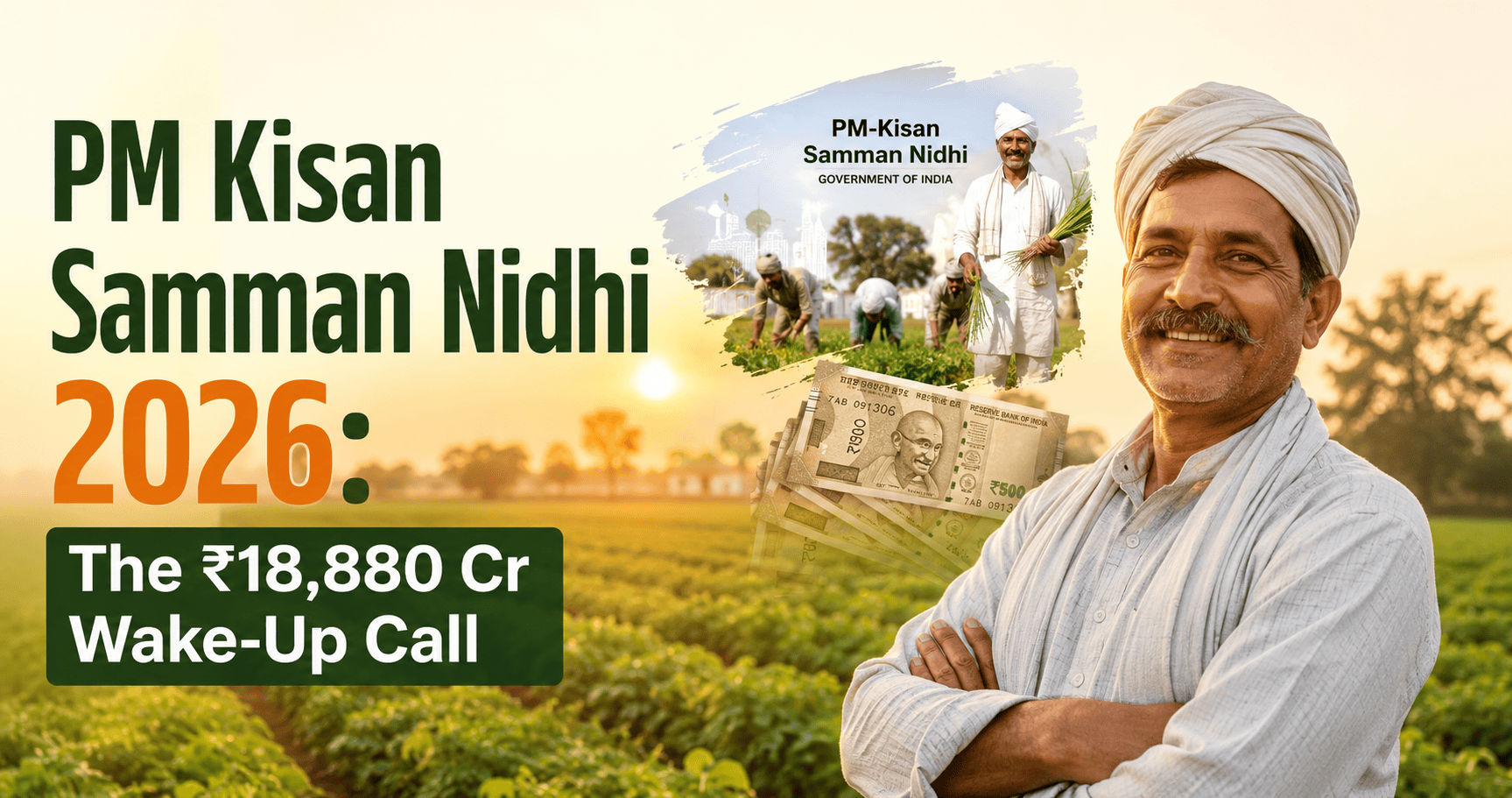
In a small farming village near Tarakeswar, West Bengal, a farmer named Ramesh hears his phone buzz. One line on the screen changes his morning: ₹2,000 credited to your account.
No paperwork. No bank queue. No middleman asking for a “processing fee.” Just a government promise, kept — again.
Now multiply that single notification by 9.44 crore farmers across India, all receiving money on the very same day. That’s ₹18,880 crore, moved instantly, directly, and transparently in one coordinated push. That’s the real story of PM Kisan Samman Nidhi — and it’s a story that has almost nothing to do with farming, and everything to do with trust, technology, and scale.
📌 Quick Takeaway: PM Kisan Samman Nidhi gives eligible farmer families ₹6,000 a year, paid in three installments of ₹2,000 every four months, directly into their bank accounts.
If you run a business, manage a marketing team, or are building a startup, this isn’t just a “government scheme update.” It’s a live case study in how India moves trust, money, and opportunity at a scale most companies only dream of reaching.
The Story So Far: What Is PM Kisan Samman Nidhi?
Rewind to 2019. India launches PM Kisan Samman Nidhi, a bold promise: ₹6,000 a year, paid in three equal installments, sent straight to a farmer’s bank account. No subsidy routed through ten different departments. No paper trail that mysteriously vanishes halfway through. Just Direct Benefit Transfer (DBT) — money moving from treasury to farmer, with nothing in between.
At launch, skeptics called it too ambitious to run reliably at national scale. Seven years and 23 installments later, the numbers tell a different story:
💰 Since 2019, PM Kisan Samman Nidhi has disbursed more than ₹3.46 lakh crore — one of the largest digital cash-transfer operations on the planet.
That’s not a welfare footnote. That’s an infrastructure achievement — the same combination of trust, logistics, and technology that every founder is quietly trying to build for their own product, just applied to 90+ million households instead of a startup’s first thousand users.
The most recent chapter unfolded on June 20, 2026, when the government released the 23rd installment of PM Kisan Samman Nidhi. Here’s what that single day looked like:
Metric
Figure
Installment number
23rd
Date released
June 20, 2026
Farmers benefited
9.44 crore+
Total amount transferred
₹18,880 crore+
Amount per farmer
₹2,000
Stop and picture the operational challenge behind that table: verifying nearly 950 million identities, checking bank-account mappings, running fraud filters, and executing a coordinated national payout — all in a single push. That’s not “government paperwork.” That’s enterprise-grade fintech infrastructure, running at a scale most Series C startups never touch.
Naturally, every farmer is now asking the same question you’d ask about any recurring product release: when’s the next drop?
⚠️ Important: The government has not yet officially announced a date for the 24th installment of PM Kisan Samman Nidhi. Based on the scheme’s consistent four-month cycle, most reports estimate it will land around October 2026 — but treat this as an educated guess, not a confirmed date.
Don’t trust random dates circulating on WhatsApp or social media. The only source that matters is the official PM-KISAN portal. Everything else is speculation wearing the costume of news.
Who Qualifies — and Why It’s a Goldmine of Market Insight
Not every farmer automatically qualifies for PM Kisan Samman Nidhi. To receive it, a farmer must:
Own cultivable agricultural land registered in their own name
Have Aadhaar linked to their bank account
Have completed e-KYC verification
Have updated, verified land records on file
Certain groups are excluded entirely — institutional landholders, constitutional post holders, sitting or former MPs/MLAs, government employees, and pensioners drawing ₹10,000 or more a month.
🎯 Why this matters to you: This eligibility list is essentially a pre-verified, income-supported consumer segment — tens of millions of rural households with predictable, recurring cash inflow every four months. That’s precisely the kind of demand signal agritech, rural fintech, and D2C brands build entire go-to-market strategies around.
The Hidden Business Lesson: Why “Eligible” Isn’t “Paid”
Here’s where this story gets genuinely useful, even if you’ve never set foot on a farm. Despite clear eligibility rules, a meaningful share of farmers still miss their installment every cycle. The reason is rarely ineligibility — it’s friction:
Incomplete e-KYC verification
Aadhaar linked to a bank account, but not properly mapped through NPCI
Outdated or mismatched land records
Missing Farmer ID in states where it’s now mandatory
Sound familiar? It should. This is the exact failure pattern that quietly kills conversion rates in any digital product — a user is “interested” and “qualified,” but a broken step in the backend costs the business the transaction anyway.
💡 The lesson for founders: At national scale, PM Kisan Samman Nidhi is running the same onboarding-and-verification battle every fintech, SaaS, or D2C founder fights daily. Audit your funnel the way this scheme audits eKYC failures — friction, not intent, is usually the real enemy.
What This Means for Startups & Entrepreneurs
If you’re building or marketing a product, here are three story beats worth stealing from this scheme’s playbook:
Trust compounds over time. Farmers didn’t trust DBT payments overnight. Consistency — installment after installment, on schedule — built the credibility that now makes Aadhar-linked, DBT-style models a template for rural fintech products.
Friction, not disinterest, kills conversion. Millions of “eligible” users still fail to receive their payout because of one broken verification step. That’s a UX lesson, not a demand-side problem.
Underserved markets reward patience. Rural India, long dismissed as “hard to monetize,” is now proven ground for high-volume digital transactions. If a government scheme can move ₹18,880 crore through rural bank accounts in a day, a well-designed rural product can grow there too.
Case Study: Reading a Government Calendar Like a Marketer
A small agritech startup noticed something simple: farmers who’d just received their PM Kisan Samman Nidhi installment tended to make input-buying decisions — seeds, fertilizer, equipment rentals — within days of the payout landing.
So the founders did what any sharp marketer would do with a predictable payday. They timed SMS campaigns, vernacular ad creatives, and dealer outreach to launch right after each installment date.
📈 Result: Campaign response rates spiked noticeably in the days immediately following each installment — because the startup treated a government payment calendar exactly the way an e-commerce marketer treats a salary cycle.
That’s the kind of pattern-recognition that separates founders who truly understand their market from those who are simply guessing.
The Numbers That Matter
Detail
Figure
Scheme launched
February 2019, effective from December 2018
Annual support per farmer family
₹6,000
Per installment
₹2,000, three times a year
23rd installment beneficiaries
9.44 crore+ farmers
23rd installment amount
₹18,880 crore+
Total disbursed since launch
₹3.46 lakh crore+
Expert Insights
Policy economists have repeatedly noted that direct cash-transfer models like PM Kisan Samman Nidhi tend to outperform traditional loan-waiver schemes, mainly because money reaches the intended recipient without leakage through intermediaries. International institutions, including the World Bank, have cited India’s DBT infrastructure as a model worth studying for other developing economies.
For business leaders, the parallel is direct: removing intermediaries and friction points doesn’t just improve fairness at a policy level — it improves conversion, retention, and trust at a business level too.
Conclusion & Takeaway
Strip away the politics and the paperwork, and PM Kisan Samman Nidhi is really a story about infrastructure, trust, and scale — the same three things every founder is trying to build, just applied to 90 million-plus households instead of a startup’s first thousand users.
🔑 The big picture: The 23rd installment moved ₹18,880 crore in a single coordinated push. The 24th is expected around October 2026, though nothing is official yet.
For farmers, the takeaway is practical: keep your e-KYC, Aadhaar-bank linkage, and land records updated so the next installment reaches you without friction. For founders and marketers, the takeaway is strategic: study how this scheme builds trust and removes friction at scale — because the same principles, applied smarter and smaller, are exactly what will grow your own business.
Call to Action
Found this story useful? Digital Startup India regularly turns real government and market stories like this one into practical insight for founders, marketers, and entrepreneurs. Subscribe to our newsletter so you never miss the next story worth learning from.
Faq’s
What exactly is PM Kisan Samman Nidhi?
It's a Central Government scheme that provides ₹6,000 a year to eligible landholding farmer families, paid in three installments of ₹2,000 directly into their bank accounts via Direct Benefit Transfer.
When is the 24th installment of PM Kisan Samman Nidhi expected?
No official date has been announced yet. Based on the scheme's regular four-month cycle, it's widely estimated around October 2026 — but this is not confirmed.
How much was disbursed in the 23rd installment?
Over ₹18,880 crore was transferred to more than 9.44 crore farmers on June 20, 2026.
Why should a non-farming business care about this scheme?
Because it's a live case study in scaling trust, payments, and identity verification to hundreds of millions of users — and a strong signal of predictable, recurring purchasing power in rural markets.
How can a farmer check their PM Kisan Samman Nidhi status?
By visiting the official pmkisan.gov.in portal and checking beneficiary status using their Aadhaar number, mobile number, or registration number.
Want more real-world stories that turn government and market data into business insight? Follow Digital Startup India and subscribe for weekly breakdowns built for founders, marketers, and decision-makers.
Learn 5 effective return policy strategies that help increase repeat customers, improve customer trust, and…
Digital Startup India is more than a community — it’s an infrastructure for trust, growth, and opportunity, built to help you discover, connect, collaborate, and scale efficiently.