

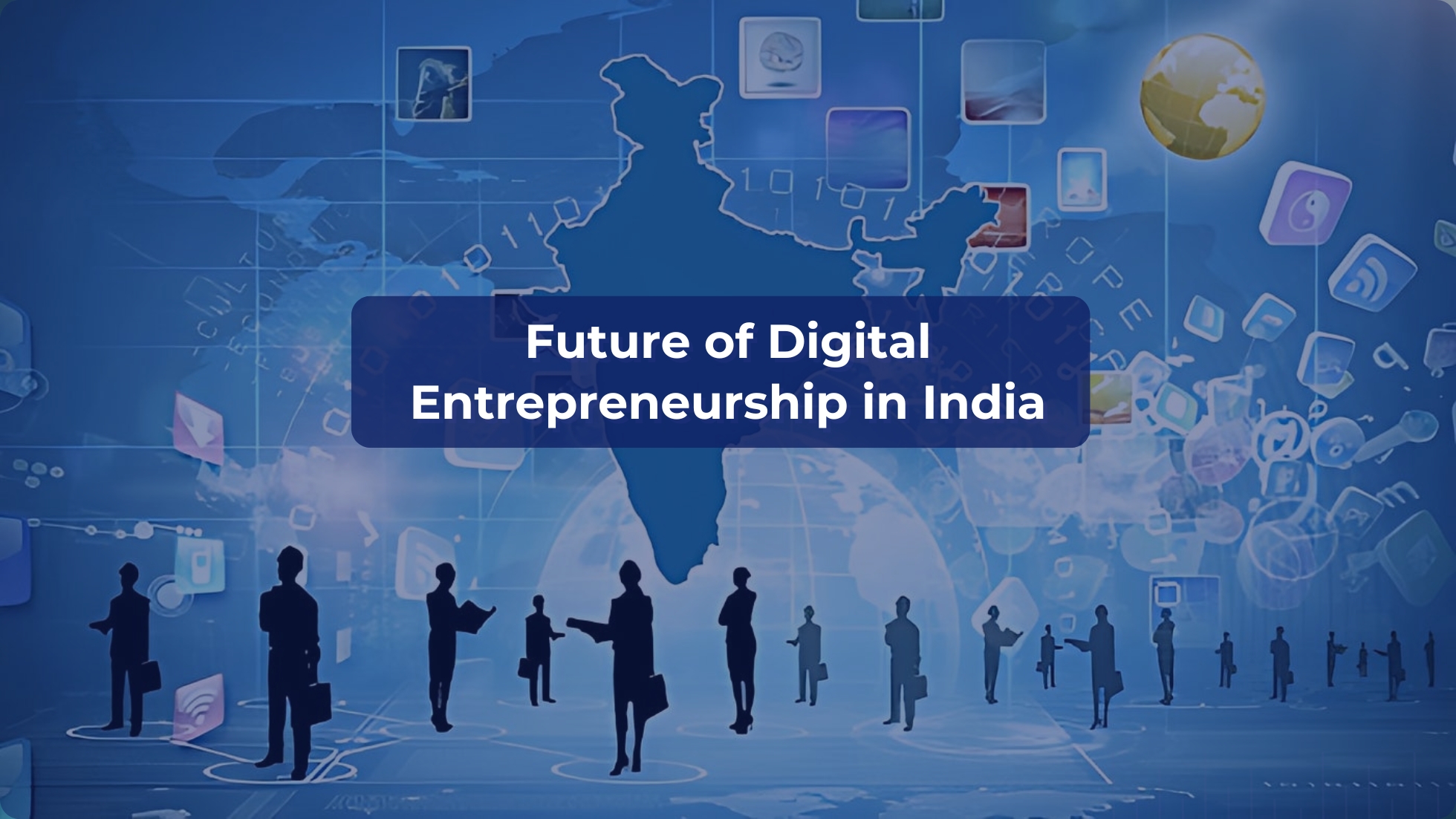
Future of Digital Entrepreneurship in India: 2026 Trends & Insights
Table of Contents
-
Future of Digital Entrepreneurship in India: 2026 Trends & Insights
- The Macro Shift: From Hype to Hard Returns
- Why "Bharat-First" Products Are the Future
- The AI Revolution: Moving Beyond the Chatbot
- Tapping into the $1.4 Trillion Opportunity: The SME and MSME Backbone
- Navigating the New Regulatory Landscape
-
Key Verticals Shaping 2026 and Beyond
- What Is Digital Entrepreneurship?
- Some of the most important Digital Entrepreneurial sectors.
- Creation and Content Creator Economy.
- Indian Digital Entrepreneurship Opportunities.
- The difficulty of being a digital entrepreneur.
- Digital Entrepreneurial Trends in the Future.
- India How to Start a Digital Business.
- Conclusion
- Faq's
The era of growth-at-all-costs is fading. For the Indian digital entrepreneur, 2026 has dawned with a new, more grounded reality. The questions are no longer just about scale, but about sustainability, intelligence, and profitability . With a market of 1.4 billion consumers that behaves like a federation of distinct micro-economies, the path to success is complex . However, for those who can navigate this landscape, the opportunities are boundless. This blog post explores the critical shifts defining the future of digital entrepreneurship in India, from the rise of agentic AI to the imperative of hyper-personalization.
India is going through one of the most thriving digital changes in the world. The past ten years have been marked by a fast increase in internet access, use of smartphones, electronic payment, and online applications within the country. These changes are not only transforming the way people communicate and consume what they are also transforming the way businesses are built and worked.
Startup Growth Guide for India
India has seen the emergence of the digital economy that has paved the way to a new breed of entrepreneurs. Today, any person who has access to the internet, has a digital capability and a good idea can simply begin an online business anywhere within the country. In small towns and big metropolises, thousands of people are starting digital businesses and surfing on business opportunities on the Internet in India.
Taxation for Startups: A Practical Guide for Indian Entrepreneurs
Online entrepreneurship is emerging as one of the greatest economic developmental powers. Indian startups in the new technology industry are developing platforms, software applications, markets and digital services that are used by millions of customers worldwide. The change is transforming industries, generating employment, and facilitating innovation in industries.
AI in Digital Marketing Future Trends
The Macro Shift: From Hype to Hard Returns
The Indian startup ecosystem is undergoing a significant “reset.” Investors and market leaders are moving away from vanity metrics and focusing on execution and return on equity (ROE) . The frothy days of unlimited capital are over; in a market where capital is expensive, demonstrating a clear path to profitability is no longer optional—it is the price of admission . For digital entrepreneurs, this means building businesses with disciplined data strategies and a laser focus on unit economics from day one.
Why “Bharat-First” Products Are the Future
For years, digital products were built for the English-speaking, urban elite. The future of digital entrepreneurship in India lies in penetrating the “Bharat” market—the vast, diverse, and digitally hungry Tier-II and Tier-III cities . With the proliferation of low-cost data and smartphones, these consumers are coming online, but they demand relevance in their language and cultural context.
Startup India Program
AI is the key that unlocks this potential. It enables entrepreneurs to build and scale products in native languages, catering to local nuances in education, entertainment, and finance . The old playbook of a one-size-fits-all strategy is dead. The new winners will be those who build for India’s complexity, not in spite of it .
The AI Revolution: Moving Beyond the Chatbot
Artificial intelligence is the central pillar of the new entrepreneurial landscape. But in 2026, the conversation has shifted from experimental “copilots” to tangible, workflow-altering automation .
https://digitalstartupindia.com/category/startup-india-government-schemes/
Agentic AI and the Middle Office Revolution
AI is no longer just a front-end chatbot. It is moving into the “middle office”—the critical workflows that define a company’s efficiency. We are seeing AI that can underwrite loans, automate complex compliance tasks like KYC/AML, detect sophisticated fraud patterns, and even act inside enterprise software to complete tasks . For a digital entrepreneur, this means you can build leaner, more efficient operations that were previously only possible for large corporations.
The Data Imperative
AI is only as good as the data it’s built on. As VCs and industry leaders point out, shallow datasets lead to AI “hallucinations” and unreliable outputs . The future belongs to entrepreneurs who treat data as their most valuable asset. This means adopting strict “zero sheets” policies (eliminating scattered Excel files) and building proprietary, domain-specific datasets that can power reliable, customer-facing AI tools .
Tapping into the $1.4 Trillion Opportunity: The SME and MSME Backbone
A massive, often overlooked, opportunity for digital entrepreneurs lies in serving India’s 60+ million Micro, Small, and Medium Enterprises (MSMEs) . These enterprises contribute nearly 30% to India’s GDP but are often underserved by technology .
The future of digital entrepreneurship in India is bright for those building for this sector. We are seeing the rise of “AI-powered CFOs” for SMBs, automating accounting, tax, and treasury functions . The goal is to provide small business owners with enterprise-level precision without the associated costs. Whether it’s through platforms like the ONDC for digital commerce or SaaS products for inventory and compliance, the “tech-enabled MSME” is a massive growth frontier .
Navigating the New Regulatory Landscape
As AI becomes pervasive, so does the scrutiny. The Indian government has introduced stringent amendments to the IT Rules, mandating that all AI-generated content be visibly and permanently labelled with metadata .
For digital entrepreneurs, especially those in content, media, and SaaS, this means “compliance by design” is no longer a choice. Building platforms that can automatically detect deepfakes, label synthetic media, and maintain clear audit trails is now a core feature, not an afterthought . While this adds a layer of complexity, it also builds trust with users and regulators, separating serious, durable businesses from fly-by-night operators.
Key Verticals Shaping 2026 and Beyond
Let’s look at a few sectors where the future of digital entrepreneurship in India is most vibrant:
Personalised Finance: With the Account Aggregator framework and AI, we are moving towards “a relationship manager for every Indian.” Startups can now offer hyper-personalised loans, dynamic pricing, and real-time financial advice .
Quick Commerce (Q-Commerce): Speed is becoming the organising principle across services, from 10-minute grocery delivery to rapid diagnostics and healthcare. This trend is injecting trust and transparency into fragmented, informal markets .
Manufacturing and Deep Tech: Indian entrepreneurship is moving beyond pure software. With a government push on AI, semiconductors, and quantum missions, we are seeing a rise in startups focused on high-value creation, design, and advanced manufacturing for global supply chains .
Content and “Glocal” Engagement: For content creators, the future is “glocal”—global platforms serving hyperlocal audiences. AI tools are helping produce regional content faster, but authenticity and community remain the ultimate moats in a sea of synthetic media .
The digital entrepreneurship of India looks very bright in the future. Digital innovation is being driven faster by government efforts, the rising startup scene, more venture capital, and an enormous youth base. This is the best season to venture into online entrepreneurship in India and be part of the fast-growing Indian start up ecosystem that is currently transforming.
This article will be discussing the rise of digital entrepreneurship in India, the nature of areas that are fostering innovation, and what is in store for the entrepreneurs and startups in the digital era.
What Is Digital Entrepreneurship?
Digital entrepreneurship is an invention and management of businesses through the application of digital technologies, online platforms and internet tools. Digital businesses use websites, mobile applications or digital platforms as the main way of carrying out business unlike the conventional businesses that rely on physical location and offline business.
Digital entrepreneurship in India is a concept that has been increasing at a high rate because technology has been easily usable and affordable.
Comparison of Traditional Business and Digital Business.
Conventional business is one that is usually tangible, in terms of physical shops, offices, and face to face customer relations. They demand huge capital investment and infrastructure.
On the contrary, digital businesses have a number of advantages:
Lower startup costs
Global market access
Flexible operations
Faster scalability
Data-driven decision making
Due to such advantages, most business persons currently tend to start digital businesses in India compared to the conventional ones.
Digital Businesses are examples.
Digital entrepreneurship may be of many varieties. Examples of some of the more popular ones are:
Businesses that electronically sell products online.
Marketing agencies that offer marketing services to brands digitally.
Software product startups that sell their products on a subscription basis.
Producers and influencers who make money through the Internet.
Online learning platforms which offer online learning.
Such types of businesses show how the internet has changed the manner in which business persons conduct the construction of companies.
Digital Economy Development in India.
The digital economy in India is growing at an alarming rate and is likely to make a massive contribution to the GDP of this country in the near future. There are a number of forces that are increasing the online entrepreneurship in India and the startup ecosystem India.
Raising Internet Penetration.
India has a high number of internet users in the world. There are millions of new internet users annually that form a huge digital market place.
Key developments include:
Mobile internet penetration.
High-speed internet access at a reasonable price.
Highly increased users of smartphones.
This increasing population of the digital world provides an opportunity to the business owner to start an online business and establish contact with a large audience.
Smartphones and Data at a Low Price.
The democratic smartphones and affordable data plans have significantly contributed to the digital transformation in India.
The Internet has become cheaper than ever before by telecom companies. Thus, electronic services with the help of e-commerce, streaming platforms, and online education are becoming a part of everyday life.
This change has increased the rate of digital startups and has motivated entrepreneurs to create new online platforms.
How to Use the Startup India Portal: From Registration to Growth
Government Digital Initiatives.
The government has launched a number of programs to help with digital innovation and entrepreneurship.
Two major programs include:
Digital India Initiative
Digital India initiative aims at enhancing digital infrastructure, digital literacy and the encouragement of online services in the country.
Startup India Program
Startup India program assists business people by:
funding opportunities
tax benefits
mentorship programs
startup incubation centers
Such efforts are making the Indian startup ecosystem stronger and increasing the number of people who start a business based on technology.
Rise of Digital Payments
The implementation of digital payment platforms like UPI has changed the financial transactions in India.
Benefits include:
instant payments
secure transactions
simplified online commerce
New online businesses are being facilitated in India through this financial infrastructure and digital platforms are also being empowered.
Some of the most important Digital Entrepreneurial sectors.
There are a number of industries that are contributing significantly towards the future of digital entrepreneurship in India.
E-Commerce and Online Retail
The e-commerce sector is among the growth rate leaders in the digital economy in India.
The online markets enable business people to be able to sell their products directly to consumers without necessarily having to open physical shops.
The potential opportunities in this industry are:
online retail stores
niche product marketplaces
direct-to-consumer brands
dropshipping businesses
Numerous thriving online companies began as small online shops and eventually evolved into massive brands.
Online Services and outsourcing.
The demand on digital services has become enormous due to the emergence of remote work.
Businesses across the globe are getting services of freelancers and agencies.
The most popular online service opportunities are:
web development
mobile app development
digital marketing
graphic design
business consulting
These services are highly skilled and do not need much initial investment.
EdTech and Online Learning
The other significant source of digital business trends in India is education technology.
Online learning is changing the way education is provided in that it is making courses available to millions of students.
The opportunities within this sector will be:
online course platforms
skill training programs
tutoring services
professional certification studies.
The startups in the field of EdTech are assisting individuals in acquiring new skills and creating better career opportunities.
Financial Technologies and Digital Payments.
The financial services industry is being transformed by such firms as financial technology.
FinTech startups are coming up with solutions to:
digital payments
lending platforms
wealth management tools
financial analytics
These technologies are making finance more accessible and are establishing new markets.

Creation and Content Creator Economy.
The creator economy is expanding very fast in India.
Millions of creators are gaining their audiences using platforms like:
YouTube
social media platforms
podcasts
blogging platforms
Creators sell their audiences:
advertising
brand partnerships
digital products
community memberships
This industry is establishing a new generation of India.
Digital Innovation Role of Startups.
The innovation in India is driven by startups in the digital economy.
There are numerous technology startups in India that are creating new platforms and tools that will address real-world problems.
Examples include:
Business software companies that are SaaS.
Intelligent AI-powered startups.
e-commerce between consumers and vendors.
supplies chain enhancement by logistics technology firms.
Startups introduce agility and creativity in the market. They test new things, develop new solutions and disrupt traditional industries.
Venture capital firms, incubators, and the innovation hubs have contributed to the Indian startup ecosystem significantly growing.
This has led to the existence of thousands of digital startups in India.
Indian Digital Entrepreneurship Opportunities.
Online business in India has immense opportunities in the future that entrepreneurs will access.
There are a number of new areas that are capturing new founders and investors.
AI-Powered Startups
The field of artificial intelligence is changing the healthcare, financial, marketing, and customer care industries.
Business people are developing AI applications in:
data analysis
automation
predictive insights
customer support
These are the technologies that are defining the future generation of technology startups India.
Remote Service Businesses
Remote services enable entrepreneurs to attend to customers anywhere in the world without having offices.
Examples include:
software development services.
digital consulting
online coaching
marketing agencies
These are extremely scalable businesses that are profitable.
Online Marketplaces
Buyers and sellers are linked in the marketplaces using digital platforms.
Examples of popular marketplace models are:
freelance platforms
product marketplaces
service marketplaces
These networks help entrepreneurs to generate value through networking.
Digital Consulting
Companies are using online strategies to expand on the web.
Digital advisors assist companies in:
digital transformation
marketing strategies
data analytics
technology implementation
The experienced professionals have a lot of opportunities in this field.
Creator Economy Platforms
The creator economy is still growing with more individuals developing personal brands over the Internet.
Entrepreneurs are creating platforms which are helping creators with:
monetization tools
interaction aspects with the audience.
online platforms of products.
This industry will keep on increasing with the rise in online communities.
The difficulty of being a digital entrepreneur.
There are various challenges that digital entrepreneurs experience despite the opportunities.
Intense Competition
The barrier to entry is low and thus most individuals begin installing businesses in the digital world that increases competition.
To be successful, entrepreneurs need to distinguish their products and services.
Funding Challenges
Startups are more often than not challenged when trying to get funding at an early stage.
Many founders rely on:
bootstrapping
angel investors
venture capital
Availability of funds can make the difference between the speed of business expansion.
Digital Marketing Costs
Advertising and marketing campaigns through the internet are costly.
Companies have to be cautious when planning their marketing programs to reap good returns.
Regulatory Issues
Created regulations on data privacy, financial services and digital platforms may pose a challenge to compliance.
Entrepreneurs have to be aware of the legal requirements.
Technology Infrastructure
Online companies require sound technology infrastructure.
Technical problems like server failure or cyber attacks may affect operations.
The entrepreneurs need to invest in safe and scalable technology systems.

Digital Entrepreneurial Trends in the Future.
The future of digital entrepreneurship in India will be under several trends that are emerging.
Businesses were run by Artificial Intelligence.
AI technology is making businesses automated and enhancing customer experiences.
Examples include:
AI chatbots
predictive analytics
automated marketing tools
AI will keep changing digital businesses.
Web3 and Blockchain Startups
Web3 is developing decentralized systems that are establishing alternate systems of forming online communities and financial systems.
Examples of use of blockchain startups include:
finance
supply chain management
digital identity
smart contracts
Creator Economy Growth
The creator economy is growing because the number of people establishing digital brands is growing.
The creators will keep gaining more and more significance on platforms.
Remote-First Companies
Teleworking is becoming a part of the contemporary businesses.
Business people are establishing firms that have fully distributed teams and international customers.
Global Digital Services
The Indian entrepreneurs are also offering digital services to foreign clients more and more.
This is a tendency that enhances the image of India as a technology hub in the world.
India How to Start a Digital Business.
The initiation of a digital business is something that has to be planned and executed carefully.
Step 1: Find a Digital Niche to profit.
Determine market demand for research and identify issues that require solutions.
Select an area of niche you are familiar with or skilled in.
Step 2: Build Digital Skills
Acquire the knowledge of the basic digital skills including:
marketing
technology development
business strategy
analytics
The skills will assist the entrepreneurs to run digital business.
Step 3: Create a Business Plan
Formulate a proper strategy that includes:
target market
revenue model
marketing strategy
growth goals
A good business plan enhances success.
Step 4: release a Website or Platform.
The basis of your online enterprise is your site or platform.
Focus on:
user experience
performance
security
Step 5: Adopt Digital Marketing Strategies.
Marketing is a very vital aspect in business development.
Strategies, which may work, are:
search engine optimization
social media marketing
content marketing
email marketing
Step 6: Technology Scaling of the Business.
Automation and technology tools can be used to expand the operations of your business as you grow.
This will enable the entrepreneurs to reach more people and be more productive.
Conclusion
Digital entrepreneurship in India is poised to bring in exciting opportunities in the future. The fast pace of technological improvement, increased internet penetration, and favorable government programs are providing a platform in which digital business is able to flourish.
The Indian startup scene is in the process of growth, which is drawing in entrepreneurs, investors, and innovators nationwide. The opportunities of online business in India will only keep growing as the number of digital platforms and the emergence of new technologies grow.
To any budding entrepreneur, innovation, flexibility, and everlasting learning is the main ingredient to success. With the use of digital solutions, the development of solid networks, and awareness of market demands, entrepreneurs will be able to develop businesses that will engage millions of users.
Digital entrepreneurship is not only a fad, but it is defining the future of work, innovation and economic development in India.
It is the right moment to consider entrepreneurship on the Internet in India and join the new generation of online innovators.

Empowering India’s Entrepreneurs Through AI-Driven Education and Innovation.
Faq’s
What is digital entrepreneurship in India?
Digital entrepreneurship refers to creating businesses using digital platforms, online tools, and internet technologies.
Why is digital entrepreneurship growing in India?
Factors such as internet penetration, affordable data, and government startup initiatives are driving growth.
What are examples of digital businesses?
Examples include e-commerce stores, SaaS startups, digital marketing agencies, and online education platforms.
How can beginners start digital businesses?
Beginners can start by learning digital skills, identifying a niche, building a website, and using online marketing strategies.
What sectors offer opportunities in digital entrepreneurship?
E-commerce, fintech, edtech, digital services, and creator economy platforms offer strong opportunities.