Categories
Recent Posts




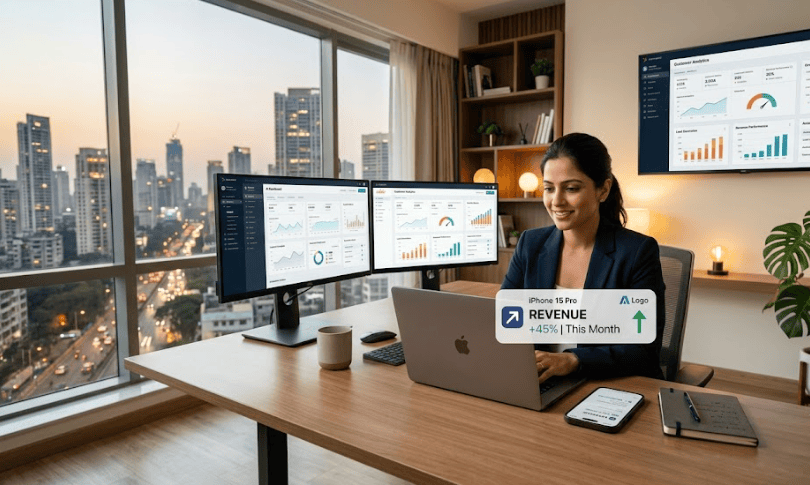
Table of Contents
The Solopreneur Economy: Why One-Person Startups Win
Introduction
A decade ago, launching a startup almost always meant building a team before building a business.
Founders searched for co-founders, hired developers, brought in designers, outsourced marketing, and assembled sales teams, often before validating whether customers even wanted the product. Success was frequently measured by the size of a company's workforce as much as its revenue.
That assumption is quietly disappearing.
Today, a growing number of founders are building profitable businesses without hiring dozens of employees. Some are running software companies with only one or two people. Others are operating e-commerce brands, consulting firms, media businesses, and AI-powered SaaS products almost entirely on their own. What once required an office full of specialists can now be managed with cloud software, automation, and artificial intelligence.
This shift has given rise to what many entrepreneurs now call the solopreneur economy, a new generation of businesses built around leverage rather than headcount.
The idea isn't that every successful company should remain a one-person operation forever. Instead, it reflects a broader change in how businesses are created. Entrepreneurs are proving they can validate ideas, generate revenue, and build sustainable companies long before hiring their first employee.
For aspiring founders, that changes one of the biggest assumptions about entrepreneurship: you no longer need a large team to build something meaningful.
The Traditional Startup Playbook Is Being Rewritten
For years, startup culture followed a familiar pattern.
Raise funding.
Build a team.
Scale quickly.
Hire aggressively.
Growth often came before profitability, with many startups prioritising market share over sustainable business fundamentals. During the years of abundant venture capital, this approach became almost an industry standard.
Today's environment looks very different.
Investors have become more disciplined, funding cycles have become more selective, and founders are under increasing pressure to demonstrate efficient use of capital. Companies are expected to generate revenue sooner, manage costs carefully, and prove that customers genuinely value their products.
This changing landscape has encouraged entrepreneurs to rethink how businesses should grow.
Instead of hiring ten people to accomplish ten tasks, founders are increasingly asking a different question:
What can technology accomplish before I hire another employee?
That simple shift in thinking is redefining how startups are built. Data highlights how massive this shift has become, with Forbes reporting that millions of nonemployer businesses now collectively generate over a trillion dollars in economic output.
Why the Solopreneur Economy Is Growing
The rise of one-person startups is not being driven by a single technology or business trend.
It is the result of several major changes happening simultaneously.
Cloud computing has reduced infrastructure costs.
No-code platforms have made software development more accessible.
Digital payments have simplified transactions.
Remote work has expanded access to global customers.
Artificial intelligence has accelerated productivity across almost every business function.
Together, these developments have dramatically lowered the cost of entrepreneurship.
The solopreneur economy is growing fast because advanced digital tools let a single person build a highly profitable business with very low overhead costs. Unlike massive corporations, one-person startups can pivot instantly, make rapid decisions, and build deeply personal connections with their audience without getting bogged down by office politics or heavy management layers. Aspiring solo business owners can pick up critical building blocks from curated lists like 20 Profitable Business Ideas in India, proving that sharp execution and clear market validation matter far more than the size of your team.
Tasks that previously required specialised departments can now be completed using affordable software subscriptions or AI-powered tools.
A founder launching a new business today can build a website without writing code, create professional branding in a matter of hours, produce marketing content with AI assistance, automate customer support, manage accounting through cloud platforms, analyse customer behaviour using affordable analytics tools, and even sell products globally from a laptop. None of this eliminates the need for expertise, but it fundamentally changes how entrepreneurs access it. Instead of hiring full-time specialists from day one, founders can rely on a combination of software, automation, freelancers, and strategic partnerships until the business reaches a stage where permanent employees become essential.
AI Has Become the Ultimate Business Partner
Artificial intelligence is often described as a productivity tool.
For solopreneurs, it has become something much more significant.
It functions as a research assistant, marketing strategist, copywriter, customer support representative, programmer, translator, analyst, and brainstorming partner, all available on demand.
While AI cannot replace strategic thinking or industry expertise, it significantly reduces the amount of repetitive work required to build and operate a business.
Consider the responsibilities that traditionally consumed a founder's time.
Writing emails.
Preparing proposals.
Analysing spreadsheets.
Creating presentations.
Responding to customer queries.
Producing marketing content.
Researching competitors.
Many of these activities can now be completed faster with AI-assisted workflows, allowing entrepreneurs to spend more time on product development, customer relationships, and business strategy.
The result is not fewer responsibilities.
It is greater leverage.
The most successful solopreneurs are not necessarily working fewer hours, they are accomplishing more within the same number of hours.

Small Teams Often Move Faster
One of the biggest misconceptions in business is that larger organisations always outperform smaller ones.
In reality, every additional employee introduces greater complexity.
More meetings.
More approvals.
More communication.
More coordination.
Decision-making slows as organisations grow.
Solopreneurs operate differently.
Ideas can be tested immediately.
Pricing can change overnight.
Products can be updated without multiple layers of approval.
Customer feedback reaches the decision-maker directly.
This agility allows many small businesses to adapt far more quickly than larger organisations burdened by internal processes.
Speed has become a competitive advantage in markets where customer expectations, technology, and competition evolve rapidly.
For many startups, the ability to experiment quickly is more valuable than having a large workforce.
The Businesses Best Suited for Solopreneurs
Not every company can be built by one person.
Manufacturing businesses, logistics companies, hospitals, large retail chains, and infrastructure projects naturally require sizable teams and complex operations. However, many modern businesses, including SaaS products, digital agencies, consulting firms, online education platforms, creator-led businesses, AI-powered software tools, digital product marketplaces, and personal branding ventures are well suited to the solopreneur model. What these businesses have in common is low operational overhead and the ability to scale through technology, systems, and expertise rather than a large workforce. That doesn't make them easier to build; it simply means founders can focus on proving demand first, with hiring becoming a consequence of business growth rather than its starting point.
The Biggest Myth About Solopreneurship
The term solopreneur often creates the impression of someone working entirely alone handling every task, wearing every hat, and refusing outside help.
In reality, successful solopreneurs rarely build businesses in isolation.
They simply choose a different way of accessing talent.
Instead of hiring full-time employees from day one, they rely on a flexible network of freelancers, consultants, software subscriptions, automation platforms, and specialised agencies. This approach keeps fixed costs low while giving founders access to expertise whenever it's needed.
Think of it this way.
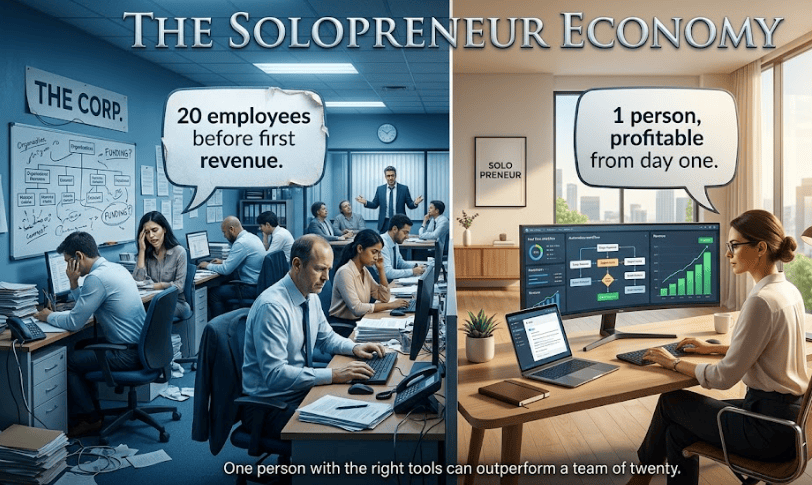
A traditional startup may hire a graphic designer, content writer, accountant, customer support executive, and marketing manager before generating significant revenue.
A modern solopreneur is more likely to use design software, AI writing assistants, cloud accounting tools, automated customer support, and freelance specialists only when a project requires additional expertise.
The result isn't a one-person company doing less.
It's a lean business doing more with fewer permanent resources.
Why Investors Are Paying More Attention to Lean Startups
For years, startup success was often measured by growth at any cost.
Companies raised large funding rounds, expanded teams rapidly, and focused on capturing market share as quickly as possible. Profitability frequently became a secondary objective.
That mindset has changed considerably.
Following a slowdown in global venture funding, investors have become far more selective about where they deploy capital. Rather than rewarding rapid hiring, many now look for businesses that demonstrate capital efficiency, disciplined spending, and sustainable growth.
A startup that generates meaningful revenue with a team of three often attracts more attention than one burning significant amounts of capital with a workforce of fifty.
This doesn't mean investors prefer tiny companies.
It means they increasingly value founders who understand how to allocate resources efficiently before scaling operations.
The solopreneur economy is growing fast because advanced digital tools let a single person build a highly profitable business with very low overhead costs. Solo founders can quickly test out their concepts using frameworks like the ones detailed in the Zerodha Success Story to learn how to scale effectively without relying on massive outside funding. Because of this massive digital shift, recent business data highlighted by the U.S. Chamber of Commerce shows that ultra-lean, one-person startups are launching at record rates and rapidly reshaping the global workforce.
For entrepreneurs, the message is becoming clear: hiring should solve a genuine business need, not serve as a symbol of growth.

When Should a Solopreneur Hire Their First Employee?
One of the most common questions founders ask is whether they should continue operating alone or begin building a team.
There isn't a universal answer, but several indicators suggest it may be time to hire.
You consistently turn away new business because of limited capacity.
Administrative work prevents you from focusing on strategy and growth.
Customer support begins affecting service quality.
Revenue is stable enough to comfortably support long-term salaries.
Specialised expertise becomes essential for continued expansion.
The decision should be driven by business requirements, not by external expectations about what a "real startup" should look like.
Many successful founders spend years operating as solo entrepreneurs before gradually assembling highly specialised teams.
The Future Belongs to Businesses That Use Leverage Wisely
Entrepreneurship has always rewarded people who solve problems efficiently.
Technology is simply changing what efficiency looks like.
In the past, growth often required larger offices, bigger teams, and increasing operational complexity.
Today, technology enables founders to create systems that perform much of the repetitive work once handled by employees.
Artificial intelligence writes first drafts.
Automation manages workflows.
Cloud platforms simplify operations.
Digital payments remove transaction barriers.
Online marketplaces provide global reach.
Together, these technologies allow entrepreneurs to focus their time where it creates the greatest value: solving customer problems, improving products, and making better strategic decisions.
The businesses most likely to thrive over the coming decade won't necessarily be those with the largest workforces.
They will be those that combine human expertise with intelligent technology to deliver exceptional value.
Conclusion
The rise of the solopreneur economy isn't signalling the end of traditional businesses or large organisations.
Instead, it reflects a broader shift in how entrepreneurship begins.
Founders no longer need to spend months assembling teams before validating an idea. They can build products, attract customers, generate revenue, and refine business models with far fewer resources than previous generations of entrepreneurs.
For many, remaining a one-person startup isn't the final destination, it's the smartest starting point.
As artificial intelligence, automation, and digital infrastructure continue to evolve, the businesses that succeed won't necessarily be those that hire the fastest. They'll be the ones that learn the fastest, adapt the quickest, and scale only when growth genuinely demands it.
The future of entrepreneurship may not belong to the biggest teams.
It may belong to the smartest ones.
Faq's
What is a solopreneur?
A solopreneur is an entrepreneur who starts and operates a business independently, often using technology, automation, and external specialists instead of building a large in-house team from the outset.
Can a one-person startup become a successful business?
Yes. Many successful businesses begin as one-person startups. Modern tools for automation, cloud computing, and artificial intelligence allow founders to validate ideas, serve customers, and generate revenue before expanding their teams.
Is a solopreneur different from a freelancer?
Yes. Freelancers typically sell their time or expertise to clients, while solopreneurs build businesses that can grow beyond their personal working hours through products, systems, technology, or scalable services.
Does being a solopreneur mean never hiring employees?
No. Most solopreneurs hire when their business reaches a stage where additional people are necessary. The philosophy is to delay unnecessary hiring until it supports sustainable growth.
Which businesses are best suited to solopreneurs?
Software products, consulting firms, digital agencies, online education platforms, creator businesses, newsletters, digital products, and AI-powered services are among the businesses most compatible with the solopreneur model.
Will AI replace entrepreneurs?
No. AI is more likely to become a productivity multiplier than a replacement. Entrepreneurs who combine creativity, strategic thinking, and customer understanding with AI tools will have a stronger competitive advantage than those relying on technology alone.
A solopreneur is an entrepreneur who starts and operates a business independently, often using technology, automation, and external specialists instead of building a large in-house team from the outset.
Yes. Many successful businesses begin as one-person startups. Modern tools for automation, cloud computing, and artificial intelligence allow founders to validate ideas, serve customers, and generate revenue before expanding their teams.
Yes. Freelancers typically sell their time or expertise to clients, while solopreneurs build businesses that can grow beyond their personal working hours through products, systems, technology, or scalable services.
No. Most solopreneurs hire when their business reaches a stage where additional people are necessary. The philosophy is to delay unnecessary hiring until it supports sustainable growth.
Software products, consulting firms, digital agencies, online education platforms, creator businesses, newsletters, digital products, and AI-powered services are among the businesses most compatible with the solopreneur model.
No. AI is more likely to become a productivity multiplier than a replacement. Entrepreneurs who combine creativity, strategic thinking, and customer understanding with AI tools will have a stronger competitive advantage than those relying on technology alone.