


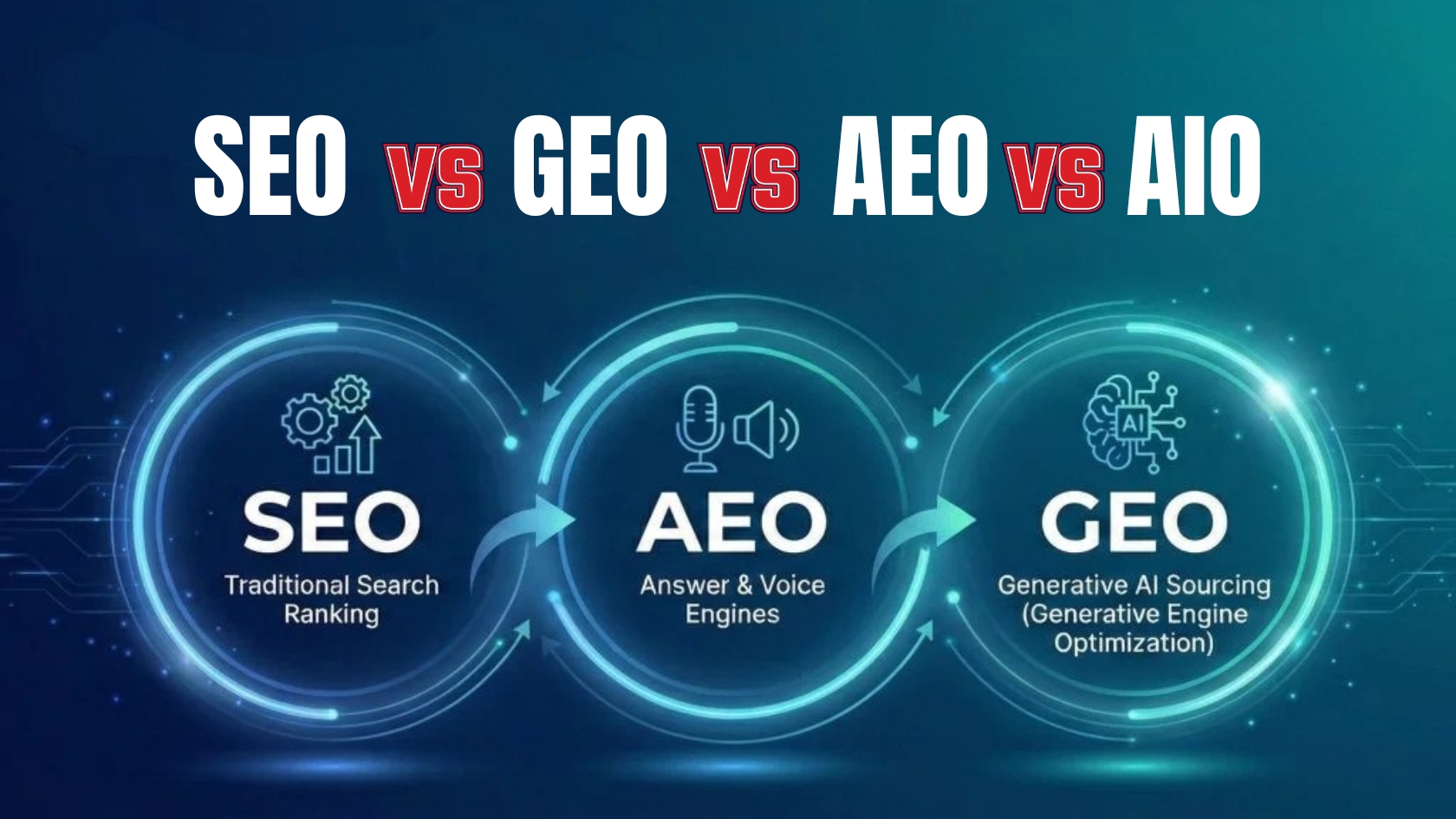
SEO vs GEO vs AEO: The 4 Massive Pillars of Search Optimization in the AIO Era
Table of Contents
-
SEO vs GEO vs AEO: The 4 Massive Pillars of Search Optimization in the AIO Era
- Introduction
- What Is SEO vs GEO vs AEO?
- Understanding Traditional SEO (Search Engine Optimization)
- What Is Generative Engine Optimization (GEO)?
- What Is Answer Engine Optimization (AEO)?
- What Is AI Optimization (AIO)?
- SEO vs GEO vs AEO – Key Differences
- SEO vs GEO vs AEO vs AIO – How They Work Together
- Real-World Examples of Modern Search
- Why GEO and AEO Are Replacing Traditional SEO
- Future of Search 2026 (AIO Era)
- Challenges in SEO vs GEO vs AEO vs AIO
- Comparison Table
- How Businesses Should Adapt
- Conclusion
Introduction
Search is no longer what it used to be. A few years ago, typing keywords into a search engine and scrolling through blue links was the standard way to find information. Today, users expect direct answers, conversational responses, and highly personalized results. This shift has transformed how content is discovered and consumed online.
The debate around SEO vs GEO vs AEO reflects this massive evolution in digital search. Traditional Search Engine Optimization (SEO) is no longer enough on its own. New approaches like Generative Engine Optimization (GEO), Answer Engine Optimization (AEO), and AI Optimization (AIO) are redefining how businesses reach audiences.
From AI-generated answers to voice assistants and chat-based search tools, the landscape is becoming more intelligent and user-focused. Understanding these emerging strategies is essential for anyone looking to stay relevant in the Future of Search 2026.
This article explores each concept in depth, compares their roles, and explains how they work together to shape the next era of search.
What Is SEO vs GEO vs AEO?
The comparison of SEO vs GEO vs AEO represents the transition from traditional search strategies to modern, AI-driven approaches.
SEO
(Search Engine Optimization) focuses on improving website visibility in search engine results pages using keywords, backlinks, and technical optimization.
GEO
(Generative Engine Optimization) is designed for AI-powered platforms that generate answers instead of listing links. It focuses on making content understandable and usable by AI systems.
AEO
(Answer Engine Optimization) targets platforms that provide direct answers, such as featured snippets and voice assistants.
This comparison is important because user behavior has changed. People no longer want to browse multiple pages—they want quick, accurate answers.
The evolution from SEO to GEO and AEO reflects a shift from searching information to receiving answers instantly.

Understanding Traditional SEO (Search Engine Optimization)
Traditional SEO has been the foundation of digital marketing for decades. It focuses on optimizing content to rank higher in search engines like Google.
SEO works through several key components:
Keyword optimization
Backlink building
Technical website improvements
Content relevance
Search engines use algorithms to rank pages based on these factors. The goal is to appear on the first page of search results, where most users click.
However, traditional SEO has limitations in today’s environment. With the rise of AI and zero-click searches, users often get answers directly without visiting websites.
This shift means that ranking alone is no longer enough. Content must now be structured to provide value beyond clicks.
What Is Generative Engine Optimization (GEO)?
Generative Engine Optimization is a new approach focused on AI-driven search systems that generate responses instead of displaying links.
Platforms like ChatGPT and AI-powered search engines analyze large amounts of data to create answers in real time. GEO ensures that your content is included in these generated responses.
Unlike traditional SEO, GEO focuses on:
Context and meaning rather than keywords
Structured and clear content
Authority and trustworthiness
Content optimized for GEO is designed to be easily understood by AI models. This includes using clear explanations, logical structure, and factual accuracy.
As AI-generated search becomes more common, GEO is becoming a critical part of digital strategy.
What Is Answer Engine Optimization (AEO)?
Answer Engine Optimization focuses on delivering direct, concise answers to user queries.
AEO is commonly associated with:
Featured snippets on search engines
Voice assistants like Alexa and Siri
Quick-answer boxes
Instead of encouraging users to click on links, AEO aims to provide immediate answers.
This requires content to be:
Structured in a question-and-answer format
Clear and concise
Easily extractable by search engines
AEO is particularly important for mobile and voice search, where users expect fast and accurate responses.
What Is AI Optimization (AIO)?
AI Optimization (AIO) represents the next stage of search evolution. It focuses on optimizing content for AI-driven ecosystems where personalization and intent play a central role.
In AIO, search is no longer just about keywords or even answers. It is about understanding user intent and delivering highly relevant, personalized content.
AI-driven systems analyze:
User behavior
Context of queries
Preferences and past interactions
This allows them to provide tailored results that go beyond generic answers.
AIO is not a replacement for SEO, GEO, or AEO. Instead, it integrates all these approaches into a unified, intelligent system.

SEO vs GEO vs AEO – Key Differences
Understanding SEO vs GEO vs AEO requires looking at how each approach differs in strategy and execution.
SEO focuses on ranking in search results through keywords and backlinks. GEO focuses on being included in AI-generated responses. AEO focuses on providing direct answers.
The key difference lies in how users interact with content. SEO targets clicks, AEO targets answers, and GEO targets AI-generated summaries.
This shift reflects a broader change in digital behavior—from exploration to instant information.
SEO vs GEO vs AEO vs AIO – How They Work Together
Rather than competing, SEO, GEO, AEO, and AIO represent an evolution of search strategies.
SEO remains important for visibility and website traffic. AEO enhances content for quick answers. GEO ensures inclusion in AI-generated responses. AIO brings everything together through personalization and intelligence.
An integrated strategy combines all four approaches:
SEO for discoverability
AEO for instant answers
GEO for AI integration
AIO for personalized experiences
This combination allows businesses to stay relevant across multiple platforms and user behaviors.
Real-World Examples of Modern Search
Modern search is already showing how these strategies work in practice. Users interact with different platforms depending on their needs.
Google search results with featured snippets providing instant answers
Voice assistants like Alexa and Siri responding to spoken queries
Chat-based tools delivering conversational responses
AI-generated summaries replacing traditional search results
These examples highlight how search is moving toward faster, smarter, and more intuitive experiences.
Why GEO and AEO Are Replacing Traditional SEO
The rise of GEO and AEO is driven by changing user behavior. People now expect quick answers instead of browsing multiple pages.
Zero-click searches are becoming more common, where users get information directly from search engines without clicking on links.
AI-driven systems are also improving rapidly, making it easier to generate accurate and contextual responses.
This shift does not mean SEO is obsolete. Instead, it means SEO must evolve to include new strategies that align with modern search behavior.

Future of Search 2026 (AIO Era)
The Future of Search 2026 will be defined by AI-first experiences. Search engines will become more conversational, predictive, and personalized.
Users will interact with systems that understand context, preferences, and intent. This will reduce the need for manual searching.
Traditional rankings may become less important as AI systems prioritize relevance and accuracy over position.
Businesses that adapt to this change will gain a competitive advantage, while those relying only on traditional SEO may struggle to stay visible.
Challenges in SEO vs GEO vs AEO vs AIO
Despite their advantages, these strategies come with challenges. One major issue is content accuracy. AI systems rely on data, and inaccuracies can lead to misleading results.
AI hallucination is another concern, where systems generate incorrect information. This makes it important to maintain high-quality, reliable content.
Ranking unpredictability is also a challenge. With AI-driven systems, it becomes harder to control how content is presented.
Technical complexity increases as businesses must optimize for multiple platforms and technologies.
Comparison Table
Strategy | Focus | Platform | Key Goal | Optimization Style |
SEO | Keywords & ranking | Search engines | Website traffic | Keyword & backlinks |
GEO | AI-generated answers | AI platforms | Inclusion in responses | Context & clarity |
AEO | Direct answers | Voice & search | Instant answers | Structured content |
AIO | Personalization | AI ecosystems | User intent | Intelligent optimization |
How Businesses Should Adapt
To succeed in this evolving landscape, businesses must rethink their content strategies. Traditional SEO alone is no longer sufficient.
Content should be designed to be:
Clear and structured for AI understanding
Informative and concise for quick answers
Engaging and valuable for users
Multi-platform optimization is essential. Businesses must ensure their content performs well across search engines, AI tools, and voice assistants.
Adapting to these changes requires continuous learning and flexibility.
Conclusion
The evolution from SEO vs GEO vs AEO to AI-driven optimization reflects a fundamental shift in how information is accessed and delivered. Traditional search strategies are no longer enough in a world where users expect instant, personalized answers.
SEO, GEO, AEO, and AIO each play a unique role in this ecosystem. Together, they create a comprehensive approach to modern search optimization.
As we move into the Future of Search 2026, businesses must embrace these changes to remain competitive. The key is not to replace old strategies but to integrate new ones effectively.

Empowering India’s Entrepreneurs Through AI-Driven Education and Innovation.
Faq’s
What is SEO vs GEO vs AEO?
It is the comparison between traditional SEO and modern optimization methods like GEO and AEO that focus on AI-generated and direct answers.
What is Generative Engine Optimization?
GEO is the process of optimizing content for AI systems that generate responses instead of listing links.
What is Answer Engine Optimization?
AEO focuses on providing direct, concise answers for search engines and voice assistants.
What is AIO in search?
AIO stands for AI Optimization, which focuses on personalizing search results using artificial intelligence.
Is SEO still relevant in 2026?
Yes, but it is evolving. SEO must be combined with GEO, AEO, and AIO to remain effective.