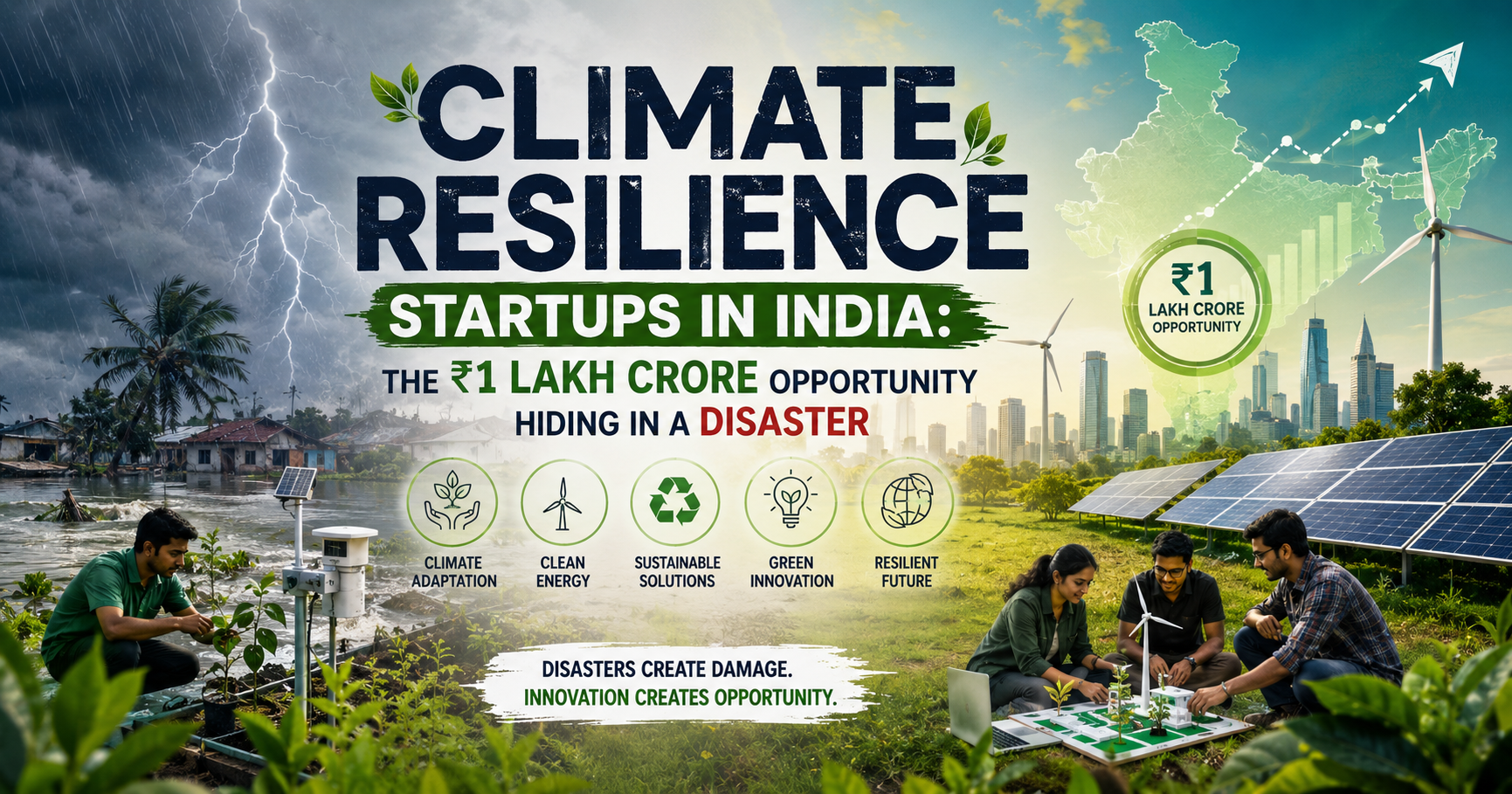
Climate Resilience Startups in India: The ₹1 Lakh Crore Opportunity Hiding in a Disaster
Every founder loves to talk about "disruption." Last week, the Himalayas gave India a reminder of what real disruption looks like — and it had nothing to do with an app.
A glacier collapsed on the China-Nepal border, triggering flash floods that killed hundreds of people, destroyed roads and bridges, wiped out 12 hydropower dams, and left thousands missing. It is one of the deadliest disasters the region has seen in years, and it happened right next door to a part of the world where climate resilience startups in India are quietly becoming one of the fastest-growing categories in tech.
This blog is not about the tragedy itself — it's about what it means for entrepreneurs, business owners, and founders who are building (or thinking of building) in India today. Because behind every disaster like this is a business question nobody wants to ask out loud: is anyone actually building for the risks we already know are coming?
1. What Just Happened in the Himalayas
Here's the short version, in plain language.
On 26 August 2026, a chunk of glacier broke off a mountain on the China-Nepal border. It triggered a landslide, which released a massive wall of water and debris into the valleys below. Villages, roads, bridges, schools, and hydropower stations were destroyed within minutes.
As of the latest reports, more than 470 people are confirmed dead and over 1,500 remain missing across Nepal and Tibet, with Nepal's government warning the final toll could rise further. Nepal's finance minister has estimated the country will need up to $5 billion just to rebuild. At least 18 schools were destroyed and another 20 damaged, affecting roughly 10,000 children. Twelve hydropower dams — representing over 430 megawatts of capacity — were knocked offline overnight.
This wasn't a random freak accident. Scientists have been warning for years that the Himalayas are heating up faster than the global average, glaciers are melting unpredictably, and "once-in-a-century" floods are now showing up every five to ten years.
2. The Real Business Story Nobody Is Talking About
Here's the part that matters for founders: this disaster happened in the middle of the biggest infrastructure building boom the Himalayas have ever seen.
China is constructing a $168 billion megadam on the Yarlung Tsangpo river in Tibet — the largest hydropower project in the world. India's largest state-backed hydropower company is building an 11,200-megawatt dam downstream. Nepal has been adding dam after dam along its Himalayan rivers, often financed by its two much larger neighbours. Add new highways, tunnels, and railways being blasted through fragile mountains, and you get a simple picture: massive capital is flowing into one of the most disaster-prone regions on Earth, often faster than the risk-monitoring systems around it.
That gap — between how fast infrastructure is scaling and how slowly resilience is catching up — is not just a policy problem. It's a market. And markets are exactly where founders should be looking.
3. Why This Is a Wake-Up Call for Every Indian Founder
You don't need to run a hydropower company or a construction firm for this to be relevant to you. Three things about this disaster should matter to every entrepreneur and business owner in India, no matter what you build.
First, climate risk is now a business risk, not just an environmental one. Uttarakhand alone has 1,266 glacial lakes that could behave the same way. Floods, heatwaves, and unpredictable monsoons are already disrupting supply chains, logistics, tourism, and agriculture-linked businesses across India.
Second, early-warning and monitoring systems are still shockingly basic. Even China, with some of the best engineers in the world, could not fully predict this event. That tells you the technology gap here isn't a nice-to-have — it's wide open.
Third, trust and data-sharing are broken, even between governments. Rumours that the flood was caused by a dam burst spread instantly, in the absence of shared, verified data. Any founder building tools around transparent monitoring, verification, or public risk communication has a real problem to solve, not a hypothetical one.
4. The Climate Resilience Startup Opportunity in India
This is where the numbers get interesting for anyone thinking about building here.
India's climate-tech sector has already pulled in $12.8 billion in cumulative funding across 1,583 startups over the last 17 years, according to a 2026 industry report. Annual funding jumped from roughly $315 million in 2020 to $2.6 billion in 2025, and the first five months of 2026 alone saw $791 million deployed across 74 deals. This is not a niche category anymore — it is one of the fastest-growing corners of Indian tech.
But look closer at where that money has gone: renewable energy and energy efficiency dominate, while water and disaster-related technology has attracted only around $208 million of that $12.8 billion. That's a tiny sliver of a very large pie, and it points to a clear white space for climate resilience startups in India that few founders are chasing yet.
Here are the specific sub-sectors worth watching:
Early-warning and monitoring systems. Low-cost IoT sensors and satellite-based monitoring for glacial lakes, rivers, and landslide-prone slopes — the exact gap that made this week's disaster so hard to predict.
Climate risk analytics (B2B SaaS). Tools that help infrastructure companies, insurers, and even other startups model and price climate risk before they build, lend, or insure.
Parametric and climate insurance-tech. Insurance products that pay out automatically based on measurable triggers (rainfall levels, river height, seismic activity) instead of slow manual claims — hugely useful for farmers, small businesses, and infrastructure operators in disaster-prone states.
Disaster logistics and drone-based response. Rapid-deployment supply chains, drone delivery for cut-off regions, and coordination platforms for rescue and relief operations.
Resilient infrastructure materials and design. Construction-tech and materials startups building for flood, landslide, and seismic resistance from day one, instead of retrofitting later.
Transparent public-data platforms. Tools that make climate and disaster data open and verifiable across state or even national borders, reducing the kind of misinformation that spread after this flood.
5. Business Continuity Lessons for Every Startup (Not Just Climate Ones)
Even if none of the above is your business, this disaster is a useful mirror for how prepared your own startup actually is. Ask yourself honestly:
If your primary warehouse, data centre region, supplier, or key local market were suddenly cut off for two weeks, what would happen to your business? Do you have a written business continuity plan, or is it "we'll figure it out"? Is your data backed up somewhere geographically separate from your main office? Have you actually reviewed your business insurance for climate-related disruption, or is it sitting unread in a folder?
Most Indian startups, especially early-stage ones, treat these questions as things "big companies" worry about. The Himalaya floods are a reminder that disruption doesn't check your company's size before it hits.
6. A Practical Disaster-Readiness Checklist for Founders
You don't need a large team or a big budget to start building resilience into your business. Here's a simple starting checklist:
- Map your single points of failure — one supplier, one server region, one warehouse, one city.
- Write a one-page business continuity plan and share it with your core team.
- Back up critical data and documents outside your primary office location.
- Review your business insurance specifically for climate and disaster-related disruption.
- Diversify at least one critical supplier or logistics partner outside your main region.
- Set up a basic early-warning habit — even something as simple as monitoring local weather and disaster alerts for regions your business depends on.
- If you're building in climate-tech, disaster-tech, or insurance-tech, treat this event as real-world validation, not just a news story — the demand gap is measurable and growing.
7. Government Support and Funding Routes
Founders exploring this space in India aren't starting from zero. The Startup India initiative, state-level climate and innovation missions, and dedicated climate-tech funds and accelerators have all been actively backing this sector, which is part of why funding has grown nearly tenfold between 2020 and 2025. If you're building in early-warning systems, disaster-tech, or climate risk analytics, it's worth researching sector-specific grants and blended-finance programs rather than relying purely on private venture capital, since many of these problems sit at the intersection of public good and business opportunity.
8. Final Thoughts
Disasters like the Himalaya floods are tragic, and the human cost is the part that matters most. But if you're an entrepreneur, business owner, or founder in India, it's worth sitting with an uncomfortable truth: the world doesn't wait for your business plan to catch up with its risks. Climate change is compounding what used to be rare, predictable events into recurring ones, and the businesses, tools, and safety nets to handle that simply don't exist yet at the scale needed.
That gap is exactly where founders build. Whether you end up building the next climate resilience startup in India or simply making your own business more disaster-ready, this week's floods are a clear signal that resilience is no longer optional — it's the next big market.