Categories
Recent Posts





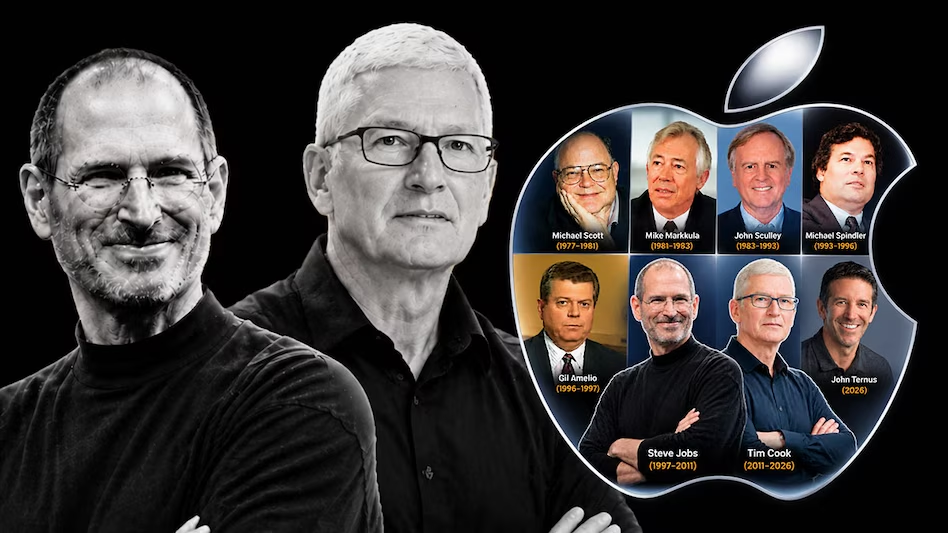
Table of Contents
On 1 September 2026, one of the most successful runs in modern business quietly ended. And it ended not with a press conference, but with an email.
The Tim Cook farewell email to Apple employees was short. It did not talk about the $4.6 trillion valuation. It did not list the iPhone launches. Instead, one nine-word line did all the work — and that single line is the most useful thing a founder can read this month.
If you are building a startup in India, running a small business, or leading a 15-person team out of a coworking space in Bengaluru or Gurugram, this story is not "big tech gossip." It is a free case study in the one thing you cannot buy, borrow, or fundraise your way into.
Let us break down the whole thing in simple language.
What Actually Happened at Apple
Here are the plain facts, without the noise.
Tim Cook stepped down as Apple CEO after 15 years. John Ternus, a 25-year Apple veteran and the company's hardware engineering chief, officially took over on Tuesday, 1 September 2026. Apple had announced this transition back in April 2026, so it was planned — not a crisis.
Cook has not left the building. He moved into the role of executive chairman, where he is expected to handle Apple's relationships with governments and policymakers, especially the delicate US–China equation.
Apple's stock rose about 2.2% in midday trading on the day of the handover. The market treated it as a clean, boring transition. For a $4.6 trillion company, "boring" is a compliment.
And on his final day as CEO, Cook sent a note to employees. That is the Tim Cook farewell email everyone is now quoting.
Suggested image alt text: "Tim Cook farewell email as John Ternus takes over as Apple CEO in 2026"
The 9 Words That Made Everyone Stop
Cook could have written about revenue. He led Apple from roughly $350 billion in value to more than $4.5 trillion. Annual sales went from $108 billion to $416 billion. Profit grew more than four times over.
He wrote about none of that as his proudest achievement.
Instead he said he was most proud of what an annual report could never capture, and then delivered the line: <cite>"This place is proof that culture triumphs over everything."</cite>
Nine words.
Read them again slowly, because there is something sneaky hiding in them. Cook did not say "I built a great culture." He said the place is proof. That is a leader admitting the thing he is proudest of was never fully under his control.
That humility is the most instructive part of the entire Tim Cook farewell email. He inherited a culture built long before him. His job, for 15 years, was to protect it, model it, and not break it.

Why Culture Beats Strategy: The Real Lesson
Here is the uncomfortable truth buried in the Tim Cook farewell email: culture wins whether your culture is good or bad.
Think of it this way.
Your brand is how customers feel about your company. Your culture is how your people feel about your company.
You can control your brand with a marketing budget. You cannot control your culture with a budget at all. Culture is simply the sum of thousands of small moments:
- How you speak to a junior developer at 11 PM when a deploy fails
- Whether you pay your interns on time
- What happens to the person who raises a problem in a meeting
- Who gets promoted, and who quietly gets ignored
- Whether "we are like a family" means support, or means unpaid overtime
None of that appears in a pitch deck. All of it appears in your product.
Culture will beat your best-laid plan. It will beat your policy document. It will beat your Diwali party and your Employee of the Month wall. If your team dreads Monday morning, that dread ships inside your app, your service, and your customer support replies. Your customers can feel it, even if they cannot name it.
This is why other companies make wireless earbuds, but none of them feel quite like AirPods.
Who Is John Ternus, Apple's New CEO?
If you are going to write about, invest in, or build for the Apple ecosystem, you should know the new man at the top.
Quick profile:
| Detail | Information |
|---|---|
| Joined Apple | 2001, product design team |
| Became VP, Hardware Engineering | 2013 |
| Promoted to SVP, Hardware Engineering | 2021 |
| Became CEO | 1 September 2026 |
| Education | University of Pennsylvania |
| Before Apple | Worked on VR headsets at Virtual Research Systems |
| Products he helped ship | iPad, AirPods, Apple Watch, Vision Pro |
| New annual salary | $3 million, plus an equity award targeting $55 million from 2027, mostly tied to stock performance |
Ternus is an engineer, not an operations man. Analysts read that choice as deliberate. Babak Hafezi, professor of international business at American University, told Al Jazeera that the appointment is Apple's quiet way of doubling down on hardware innovation — weaving AI into devices rather than treating AI as a separate product.
Ternus also worked under Steve Jobs and has called Cook his mentor. So Apple has not hired an outsider to "shake things up." It has promoted someone the culture already produced.
His first public test comes fast: he headlines Apple's iPhone launch event this month, with speculation swirling around foldable phones.
The Tim Cook Era in Numbers
Context matters, so here is what Cook actually handed over.
| Metric | Start of Cook's tenure (2011) | End (FY 2025 / 2026) |
|---|---|---|
| Company valuation | ~$350 billion | ~$4.6 trillion |
| Annual sales | $108 billion | $416 billion |
| Annual profit | ~$26 billion | $112 billion |
| Wearables revenue | Did not exist | $35 billion (FY2025) |
| Installed iPhone base | — | ~2.5 billion devices |
The genius here was not a new gadget. It was a business model insight: Apple could keep earning from a customer long after the iPhone was sold. Cook turned 2.5 billion devices into a recurring revenue machine. That Services business, on its own, would be a Fortune 100 company.
That is a lesson worth more than any growth hack. Cook monetised the relationship, not just the transaction.
Christopher Brown of Synovus Securities described it as Cook building a values-driven culture that created a brand loyalty flywheel worth trillions.
What Cook Got Wrong (Honest View)
A good blog does not do hagiography. Cook's record has real dents, and founders learn more from these than from the wins:
- Apple Maps, 2012. Launched badly, months after he took charge. It cost software chief Scott Forstall his job.
- Project Titan. A decade-long electric vehicle project, scrapped in 2024 — right as EVs took off in China.
- Vision Pro. Debuted in 2023 at $3,499. Sales were weak.
- AI and Siri. Apple has visibly lagged. Promised Siri upgrades slipped, and rivals moved faster.
- The "what comes after iPhone?" question. Critics say Cook never answered it.
Brian Mulberry of Zacks Investment Management framed the challenge bluntly: Apple has to prove AI will be more than just an app, and more than Siri.
Notice something, though. Every one of those misses is a product miss. None of them broke the culture. That is precisely why the company survived them — and it is exactly the point the Tim Cook farewell email was making.
Why This Matters Specifically for Indian Startups
This is not a distant American story. It lands directly on your desk.
1. India is now central to Apple's supply chain
Rising US–China tensions, tariffs and supply disruptions forced Apple to reduce single-country dependence. The result: Apple plans for most US-bound iPhones to be made in India by the end of 2026, with AirPods and iPads assembly expanding in Vietnam.
For Indian founders, that means real, measurable opportunity in:
- Component manufacturing and precision engineering
- Logistics, warehousing and last-mile tech
- Quality assurance and compliance software
- Industrial automation and factory-floor SaaS
- Skilling and workforce management platforms
When a $4.6 trillion company relocates production, an entire vendor ecosystem gets built around it. That ecosystem is being built in India right now.
2. The "boring" operations founder can be the best CEO
Cook was not a product visionary. He was a supply chain expert. Indian startup culture over-celebrates the charismatic front-facing founder and undervalues the co-founder who fixes unit economics, vendor contracts and delivery timelines.
Cook's 1,100%+ run is a permanent argument for that second person.
3. Succession planning is not just a big-company problem
Apple announced the change in April and executed it in September. Five months of clarity. No panic, no leadership vacuum, stock up on transition day.
Most Indian SMEs and family businesses — and honestly, most funded startups — have zero written succession plan. Ask yourself: if you were unavailable for 90 days starting tomorrow, who signs off? Who talks to investors? Who holds the culture together?
4. Culture is your cheapest retention tool
You are probably competing for talent against companies that can outpay you. You cannot win on salary. You can win on how people feel at 7 PM on a Wednesday.
That is not a soft benefit. In a market with high attrition, it is a hard financial one.
7 Leadership Lessons for Founders and Business Owners
Distilled from the Tim Cook farewell email and the 15 years behind it:
1. Do not imitate your predecessor. When Cook replaced Steve Jobs, he followed Jobs' own advice — <cite>"Never ask what I would do, just do the right thing."</cite> If you took over a family business, stop trying to be your father.
2. Culture is built in small moments, not offsites. It is the sum of thousands of tiny decisions, and it forms whether you intend it or not.
3. Monetise the relationship, not just the sale. Cook's Services business is the template. What can you sell your existing customer next month?
4. Promote from within when culture matters more than disruption. Ternus spent 25 years absorbing Apple's DNA before he got the top job.
5. Survive your failures publicly. Maps, Titan, Vision Pro. A strong culture absorbs failure; a weak one uses it to start blaming.
6. De-risk your single point of dependency. Apple's China concentration was efficient until it was dangerous. Check yours — one client, one platform, one supplier, one engineer who understands the codebase.
7. Step back to see further. Cook built a strong leadership bench and stayed out of the daily spotlight, which gave him room for strategy and hard decisions. Founders who insist on approving every invoice never get that room.
<a name="checklist"></a>
Your Culture Checklist (Even With 10 Employees)
Do this in the next 30 days. It is free.
- Write down the three behaviours you will not tolerate, and share them with the team
- Identify the person everyone quietly goes to for help — that person is your culture, so protect and reward them
- Run one skip-level conversation with a junior employee, and only listen
- Check whether your last promotion rewarded loudness or contribution
- Document a 90-day continuity plan for your own absence
- Ask three employees what they would change if they were the founder, then actually change one thing
- Stop calling the company a "family." Call it a great team and pay it like one
Final Thoughts
The Cook era is over. Ternus now inherits arguably the most important consumer product company on earth, a hard AI problem, an unfinished manufacturing shift, and a shareholder base with very little patience.
But the most important decisions he will make will not show up in a product roadmap or an earnings call. They will show up in how the people who build those products feel about coming to work every day.
That is the whole message of the Tim Cook farewell email, and it applies just as much to a two-person startup in Ambala as it does to Cupertino.
You are always building a culture. The only question is whether you are building it on purpose.
Over to you: What is the one culture rule you refuse to break in your company? Tell us in the comments.
Frequently Asked Questions (FAQs)
Q1. What did Tim Cook say in his farewell email to Apple employees? In his farewell email, Tim Cook said he was most proud of something an annual report could never capture — Apple's culture. His nine-word line, that the place is proof culture triumphs over everything, became the most quoted part of the note. He also spoke about a shared belief that the work matters and that Apple has a responsibility to leave the world better.
Q2. Who is the new CEO of Apple in 2026? John Ternus became Apple's CEO on 1 September 2026. He joined Apple in 2001, became VP of hardware engineering in 2013 and SVP in 2021. He has worked on the iPad, AirPods, Apple Watch and Vision Pro.
Q3. Why did Tim Cook step down as Apple CEO? Apple announced the planned transition in April 2026 after Cook's 15-year tenure. It was a managed succession rather than a sudden exit. Cook has moved into the executive chairman role, where he is expected to focus on strategy and Apple's relationships with governments and policymakers.
Q4. Is Tim Cook still working at Apple? Yes. Cook is Apple's executive chairman. He will earn $2 million annually effective 26 September, along with restricted stock units in 2027 with a target value of $45 million.
Q5. What is John Ternus's salary as Apple CEO? Apple disclosed in a regulatory filing that Ternus's annual salary was raised to $3 million. He also receives an annual equity award with a target value of $55 million starting in 2027, most of it tied to Apple's stock performance.
Q6. How did Apple grow under Tim Cook? Apple's annual sales rose from $108 billion to $416 billion, and profit grew more than fourfold to $112 billion. Company value went from roughly $350 billion to more than $4.5 trillion. The wearables business alone brought in $35 billion in fiscal 2025.
Q7. What does the Apple CEO change mean for India? Apple has been expanding manufacturing in India to reduce dependence on China. The plan is for most US-bound iPhones to be made in India by the end of 2026. That expansion creates opportunities for Indian startups in components, logistics, automation, quality compliance and workforce skilling.
Q8. What can startup founders learn from Tim Cook's leadership? Three things stand out: build recurring revenue from existing customers instead of chasing only new sales, treat culture as your most durable asset, and plan succession early. Cook also showed that an operations-focused leader can succeed a visionary founder without imitating them.
Q9. What were Tim Cook's biggest failures at Apple? The main ones were the flawed 2012 Apple Maps launch, the electric vehicle project cancelled in 2024, weak sales for the $3,499 Vision Pro headset, and Apple falling behind rivals in AI, including delays in revamping Siri.
Q10. What is the biggest challenge for Apple's new CEO? Artificial intelligence. Analysts say Ternus must prove AI can be more than an app or an upgraded Siri. He also has to keep shifting manufacturing out of China without damaging margins.