Categories
Recent Posts





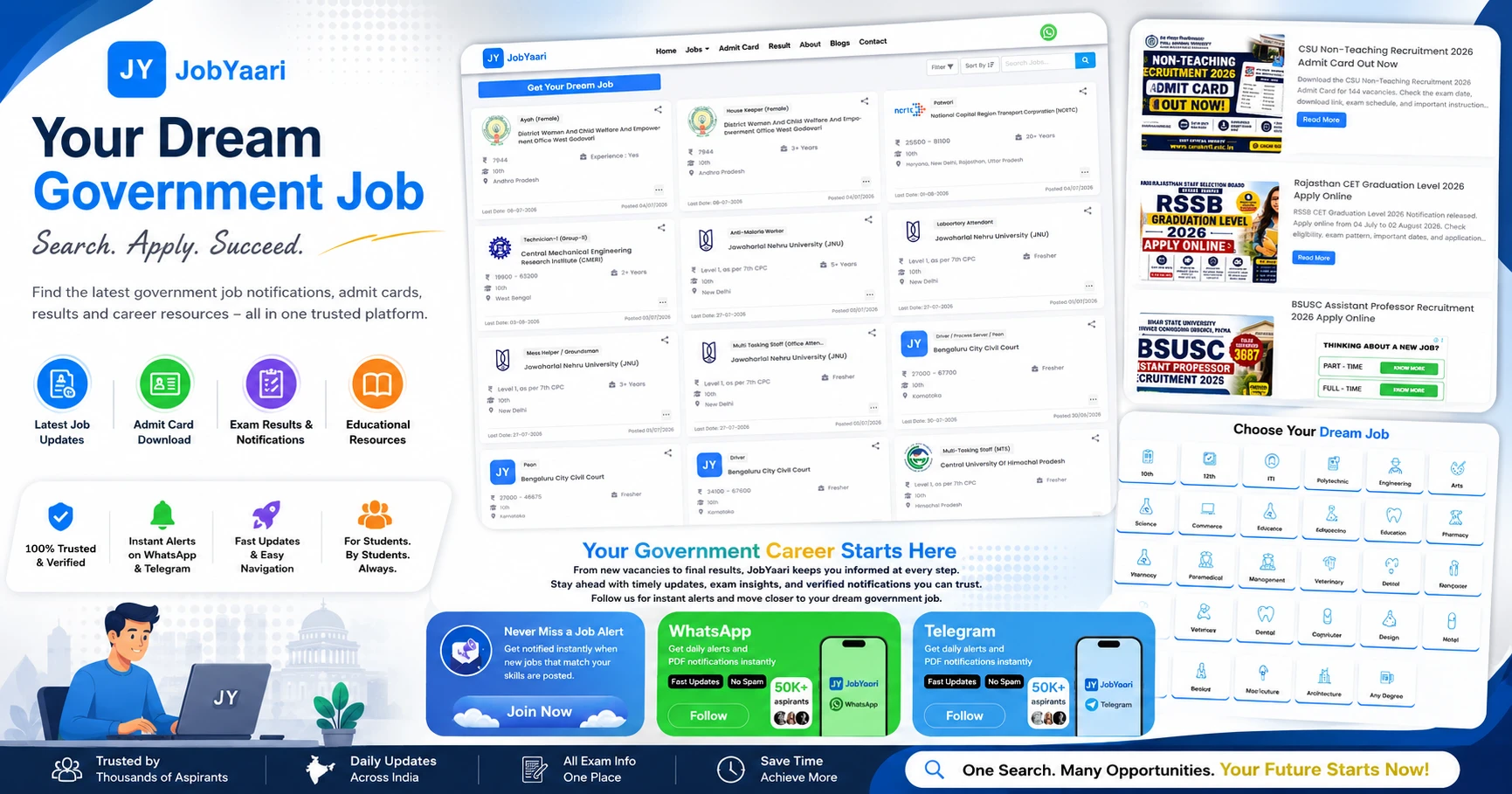
Table of Contents
Business: JobYaari
Website: jobyaari.com
Tagline: Find Your Dream Government Job
Category: Government Job Discovery Platform · Sarkari Naukri Portal · EdTech / GovTech
Social Media: Facebook · Instagram · LinkedIn · YouTube · WhatsApp Channel
WhatsApp Channel: whatsapp.com/channel/0029Vb6ewxeBqbrEjLgEyJ1S
Facebook: facebook.com/people/Jobyaari/61581393329005
Instagram: instagram.com/jobyaari
LinkedIn: linkedin.com/company/jobyaari
Users: 50,000+ aspirants
Job Database: 10,000+ latest jobs
Geographic Coverage: All 28 states + 8 union territories across India
Qualification Coverage: 10th pass to Post-Graduate
Stage: Active growth — established user base, daily content publishing
Time to Read: 15 minutes
Target Reader: Digital product founders, EdTech entrepreneurs, content platform builders,
Sarkari Naukri aspirants, startup founders in media and information platforms
The One-Line Summary
JobYaari is a government job discovery platform built specifically for India's 450+ million government job aspirants — providing verified, daily-updated Sarkari Naukri notifications, admit cards, exam dates, answer keys, and results through a smart-filtered, mobile-friendly platform and WhatsApp channel, serving 50,000+ users in one of the most competitive content verticals on the Indian internet.
The Market — Why Government Jobs Are India's Most Searched Career Category
Before understanding what JobYaari built, you need to understand the size, intensity, and emotional weight of the market it built for.
India's government job market is unlike anything that exists in the developed world.
The numbers are staggering.
Every year, millions of Indians compete for a relatively small number of government positions.
The UPSC Civil Services examination — one of the most competitive exams in the world — receives approximately 500,000 applications annually for roughly 1,000 final selections.
The SSC CGL examination receives over 30 million applications for a few thousand posts.
Railway recruitment notifications routinely attract 10 to 20 million applicants for positions numbering in the thousands.
The competition ratio in Indian government recruitment is not 10-to-1 or even 100-to-1. It is frequently 1,000-to-1, 5,000-to-1, and sometimes 10,000-to-1.
Why do so many Indians compete so intensely for government positions?
The reasons are deeply embedded in India's social and economic structure:
Job security — A government job in India is one of the most secure employment arrangements available anywhere in the world. Dismissal from a confirmed government position is extraordinarily difficult. In a country where private sector employment can be precarious, this security has an economic and emotional value that cannot be overstated.
Social status — In many Indian communities — particularly in North and Central India — a government job is a marker of respectability, social standing, and family honour that private sector employment, regardless of salary, cannot match. The question "kya karta hai?" (what does he do?) in Indian families is most satisfactorily answered with "government job."
Pension and benefits — The 7th Pay Commission salary structures, medical benefits, housing allowances, pension entitlements, and other perquisites of government employment represent a total compensation package that the private sector at equivalent levels rarely matches.
Predictable career progression — Government employment offers clear, transparent, rule-based promotion timelines that remove the uncertainty and political dynamics of private sector career advancement.
The cumulative effect of these factors is a population of aspirants that numbers in the hundreds of millions — including students preparing for government exams for 3 to 7 years after their formal education, parents investing significantly in coaching fees and study materials for their children, and entire coaching ecosystems in cities like Prayagabad, Patna, Jaipur, and Delhi built specifically around government exam preparation.
This is the market JobYaari was built for.
The Problem — India's Government Job Information Is Broken
Despite the enormous demand for government job information, the experience of finding, verifying, and acting on Sarkari Naukri notifications in India is genuinely painful.
Here is what an aspiring government job candidate goes through without a platform like JobYaari:
Step 01 — Discovery
Notifications are published on dozens of different official websites — SSC.nic.in for SSC jobs, RailwayRecruitment.in variants for railway jobs, individual state PSC websites for state government posts, individual department websites for departmental recruitment, bank websites for banking jobs, and defence websites for armed forces recruitment.
Tracking all of these manually is a full-time job.
Step 02 — Verification
Official government websites are often poorly designed, slow to load, inconsistently updated, and difficult to navigate on mobile devices.
Unofficial sources — WhatsApp forwards, social media posts, news websites — frequently publish inaccurate notification details, wrong application deadlines, incorrect eligibility criteria, and sometimes outright fake notifications.
A candidate who acts on inaccurate information risks missing real opportunities or wasting time on invalid ones.
Step 03 — Filtering
A candidate with a B.Sc. Agriculture degree looking for government jobs in Haryana needs to filter out posts requiring engineering qualifications, arts backgrounds, or located in other states.
Without smart filtering, browsing a comprehensive job portal is like searching for a specific fish in an ocean.
Step 04 — Timely action
Government job applications have hard deadlines.
A notification published on a Tuesday with an application deadline the following Friday gives a candidate fewer than four days to find the notification, read it carefully, prepare documents, fill the online application, and submit it before the window closes.
Missing this window — because the notification wasn't seen in time — means waiting for the next recruitment cycle, which could be months or years away.
Step 05 — Exam preparation tracking
After applying, a candidate needs to track exam dates, admit card release, result declarations, and answer key publications — each announced at different times on different official websites.
JobYaari was built to solve every one of these problems in a single, free, mobile-friendly platform.
What JobYaari Built — The Complete Platform Architecture
JobYaari is not simply a job listing website.
It is a comprehensive government career information ecosystem covering every stage of a candidate's journey from discovering a job opportunity to receiving their final result.
Core Feature 01 — Smart Qualification-Based Job Discovery
The most distinctive architectural decision in JobYaari's platform is its qualification-based navigation system — the primary way users discover relevant jobs.
Rather than showing every government job notification to every user and requiring them to manually filter by qualification, JobYaari organises its entire job database around the candidate's educational level:
Pre-Graduate Jobs:
— 10th Pass Jobs — for candidates who completed Class 10 and are eligible for Group D, peon, constable, and similar positions
— 12th Pass Jobs — for candidates who completed Class 12 and are eligible for clerk, LDC, and similar positions
— ITI Jobs — for Industrial Training Institute certificate holders eligible for technical posts
— Polytechnic Jobs — for diploma holders eligible for junior engineer and technical assistant positions
Graduate Jobs:
— Any Graduate — positions open to graduates of any stream
— Engineering — technical and engineering government positions
— Science — positions for BSc, B.Pharma, and related science graduates
— Arts — positions for BA and humanities graduates
— Commerce — positions for BCom, BBA, and commerce graduates
— Medical — positions for MBBS, BDS, nursing, and allied health graduates
— Education — positions for BEd, teaching, and education sector graduates
Post-Graduate Jobs:
— Any Post-Graduate — positions open to postgraduates of any discipline
— Engineering, Science, Arts, Commerce, Medical, Education — subject-specific post-graduate positions
This architecture reflects a deep understanding of how Indian job aspirants actually think about their job search.
An aspirant does not browse "all government jobs" — they browse "government jobs I am eligible for."
By making qualification the primary navigation axis, JobYaari reduces the cognitive load of job discovery to almost nothing.
A candidate knows their qualification. They click it. They see only jobs they can actually apply for.
Core Feature 02 — Job Type Classification
Beyond qualification, JobYaari classifies jobs by sector — the second most important filter for government job aspirants:
SSC / State PCS — Staff Selection Commission central government jobs and State Public Service Commission examinations — the most prestigious non-UPSC government positions, attracting millions of applicants annually.
Railway — Indian Railways is the world's fourth-largest railway network and one of India's largest employers. Railway recruitment notifications attract some of the highest application numbers of any employer in the country.
Teaching — Central and state government teaching positions — TGT, PGT, primary teachers, college lecturers — covering one of India's largest employment sectors.
Police / Army — Constable, sub-inspector, soldier, and officer recruitment across central and state police forces and the Indian Army, Navy, and Air Force.
Banking — IBPS PO, IBPS Clerk, SBI PO, SBI Clerk, RRB Officer, and other banking sector government positions — among the most actively sought positions for commerce and any-graduate aspirants.
Nursing — Government hospital nursing positions — one of the fastest-growing government recruitment categories as India expands public healthcare infrastructure.
This classification allows an aspirant who knows their sector preference — "I want a banking job" or "I want a railway job" — to navigate directly to relevant notifications without browsing irrelevant sectors.
Core Feature 03 — State-Wise Job Discovery
JobYaari's state-wise navigation covers all 28 Indian states and all 8 union territories — from Andaman & Nicobar to West Bengal, from Ladakh to Lakshadweep.
Every state has a dedicated page showing current government job notifications from that state's departments, PSCs, and government bodies.
This geographic comprehensiveness serves two distinct candidate populations:
Home-state aspirants — Candidates who want government jobs specifically in their home state — because state government jobs often carry residency requirements, because family proximity matters, or because candidates prefer to serve in their linguistic and cultural community.
Pan-India aspirants — Candidates who are open to government positions anywhere in India and use the state pages to discover opportunities they might not have been aware of in states where they have not been monitoring notifications.
The inclusion of union territories — Chandigarh, Andaman & Nicobar, Dadra & Nagar Haveli, Daman & Diu, Lakshadweep, Puducherry, Jammu & Kashmir, Ladakh — reflects an attention to completeness that many competing platforms miss.
Core Feature 04 — Admit Card Tracking
The admit card — or hall ticket — is the document that allows a candidate to appear in a government examination.
Without it, you cannot sit for the exam.
Admit cards are released on official websites, typically 2 to 4 weeks before the examination date, and must be downloaded and printed by the candidate before the exam day.
Missing an admit card release means either scrambling to download it at the last minute or, in the worst case, being unable to appear for an examination you spent months preparing for.
JobYaari's dedicated Admit Card section tracks admit card releases across all major government recruitments — notifying users when cards become available and providing direct links to official download portals.
This is one of the most time-sensitive and practically valuable features of any government job platform.
Core Feature 05 — Result Updates
Government examination results are declared on official websites — often without advance notice of the declaration date, at unpredictable intervals after the examination.
A candidate may check an official website dozens of times before a result is declared, wasting time and creating anxiety.
JobYaari's Result section tracks result declarations across central and state government examinations — updating immediately when official results are published and notifying users through the platform and WhatsApp channel.
For a candidate waiting for a result that determines their career trajectory, this timely notification service has genuine emotional and practical value.
Core Feature 06 — The Blog / Information Hub
JobYaari's blog is not a generic content marketing section.
It is a specialised information resource for government job aspirants — covering detailed recruitment notifications, eligibility breakdowns, application process guides, exam date announcements, and result coverage.
Recent blog posts from the live platform demonstrate the depth and timeliness of this content:
CSC Aadhaar Supervisor Recruitment 2026 — 125 posts, eligibility, age limit, last date, application link.
RRB Isolated Categories Exam Date 2026 — CBT scheduled for 14 & 15 July 2026, exam schedule details.
ABVMU CAHET Result 2026 — Direct scorecard download link, merit list, qualifying status, counselling updates.
CGPSC Sub Inspector SI Admit Card 2026 — Hall ticket download link, exam date, required documents.
UPSSSC Forest Guard Recruitment 2026 — 708 posts, PET 2025 requirement, age limit, selection process.
UP Anganwadi Recruitment 2026 — 787 posts, application process, eligibility.
UPSC Recruitment 2026 — 450 posts, application process, notification details.
Each blog post is a complete, actionable guide that a candidate can use to understand exactly what a recruitment notification means, whether they are eligible, how to apply, and what to expect.
This content serves both immediate utility — giving candidates the information they need to act — and long-term SEO value — appearing in Google search results when candidates search for specific recruitment notifications by name.
Core Feature 07 — WhatsApp Channel Integration
JobYaari's WhatsApp Channel — with 50,000+ aspirants subscribed — is arguably the platform's most powerful distribution mechanism.
The channel promises "Fast Updates, No Spam" — two things that every government job aspirant desperately wants and that most information channels fail to deliver.
The strategic logic of WhatsApp as the primary notification channel for a Sarkari Naukri platform is compelling:
WhatsApp penetration — WhatsApp has over 500 million users in India. It is the dominant mobile communication channel across all age groups, income levels, and geographic areas. An aspirant in a small town in Bihar is as likely to have WhatsApp as an urban professional in Bengaluru.
Pull vs. push notification — Website visitors must actively remember to visit the platform to check for new notifications. WhatsApp delivers updates directly to the candidate's phone — making JobYaari's notifications visible even when the candidate is not actively job-searching.
Zero friction for aspirants — Following a WhatsApp channel requires a single tap. No app download, no account creation, no email subscription. The barrier to joining is the lowest of any notification mechanism available.
PDF sharing capability — Government job notifications are often published as official PDF documents. WhatsApp channels can share PDFs directly — allowing JobYaari to deliver official notification documents to subscribers instantly, rather than just linking to external websites.
Rural and semi-urban reach — Many of India's most active government job aspirants are in Tier-3 cities, small towns, and villages where internet connectivity may be limited to mobile data. WhatsApp's efficiency on mobile networks makes it the most reliable channel for reaching these aspirants.
The "No Spam" commitment is as important as "Fast Updates."
WhatsApp channels that send irrelevant notifications lose subscribers quickly in a user behaviour environment where channel quality is ruthlessly evaluated by aspiring candidates who receive dozens of notifications daily.
The Content Strategy — Why JobYaari Is Built to Win on Google
JobYaari's content architecture is engineered for organic search dominance in a highly competitive vertical.
Understanding this requires understanding how government job aspirants search.
When a candidate sees a newspaper headline about "UPSSSC Lower PCS Recruitment 2026," their first action is to open Google and search for "UPSSSC Lower PCS Recruitment 2026 notification."
The search results page for this query will include the official government website, national newspapers, and a handful of Sarkari Naukri portals that published detailed coverage of the notification.
JobYaari's blog posts are structured to appear in these search results — with complete notification titles as post headings, detailed eligibility and application information in the body, and direct links to official portals.
Each individual recruitment notification is a discrete SEO opportunity.
With thousands of government recruitments published annually across all states and central departments, a platform that consistently covers each notification comprehensively generates thousands of individually ranking pages.
The SEO keywords embedded in JobYaari's meta description reflect a sophisticated understanding of how aspirants search:
"government jobs, latest government jobs, govt jobs, sarkari naukri, government jobs 2026, latest govt jobs, government job notifications, government vacancies, govt recruitment, sarkari result, admit card, government exam updates, india government jobs, central government jobs, state government jobs, railway jobs, bank jobs, defence jobs, police jobs, teaching jobs, engineering government jobs, technical government jobs, government jobs after graduation, government jobs after 12th, government jobs after 10th, upcoming government jobs, free job alert."
This keyword taxonomy covers the full spectrum of how Indian aspirants search for government job information — by sector (railway, bank, defence, police, teaching), by qualification (10th, 12th, graduation), by timing (upcoming, latest), and by content type (notifications, results, admit cards).
A platform that ranks for all of these keyword clusters simultaneously generates compounding organic traffic that does not require paid advertising to sustain.
The Competitive Landscape — What JobYaari Is Up Against
The Sarkari Naukri portal market is one of India's most competitive content verticals.
JobYaari competes against platforms that have been operating for 10 to 15 years with massive established audiences:
FreeJobAlert.com — 12+ years old, described as "India's leading Sarkari Naukri portal," serving millions of users. The dominant incumbent with the deepest content archive and largest organic search footprint.
SarkariResult.com — One of the most-visited websites in India specifically for sarkari results and admit cards. Massive traffic from result declaration queries.
SarkariJob.com — Established portal with comprehensive coverage of SSC, Railways, State Government, and other recruitments.
MySarkariNaukri.com — Operating since 2009 with millions of aspirants served.
FreeJobAlert.com — Operates since 2011 with comprehensive central and state government coverage.
Against these incumbents, JobYaari's differentiation strategy is clear and deliberate:
Smart filtering vs. overwhelming volume — Established platforms often show all jobs in a single undifferentiated stream. JobYaari's qualification-based navigation system filters relevance automatically — showing candidates only what applies to them.
Modern platform design — Older Sarkari Naukri portals often have cluttered, advertising-heavy interfaces that are difficult to navigate on mobile. JobYaari's clean, fast, mobile-first design reflects a modern understanding of user experience that legacy platforms built in 2009–2011 have not fully updated.
WhatsApp-first distribution — Established platforms rely primarily on email subscriptions and direct website visits. JobYaari's WhatsApp channel reflects a recognition that WhatsApp is now the dominant mobile communication channel for exactly the aspirant demographic it serves.
India's 1st job searching portal with lots of filter — JobYaari positions itself explicitly as the most filter-rich government job discovery platform — a claim that speaks directly to the pain point of aspirants overwhelmed by unfiltered notification volumes.
The User Reviews — What 50,000 Aspirants Actually Say
JobYaari's platform features genuine user testimonials that reflect the specific value aspirants receive:
Pratham (4 weeks ago, 4.5/5): "Very helpful platform for government job aspirants. Timely updates."
Karan (4 weeks ago, 4.5/5): "Simple UI and reliable job alerts. Highly recommended."
Ritika (3 weeks ago, 5/5): "Saves a lot of time. Everything is available at one place."
Shivam (3 weeks ago, 5/5): "Reliable job alerts and simple UI. Highly recommended."
Three themes emerge consistently across these reviews:
Time saving — "Saves a lot of time" and "Everything available at one place" reflect the core value proposition: JobYaari eliminates the need to monitor multiple official websites and news sources separately.
Reliability — "Reliable job alerts" and "Timely updates" reflect the trust that aspirants place in JobYaari's accuracy and speed. In a market full of unreliable, delayed, or inaccurate notification sources, consistency and accuracy are genuine differentiators.
Simplicity — "Simple UI" appears in multiple reviews — reflecting the value of a clean, navigable interface in a category where competitor platforms are often cluttered and difficult to use.
The Mission — Four Pillars That Define What JobYaari Is Building
JobYaari's mission statement identifies four foundational commitments that distinguish it from a simple job aggregator:
Empower Every Job Aspirant — Not just urban, educated, digitally sophisticated aspirants. Every aspirant — including those in small towns, those with limited digital literacy, those from disadvantaged backgrounds who face additional barriers to government employment information. This commitment to universal access shapes the platform's design decisions: simple navigation, mobile-first layout, WhatsApp channel distribution, and free access to all content.
Equal Career Opportunities — JobYaari explicitly positions itself as a tool for bridging the information gap between aspirants who have access to coaching institutes, paid subscription services, and urban networks — and aspirants who do not. A candidate in a village in Chhattisgarh should have the same access to accurate, timely government job information as a candidate in a Chandigarh coaching institute. JobYaari's free platform and WhatsApp channel directly serve this equity mission.
Trusted Job Information — Every notification, exam update, and result shared on JobYaari comes from verified, official sources. This commitment to source verification is what separates a trusted platform from a WhatsApp forward — and it is the single most important quality factor in a market where inaccurate information has real career consequences for real people.
Simplify the Job Search — Organising complex government job details into clear, user-friendly formats. Government recruitment notifications are written in official bureaucratic language with dense tables of eligibility criteria, reservation category breakdowns, fee structures, and selection process descriptions. JobYaari translates this complexity into information that any candidate can understand and act on.
The Social Media Strategy — Meeting Aspirants Where They Are
JobYaari's social media presence across Facebook, Instagram, LinkedIn, and YouTube reflects an understanding that aspirants research and verify information across multiple platforms before trusting a source.
Facebook — The primary community platform for the age demographics most represented among Sarkari Naukri aspirants. Government job aspirants share information, ask questions, and support each other through social media communities that are primarily Facebook-based, particularly in North and Central India.
Instagram — The platform where younger aspirants — those who are beginning their government exam preparation immediately after Class 12 or graduation — discover and follow information sources. Instagram content for government job platforms typically includes exam tips, important dates presented visually, and motivational content for aspirants in long preparation cycles.
LinkedIn — Serves the aspiration to professional credibility — positioning JobYaari as a serious career resource, not just a notification aggregator. LinkedIn presence also builds trust with advertisers, partners, and the broader professional ecosystem.
YouTube — The natural extension of a government job information platform into video content — exam guidance, notification breakdowns, application tutorials, and result analysis. The YouTube audience for government exam content in India is enormous: channels dedicated to SSC, Railway, and Banking exam preparation regularly accumulate millions of subscribers.
The Business Model — How a Free Platform Generates Revenue
JobYaari is free for all users — no subscription fees, no pay-per-access content, no premium tiers visible on the current platform.
Understanding how a free information platform in the Sarkari Naukri vertical generates revenue requires understanding the advertising economics of this category.
Display Advertising — High-traffic Sarkari Naukri portals generate substantial revenue through Google AdSense and direct display advertising. The aspirant audience is young, large, and actively engaged — making it commercially attractive for advertisers offering banking products, insurance, mobile recharges, educational courses, and government exam coaching materials.
Affiliate Revenue — Educational platforms offering SSC coaching, banking exam preparation, and government job course materials pay referral commissions to traffic sources. A Sarkari Naukri portal that generates referrals to paid coaching platforms earns commissions on any resulting purchases.
Sponsored Content / Native Advertising — Coaching institutes, test series providers, and educational technology companies advertise within government job information platforms through sponsored posts, banner advertisements, and promoted listings.
WhatsApp Channel Monetisation — As WhatsApp expands its channel monetisation capabilities in India, platforms with large, engaged subscriber bases on WhatsApp channels will have additional direct revenue opportunities.
The economics of this model compound with traffic scale.
At 50,000 active users — a figure that represents early-stage growth in this market — revenue may be modest.
At 500,000 users, or 5 million users, the advertising and affiliate economics become genuinely substantial.
The growth path from 50,000 to 5 million users is a content consistency and SEO compounding problem — one that JobYaari's daily publication schedule and smart SEO architecture are directly addressing.
The Platform Design — Why "Filters" Are JobYaari's Core Competitive Claim
JobYaari's own positioning statement — "India's 1st Job searching portal with lots of filter" — places filtering capability at the centre of its value proposition.
This is not a trivial claim.
The filtering architecture that JobYaari has built addresses the single most painful aspect of government job discovery: relevance filtering.
Consider how many categories a single aspirant needs to filter simultaneously to find relevant jobs:
Qualification filter — Am I eligible based on my education level?
Stream filter — Does my specific degree stream (engineering, arts, science, commerce) qualify?
State filter — Is this job in a state where I want to work?
Job type filter — Is this the sector I want to work in (banking, railway, teaching)?
Category filter — Does my reservation category (General, OBC, SC, ST) affect eligibility?
Age filter — Am I within the age limit for this recruitment?
Application deadline filter — Is this recruitment still open for application?
JobYaari's architecture provides filtering on qualification level, stream, state, and job type — giving aspirants the most relevant subset of government jobs from a database of 10,000+ listings.
This is the "lots of filter" claim in action — and it is exactly what aspirants need.
The 50,000 Aspirant Milestone — What It Actually Represents
JobYaari's claim of 50,000+ aspirants is worth interpreting carefully in the context of the Sarkari Naukri market.
In absolute terms, 50,000 users is a small number relative to the incumbents — established platforms in this space serve millions of users.
But in the context of a new platform establishing itself in a highly competitive market against decade-old incumbents, 50,000 users represents genuine market validation.
More importantly, the quality of engagement matters as much as the quantity.
A Sarkari Naukri platform that has 50,000 highly engaged, regular users — checking daily for new notifications, following the WhatsApp channel, sharing content with friends in similar preparation situations — is building the kind of organic word-of-mouth growth that compounds over time.
Government job aspirants form tight communities.
Preparation groups, study circles, coaching institute batches, village networks where one successful candidate becomes a reference for dozens of others — the social networks of Sarkari Naukri aspirants are dense and trust-based.
A platform that earns genuine trust from one aspirant becomes a recommendation to their entire network.
The path from 50,000 to 500,000 to 5 million users in this market is not primarily about technology or advertising.
It is about consistency of accurate information, speed of updates, simplicity of experience, and the organic trust that compounds when you help someone find and successfully apply for a government job that changes their life.
The Bigger Picture — What JobYaari Is Actually Building
Every case study in this library is ultimately about a founder's belief that something important was missing — and their decision to build it.
JobYaari exists because someone recognised that India's hundreds of millions of government job aspirants — the largest concentrated group of career-focused information seekers in the world — were being served by a combination of cluttered legacy portals, unreliable WhatsApp forwards, paid coaching institutes that filter information to sell courses, and official government websites that are technically functional but practically inaccessible.
The aspiration of JobYaari is explicit in its mission: "bridging the information gap and giving aspirants from all backgrounds equal access to government job opportunities across India."
That is not a marketing statement.
It is a description of a real, persistent, consequential inequality in access to information — and a commitment to reducing it through a free, accurate, well-designed, daily-updated platform that any aspirant in any corner of India can use.
If you are a student in a small town in Haryana or Uttar Pradesh or Bihar whose parents scraped together coaching fees so you could prepare for SSC CGL, and JobYaari's WhatsApp notification arrives on your phone three hours before the official notification link stops working — and you apply in time for a recruitment you would otherwise have missed — the value JobYaari created for you in that moment is immeasurable.
That is what JobYaari is building.
One notification at a time.
For fifty thousand aspirants today.
For five million aspirants tomorrow.
What Every Content Platform Founder Should Take From JobYaari's Story
Lesson 01 — Relevance filtering is the highest-value feature in high-volume information markets.
When the supply of information exceeds a user's ability to process it — which is always true for government job notifications in India — the platform that filters most intelligently wins the most loyal users.
JobYaari's qualification-based navigation is not a feature.
It is the product.
Lesson 02 — WhatsApp is India's most powerful organic distribution channel for information platforms.
Email newsletters have declining open rates.
App push notifications face permission barriers.
WhatsApp channels reach users directly, on the device they check most frequently, through a platform they already use for everything.
A 50,000-subscriber WhatsApp channel is more valuable than a 200,000-email list in the Indian aspirant market.
Lesson 03 — In high-competition content verticals, speed plus accuracy equals trust.
FreeJobAlert and SarkariResult dominate because aspirants have been trusting them for 10+ years.
JobYaari can build that trust in months by being consistently faster and more accurate than those incumbents.
One well-timed, perfectly accurate notification earns more trust than twenty generic updates.
Lesson 04 — The equity mission and the growth strategy are the same thing.
JobYaari's commitment to giving aspirants from all backgrounds equal access to information is not charity — it is the market opportunity.
The aspirants who have been most poorly served by existing platforms — rural, lower-income, low-digital-literacy — are the most numerous, the most loyal when served well, and the most likely to refer others in their network.
Serving the underserved is both the right thing to do and the largest growth opportunity available.
Lesson 05 — In content platforms, daily consistency creates compounding value.
A platform that publishes accurate government job content daily for three years has built an SEO asset worth millions in equivalent advertising spend.
Every blog post about a specific recruitment notification is a page that will rank in Google search results for that recruitment term — and those rankings are durable, compounding, and free.
The discipline to publish daily, accurately, and completely is the single most important operational capability a Sarkari Naukri platform can develop.
Lesson 06 — Qualification-specific categorisation is the unsolved UX problem in Sarkari Naukri.
The reason JobYaari's filtering claim resonates is that most existing platforms present job notifications chronologically without qualification-based filtering.
An aspirant with a 10th pass qualification sees the same homepage as an aspirant with an MTech degree.
JobYaari's architecture of building separate, qualification-specific entry points — 10th, 12th, ITI, Polytechnic, Graduate, Post-Graduate — solves a real problem that incumbents have not prioritised solving.
The One Lesson From JobYaari's Story
"India has 450 million people actively seeking government employment information, and the platforms serving them were built in 2009 for 2009's internet. The candidate in a small town who cannot afford a coaching institute and has no network to tell them about new job notifications deserves the same timely, accurate information as the candidate enrolled in the best SSC preparation centre in Mukherjee Nagar. We built JobYaari to make that equality real. One notification, one admit card update, one result alert at a time."
Quick Reference Card
| Element | Detail |
|---|---|
| Platform | JobYaari |
| Website | jobyaari.com |
| Category | Government Job Discovery Platform |
| Users | 50,000+ aspirants |
| Job Database | 10,000+ latest jobs |
| Coverage | All 28 States + 8 Union Territories |
| Qualification Levels | 10th · 12th · ITI · Polytechnic · Graduate · Post-Graduate |
| Job Types | SSC/PCS · Railway · Teaching · Police/Army · Banking · Nursing |
| Key Features | Smart filters · Admit card tracking · Result updates · Blog · WhatsApp alerts |
| WhatsApp Channel | 50,000+ subscribers · Fast Updates · No Spam |
| Social | Facebook · Instagram · LinkedIn · YouTube |
| Mission | Empower aspirants · Equal access · Trusted information · Simplified search |
| Positioning | India's 1st job portal with lots of filters |
| Business Model | Free platform · Display advertising · Affiliate revenue |
| Competitive edge | Smart qualification filters · Modern UX · WhatsApp-first · Daily accuracy |
| Market size | 450M+ government job aspirants across India |
Connect With JobYaari
🌐 Website: jobyaari.com
💬 WhatsApp Channel: whatsapp.com/channel/0029Vb6ewxeBqbrEjLgEyJ1S
📘 Facebook: facebook.com/people/Jobyaari/61581393329005
📸 Instagram: instagram.com/jobyaari
💼 LinkedIn: linkedin.com/company/jobyaari
▶️ YouTube: Available via platform
📋 Latest Jobs: jobyaari.com/updates/jobs
🎫 Admit Cards: jobyaari.com/updates/admit-card
🏆 Results: jobyaari.com/updates/result
📝 Blogs: jobyaari.com/blog