How Two Bengaluru Engineers Are Making Travel Easier for People With Disabilities
Bengaluru-based TRUE Assistive Technology is making travel easier for people with disabilities and older adults. Discover how its rotating car seat and other mobility solutions are helping address everyday accessibility challenges.
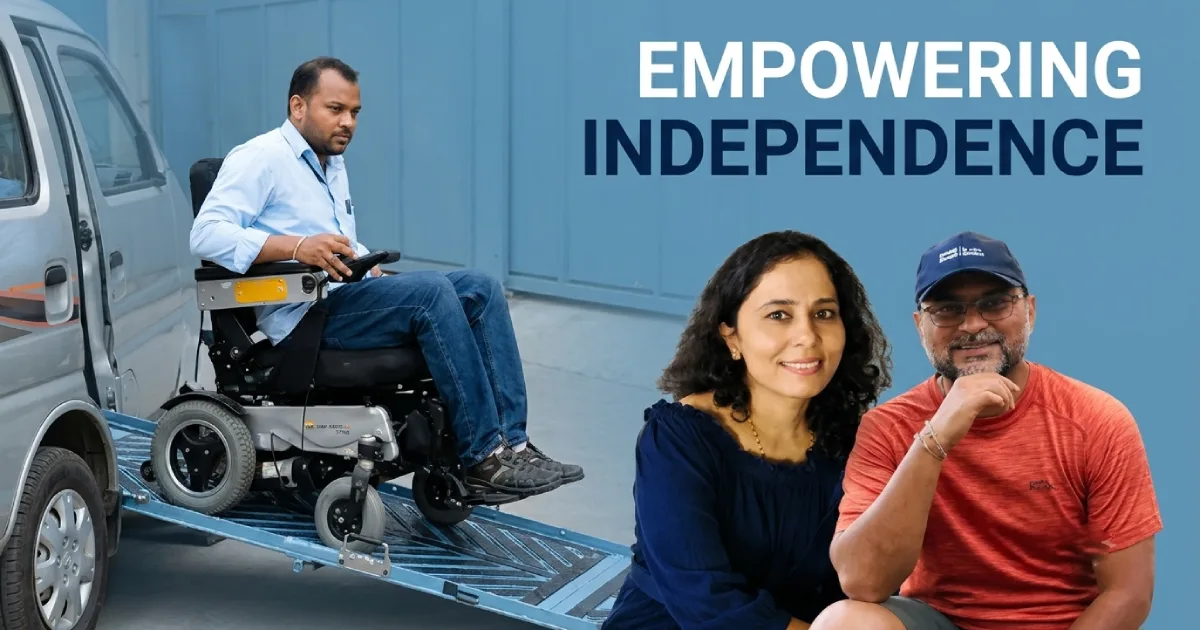
Being driven into a car is an activity which many people do without thinking. For an older person or physical-disabled person, this simple exercise can be a challenge. It could take a lot of effort and/or family assistance to sit up, get in and out of the car.
Bengaluru-based TRUE Assistive Technology is trying to make this commonplace experience simpler.
The company was established by engineers, Naina Padaki and Anand Kutre, who strive to create mobility solutions to help the handicapped and the elderly to travel with greater comfort, safety and independence.
It has many well-known innovations - one is the rotating car-seat mechanism which looks toward the car door, known as TurnPlus. A passenger will be able to sit down before rotating the vehicle's seat into position, rather than having to struggle to get in.
It started as an engineering problem and it now's become a business that addresses a much larger need: Mobility for those who are often neglected by traditional mobility services.
The Idea Behind TRUE Assistive Technology
The idea for TRUE Assistive Technology started out as a simple suggestion.
TRUE Assistive Technology was not created with a complex business plan, it was created to solve a practical problem.
In 2013, it was decided to create a swivel seat for the Toyota Corolla Altis. The early prototype was displayed in an Auto Show, but was too expensive to be a viable solution for more customers.
The designers didn't give up on the concept but started thinking how to make accessible mobility products more usable in the household context of India.
They were inspired by the sight of how readily available infrastructure and assistive technologies would aid persons with disabilities to be able to live independently in the society.
They understood that India was in need of solutions that would cater to the local context – one where families may not have access to the cost of vehicle modification.
It took time, engineering expertise and knowledge of the population that the products would be used by to develop these products. The founders kept at work looking for solutions to allow passengers to move about more comfortably and not always having to be lifted and moved by another person.
In 2022, the company was incorporated and the project became a business to provide accessible mobility.
Also Read: SolarSure Success Story
TurnPlus: An Innovation with a Practical Purpose
The mobility challenge for passengers with poor mobility is getting in and out of a car seat.
This is a standard car seat, which is permanently attached to the car. Entering may take a lot of effort, and even help from a caregiver, depending on the individual's condition.
TurnPlus' solution to this is a rotating seat mechanism.
The seat rotates towards the car door, so the passenger can sit down from a more convenient position. It can then back up to the car. This will make it easier to transition into a regular car seat.
Depending on their needs and the vehicle's suitability, the solution can be useful for older persons and persons with various mobility needs.
The convenience is not the only benefit for families. Getting in and out of a vehicle may be physically demanding for the person being assisted, and may also be demanding for the person doing the assisting – especially if they have to get in and out for medical visits or daily activities.
These transfers can be easier with the use of an appropriate assistive device; and journeys can be planned with increased confidence.
But it all depends on the user's mobility, seating and transfer requirements. Compatibility with the vehicle, as well as professional installation or evaluation are also relevant.
S. Department of Transportation grants are funding the installation of ramps and other mobility solutions at Rotating Seats sites.
Expanding Beyond the Car Door
When making the decision to explore accessibility issues, the idea was that the issues didn't stop at the car door.
A person with a wheelchair may be able to get into a vehicle, but may find it difficult to go up and down the stairs in their home, at their clinic or at other buildings. It can be physically challenging for the person and the carer to get between the bed, wheelchair and vehicle.
To tackle some of these issues, TRUE changed its focus to include several more products.
It has a range of mobility solutions such as portable ramps, modular ramps, transfer aids, lifting devices and accessibility modifications to vehicles. They are designed to assist individuals to move in various environments and to move around more easily.
Changes in the floor height can be solved with ramps and specific movement requirements with transfer and lifting aids. This will be dependent on the individual's condition, the environment and the amount of assistance that is required.
This more holistic approach is essential as accessibility is seldom achieved from a single product. Someone might require assistance in the house, upon entering a building and when travelling.
The company is solving various mobility problems and helping to bring about a more realistic definition of assistive technology.
Also Read: Medulance Success Story
The Real Impact: Making Family Travel More Manageable
When it comes to accessible mobility, it becomes apparent when we consider the lives of its users.
Earlier, Rashmi Sampath and her daughter Deeksha walked carelessly and it was a challenging physical effort.
Deeksha is 16, and has SMA (Spinal Muscular Atrophy) and needs support for mobility. It was a strain for her mother to lift her into a car before.
The family had to change the way they approached this aspect of a journey when they were outfitted with a rotating car seat. Deeksha could make herself at home on the seat before travelling back into the vehicle, making entry into the car easier.
The family later travelled by car almost 1,000 km from Bengaluru to Kanyakumari. It was a journey to highlight the benefits of a mobility solution that is simple and accessible to enable more extended trips to be more manageable.
The benefit isn't just about getting from one place to another for families in similar circumstances. It's also about additional options in planning vacations, appointments and visits with family.
An assistive device can't take away all travel barriers and every individual's needs are different. When a solution is targeted at a particular problem, it can have an impact on the lives of everyday people.
Over 1,000 People Reached With Mobility Products
According to recent reports, there have been over 1,000 persons with disabilities or older passengers assisted in travelling with the mobility solutions provided by TRUE Assistive Technology.
This is an important milestone for a company working in a specialised area of technology. It demonstrates that mobility is not just an engineering problem, but also a real need of the families across India.
This number is not necessarily a reflection on how much each user's independence has been increased. The experience of an individual can vary based on their mobility needs, the product used and how it is being used.
But the big idea here is simple: Products created with an understanding of everyday problems can make a difference if deployed to the right audiences.
The company's work also has stressed the need for the creation of assistive technology, taking into account its affordability, usability, and local needs.
Also Read: Zerodha Case Study
Why Accessible Technology Is Important in India
The term 'accessibility' is frequently used when talking about ramps, public buildings and wheelchair access. But it also has the smaller things that enable people to lead their lives.
Activities such as entering and leaving vehicles, moving to a clinic, visiting family or moving safely around the home can impact a person's independence and decision making.
The family members may have to regularly provide physical assistance to these activities when they become difficult. This may impact on the time, energy and responsibilities of those supported as well as those care giving.
Assistive technology can be used to overcome some of these barriers. However, to achieve greater benefit, products must be suitable to the users' needs, available via suitable channels and be accompanied by reliable information on products use.
Also, businesses that operate in this field have to deal with challenges like product development, testing, pricing of the products and informing their customers about which product they are suitable for.
The story of TRUE Assistive Technology exemplifies the power of engineering applied to a problem that is sometimes regarded as an inevitable consequence of ageing and/or disabilty.
How Entrepreneurs Can Benefit From TRUE Assistive Technology's Journey
The journey of this company provides some good insights for individuals who would like to create a business around an actual problem.
1. Begin by Identifying a Real Problem
The first thing you need to do is to begin by identifying a problem that people face.
It's not always necessary to make an entirely new invention to have a good business idea. In some cases, the opportunity is actually in improving an existing product in a way that will make it available to a wider audience.
The rotating car seat is designed to solve a problem faced by passengers and caregivers in their daily transportation.
2. Create User-Centred Designs
A product can be very neat from an engineering standpoint, but be useless if it is hard to use or not appropriate for the user.
The user's environment, physical requirements, budget and daily activities are critical factors to consider when designing assistive technology.
3. Continue to Refine the Solution
The initial concept for the car-seat was met with a price issue. Sometimes, the most important part of the product is to make its application more convenient and accessible, rather than the technology itself.
It is important for entrepreneurs to take into account usability, compatibility, maintenance and customer experience.
4. See Through the Initial Product
One solution can bring forth other issues that customers might have. In this instance, access to movement is not just accessible in cars, but in homes and public places as well.
The interconnected needs can be understood to create a more useful product offering that does not lose any sight of the original purpose.
Also Read: How Alakh Pandey Built Physics Wallah
A Success Story: Independence and Inclusion
TRUE Assistive Technology's story exemplifies how engineering can be used to address everyday problems that make a difference to real life people.
They started with a challenge of accessing car seats, Naina Padaki and Anand Kutre. Their work expanded to creating a more accessible and convenient way for people with disabilities and the elderly to move around.
TurnPlus and the other mobility solutions cannot address all barriers to people. They do, however, have practical solutions to support individual problems of mobility and mobility.
The company's reported reach of over 1,000 has also underscored the need for solutions that take into account the needs of the passengers and the caregivers.
Accessible technology is more than just machinery in the end. It is all about assisting people to participate in daily life in a more comfortable, dignifying and choiceful way.
As a lesson for entrepreneurs, this is a reminder that often the best ideas are those that come from understanding a problem others have dealt with and working to resolve it.
Source & Disclaimer
This article is independently written using publicly available reports about TRUE Assistive Technology, its founders Naina Padaki and Anand Kutre, and their journey of developing accessible mobility solutions for people with disabilities and older adults. Business milestones, product details and impact figures are based on published reports and may change over time.
Digital Startup India is an independent private platform and is not affiliated with or endorsed by TRUE Assistive Technology, Naina Padaki, Anand Kutre, or any organisation mentioned in this article.
Naina Padaki and Anand Kutre
TRUE Assistive Technology
Built something worth sharing?
Tell us about your journey — we feature founders from across India.