Categories
- AI Tools & Technology 66
- Business Growth & Scaling 33
- Business Insights 8
- Business Registration & Compliance 4
- Business Segments 9
- Cybersecurity 1
- Digital Marketing for Startups 11
- Digital Startup India 37
- Ecosystem & Insights 1
- Events & Networking 5
- Finance 1
- Founder Playbooks & Case Studies 1
- Founder Stories 4
- Funding 5
- Government Schemes 5
- Growth 5
- Her Story 4
- Jobs & Careers 5
- Learning & Skills 5
- Marketing 5
- MSME & Small Business 2
- Startup Ecosystem & Insights 3
- Startup Funding & Investment 1
- Startup Guides 7
- Startup News 4
- Tech & Innovation 4
- Technology 5
- Trending News 4
- Uncategorized 0
Recent Posts






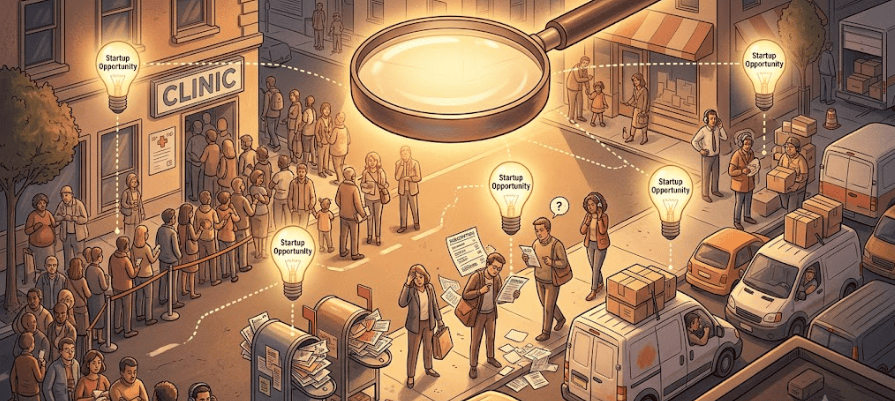
Table of Contents
13 Brilliant Everyday Problems Worth Millions to Solve
Introduction
Every billion-dollar company started with a problem that most people ignored. The next great startup probably won't invent something entirely new, it will simply make everyday life a little less frustrating.
When people think about startup ideas, they often imagine groundbreaking inventions, futuristic technologies, or revolutionary scientific discoveries.
Reality tells a different story.
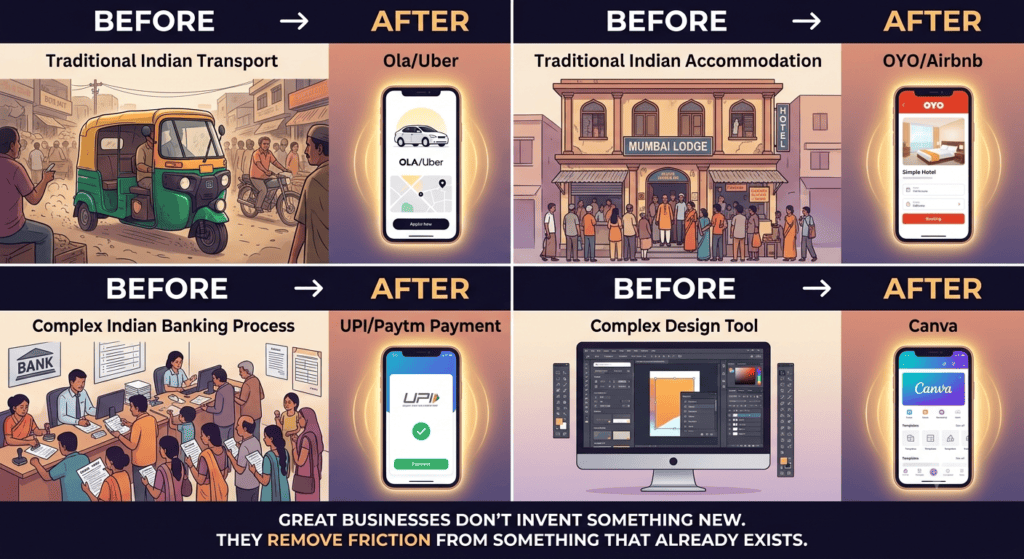
Uber didn't invent taxis.
Airbnb didn't invent hotels.
Stripe didn't invent payments.
Canva didn't invent graphic design.
Each of these companies became successful because they removed friction from an existing experience.
That's one of the most overlooked truths in entrepreneurship.
People don't buy products.
They buy solutions to problems.
The bigger the frustration, the more valuable the solution becomes.
Today's entrepreneurs have access to technologies like artificial intelligence, automation, cloud computing, and low-code platforms that make building businesses easier than ever. What hasn't changed is the source of great startup ideas.
They still come from everyday life.
The slow checkout queue.
The confusing government form.
The forgotten subscription.
The missed medical appointment.
The delayed delivery.
Small frustrations experienced by millions of people often represent opportunities worth millions or even billions of dollars.
Why Great Businesses Begin with Annoyance
Most founders spend too much time asking, "What business should I start?"
A better question is:
"What frustrates people every single day?"
The answer usually leads to stronger business ideas.
Recurring frustrations create recurring demand.
When people repeatedly experience the same inconvenience, they actively seek better solutions and they're often willing to pay for them.
That's exactly why founders should become problem collectors rather than idea collectors.
1. Wasting Hours on Administrative Paperwork
Despite rapid digitalisation, millions of people still spend hours filling out forms, uploading the same documents repeatedly, and navigating complex administrative processes.
Whether it's opening a bank account, applying for government schemes, or completing business registrations, paperwork remains unnecessarily time-consuming.
Startups that simplify documentation, automate form filling, verify identities, or centralise digital records could dramatically improve everyday experiences.
2. Subscription Fatigue
Consumers now pay for streaming platforms, productivity software, cloud storage, fitness apps, newsletters, and countless digital services.
Many forget what they're paying for.
Others continue paying for products they no longer use.
A smart financial assistant that automatically tracks subscriptions, highlights wasteful spending, negotiates better pricing, or recommends cancellations addresses a growing global problem.
3. Finding Reliable Home Services
Need an electrician.
A plumber.
A carpenter.
A cleaner.
Finding trustworthy professionals remains surprisingly difficult.
Most people still rely on neighbours, WhatsApp groups, or online reviews that aren't always reliable.
There's still room for platforms that verify professionals, guarantee service quality, and build long-term trust between households and skilled workers.
4. Food Waste at Home
Millions of households throw away perfectly edible food every week.
Often, it's because people forget what's already in their refrigerator or pantry.
Smart inventory apps powered by AI could track expiry dates, recommend recipes based on available ingredients, automatically generate shopping lists, and help families reduce food waste while saving money.
5. Waiting for Healthcare Appointments
Booking a doctor's appointment should take minutes.
Instead, patients often spend days calling clinics, comparing hospitals, checking availability, and managing follow-ups.
Even after treatment, medication reminders, diagnostic reports, and follow-up consultations are frequently scattered across different platforms.
Startups that create unified healthcare scheduling, AI-powered symptom guidance, and personalised patient management could improve healthcare access while reducing administrative burdens for hospitals and clinics.
6. Managing Household Expenses
Most families know they're spending too much.
Very few know exactly where.
Expenses are spread across UPI payments, credit cards, bank accounts, subscriptions, and cash transactions, making budgeting surprisingly difficult.
An intelligent financial platform that categorises spending automatically, predicts future expenses, and recommends savings opportunities could become indispensable for millions of households.
Financial awareness is a daily problem, not just a monthly one.
7. Information Overload
People receive hundreds of emails, notifications, articles, videos, reports, and messages every week.
The challenge is no longer finding information.
It's filtering what actually matters.
AI-powered personal knowledge assistants that summarise newsletters, prioritise emails, organise research, and deliver concise daily briefings could become as common as email itself.
Saving time has become one of the world's most valuable services.
8. Remembering Everything
Birthdays.
Bill payments.
Warranty expirations.
Vehicle servicing.
Insurance renewals.
Prescription refills.
Modern life depends on remembering dozens of small responsibilities, and forgetting even one can become expensive.
There's an opportunity to build intelligent life-management platforms that proactively remind users, automate renewals where possible, and consolidate personal responsibilities into one simple dashboard.
Instead of another productivity app, people need a personal operations manager.

9. Last-Mile Delivery Frustrations
Waiting all day for a package has become surprisingly normal.
Customers still receive vague delivery windows, delayed updates, and failed delivery attempts despite significant advances in logistics.
Businesses that improve route optimisation, real-time communication, secure delivery lockers, neighbourhood pickup solutions, or predictive delivery scheduling continue to have enormous potential.
The last kilometre of delivery remains one of logistics' biggest challenges.
10. Small Business Administration
Millions of entrepreneurs spend more time managing invoices, GST filings, payroll, inventory, customer support, and compliance than actually growing their businesses.
Most don't need more software.
They need fewer administrative tasks.
AI-powered business assistants capable of automating routine operations could free founders to focus on sales, innovation, and customer relationships instead of paperwork.
11. Learning Practical Skills
Traditional education teaches theory.
Employers increasingly demand practical skills.
Professionals now need to learn AI, automation, digital marketing, data analysis, financial literacy, negotiation, and communication throughout their careers.
Platforms delivering personalised, project-based learning that adapts to each user's goals could transform lifelong education.
Learning is no longer something people do once.
It's becoming a continuous process.
12. Digital Trust
People interact with strangers every day.
Freelancers.
Marketplace sellers.
Online tutors.
Rental hosts.
Service providers.
Despite reviews and ratings, verifying credibility remains difficult.
Businesses focused on identity verification, reputation systems, credential validation, and trust infrastructure could become essential as more economic activity moves online.
Trust is becoming digital infrastructure.
13. Decision Fatigue
Modern consumers make hundreds of decisions every day.
Which insurance policy?
Which laptop?
Which investment?
Which university?
Which healthcare plan?
Choice has become overwhelming.
AI-powered decision assistants capable of comparing options, understanding personal preferences, explaining trade-offs, and offering unbiased recommendations represent one of the next frontiers of consumer technology.
The businesses that reduce mental effort may become just as valuable as those that save time.

The Best Startup Ideas Usually Feel Obvious in Hindsight
Looking back, the world's most successful startups appear inevitable.
Ordering a taxi through an app.
Booking accommodation online.
Sending money instantly.
Designing graphics without professional software.
Each idea now feels obvious.
That's because great businesses simplify problems people had simply accepted as normal.
The same opportunity exists today.
Every inconvenience you encounter is a signal.
Every complaint you hear is market research.
Every workaround someone creates is evidence that a better solution is waiting to be built.
Founders who learn to notice these signals often discover opportunities long before everyone else.
Strategic data analyzed by venture capitalists like Tom Tunguz consistently emphasizes that early-stage companies collapse not from a lack of unique ideas, but from a failure to accurately measure operational cash runways and unit economics. For modern business owners operating in a tight capital environment, learning to separate vanity metrics from actual profitability, as outlined in our comprehensive guide on startup advice and myths ensures you build a scalable, audit-ready enterprise that stands out to venture capitalist firms and institutional investors alike.
Conclusion
The future's biggest startups may not emerge from cutting-edge laboratories or billion-dollar research facilities.
They'll emerge from kitchens, offices, hospitals, classrooms, warehouses, supermarkets, and smartphones, from places where ordinary people experience unnecessary friction every day.
Entrepreneurs often spend months searching for brilliant ideas.
In reality, the best ideas are usually hiding in plain sight.
Observe what frustrates people.
Listen to repeated complaints.
Pay attention to inefficient systems.
Because every everyday problem solved is an opportunity to create meaningful value.
And sometimes, that value is worth millions.
Faq's
Why do successful startups focus on everyday problems?
Everyday problems affect millions of people repeatedly. Solving these issues crea
How do I identify problems worth solving?
Pay attention to recurring frustrations, inefficient processes, customer complaints, and tasks people frequently try to simplify or automate.
Do I need a revolutionary idea to build a successful startup?
No. Many of the world's largest companies succeeded by improving existing experiences rather than inventing entirely new industries.
Can AI help solve everyday problems?
Yes. AI can automate repetitive tasks, personalise recommendations, improve decision-making, reduce administrative work, and enhance customer experiences across many industries.
What makes a problem a good business opportunity?
A strong opportunity solves a frequent, costly, or time-consuming problem for a large number of people who are willing to pay for a better solution.
Everyday problems affect millions of people repeatedly. Solving these issues crea
Pay attention to recurring frustrations, inefficient processes, customer complaints, and tasks people frequently try to simplify or automate.
No. Many of the world's largest companies succeeded by improving existing experiences rather than inventing entirely new industries.
Yes. AI can automate repetitive tasks, personalise recommendations, improve decision-making, reduce administrative work, and enhance customer experiences across many industries.
A strong opportunity solves a frequent, costly, or time-consuming problem for a large number of people who are willing to pay for a better solution.