Categories
Recent Posts




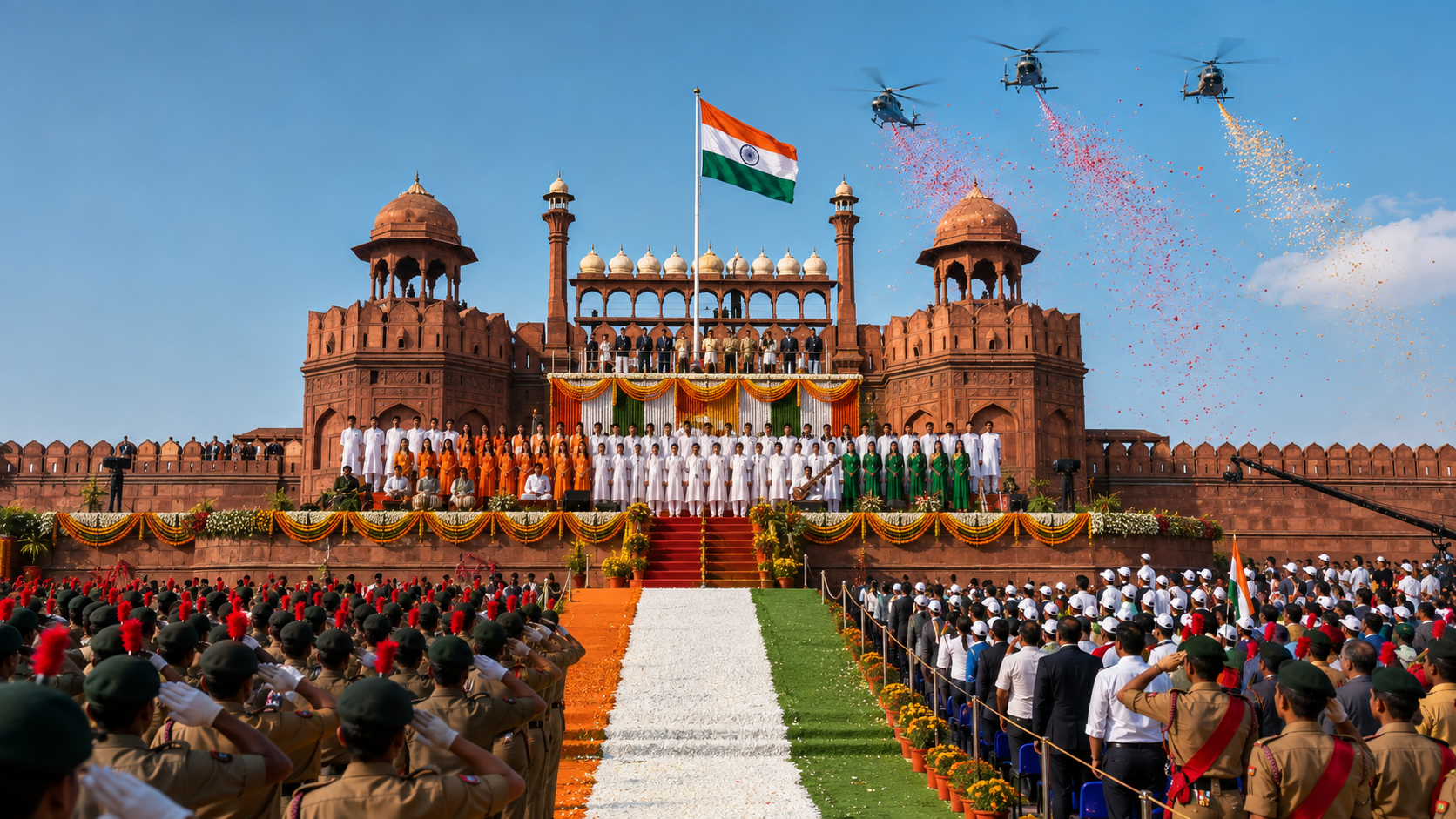
Table of Contents
80th Independence Day 2026: Vande Mataram at Red Fort, Sapta Dhara and Modi's Viksit Bharat Push
India celebrated its 80th Independence Day 2026 on Saturday, 15 August, and this year's ceremony at the Red Fort was different from every one that came before it. For the first time since 1947, the national song Vande Mataram was officially sung from the Red Fort grounds. Prime Minister Narendra Modi unfurled the tricolour and addressed the nation for the 13th year in a row — and used the platform to lay out a seven-point roadmap for a developed India by 2047.
Here is everything that happened, explained in simple language, and what it actually means for India's founders, students and working professionals.
7 Government Schemes Every Indian Entrepreneur Must Know in 2026
Quick Highlights of the 80th Independence Day 2026
| What | Detail |
|---|---|
| Occasion | 80th Independence Day, 15 August 2026 |
| Venue | Red Fort, New Delhi |
| Flag hoisted by | PM Narendra Modi (13th consecutive time) |
| Theme | 150 years of Vande Mataram + Yuva Shakti for Viksit Bharat 2047 |
| Big first | Official rendition of Vande Mataram at the Red Fort |
| Big announcement | "Shakti ki Sapta Dhara" — seven pillars of growth |
| Special guests | Around 5,000 invitees from all walks of life |
Vande Mataram Echoes at the Red Fort for the First Time
The most talked-about moment of the morning came right after the flag hoisting. An Army band played the tune of Vande Mataram while the guests present sang along — the first time the national song has been part of the official Independence Day programme at the Red Fort.
Two Mi-17 helicopters of the Indian Air Force showered flower petals over the venue. One carried the national flag; the other carried a flag with Vande Mataram on it. The ceremony also included the traditional 21-gun salute and a guard of honour for the Prime Minister.
Startup India Registration: The Complete 2026 Walkthrough
The timing is not a coincidence. Vande Mataram was written by Bankim Chandra Chattopadhyay in 1875, and the country is currently in the middle of a year-long commemoration of its 150th anniversary that runs until November 2026. Making it part of the 80th Independence Day 2026 celebration tied the two milestones together.
Why it matters: Independence Day ceremonies rarely change format. A first-of-its-kind addition after 79 years is the kind of detail that will be quoted in history books and school textbooks for decades.
"Shakti ki Sapta Dhara": The Seven Pillars of Viksit Bharat
The centrepiece of the Prime Minister's address was a seven-point reform framework he called Sapta Dhara — literally, seven streams of strength. Think of it as a checklist of the sectors the government wants to push hardest between now and 2047.
The seven areas are:
- Manufacturing — making India a global production base, not just an assembly line.
- Agriculture and food processing — moving farmers up the value chain from raw produce to packaged, exportable goods.
- Technology and innovation — deep tech, R&D, patents and homegrown platforms.
- Gati Shakti (logistics) — roads, ports, rail and warehousing that cut delivery time and cost.
- Raksha Shakti (defence) — building weapons systems at home instead of importing them.
- Green and blue economy — clean energy on land, and the ocean economy at sea.
- Soft power — culture, yoga, cinema, cuisine and design as export assets.
What this means for startups: Six of these seven streams are direct business opportunities. If you are building in agritech, defence tech, EV and clean energy, logistics SaaS, semiconductors or D2C food brands, this is a signal about where policy attention, procurement budgets and incentive schemes are likely to flow over the next few years. Sectors that get named in a Red Fort speech usually see follow-up in the next Union Budget.
80TH INDEPENDENCE DAY CELEBRATION 2026
From "Fragile Five" to the Fastest-Growing Major Economy
The Prime Minister spent a large part of the speech on India's economic turnaround. His core claim: over the last 12 years, public effort has carried India from being counted among the "Fragile Five" economies to becoming the world's fastest-growing major economy.
For context, "Fragile Five" was a label used by international analysts around 2013 for five emerging economies seen as too dependent on foreign money and vulnerable to a currency shock. India was on that list.
He backed the claim with a set of before-and-after numbers from the last 12 years:
| Indicator | Growth cited |
|---|---|
| Mobile phone production | Up around 33x |
| Modern railway coaches | Up around 21x |
| Electronics manufacturing | Up around 7x |
| Khadi and village industries output | Up around 5x |
| Defence production | Up around 4x |
| Internet users | Up around 4x |
| Patents granted | Up around 4x |
| Digital transactions | Up around 100x |
The 100x jump in digital transactions is the number every digital-first business should pay attention to. It is the clearest proof that UPI-scale infrastructure has changed customer behaviour permanently — and that a village customer today is as reachable as a metro customer.
"Dream Big": The 2047 Message to Young India
The Prime Minister's message to the youth was direct — small dreams are no longer enough, and India should aim high because it wants to be a developed nation by 2047. He argued that when the world's most populous country makes a resolve of this size, the world is forced to look at it differently.
PM Modi urges youth to assume leadership, join Census exercise digitally
This year's theme deliberately spotlighted Yuva Shakti — youth power. The guest list reflected it: alongside farmers, scientists, women entrepreneurs and beneficiaries of government schemes, the Red Fort hosted thousands of cadets and My Bharat volunteers, with around 5,000 special guests in total, many in traditional dress.
Naxalism, and a 100-Day Anti-Drug Campaign
Two other announcements stood out.
On Left-wing extremism, the Prime Minister said Maoist extremism is now in its final stage. He recalled the government's 2014 pledge to free the country of Naxalism and said districts that once saw regular violence are now seeing roads, schools and a rebuilt sense of trust.
On drug abuse, he called for a collective national effort to make India drug-free and urged families to take part in a 100-day nationwide campaign — the Nasha Mukt Yuva Abhiyan. Expect school, college and panchayat-level participation drives over the next three months.
What the 80th Independence Day 2026 Means for Founders and Professionals
Strip away the ceremony and three practical signals remain:
- Policy direction is now published in advance. Sapta Dhara tells you which seven buckets will attract schemes, PLI-style incentives and government procurement. Building inside one of those buckets means less friction on funding and approvals.
- Manufacturing and defence are the loudest bets. Both got their own place in the seven pillars. Hardware startups, component makers and dual-use tech companies are firmly in the spotlight.
- Digital scale is a solved problem; trust is the next one. With digital transactions up roughly 100x, the bottleneck for most consumer businesses is no longer payments or reach — it is credibility, service and retention.
The 2047 deadline is 21 years away. For anyone in their twenties or thirties today, the "developed India" target is not an abstract slogan — it is a description of the market you will spend your entire working life building in.
Final Word
The 80th Independence Day 2026 will be remembered for one image and one idea: Vande Mataram ringing out from the Red Fort for the first time, and a seven-stream blueprint for 2047 handed to the generation that will actually have to build it. The ceremony was about the past. The speech was entirely about the next 21 years.
What did you think of this year's address? Tell us in the comments — and share this with someone who missed the speech.