Categories
Recent Posts
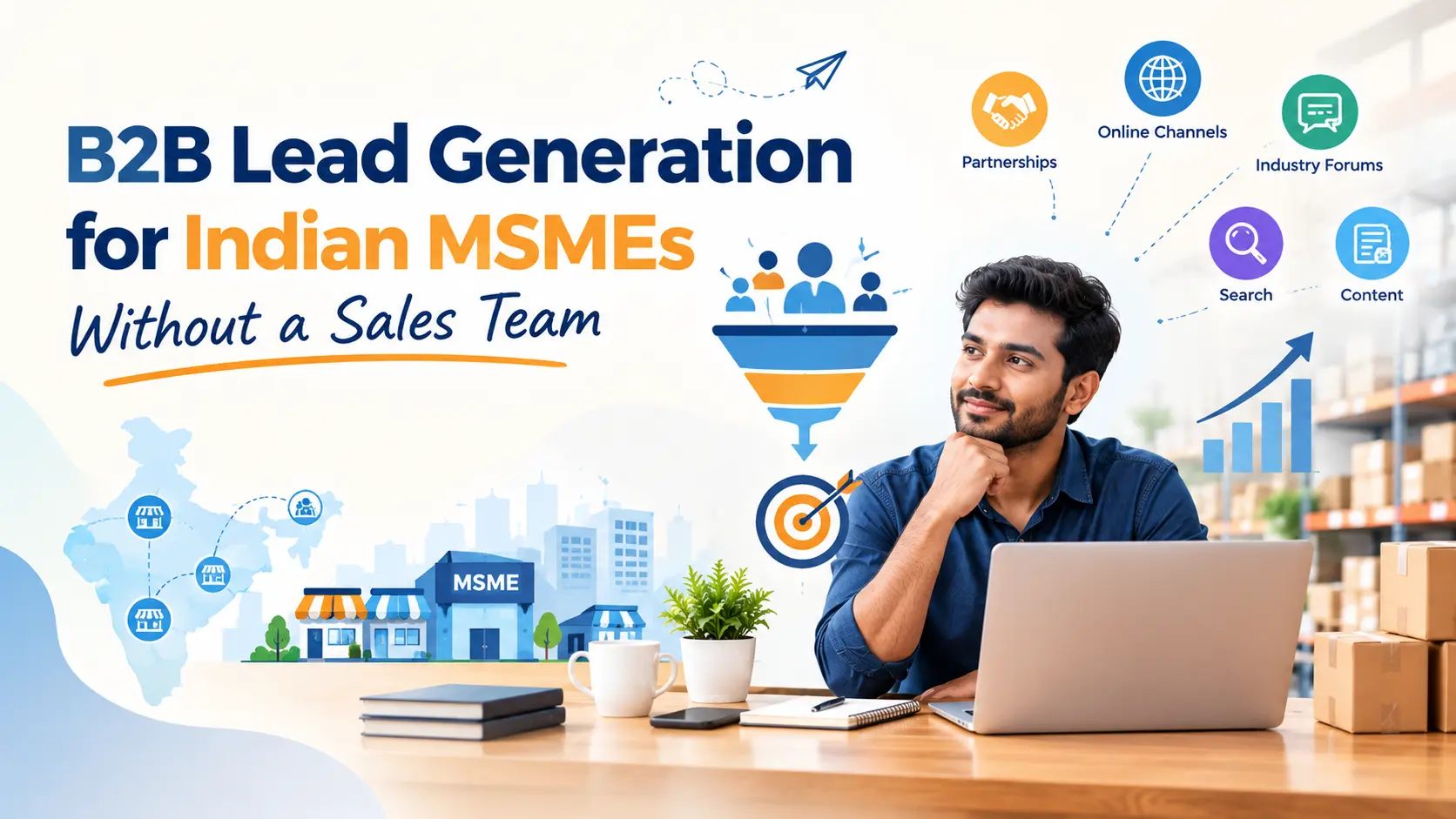

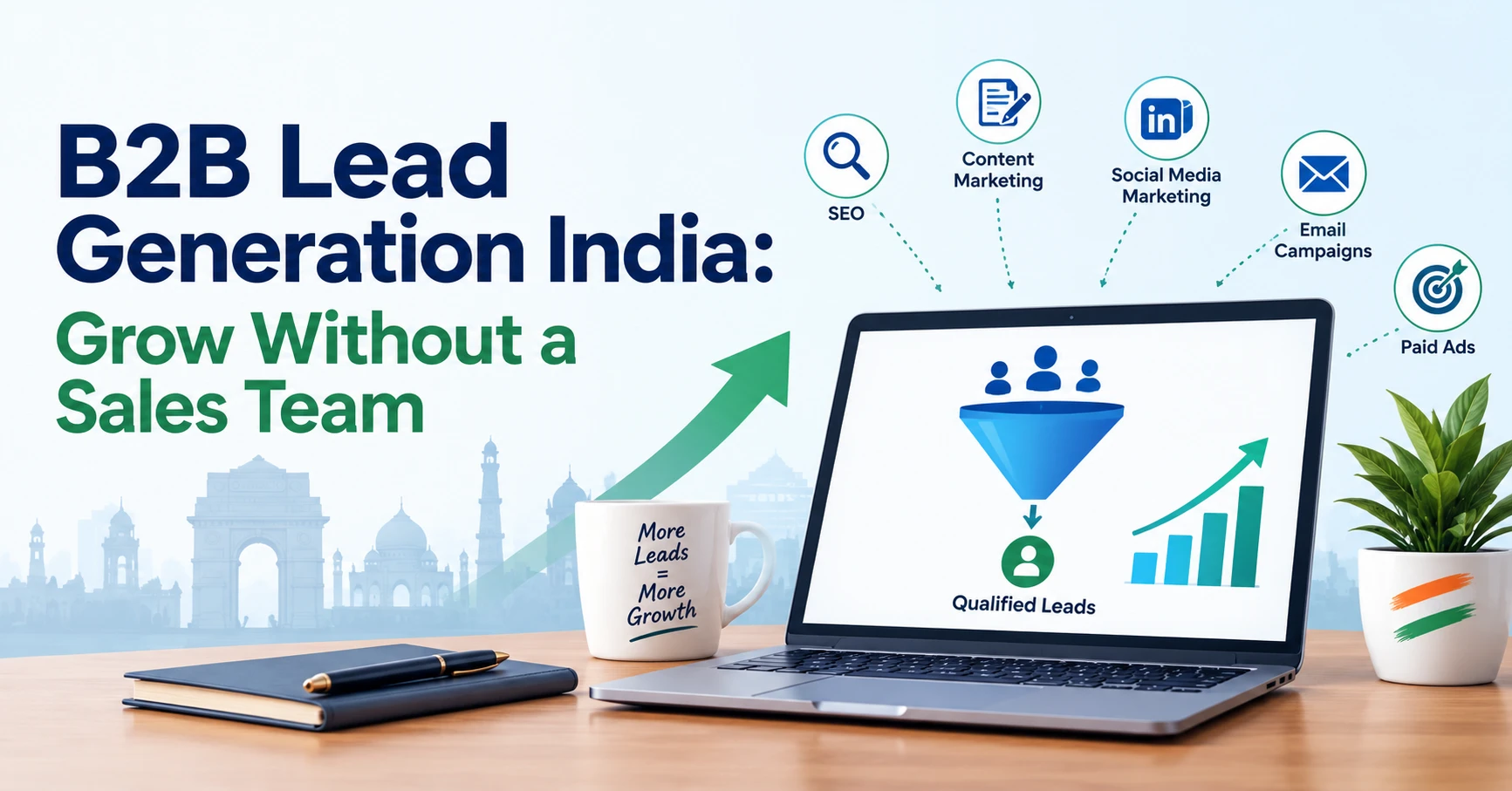
Table of Contents
B2B Lead Generation for Indian MSMEs Without a Sales Team: The Founder's Playbook (2026)
Last Updated: September 2026
You didn't start your business to spend every evening cold-calling strangers who hang up on you.
But here's the truth nobody tells first-time founders: most Indian MSMEs don't lose business to a "better" competitor. They lose it to a competitor who simply showed up first — in a Google search, a LinkedIn feed, or a WhatsApp forward — while they were still trying to afford their first salesperson.
If you're a founder, co-founder, or business owner reading this on your phone between meetings, here's the good news: you don't need a sales team to build a steady pipeline of B2B leads in India. You need a system. This guide gives you one — the same approach we've used and refined with small manufacturers, service firms, and D2C-to-B2B brands over the last decade, broken down so you can start today, not "someday."
What B2B Lead Generation Actually Means for a Small Indian Business
B2B lead generation is simply the process of getting other businesses to notice you, trust you, and raise their hand to talk to you — before you ever ask them to buy anything.
For a large company, that job belongs to a sales team of ten people with a CRM and a quota. For an MSME, that job has to belong to a system: a few channels, a bit of content, and some smart automation, all running quietly in the background while you run the actual business.
The goal isn't to "sell." The goal is to make it easy for the right business buyer to find you, believe you can solve their problem, and message you first.
Why Indian MSMEs Struggle With This (And Why It's Not Your Fault)
If you've felt stuck, it's probably one of these — and all of them are fixable:
- No budget for a dedicated salesperson. A decent B2B sales hire in a metro city costs ₹35,000–₹70,000 a month, plus incentives. Most MSMEs can't justify that before leads even exist.
- Founder is doing five jobs at once. Production, finance, hiring, delivery — sales gets whatever time is left over, which is usually none.
- Relying on one channel. Many MSMEs still depend entirely on word-of-mouth or a single IndiaMART listing, so growth stalls the moment referrals slow down.
- No system to follow up. A lead messages once, gets a slow reply, and moves to a competitor who replied in five minutes.
None of these are character flaws. They're structural problems — and structural problems are solved with structure, not more hustle.
The No-Sales-Team Lead Generation Framework
Here's the exact framework, built around channels an Indian MSME can realistically run alone or with one junior hire.
1. Make the Founder the Front-Line Brand (LinkedIn)
In India's B2B space, buyers increasingly trust a founder's voice over a company page. Posting two to three times a week about real problems you solve, client wins (with permission), and lessons from the business builds more trust than any sales pitch.
- Comment on posts from your ideal buyer's industry before you ever post yourself — this gets you seen by the right people.
- Turn every client project into a short "problem → solution → result" post.
- Add a simple call-to-action: "DM me if you're facing this too."
2. Treat WhatsApp Business as Your Mini-CRM
This is the most underused B2B channel in India, and it's free.
- Set up a WhatsApp Business catalog with your services/products.
- Use quick replies and automated greeting messages so no lead waits more than a few minutes.
- Save every inbound enquiry as a labeled contact ("Hot," "Follow-up," "Cold") so nothing falls through the cracks.
3. Win the "Google Search" Moment
When a procurement manager searches "[your service] near me" or "[your product] supplier India," you want to be the business that shows up — not buried on page three.
- Claim and fully complete your Google Business Profile with photos, services, and genuine reviews.
- Publish simple, keyword-rich pages or blog posts answering the exact questions your buyers type into Google (this article is a live example).
- Ask happy clients for a two-line Google review right after a successful delivery — timing matters more than wording.
4. Use B2B Marketplaces as a Lead Machine, Not Just a Listing
Platforms like IndiaMART, TradeIndia, and the Government e-Marketplace (GeM) exist specifically because Indian buyers still search them daily.
- Keep your IndiaMART/TradeIndia catalog updated monthly — stale listings rank lower and convert worse.
- Respond to every enquiry within the hour; marketplaces often show buyers your average response time.
- Register on GeM to access government and PSU buyers, who place large, recurring B2B orders.
5. Build a Referral and Partnership Engine
Your happiest clients and your non-competing vendors are your cheapest sales team.
- After every successful project, simply ask: "Do you know one other business that could use this?"
- Partner with complementary businesses (a packaging MSME partnering with a logistics MSME, for example) and swap warm introductions.
6. Automate the Boring 80% So You Only Do the Important 20%
You don't need expensive software. Free or low-cost tools can run most of this for you:
- A simple email sequence tool to follow up with enquiries automatically over 5–7 days.
- A free CRM (even a well-organized Google Sheet works at the start) to track every lead's stage.
- A basic chatbot on your website or WhatsApp to answer FAQs and capture contact details 24/7.
7. Direct, Personalized Outreach (Used Sparingly, Done Well)
Cold outreach isn't dead — generic cold outreach is. One well-researched LinkedIn message or email to a specific decision-maker, referencing their actual business, outperforms a hundred copy-pasted messages.
Government Support That Can Strengthen Your Lead Generation (September 2026)
Alongside your own marketing effort, a few official government routes genuinely widen your reach to new B2B buyers — mostly by improving your credibility and giving you access to buyer networks you couldn't reach alone. Here's what currently applies to Indian MSMEs. Always verify current terms on the official site below before applying, as scheme rules are revised from time to time.
Udyam Registration (the foundation for everything else)
- Eligibility: Any micro, small, or medium enterprise in India (manufacturing or services) based on investment and turnover limits.
- Benefits: Official MSME status, access to priority-sector lending, protection against delayed payments, eligibility for almost every other MSME scheme — including the ones below.
- Documents: Aadhaar number of the proprietor/partner/director, PAN, and business/bank details. No supporting documents need to be uploaded; it is a self-declaration-based system.
- Application process: Apply directly online; it is free and usually completed the same day.
- Amount/financial assistance: No direct cash subsidy — it's a registration that unlocks eligibility for other benefits.
- Official website: udyamregistration.gov.in
GeM (Government e-Marketplace) Registration
- Eligibility: Any Udyam-registered MSME with a valid PAN and GSTIN (GST-exempt categories can register with supporting proof).
- Benefits: Direct access to government departments, PSUs, and public-sector buyers who place frequent, often large, recurring orders — a genuine lead source most MSMEs overlook.
- Documents: PAN, Udyam Registration certificate, GSTIN, bank account details, and a digital signature certificate (DSC) or Aadhaar-based e-signature for the authorized signatory.
- Application process: Register as a seller on the portal, complete organisation and bank KYC, and list your products/services in the relevant category.
- Amount/financial assistance: No subsidy; registration itself is free. MSEs also get purchase-preference benefits in certain government tenders.
- Official website: gem.gov.in
NSIC Marketing Facilitation Scheme
- Eligibility: Micro and Small Enterprises (MSEs) already registered under NSIC's Single Point Registration Scheme (SPRS); trading-only units without value addition are not eligible.
- Benefits: NSIC helps you bid for and win contracts with central/state government departments, PSUs, and reputed private buyers, and facilitates consortium bidding for larger tenders you couldn't win alone.
- Documents: The prescribed application form (Annexure-A) signed by an authorised signatory, plus supporting business documents listed in the form.
- Application process: Register under SPRS (your unit will be inspected before empanelment), submit the Annexure-A form, and pay the applicable annual enlistment fee.
- Amount/financial assistance: Not a cash subsidy — NSIC charges a small annual enlistment fee (as low as ₹1,000 + GST for smaller units; SC/ST-owned units are exempt) and a facilitation fee of 5% on contracts won through the scheme.
- Official website: nsic.co.in
A note on trade-fair and export support
If you're chasing B2B buyers outside India, the International Cooperation (IC) Scheme run by the Ministry of MSME can support participation in international trade fairs and buyer-seller meets. Reimbursement categories and amounts are revised periodically, so check the current sanction orders on the official site before budgeting around them: dcmsme.gov.in.
Who should apply for these government routes
- Founders already selling B2B who want access to government/PSU buyers.
- Manufacturers and service MSMEs that can handle recurring institutional orders.
- Businesses planning to exhibit at trade fairs to reach new B2B markets.
- Early-stage MSMEs that haven't yet registered on Udyam — this should be your very first step, since nearly everything else depends on it.
Who This Playbook Is For
- Founders and solo business owners who are currently doing sales themselves, part-time.
- Small manufacturers and B2B service providers who can't yet justify a full sales hire.
- Agencies, consultants, and exporters who need a steady, low-cost lead pipeline.
- Anyone who has tried "posting on social media" without a system and seen no real results.
Common Mistakes Indian MSMEs Make in B2B Lead Generation
- Treating marketplaces as "set and forget." An outdated IndiaMART listing quietly loses you leads every single day.
- Replying to enquiries hours (or days) later. In B2B, the first business to respond usually wins the deal.
- Posting on LinkedIn with no consistency. Three posts in a burst, then silence for two months, trains the algorithm to stop showing you.
- Chasing every channel at once. Trying LinkedIn, Instagram, cold email, and marketplaces all in week one usually means doing all of them badly.
- Not tracking where leads actually come from. Without even a basic spreadsheet, you can't tell what's working — so you can't do more of it.
- Skipping Udyam/GeM registration because it "sounds complicated," when it's free and often takes under an hour.
Your Simple 30-Day Action Plan
| Week | Focus |
|---|---|
| Week 1 | Complete Udyam registration (if not done), set up Google Business Profile, and organize a basic lead-tracking sheet. |
| Week 2 | Set up WhatsApp Business with a catalog and auto-replies; update your IndiaMART/TradeIndia listing fully. |
| Week 3 | Post on LinkedIn 2–3 times, engage daily in your buyers' spaces, and ask three happy clients for referrals. |
| Week 4 | Register on GeM (if relevant), set up one automated email follow-up sequence, and review which channel brought your best leads. |
The Bottom Line
You don't need to hire a sales team to be found, trusted, and chosen by the right B2B buyers in India. You need a handful of channels run consistently, a simple way to track every lead, and the discipline to show up even when it feels slow. Start with one channel from this guide this week — not all of them — and build from there.