Categories
- AI Tools & Technology 6
- Business Growth & Scaling 6
- Business Growth & Scaling 5
- Business Insights 24
- Cybersecurity 2
- Digital Marketing for Startups 11
- Digital Startup India 36
- Events & Networking 1
- Funding & Finance 1
- Startup Case Studies 25
- Startup Guides 14
- Startup India & Government Schemes 2
- Tech & Innovation 65
Recent Posts





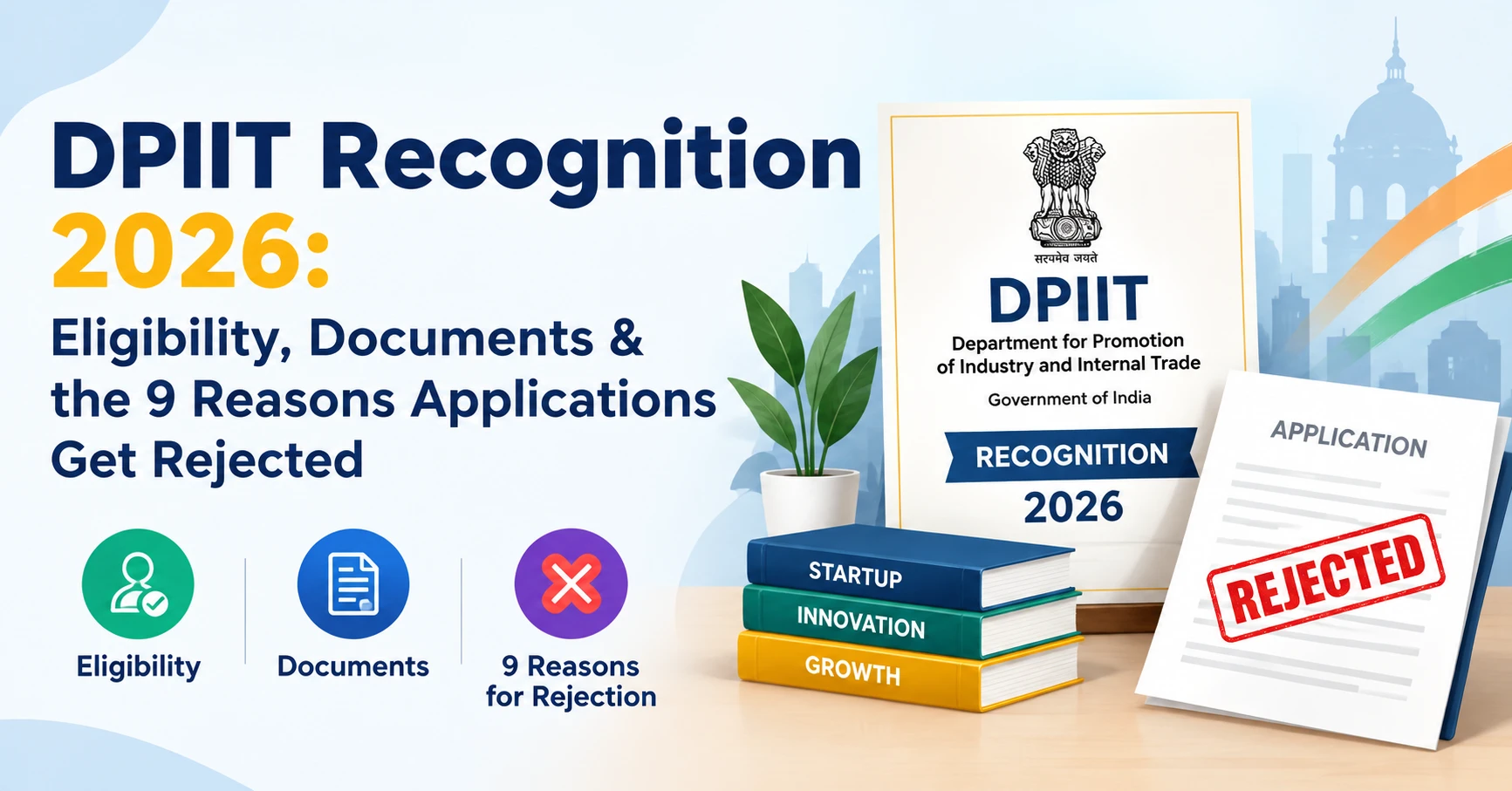
Table of Contents
Here is something most founders find out the hard way.
You spend a weekend filling the DPIIT application. You write a beautiful paragraph about how your company is "using the latest technology to deliver quality services." You upload your incorporation certificate. You hit submit. You start telling people you are "registered with Startup India."
Eleven days later, one line appears on your dashboard: application not approved.
No phone call. No explanation you can act on. Just a closed door — and by then you have already told an investor you are DPIIT recognised.
The uncomfortable truth is that almost nobody gets rejected because their business is bad. They get rejected because of a form. A mismatched date. A missing letterhead. A paragraph that sounded impressive to them and said nothing to the officer reading it.
This guide fixes that. It covers the new rules that came into force in February 2026 (most articles you will read today are still quoting the old ones), the exact documents you need, the real reason applications die, and a free checklist you can tick off before you click submit.
Quick answer for people in a hurry
| Question | Answer (as of September 2026) |
|---|---|
| What is DPIIT recognition? | An official certificate from the Department for Promotion of Industry and Internal Trade that makes your company a "Startup" in the eyes of the Government of India |
| Who can apply? | Private Limited Company, LLP, Registered Partnership Firm, or Cooperative Society |
| Age limit | Up to 10 years from incorporation (20 years for Deep Tech) |
| Turnover limit | Under ₹200 crore in any financial year (₹300 crore for Deep Tech) |
| Where to apply | NSWS portal — nsws.gov.in |
| Government fee | ₹0. It is completely free. |
| Usual time | 2–10 working days for a clean application |
| Biggest reason for rejection | A vague innovation write-up |
What DPIIT recognition actually is (and what it is not)
DPIIT recognition is not a licence. It does not let you do business. You could run your company for twenty years without it.
What it does is switch on a set of doors that stay locked for everyone else.
Think of it like this: registering your company with the MCA makes you legal. DPIIT recognition makes you visible — to the tax department's startup benefits, to government tenders, to the ₹10,000 crore Fund of Funds, to state government schemes, and to a certain kind of investor and accelerator who will not look at your deck without that certificate number.
What it is not:
- It is not the same as your 80-IAC tax holiday. That is a completely separate application with a completely different committee. (More on this later — this confusion alone costs founders months.)
- It is not permanent. Under the 2026 rules, it can be taken back.
- It is not an award or a rating. It is a status check.
For scale: PIB confirmed 2,12,283 DPIIT-recognised startups as of 31 January 2026, and DPIIT recognised over 55,200 startups in FY 2025-26 alone. The Startup India portal has since crossed 2.4 lakh. You are not applying to an exclusive club. You are applying to a queue. Which is exactly why a sloppy application gets closed in seconds.
The big change: what happened on 4 February 2026
This is the part that matters most in 2026, and it is the part most blogs have not updated.
On 4 February 2026, DPIIT issued Gazette Notification G.S.R. 108(E), superseding G.S.R. 127(E) of 19 February 2019 — the notification that had defined "startup" in India for seven years. Three things changed, and one new restriction appeared.
Old rules vs new rules
| What | Before Feb 2026 | Now (2026 framework) |
|---|---|---|
| Turnover ceiling | ₹100 crore | ₹200 crore |
| Age limit | 10 years | 10 years (unchanged for general startups) |
| Deep Tech category | Did not exist | New category: 20 years, ₹300 crore |
| Cooperative societies | Not eligible | Eligible |
| How you spend your money | Not specified | Negative list introduced |
| Where you apply | Startup India form | NSWS (nsws.gov.in) |
Why the turnover change matters to you
The old ₹100 crore ceiling created what people in the ecosystem called a "graduation cliff." A company that finally started scaling would cross ₹100 crore, lose its recognition, and lose its Section 80-IAC tax holiday and procurement advantages at the exact moment it was hiring fastest and burning most. You were punished for growing.
Doubling the ceiling to ₹200 crore removes that cliff for most companies.
If you are already recognised, you do not need to re-apply. The higher thresholds apply to you automatically.
The new Deep Tech category
For the first time, DPIIT formally recognises science-led, R&D-heavy ventures as a separate class — space tech, biotech, advanced manufacturing, new materials, and similar.
Deep Tech startups get:
- 20 years from incorporation instead of 10
- ₹300 crore turnover ceiling instead of ₹200 crore
The logic is simple: a molecule or a satellite component takes a decade to reach revenue. A ten-year clock was killing exactly the companies India wanted to build.
Important: this classification is not automatic. It is attribute-based, not sector-based. Calling yourself "AI-powered" will not get you in. You have to show:
- Demonstrable R&D expenditure
- Novel intellectual property you own
- Long development cycles
- Genuine technological or scientific uncertainty
And you have to show it with documents — research papers, patent filings, R&D expense statements.
The new negative list (read this even if you are already recognised)
This is the clause nobody is talking about, and it is the one that can cost you everything retrospectively.
The 2026 notification restricts how a recognised startup deploys its capital. You are not supposed to park startup money in:
- Residential real estate (unless it is genuinely used for core operations)
- Non-operational land or buildings
- Luxury assets — yachts, aircraft, premium vehicles
- Speculative or unrelated investments
- Treasury securities unrelated to your business
Break this and you can lose recognition — and the tax benefits that came with it can be revoked. The Inter-Ministerial Board can pull a certificate retrospectively if it was obtained through misrepresentation.
Translation for founders: the founder's new car is now a compliance question. Talk to your CA before that purchase.
Eligibility: the 6 boxes you must tick
Every one of these has to be true. Not most of them. All six.
| # | Condition | The detail that trips people up |
|---|---|---|
| 1 | Entity type — Pvt Ltd, LLP, Registered Partnership Firm, or Cooperative Society | A sole proprietorship or a One Person Company registered as a proprietorship cannot apply. Convert first. An unregistered partnership also fails. |
| 2 | Age — within 10 years (20 for Deep Tech) | Counted from your date of incorporation on the certificate, not from when you started operations or launched the product |
| 3 | Turnover — under ₹200 crore (₹300 crore Deep Tech) in any financial year since incorporation | "Any year" — not just last year. One spike in an earlier year counts. |
| 4 | Innovation — working towards innovation, development, or improvement of products, services or processes | Or a scalable business model with high potential for employment generation or wealth creation |
| 5 | Original entity — not formed by splitting up or reconstructing an existing business | A new company that is essentially your old firm with a new name will be rejected |
| 6 | Indian entity — incorporated/registered in India | Foreign parent structures need care here |
You are NOT eligible if…
- You are a sole proprietor or a freelancer with a GST number
- Your company is more than 10 years old (and not Deep Tech)
- You are a holding company or investment vehicle with no operations
- You are a reseller or trading business with no differentiation — buying and selling at a margin is commerce, not innovation
- Your entity was carved out of an existing business to look new
- You are a pure services agency doing what a thousand other agencies do
That last one stings, and it is worth being honest about. A web development agency, a digital marketing agency, a recruitment consultancy — these get rejected regularly, not because services are disqualified, but because the application never explained what was different. If you genuinely have a proprietary process, tool, or delivery model, say that clearly. If you do not, DPIIT recognition may not be your next step.
Documents required for DPIIT recognition in 2026
Keep everything as clear, readable PDFs. Scanned-with-a-phone-at-an-angle documents get rejected for legibility alone.
| # | Document | Applies to | Notes |
|---|---|---|---|
| 1 | Certificate of Incorporation / Registration | All | From MCA, Registrar of Firms, or Registrar of Cooperative Societies |
| 2 | PAN card of the entity | All | The company's PAN, not the director's |
| 3 | MOA & AOA / LLP Agreement / Partnership Deed | As applicable | Must match the details you type in the form |
| 4 | Authorisation letter from authorised signatory | All | On company letterhead, signed, correctly worded |
| 5 | Innovation write-up | All | The single document that decides your outcome |
| 6 | Business plan or pitch deck | All | Shows market size and scalability |
| 7 | Proof of concept — prototype, screenshots, demo link, product video | If available | Enormously strengthens the case |
| 8 | Website / app link | If available | A live product is the best evidence you exist |
| 9 | Board resolution approving the application | Companies | Often forgotten |
| 10 | Details of directors/partners — name, DIN/DPIN, email, mobile | All | Must match MCA records exactly |
| 11 | Patent, trademark or IP filings | If available | Strong signal of innovation |
| 12 | R&D expenditure statement, research documentation, IP filings | Deep Tech applicants only | Mandatory for the 20-year/₹300 crore category |
| 13 | Audited financials + ITR acknowledgements | For 80-IAC later | Not needed for basic recognition |
Free download: the DSI DPIIT Application Checklist (PDF) Every document, every eligibility box, and the exact write-up structure — on one printable page you can tick off before you submit.[ Download the checklist]
How to apply: the step-by-step process
The process moved to the National Single Window System. If you are following a 2023 tutorial that tells you to fill a form on startupindia.gov.in, you are on the wrong portal.
Step 1 — Create your NSWS account. Go to nsws.gov.in and register using your business email, not a personal Gmail. This matters more than it sounds; verification emails and clarification requests all land here.
Step 2 — Add the approval. On your dashboard, go to "Add Approvals" → "Central Approvals" and find "Registration as a Startup."
Step 3 — Fill the form. Entity name, CIN/LLPIN, incorporation date, registered address, industry and sector, director/partner details. Copy every field from your incorporation certificate. Do not type from memory.
Step 4 — Write the innovation narrative. This is the real application. Section below.
Step 5 — Upload documents. Clear PDFs, correctly named, correct file type.
Step 6 — Submit and track. Watch the dashboard. If DPIIT asks for clarification, respond fast — applications go stale while founders ignore the notification.
Step 7 — Get your certificate. Typically 2 to 10 working days for a complete, accurate application. You receive a recognition certificate with a DPIIT Recognition Number.
Step 8 — Apply for 80-IAC separately. Only after recognition. Different form, different board, different timeline.
Cost: zero. DPIIT charges no fee. If someone is quoting you ₹15,000 for "government charges," they are charging you for their time and calling it something else. Professional help is a legitimate thing to pay for — inflated government fees are not.
The innovation write-up: where applications are won and lost
If you take one thing from this article, take this.
Almost every avoidable rejection traces back to this box. Founders treat it like an "About Us" page. The reviewer is looking for something completely different.
They are answering one question: does this entity do something meaningfully different, and can it scale?
What a rejected write-up looks like
"We are a technology-driven company providing world-class, innovative and quality services to our customers. We use the latest technologies like AI, ML and Blockchain to deliver best-in-class solutions. Our team is highly experienced and customer satisfaction is our top priority. We aim to become a market leader in our industry."
Read it again. It could be any company on earth. It contains no problem, no solution, no mechanism, no proof. It is marketing language, and marketing language reads as empty to a government reviewer.
What an approved write-up looks like
"Small pharmacies in Tier-3 cities lose an estimated 8–12% of stock to expiry because inventory is tracked in paper registers and there is no reorder logic.
We have built a mobile application that scans a medicine strip's barcode and automatically records batch number and expiry date. Our algorithm predicts demand from that store's past 90 days of sales and sends a reorder alert 21 days before stockout, while flagging near-expiry stock for return to the distributor within the return window.
Existing pharmacy billing software records sales. It does not predict expiry-linked loss. Our batch-level expiry prediction model is the core differentiator, and we have filed a patent application (Application No. XXXXX).
We are live with 47 pharmacies across 3 districts and have reduced expiry-related loss by an average of 61% in pilot stores. There are approximately 8.5 lakh retail pharmacies in India. Our model is software-based and replicable across states without physical infrastructure, and we project a team of 40 within 24 months."
The structure that works
Use these five blocks, in this order, in plain English:
- The problem — specific, and quantified if you can
- Your solution — what it actually does, mechanically
- What makes it different — compared to what exists today, by name
- The proof — users, pilots, revenue, patents, prototype, results
- The scale — market size, employment potential, why it can grow
Rules: Write it yourself. Do not copy from another company's application — plagiarised or near-identical write-ups are noticed. Avoid the words "world-class," "best-in-class," "one-stop solution," "cutting-edge," and "revolutionary." Use numbers wherever you honestly can. 300 to 500 clear words beats 1,000 vague ones.
The 9 reasons DPIIT applications get rejected
| # | Reason | How to avoid it |
|---|---|---|
| 1 | Vague innovation description | Use the five-block structure above. Name the problem, the mechanism, the difference, the proof. |
| 2 | Wrong entity type | Sole proprietorships and unregistered partnerships are ineligible. Convert to Pvt Ltd or LLP first. |
| 3 | Details mismatch with incorporation documents | Company name spelling, CIN/LLPIN, incorporation date, registered address — copy-paste from the certificate. One wrong character is enough. |
| 4 | Age miscalculated | The clock starts at incorporation, not at product launch or first revenue. |
| 5 | Faulty authorisation letter | Company letterhead, correct wording, proper signature, seal where required. This is a top-five rejection cause and it is entirely preventable. |
| 6 | Poor document quality | Wrong certificate uploaded, entity PAN missing, blurry or cropped scans, unreadable files. |
| 7 | Director/partner details don't match | Wrong DIN, misspelt name, dead email ID. Verification fails silently. |
| 8 | No innovation element at all | Reselling, reskinning, or replicating an existing business with no differentiation reads as a normal trading entity. |
| 9 | Treating it as a formality | It is a formal government review, not an online signup. Applications submitted in fifteen minutes usually look like it. |
A tenth, quieter one: ignoring a clarification request. DPIIT often asks a question through the NSWS dashboard rather than rejecting outright. Founders who check the dashboard weekly catch it. Founders who submit and forget do not.
What to do if your application is rejected
First: it is not fatal. There is no blacklist, no cooling-off period, no limit on attempts.
- Read the reason carefully. It usually points at either eligibility or the write-up.
- Separate the two. If it is an eligibility problem (wrong entity, over 10 years old), re-applying with the same facts changes nothing — fix the structure first. If it is a quality problem, that is fixable this week.
- Rewrite the innovation narrative from scratch. Do not edit the old one. Start again with the five blocks.
- Add evidence you did not have. A live product link. A customer testimonial. A pilot result. A trademark application receipt. Evidence beats adjectives.
- Get a second pair of eyes before you resubmit. Someone who has read approved applications will spot in ten minutes what you have stopped seeing.
- Resubmit. Most second attempts that address the actual reason go through.
What you actually get after recognition
Here is the honest version — which benefits are automatic, and which need another application.
| Benefit | What it gives you | Automatic? |
|---|---|---|
| Section 80-IAC tax holiday | 100% deduction on profits for 3 consecutive years out of your first 10 | No — separate IMB application |
| Angel tax relief | Section 56(2)(viib) was omitted by the Finance (No. 2) Act, 2024 and does not apply from AY 2025-26 — so this is now moot for every company, recognised or not | Applies generally |
| Patent & trademark fast-track | Up to 80% rebate on patent fees, 50% on trademarks, plus a facilitator paid by the government | Yes |
| Public procurement / GeM | Exemption from prior turnover and prior experience requirements (framed for manufacturing startups), plus EMD/bid security exemption and GeM seller onboarding | Yes |
| Self-certification | Self-certify compliance under 6 labour laws and 3 environment laws, with no inspections, for 5 years | Yes |
| Fund of Funds access | Indirect access via SEBI-registered AIFs — net commitments of ₹9,994 crore to 141 AIFs, which had invested ₹25,859 crore across 1,370+ startups (PIB, March 2026) | Eligibility only |
| Faster winding up | Wind up within 90 days of application under the Insolvency and Bankruptcy Code | Yes |
| State government schemes | Most state startup policies use DPIIT recognition as the base qualification | Yes |
One benefit that is no longer on the table
If an older article told you DPIIT recognition gets you into the Startup India Seed Fund Scheme — up to ₹20 lakh for proof of concept and up to ₹50 lakh for commercialisation through approved incubators — check the date on it.
Per DPIIT's June 2026 schemes playbook, the last date for startups to apply under SISFS was 31 May 2026. Disbursements to already-selected startups continue, but new applications have closed. Fresh capital is being routed through Fund of Funds for Startups 2.0, a second ₹10,000 crore corpus whose operational guidelines were issued on 25 April 2026.
This is the kind of detail that separates a guide someone actually used from a guide someone copied. Do not promise founders a window that has shut.
The 80-IAC reality check
This is where expectations need correcting.
DPIIT recognition does not give you the tax holiday. It only makes you eligible to apply for it.
The numbers tell the story. PIB reported over 3,700 cumulative 80-IAC approvals as of May 2025, against roughly 1.97 lakh recognised startups at that point — under 2%. With the recognised base now past 2.4 lakh, that share has almost certainly fallen further.
The 80-IAC gate is separate and much tighter:
- Only Private Limited Companies and LLPs qualify — partnership firms do not
- Incorporation must be after 31 March 2016 and before 1 April 2030
- Turnover under ₹100 crore in the relevant year (note: this is the tax limit and it did not rise to ₹200 crore)
- Requires an Inter-Ministerial Board certificate
- A video presentation is part of that application
- Approval takes 3 to 12 months, not days
So plan accordingly: recognition in a week, tax holiday possibly next year. They are different races.
Timeline: what to expect
| Stage | Realistic time |
|---|---|
| Getting documents and write-up ready | 2–5 days |
| Filling the NSWS application | 1–2 hours |
| DPIIT review (clean application) | 2–10 working days |
| If clarification is requested | Add 1–3 weeks |
| Re-application after rejection | 1–2 weeks to fix + review time again |
| 80-IAC / IMB certificate | 3–12 months |
Before you click submit: the 12-point final check
- Entity is a Pvt Ltd, LLP, Registered Partnership, or Cooperative Society
- Incorporation date is within 10 years (20 for Deep Tech)
- Turnover stayed under ₹200 crore in every financial year so far
- Company name spelling matches the incorporation certificate exactly
- CIN/LLPIN typed correctly, character by character
- Entity PAN uploaded (not a director's PAN)
- Authorisation letter is on letterhead, signed, correctly worded
- All director/partner names, DINs and emails match MCA records
- Innovation write-up follows problem → solution → difference → proof → scale
- The words "world-class," "best-in-class" and "one-stop solution" appear zero times
- Every uploaded PDF opens cleanly and is fully readable
- You know the difference between DPIIT recognition and 80-IAC
Want this as a printable one-pager? Download the DSI DPIIT Application Checklist (PDF) — the full document list, the eligibility boxes, and the write-up structure on a single page..[ Download the checklist]
The bottom line
DPIIT recognition is free, it takes about a week, and it unlocks doors that stay shut for everyone else. It is also a real government review, and it rejects a steady stream of genuinely good companies every month for reasons that have nothing to do with the quality of the business.
Get the entity type right. Copy every detail from your incorporation certificate instead of typing it from memory. And spend a full evening on the innovation write-up — because that one box is doing almost all the work.
If you are building in India in 2026, the rules just got friendlier. Use them properly.
Get your application reviewed before you submit
Digital Startup India works with founders across the country on exactly this step. [ Download the checklist] — and get a second pair of eyes on your write-up before DPIIT sees it.
Sources and references
- DPIIT Gazette Notification G.S.R. 108(E) dated 4 February 2026 — startupindia.gov.in
- Startup India — DPIIT Startup Recognition & Tax Exemption
- National Single Window System — nsws.gov.in
- Income Tax Department — Taxation of Start-ups and Exemption from Angel Tax, Section 56(2)(viib)
- PIB — Startup ecosystem statistics, 17 March 2026
- Startup India — Startup Schemes Playbook, June 2026
This article is for general information and is not legal or tax advice. Rules and thresholds change — verify current requirements on the official portal or consult a qualified professional before applying.