Categories
- AI Tools & Technology 6
- Business Growth & Scaling 6
- Business Growth & Scaling 5
- Business Insights 24
- Cybersecurity 2
- Digital Marketing for Startups 11
- Digital Startup India 36
- Events & Networking 1
- Funding & Finance 1
- Startup Case Studies 25
- Startup Guides 14
- Startup India & Government Schemes 2
- Tech & Innovation 65
Recent Posts




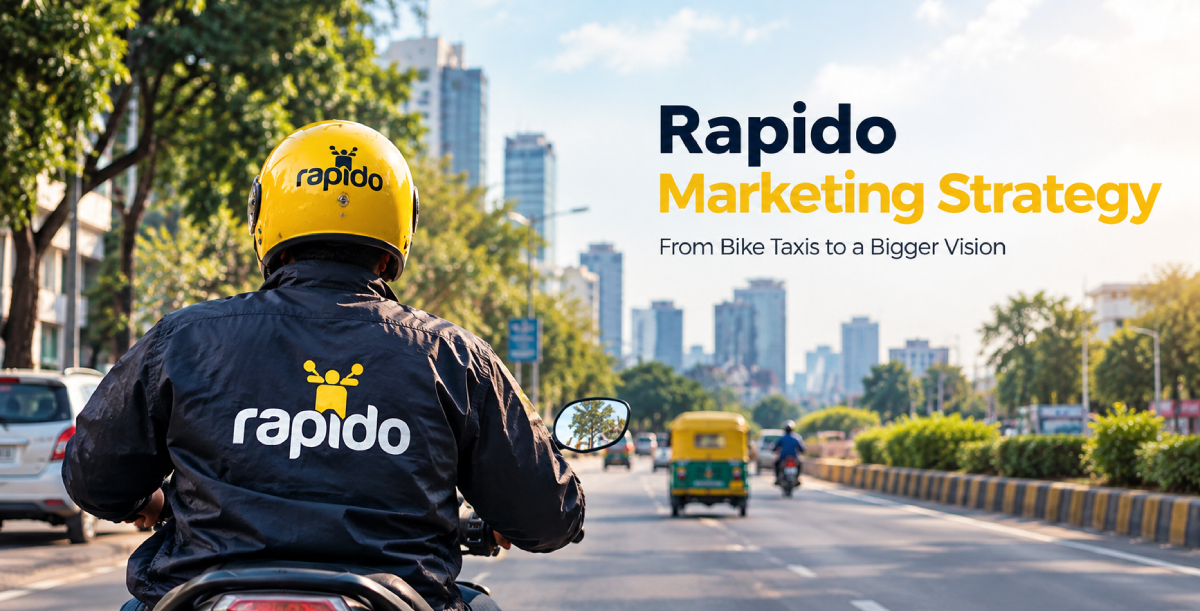
Table of Contents
Suppose you have a job appointment and you're running late.
There are a lot of people on the road. You're not too far to ride a cab, however, not far enough to walk.
After that you rent a bicycle.
You start driving in the traffic about 5 minutes later.
That's a very basic scenario, which is why that's a part of Rapido's marketing plan.
Whereas other ride-sharing startup models looked like just another new way to hail a cab, Rapido got its identity from one of the ubiquitous issues that face the residents of busy urban areas: the need to get from point A to point B in a timely, affordable and convenient manner.
The company Rapido, who started in 2015, concentrated on bike taxis. Ever since, it has branched out in a number of directions: autos, cabs and logistics; the original concept of a bike taxi has been expanded into a much wider mobility platform.
It Started With a Simple Problem
The series is based on a problem she encountered early one day.
Aravind Sanka, Pavan Guntupalli and Rishikesh S R were the founders of Rapido in 2015.
It was a very straightforward opportunity.
Indian towns have automobiles and numerous daily trips end up being fairly brief. With these trips, traveling by car does not always make the most sense, or the cheapest mode of transportation.
Rapido was concentrating on making two-wheelers.
The concept was straightforward: to enable people to travel more easily along the congested roads whilst remaining able to travel short distances.
However, making the service was just one of the challenges.
Rapido had to have two sides to the business: customers wanting to take rides and Captains wanting to make money.
This was an integral component of its growth journey.
The marketing of the product was started first.
Also Read : Zomato Success Story
Marketing Started With the Product
The company organised its bike rides around three easily understood concepts:
Affordable. Quick. Convenient.
Rather than providing an elaborate list of features, perhaps the brand should convey a simple benefit: If your destination is close by, a bike can be a convenient means of transportation.
This enabled Rapido to form a unique character of short-range commuter transport in the city.
The original bike-taxi positioning continued to be a crucial component of the company's brand story, and, later, the company branched out into autos and cabs.
Affordability Became Part of the Marketing
A frequency with which the service is used is one of the situations when price could be a strong marketing message.
Rapido's competitive pricing, promotions and marketing campaigns that targeted customers helped them to attract new users to the service.
The reasoning was simple.
If it is a reasonable price, it will get the attention of a first time customer.
If the customer can return, they were satisfied with the service in the first place.
The more customers there became, the more demand there was.
Captains Became Part of the Growth Strategy
There's a bit more ride availability for more Captains.
This established a link between the pricing, market and customer demand and supply.
In 2012, Caps joined forces with the growth strategy.
While customers may only see one side of the ride-hailing business, there is another as well—the driver.
Rapido refers to their drivers as Captains.
The company has increasingly turned its attention to the design of its platform to be attractive to the Captains, with a move towards Driver Economics. In fact, it has introduced some subscription-based element to its model instead of just being a ride-by-ride basis.
The idea is straightforward as long as the supply side of a marketplace is operating efficiently, customers may be able to potentially get rides more easily.
According to recent reports, Rapido’s monthly active users hit over 70 million and the number of drivers to almost 3 million by 2026.
That scale is an indicator of the importance of the Captain side of the business as well as customer acquisition.
Think City by City
India isn't just a market.
What might be a typical commuting routine for an individual in Bengaluru could be quite different from what it might be in Jaipur, Chennai, Lucknow or other Tier-2 cities.
Thus, Rapido has been promoting locally, regionally, through influencers and city specific promotions.
This is referred to as “hyperlocal marketing.”
Rather than have a statement which is merely "available in India" a brand can make the communication more relevant to the customer's city.
This can help make a national brand more eye-catching and appealing.
Also Read : Protien Pantry Success Story
Social Media Made the Brand More Relatable
Rapido has also been successful in communicating with customers in a more conversational manner on social media.
Its marketing has featured commuter emergencies, promos and safety and every day travel scenes.
The company has also collaborated with influencers and celebrities to reach a larger audience.
This gives the opportunity for two-way communication.
Mass awareness is derived from huge advertising campaigns and known personalities.
Everyday relevance is provided by social content that is relatable and local campaigns and situations that commuters can relate to.
It can be effective in maintaining the brand's presence in the life of the client for a mobility company.
Turning Commuting Problems Into Campaigns
A common strategy of Rapido's marketing has been to use known issues of commuters.
Bike taxis were used to highlight "affordability" as part of the “Bike Wali Taxi, Sabse Saxi” campaign and “#NoStressSawari” was used to talk about the stress of daily commuting.
As everyone knows, the very simple story formula is:
Identify a problem → show the frustration → introduce a simpler solution.
This method can be applied in other sectors other than mobility.
Technical product attributes can be forgotten but the solution to a problem can not.
Celebrity Marketing Added Reach
With increasing popularity of the brand, Rapido captured more eyeballs with celebrity endorsements.
The brand has featured celebrities such as Ranveer Singh in their ads.
However, a key factor in celebrity marketing is that it's not just about the celebrity.
While it is possible to make people aware of an ad, the only way to get them to stick with the service is to provide them with a reason to do so.
The other factors in play for Rapido are price, availability and convenience, which are complemented by advertising.
Rapido is now bigger than bike taxis.
The biggest evolution in Rapido's story is that it's gone beyond bikes.
It now includes bike taxis, auto and cab companies, and is expanding into logistics as well as even dabbling with food delivery.
This will provide the company with additional contact with customers.
It's possible to find out about Rapido initially on a bicycle trip.
That individual can rent an auto later on.
Other customers could use a cab.
It can be used by a business to deliver its network.
Rapido's gross order value was estimated to be $1.25 billion in FY25, which was approximately 2.5 times the FY24 figure due to the growth in its service.
The Numbers Behind Rapido’s Growth
These are the recent statistics depicting the significant scale up of the company.
- Founded: 2015
- Cities: 400+
- Active users: 70 million+ per month
- Drivers: nearly 3 million
- Total operating revenue FY 25: ₹866 crore
- FY25 net loss: ₹258 crore
- 2026 valuation: $3 billion
Operating revenue increased 44% year over year in its FY25 and net loss has decreased by approximately 30% year over year.
Prosus made the initial investment of $240 million in May 2026, giving Rapido the valuation of $3 billion post investment.
These numbers are indications that Rapido is no longer just a bike taxi business. It has grown to be a much bigger mobility platform.
What Businesses Can Learn From Rapido
1. Solve a problem people already have
Rapido didn't have to make a new problem. It was about a phenomenon which millions of commuters already face: navigating in the middle of a big city.
2. Keep the value proposition simple
A complicated product message is not as easy to understand for customers as “affordable, quick and convenient.
3. Construct both ends of a marketplace
Customers are only one factor of a platform. Supply matters too.
4. Think locally
It is still possible for a national business to have a different tone of voice for customers in various cities and regions.
5. Use marketing to assist the product.
Attention can be gained through advertising, but pricing and availability and customer experience determine if the customers will come back.
6. Expand around an existing network
Rapido's transition from bikes to autos, cabs and other services exemplifies the opportunities that can arise out of a pre-established customer and driver network.
The Bigger Lesson From Rapido
Rapido isn't just a story about advertising.
This is more about the link between product, pricing, supply and local marketing and behaviour.
A customer is able to observe an easy ride.
A Captain finds an earning opportunity.
Another mode of transport enters a city.
The more it gets activity, the more the platform gets!The more it gets activity, the more the platform gets!
That forms a cycle that perpetuates business growth.
It's a fascinating case study to see how an everyday problem can be transformed into a much bigger business, from bike-taxi startups that launched in 2015 to a platform in over 400 cities today.
Perhaps the most important takeaway is:
Rapido wasn't only selling bikes. It created a company that focused on the movement of people in India's cities.
Sources & Disclaimer
This article is independently written for informational and educational purposes using publicly available information from Rapido and other reliable sources. Facts, figures, services, campaigns, and company information may change over time. Readers should verify the latest information from official sources.
Primary Source: Rapido Official Website
This article is not affiliated with, sponsored by, endorsed by, or officially associated with Rapido or Roppen Transportation Services Pvt. Ltd. All trademarks, logos, brand names, and service names belong to their respective owners. This is an independent business and marketing case study.