Categories
- AI Tools & Technology 6
- Business Growth & Scaling 6
- Business Growth & Scaling 5
- Business Insights 24
- Cybersecurity 2
- Digital Marketing for Startups 11
- Digital Startup India 36
- Events & Networking 1
- Funding & Finance 1
- Startup Case Studies 25
- Startup Guides 14
- Startup India & Government Schemes 2
- Tech & Innovation 65
Recent Posts





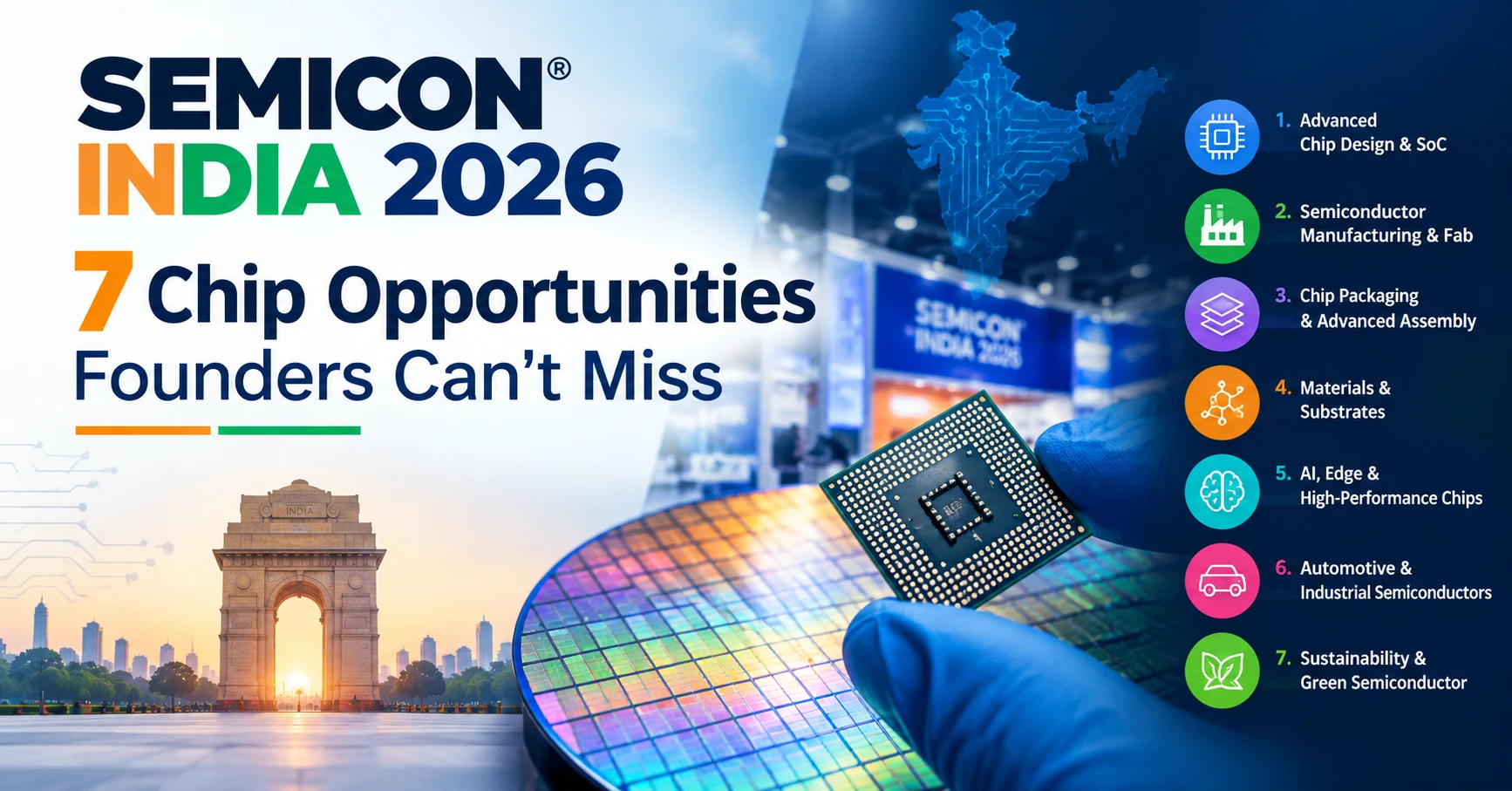
Table of Contents
SEMICON India 2026: Why Every Indian Founder Should Pay Attention Right Now (7 Big Opportunities Inside)
Ten years ago, India barely had a chip industry. Today the Prime Minister is opening one of the world's biggest semiconductor events in New Delhi, and global chip companies are showing up to see what India has to offer.
SEMICON India 2026 started today, 17 September 2026, at Yashobhoomi (India International Convention and Expo Centre) in New Delhi. PM Narendra Modi opened the event and spoke to the gathering.
If you're a founder, entrepreneur or business owner, you might think chips are only for big companies like Tata or Micron. They aren't. Chips go into almost every product people use, and the money, policy support and partnerships being set up this week will create openings for thousands of smaller businesses.
This guide covers what SEMICON India 2026 is, why it matters, and seven ways you can benefit from it.
What Is SEMICON India 2026?
SEMICON India 2026 is the 5th edition of India's main semiconductor conference and exhibition. It runs for three days and brings together:
- Global and Indian chip companies
- Policymakers and government leaders
- Investors and venture capital firms
- Researchers and academic institutions
- Startups and students
This year's theme is "Silicon to Systems: Building the Ecosystem." The idea is that India shouldn't stop at making chips. It should build the whole chain: raw materials, equipment, chip design, fabrication, packaging, and the finished electronic products we buy.
A new feature called the "Sand to Silicon to Systems" Value Chain Experience walks visitors through that journey, from sand (the source of silicon) to finished smart devices.
SEMICON India 2026: Key Facts at a Glance
| Detail | Information |
|---|---|
| Event | SEMICON India 2026 (5th edition) |
| Venue | Yashobhoomi, New Delhi |
| Dates | 17–19 September 2026 |
| Inaugurated by | PM Narendra Modi |
| Theme | Silicon to Systems: Building the Ecosystem |
| Participating companies | 600+ |
| Expected visitors | Around 50,000 |
| Countries represented | 52 |
| Speakers | 150+ |
| Executives | 400+ |
| Exhibition space | About 15,000 sq. metres |
| Country pavilions | Japan, South Korea, Malaysia, Netherlands, Singapore, Sweden |
| State booths | 12 |
| Special zones | Startup Pavilion, Innovation Showcase, Student Hackathon, Workforce Development Pavilion |
There are also six Country Roundtables set up to help companies form joint ventures, parallel sessions on the display industry, and a forum on women's leadership in tech.
Why India Is Making a Billion Bet on Chips
Chips are the new oil
Every smartphone, car, medical device, payment system and AI tool runs on semiconductors. As the global race for AI speeds up, chips are in short supply, and the countries that make them have a lot of power.
Countries like the US, Taiwan, South Korea and Malaysia spent decades building their chip industries. India has decided it can't wait that long.
The money behind the mission
- India started with an initial fund of about $10 billion to attract chip projects.
- About two months ago, the government pledged a further ₹1.9 trillion (around $19.8 billion) in subsidies for chip and electronics production.
- That brings the total to roughly $30 billion of public support.
It has worked before
India's earlier electronics subsidies (launched in 2020–21) helped Apple expand iPhone production in India. Today India makes about 25% of all iPhones. The government wants to repeat that success with semiconductors.
The bigger goal: jobs and exports
PM Modi's larger plan is to move more workers from farms into better-paying factory and tech jobs, and to grow exports in high-value industries. Chips are central to that plan.
As Pranay Kotasthane of the Takshashila Institution put it, SEMICON in New Delhi is PM Modi's way of signalling India's long-term commitment to the chip industry.
Where India's Chip Industry Stands Today
India's chip journey is still young, but it is moving:
- Tata Group and Murugappa Group have started packaging and assembling chips.
- US memory maker Micron Technology has started production in India.
- Tata is building a chip fabrication plant (fab) in Gujarat, expected to start working in early 2028.
- The government offers seed funding for semiconductor startups, plus support for chip-making equipment, new fabs and assembly units.
India began with legacy chips, the simpler chips used in electronics and power systems. The next challenge is moving to cutting-edge chips and advanced packaging.
7 Big Opportunities for Startups and Business Owners
This is the part that matters most for your business. You don't need to build a fab to benefit from SEMICON India 2026.
1. Chip design startups
Design needs brains more than big factories, and India already has a large pool of chip design engineers. Government programmes such as the Design Linked Incentive (DLI) scheme support startups building chips and chip-related IP.
Who it suits: tech founders with engineering backgrounds.
2. Supplying the big players
Every new fab and packaging unit needs hundreds of suppliers: specialty gases, chemicals, clean-room gear, testing tools, spare parts, logistics and maintenance.
Who it suits: manufacturing SMEs and industrial business owners.
3. Electronics and hardware products
When chips are made locally, Indian hardware brands can get parts more easily and design products for Indian needs, such as IoT devices, EV parts, smart meters and medical devices.
Who it suits: hardware and consumer electronics startups.
4. AI and edge computing
AI needs chips, and chips need software. Startups building AI models that run on devices, chip testing tools or design automation software can find partners at SEMICON India 2026.
Who it suits: AI and software founders.
5. Skilling and workforce training
The industry needs thousands of trained technicians and engineers. The Workforce Development Pavilion shows how big this gap is. Edtech and training companies can fill it.
Who it suits: edtech founders and training institutes.
6. Global partnerships and joint ventures
With six Country Pavilions and six Country Roundtables, Indian companies can meet partners from Japan, Korea, Singapore and elsewhere. For a small company, one good partnership can open a global market.
Who it suits: founders looking for export markets or foreign tie-ups.
7. Services around the ecosystem
Not every opportunity involves technology. The chip industry also needs legal, compliance, real estate, HR, consulting, financial and marketing services.
Who it suits: service businesses and consultants.
The Challenges You Should Know About
Chips are a big opportunity, but they come with real difficulties:
- Long timelines: chipmaking takes years, and returns are slow.
- High capital needs: even design startups need serious funding.
- Global competition: Taiwan, Korea and the US are decades ahead.
- Talent gap: skilled workers are still limited.
- Technology leap: India needs to move quickly from legacy chips to advanced ones.
Smart founders plan for these risks and go in with the full picture.
What Founders Should Do This Week
- Follow SEMICON India 2026 updates and note announcements about new policies and funding.
- Check the India Semiconductor Mission (ISM) website for current schemes and eligibility.
- Map your business to the value chain. Ask where your product or service fits between sand and finished systems.
- Connect on LinkedIn with exhibitors, speakers and startups from the Startup Pavilion.
- Look at your state's policy. Twelve states are exhibiting, and many offer extra incentives.
- Start small. A supplier contract or a pilot project can be your first step in.
Final Thoughts
SEMICON India 2026 is more than a tech expo. It shows that India wants to be a place where chips are made, not only bought.
For founders, that matters. The companies that move early, whether they design, supply, train or serve this industry, will be the ones leading it ten years from now. The next big Indian success story could come from this sector, and your company could be part of it.
Found this useful? Share it with a founder friend who should see it.