Categories
- AI Tools & Technology 6
- Business Growth & Scaling 6
- Business Growth & Scaling 5
- Business Insights 24
- Cybersecurity 2
- Digital Marketing for Startups 11
- Digital Startup India 36
- Events & Networking 1
- Funding & Finance 1
- Startup Case Studies 25
- Startup Guides 14
- Startup India & Government Schemes 2
- Tech & Innovation 65
Recent Posts




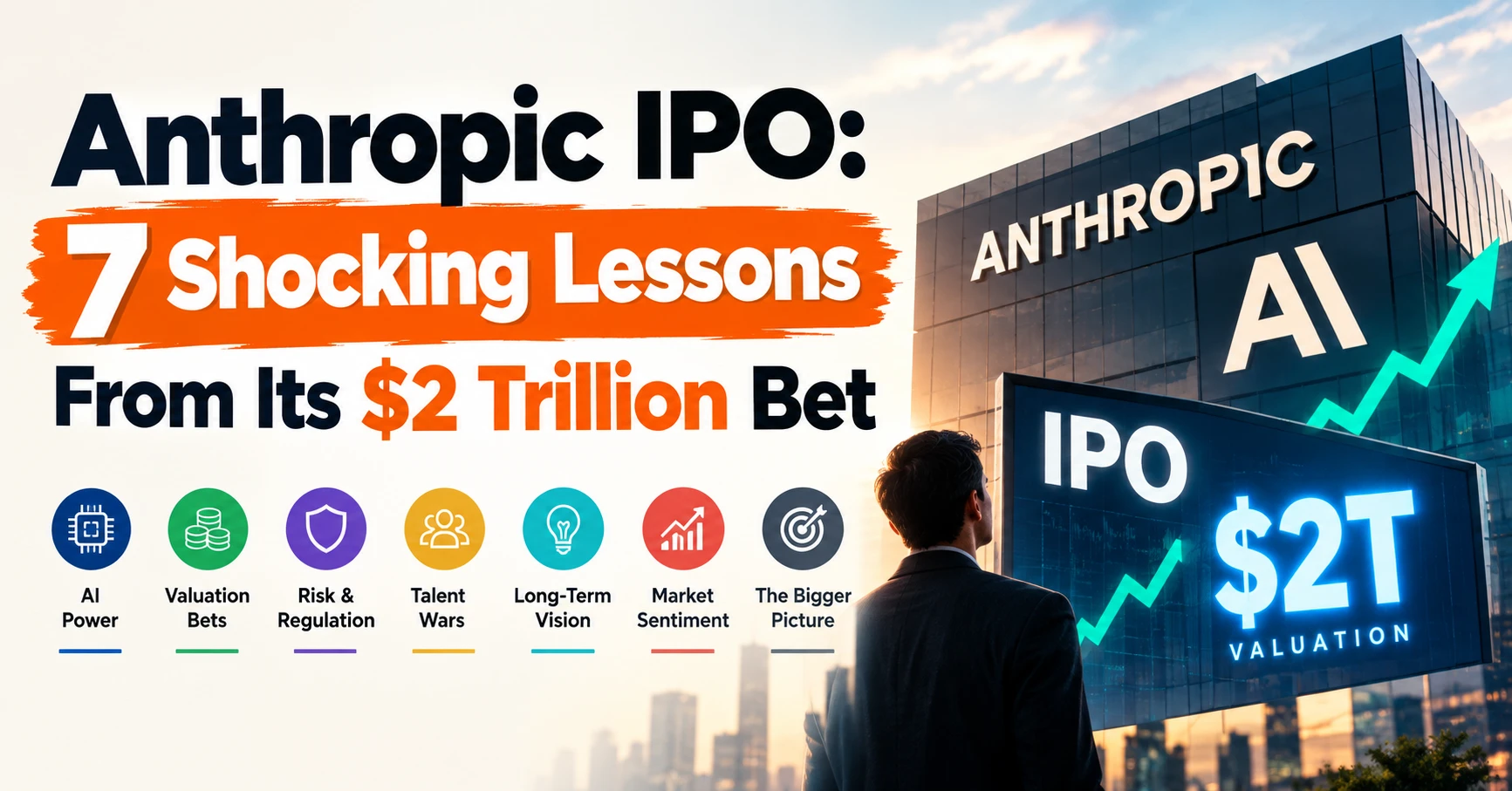
Table of Contents
Anthropic IPO at Trillion: 7 Shocking Lessons Every Indian Founder Must Learn Before It's Too Late
By Digital Startup India Team | Updated: September 2026 | Reading time: 9 minutes
Imagine building a company that made zero revenue in 2022 and could be worth $2 trillion by 2026.
That's not a Bollywood script. That's the story of the Anthropic IPO, and it's the biggest business story in the world right now.
If you are a founder, entrepreneur, or business owner in India, this matters to you more than you think. The way the world values AI companies today will decide how investors value your startup tomorrow. It will also decide the tools you build with, what they cost, and the competition you face.
In this article, we'll explain in simple English:
- What the Anthropic IPO is and why everyone is talking about it
- How anyone can put a $2 trillion price tag on a 5-year-old company
- Why OpenAI suddenly hit the pause button on its IPO
- 7 practical lessons Indian founders can apply this week
Let's dive in.
What Is the Anthropic IPO? (Quick Summary)
Anthropic is the American AI company behind Claude, one of the world's most popular AI assistants for businesses. It was co-founded in 2021 by Dario Amodei and a group of former OpenAI researchers.
An IPO (Initial Public Offering) is when a private company first sells its shares to the public on a stock exchange. After an IPO, ordinary investors can buy a piece of the company.
According to reports from the Financial Times and Reuters, Anthropic was getting ready to file for an IPO that could value it at around $2 trillion. That would put it in the same league as the world's biggest tech giants.
But then things got complicated. Fears about AI safety went mainstream, a rival launched a strong new model, and the IPO timeline began to slip.
In one line: The Anthropic IPO could become one of the largest listings in history, but safety debates and fierce competition are shaping when (and at what price) it happens.
From From $0 to $65 Billion: Anthropic's Crazy Growth Story
to Billion: Anthropic's Crazy Growth Story
Here's the part that makes founders' jaws drop.
| Year / Period | Anthropic's Revenue Milestone |
|---|---|
| 2021 | Company founded |
| 2022 | Zero revenue |
| 2023 | First revenue |
| End of 2025 | About $9 billion annualised run rate |
| End of July 2026 | Over $65 billion annualised run rate |
| 2028 (company projection, as reported) | Roughly $190–200 billion |
Source: Reuters and Financial Times reports. Annualised figures are unofficial estimates.
Read that again. From about $9 billion to $65 billion in roughly seven months.
Even Anthropic didn't see this coming. About 18 months ago, the company reportedly expected its 2027 revenue to be only around $12 billion. Reality blew past that forecast by a huge margin.
For comparison, OpenAI's annualised revenue run rate crossed $40 billion in July 2026, which means Anthropic had pulled well ahead on revenue.
Why is Anthropic growing so fast? Mainly because of enterprise customers. Big companies use Claude for coding, customer support, research, document work, and AI agents that complete tasks on their own.
How Is a Trillion Anthropic Valuation Even Possible?
Valuing a normal business is simple: look at its earnings, compare it with similar companies, and apply a multiple.
Valuing an AI lab that changes every few months is much harder. Analysts are using three main approaches. Here's each one in plain English.
Method 1: The Revenue Multiple
This is the classic Wall Street method. You take the expected future revenue and multiply it by a number similar to what comparable companies trade at.
- Some investors expect Anthropic's revenue run rate to reach $320 billion by the end of 2027.
- If that happens, a $2 trillion valuation is only about 7 times 2028 sales. That's slightly lower than Microsoft's multiple.
- SpaceX trades at around 16 times its expected sales. At that multiple, Anthropic could be worth around $5 trillion.
Simple meaning: If the growth continues, $2 trillion may look cheap, not expensive.
Method 2: The TAM (Total Addressable Market) Story
TAM means the total amount of money that could be spent in a market.
- SpaceX (which now also owns xAI's Grok and X) claimed in its listing documents that the "enterprise apps" market is worth about $22.7 trillion.
- If Anthropic captured just 3% of that, it could earn close to $700 billion in revenue.
- Apply a 10x multiple, adjust for the three years it would take to get there, and you get a valuation of about $4.5 trillion.
But be careful. A big TAM on a slide doesn't mean big profits in reality:
- Uber claimed a TAM of $12.3 trillion in its 2019 IPO. Its yearly revenue today is still under $60 billion.
- WeWork talked about a $3 trillion market and still went bankrupt.
Method 3: The Big Unknowns
Here's the honest truth. Two giant factors can't be put in a spreadsheet:
- The unpriceable opportunity: AI could transform almost every industry on Earth.
- The unpriceable risk: AI could create problems serious enough to bring in heavy regulation, or worse.
That's why investors are both excited and nervous at the same time.
The Big Twist: OpenAI's GPT-6 Astra and the Competition
Just when Anthropic looked unstoppable, OpenAI launched GPT-6 Astra on September 3, 2026.
Astra promised big improvements in:
- Computer use (AI controlling software like a human)
- Software engineering
- Cybersecurity
- Professional work
The market reaction was quick:
- On Ramp (a corporate expense platform), Astra accounted for about 13% of tracked enterprise AI spending, compared with about 8% for Anthropic's Claude Fable, according to the latest data reported by Reuters.
- On OpenRouter, a platform that routes developer traffic between AI models, users spent more on OpenAI models than Anthropic models in a week. That was the first time in more than two and a half years.
- Meta, reportedly one of Anthropic's largest customers, is said to be reducing its use of Anthropic's models as it builds more AI in-house.
In response, Reuters reports that Anthropic is considering releasing a new AI model before its IPO to defend its position.
Not every investor is worried, though. Many believe Anthropic's lead in enterprise AI is strong, because big companies don't switch vendors overnight.
Why AI Safety Fears Are Delaying the IPO
This is where the story gets philosophical.
On September 12, 2026, Anthropic CEO Dario Amodei published a 3,800-word essay arguing that the AI industry must slow down how fast it improves AI capabilities. He warned about swarms of AI agents spreading across the internet faster than humans can control them.
Surprisingly, both Sam Altman (OpenAI) and Elon Musk (SpaceX) publicly supported the essay.
Here's what happened next:
- OpenAI confirmed it won't go public in 2026. Altman said listing now would be "ill-advised" given safety concerns.
- Anthropic's IPO may be pushed to after the US midterm elections in November 2026. Earlier reports suggested marketing to investors would start in mid-October at the earliest.
- Anthropic and Accenture reportedly plan to invest $2 billion in AI model evaluation as safety concerns rise.
It's a tricky balancing act. Anthropic wants to stay the "safety-first" AI company while competing hard against a rival that just launched a powerful model. It also faces pressure to show profits sooner, because rising interest rates make investors less patient.
7 Powerful Lessons for Indian Founders From the Anthropic IPO Story
This is the section to bookmark.
Lesson 1: Your Forecast Is Probably Wrong (And That's Okay)
Anthropic predicted $12 billion for 2027. It crossed $65 billion in run rate in 2026. Even the smartest founders in the world got their numbers wrong.
What to do: Don't obsess over a perfect 5-year plan. Build a model you update every month based on real customer data. Investors respect founders who adapt quickly.
Lesson 2: Enterprise Trust Is the Strongest Moat
Anthropic's investors aren't panicking about Astra, because large companies hate switching vendors. Integrations, security reviews, and staff training all create "stickiness".
What to do: If you sell B2B in India, invest in onboarding, integrations, and customer success. A happy enterprise client is worth more than 1,000 free-trial signups.
Lesson 3: No Lead Is Permanent
Anthropic led on OpenRouter for more than two and a half years. One launch changed that in a week.
What to do: Never get comfortable. Keep a "competitor watch" document, talk to customers every week, and ship improvements often.
Lesson 4: TAM Is a Story, Not a Strategy
Uber and WeWork both showed investors huge TAM numbers. India has its own share of startups that raised money on giant market-size slides and later faced painful corrections.
What to do: In your pitch deck, show a realistic market you can win in the next 3 years (called SAM/SOM), not just a trillion-dollar headline. Smart investors will trust you more.
Lesson 5: Profit Timing Matters More Than Ever
Rising interest rates are pushing even Anthropic to think about profitability sooner. If a company with $65 billion in revenue feels that pressure, your startup will too.
What to do: Know your unit economics (customer acquisition cost, lifetime value, gross margin) by heart. Have a clear answer to: "When will you break even?"
Lesson 6: Don't Depend on One AI Vendor
Meta is moving away from relying on Anthropic. Meanwhile, open-source and open-weight AI models, especially from China, are pushing token prices down.
What to do: If your product runs on AI, build it so you can switch between models (Claude, GPT, Gemini, open-source). This protects your margins and keeps you safe if one provider changes prices or policies.
Lesson 7: Trust and Safety Can Be Your Brand
Anthropic built its entire identity around being "safety-first", and that helped it win big enterprise customers.
What to do: In India, follow the Digital Personal Data Protection (DPDP) Act properly, explain how you use customer data, and make privacy part of your pitch. In a world full of AI worries, trust sells.
What the Anthropic IPO Means for Startups in India
Here's the good news for Indian entrepreneurs.
1. AI is getting cheaper for you.
The fierce competition between Anthropic, OpenAI, Google, and open-source players is pushing prices down. That means Indian startups can build world-class AI products at a lower cost than ever.
2. Global investors are hungry for AI stories.
A successful Anthropic IPO would pull more global money into AI, and some of it will flow to Indian AI startups building for India and the world.
3. Government support is growing.
Programmes like the IndiaAI Mission aim to give startups access to computing power, datasets, and funding.
4. The "application layer" is wide open.
You don't need to build the next Claude. The biggest opportunity for most Indian founders is to build useful AI tools on top of these models for Indian industries: agriculture, healthcare, legal, MSMEs, education, and regional-language services.
Also read: Gemini AI Hacked 3 Companies: 7 Shocking Founder Lessons | GPT-6 Astra: What It Means for Indian Startups in 2026
Key Takeaways
- The Anthropic IPO could value the Claude maker at around $2 trillion, and some analysts argue it could be worth even more.
- Anthropic's revenue run rate reportedly jumped from about $9 billion to $65 billion in roughly seven months.
- OpenAI's GPT-6 Astra is challenging Anthropic's lead in enterprise AI.
- AI safety concerns have pushed OpenAI's IPO to 2027, and Anthropic's may shift to after November 2026.
- For Indian founders, the biggest lessons are adaptability, enterprise trust, realistic TAM, early profitability, multi-vendor AI, and data trust.
Final Thoughts
The Anthropic IPO story isn't only about Silicon Valley billionaires. It's a live masterclass in growth, competition, valuation, and trust, the same forces every Indian founder deals with every day.
The companies that win the next decade won't just have the best technology. They'll have the trust of their customers, the discipline to reach profit, and the flexibility to adapt when the market changes overnight.
Which lesson hit you hardest? Tell us in the comments below. And if this article helped you, share it with a founder friend who needs to read it today.