Categories
Recent Posts







Table of Contents
Karnataka's ELEVATE 2026 Is Back: How to Grab a ₹50 Lakh Government Grant (Step-by-Step)
Introduction
While for many founders, the most difficult part is creating a great product, the more difficult part may well be finding the funding to make the idea a successful business. Although VC and angel investors are a tried and true method for funding startups, government grants are an option that many startups desperately need: funding without surrendering equity.
Hence, Karnataka's ELEVATE 2026 program has emerged as one of the most sought-after startup programs in India. It has been introduced for early-stage innovative companies and provides support through grant-in-aid up to ₹50 lakh, besides mentorship and incubation support and facilities to connect with the government's innovation ecosystem.
The 2026 edition will be even more inclusive than the previous years. In a significant move, for the first time, there are four different tracks—General, Shakti (Women-led), Unnati (SC/ST founders) and Aspire (Beyond Bengaluru)—on which startups can apply, thus enabling more entrepreneurs to be included across all the four tracks in Karnataka.
In case you are looking for funding, this guide will assist you with understanding the program, the eligibility criteria, and also the total process of applying for funding.
Who is Karnataka's ELEVATE 2026 Program?
The Government of Karnataka's flagship Grant-in-Aid program for the innovative startups is called ELEVATE. The government offers financial support in lieu of developing equity in your company, to prototype, validate products, and speed up the growth of your business.
Selected startups can get a funding of up to ₹50 lakh that can be disbursed in stages as the startup grows. In addition to financial support, startups will also benefit from mentors, centres of excellence, incubators and accelerators funded by the government.
Founders keep all equity in their company, and have step-by-step support to help them get from idea to marketable product unlike startup investments.
Why ELEVATE Matters
Startups in their early stages face difficulties when it comes to raising capital, as they may have a small amount of revenue or not have much market traction.
One way to fill in this gap is through the use of government grants, such as ELEVATE, which can be used to fund ideas that would otherwise be appealing to private investors.
This kind of funding can be very useful for founders who are developing innovative technology, healthcare, education, agriculture, sustainability, manufacturing or digital solutions, helping them to ease the financial strain at the product development phase.
What's new in ELEVATE 2026?
The program, which is the largest change since its inception, was introduced this year.
Karnataka has initiated the four categories of calls together rather than holding them separately throughout the year, for a more inclusive and user-friendly application process for different founders across the state.
The Four Application Tracks
Applicants are eligible to apply in various categories as per their eligibility.
The eligible startups in Karnataka are welcome to apply for the general category. ELEVATE Shakti 2026 helps and empowers startups with the addition of at least 51% women ownership to the team to promote more women entrepreneurs to participate in the start-ups. ELEVATE Unnati 2026 is in its exclusive entrepreneurship way of promoting inclusive entrepreneurship, with at least 70% SC/ST ownership in the startup. ELEVATE Aspire 2026 is dedicated to startups outside Bengaluru Urban and is a part of the Local Economy Acceleration Programme (LEAP) to boost innovation across the state.
Each application is reviewed by the government, and is classified in the most suitable category according to the eligibility criteria.
Who Can Apply?
Not all businesses are eligible for a grant. It's important to know the requirements of the application before you start applying.
In general, the startup(s) should be identified as startups and should fulfil the conditions as mentioned in the program guidelines, operating in Karnataka. Founders also need to have the following documents ready before applying: Registration documents, Incorporation documents, Financial information, Supporting documents.
Preparing Your Documents
The first step in the preparation of an application is to have all the documents ready. Startups need to have their company registration information, incorporation certificates, founders' profiles, business information, financial records and the grant utilization plan organized prior to filling out the application form.
It's also crucial to have a professional pitch deck as it conveys the business idea, opportunity in the market, competitive edge and plans for growth. Some extra declarations or supporting documents may be required based on the category chosen.
The preparation of these documents beforehand benefits not only in terms of saving time but also for a good first impression during the evaluation.
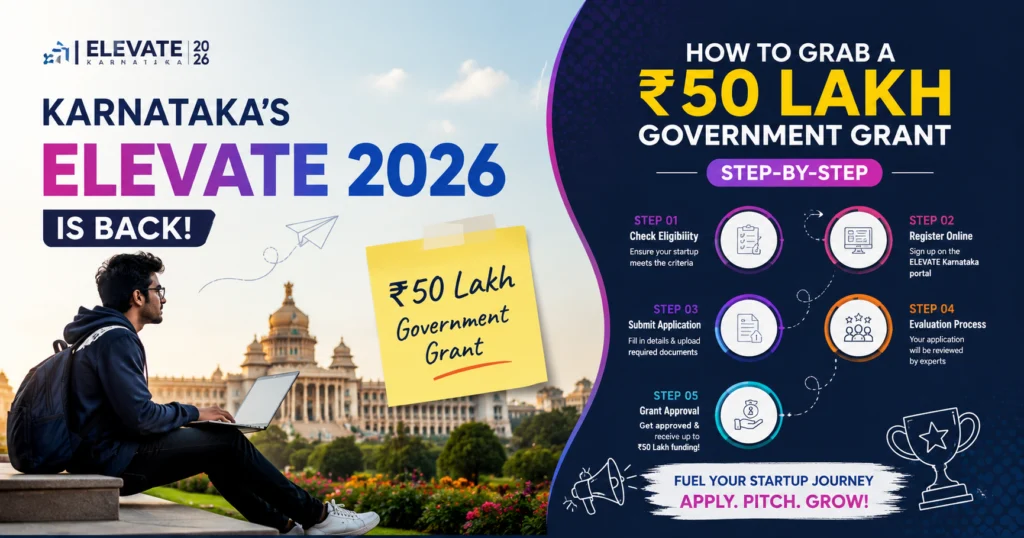
Step-by-Step Application Process
It's not just a matter of filling out an online application to ELEVATE. The program is based on a systematic evaluation process which includes assessment of your startup's innovation, business perspective and execution ability.
Step 1: Complete the Online Application
The first step will be to apply through the ELEVATE Application Portal.
Applicants will have to submit information regarding their startup, founders, business model, innovation, financials, and how the grant will be used. Uploading of supporting documents and application of the pitch deck are also part of the application.
The accuracy is crucial as the evaluation could be delayed if there is incomplete or incorrect information.
Step 2: Build a Strong Pitch Deck
One of the most important components of the application is your pitch deck.
It should concisely describe the problem that your startup is solving, how your solution is unique, the market opportunity, your revenue model, the strengths you have in competition, your team's skills and abilities, financial projections, and how you'll use the grant.
A well-presented, organized and concise application can make your startup shoot to the top of the pile when it comes to reviewers' approval.
Step 3: Initial Screening
Applicants' applications are initially screened for eligibility and completeness of information provided.
The review committee reviews whether the start-up does or does not meet the programme requirements before progressing to the next stage of evaluation. The pitch deck is an essential component in the evaluation process, so founders need to check every aspect carefully before it is submitted.
A well thought and well prepared application puts one in better odds of moving forward in the selection process.
The Evaluation Process is explained.
If your application passes the initial screening process, it will proceed to a detailed evaluation process. The stage is designed with the purpose of finding startups that have innovative ideas, impressive execution capacity and potential to be a catalyst for economic and social change.
The evaluation committee is usually made up of industry experts, startup mentors, investors, academics and government officials who evaluate each application from a number of angles. They analyze not just the idea itself, but also, whether or not the founders are capable of effectively bringing the vision to fruition.
Innovation and Problem-Solving
One of the first aspects reviewers evaluate is the originality of your solution.
They look at whether your startup addresses a genuine problem and whether your product or service offers a meaningful improvement over existing solutions. A startup solving a real industry challenge with a practical and scalable approach is likely to receive stronger consideration than one with only a broad business concept.
Market Potential
A great idea also needs a viable market.
Reviewers want to understand who your customers are, how large the market opportunity is, and whether there is clear demand for your product or service. Demonstrating customer validation through pilot projects, early sales, or user feedback can significantly strengthen your application.
Team Capability
Behind every successful startup is a capable team.
The evaluation panel considers the founders' experience, technical expertise, industry knowledge, and commitment to building the business. Even if a startup is at an early stage, a passionate and skilled team often creates confidence in its future potential.

How to Improve Your Chances of Selection
Receiving a government grant is highly competitive, so submitting a complete application alone is rarely enough. Founders should focus on presenting a business that is both innovative and practical.
Clearly Define the Problem
Many applications spend too much time describing the product and too little time explaining the problem.
Start by identifying the challenge your customers face. Then explain how your solution addresses that challenge more effectively than existing alternatives. When reviewers clearly understand the problem, they are more likely to appreciate the value of your innovation.
Demonstrate Real Progress
Even if your startup is still in its early stages, evidence of progress can strengthen your application.
This could include a working prototype, customer feedback, pilot projects, partnerships, letters of intent, or early revenue. These achievements show that your idea has moved beyond the concept stage.
Present a Realistic Financial Plan
The grant committee also wants to know how the funding will be used.
Instead of providing broad estimates, explain how the grant will contribute to product development, research, hiring, testing, marketing, or market expansion. A realistic budget demonstrates responsible financial planning and increases credibility.
Common Mistakes That Reduce Selection Chances
Many startups miss funding opportunities because of avoidable mistakes rather than weak business ideas.
One common issue is submitting incomplete applications or missing required documents. Even a strong startup may face delays if important information is missing.
Another frequent mistake is using complicated technical language without clearly explaining the business value. Reviewers should be able to understand your solution without needing extensive industry knowledge.
Some founders also present overly optimistic financial projections without supporting evidence. While ambition is important, realistic assumptions backed by market research tend to create greater confidence.
Poorly designed pitch decks are another challenge. Crowded slides, inconsistent formatting, excessive text, and unclear messaging can make it difficult for reviewers to understand your business quickly.
A Practical Example
Imagine two startups applying for ELEVATE funding.
Startup A has developed an AI-powered agriculture platform but submits a presentation filled with technical terminology and vague financial estimates. The application explains the technology in detail but provides little evidence of customer demand or implementation plans.
Startup B is building a similar solution but begins by describing the challenges faced by farmers, presents a working prototype, includes testimonials from pilot users, explains its revenue model, and clearly outlines how the grant will accelerate product development.
Although both startups have promising ideas, Startup B creates greater confidence because it combines innovation with practical execution and measurable progress.
Why Programs Like ELEVATE Matter
Government grants play an important role in strengthening India's startup ecosystem.
Unlike traditional funding, grants allow founders to focus on innovation without giving up ownership in their company. This makes them especially valuable for early-stage businesses that are still refining their products or validating their market.
For many startups, grant funding also acts as a stepping stone toward future investment. Successfully receiving support through a recognized government program can improve credibility with incubators, investors, and strategic partners.
In addition to financial assistance, programs like ELEVATE encourage collaboration between entrepreneurs, research institutions, industry experts, and government organizations, helping startups build stronger networks and accelerate growth.

Final Preparation Before You Apply
Submitting an application should be the final step—not the first. Before applying for ELEVATE 2026, take time to review every aspect of your business and application.
Ensure your startup registration details, financial information, founder profiles, and supporting documents are accurate and up to date. Your pitch deck should present a compelling story, supported by realistic data and a clear roadmap for growth.
It's also worth asking mentors, incubators, or experienced entrepreneurs to review your application before submission. A fresh perspective can help identify gaps that you may have overlooked.
Most importantly, be prepared to explain why your startup deserves government funding and how the grant will create measurable business and social impact.
The Future of Startup Grants in Karnataka
Karnataka has consistently been one of India's leading startup hubs, and initiatives like ELEVATE demonstrate the state's commitment to encouraging innovation.
As emerging technologies such as artificial intelligence, deep tech, biotechnology, clean energy, agritech, and health-tech continue to grow, government-backed funding programs are expected to play an increasingly important role in supporting early-stage ventures.
Future grant programs are also likely to place greater emphasis on sustainability, inclusive entrepreneurship, regional innovation, and solutions that address real-world challenges.
For founders, this means building businesses that are not only commercially viable but also capable of creating long-term value for society.
Why Every Founder Should Consider Government Grants
Many entrepreneurs focus exclusively on angel investors or venture capital when looking for funding. While these options can accelerate growth, government grants offer a unique advantage—they provide financial assistance without requiring founders to dilute their ownership.
For startups in the early stages, this can make a significant difference. Grant funding allows founders to invest in research, product development, market validation, and team expansion while retaining greater control over their company.
Even if your startup does not receive funding on the first attempt, the application process itself can be valuable. Preparing a strong business plan, refining your pitch deck, and clearly defining your growth strategy are exercises that strengthen your business and improve your readiness for future opportunities.
Conclusion
Karnataka's ELEVATE 2026 program offers much more than financial assistance. It provides early-stage startups with an opportunity to transform innovative ideas into scalable businesses through funding, mentorship, and access to a supportive startup ecosystem.
Securing a grant of up to ₹50 lakh is competitive, but startups that present a well-defined problem, demonstrate innovation, validate market demand, and prepare a compelling application stand a much stronger chance of success.
Instead of viewing the application as just another form to complete, treat it as an opportunity to showcase your vision, your team's capabilities, and the impact your startup can create.
Whether you're building a technology platform, healthcare solution, educational product, agritech innovation, or sustainability-focused venture, ELEVATE 2026 could become the catalyst that helps turn your idea into a successful business.

Ready to secure up to ₹50 lakh in government funding for your startup?
Don't miss the ELEVATE 2026 opportunity. Understand the eligibility, prepare your application, and follow the right steps to maximize your chances of success. Start your funding journey today and turn your innovative idea into a scalable business.
Faq's
What is Karnataka ELEVATE 2026?
ELEVATE 2026 is a Government of Karnataka startup grant program that provides funding of up to ₹50 lakh for eligible innovative startups.
Who can apply for ELEVATE 2026?
Eligible startups registered in Karnataka that meet the program's criteria can apply under the relevant category.
Is the ELEVATE grant equity-free?
Yes. The grant is provided as financial assistance, allowing founders to retain ownership of their startup.
What is the maximum grant amount available?
Selected startups can receive grant funding of up to ₹50 lakh, subject to program guidelines and evaluation.
What documents are important for the application?
Applicants typically need startup registration details, founder information, financial records, a business plan, supporting documents, and a well-prepared pitch deck.
ELEVATE 2026 is a Government of Karnataka startup grant program that provides funding of up to ₹50 lakh for eligible innovative startups.
Eligible startups registered in Karnataka that meet the program's criteria can apply under the relevant category.
Yes. The grant is provided as financial assistance, allowing founders to retain ownership of their startup.
Selected startups can receive grant funding of up to ₹50 lakh, subject to program guidelines and evaluation.
Applicants typically need startup registration details, founder information, financial records, a business plan, supporting documents, and a well-prepared pitch deck.