


Introduction
Discover why Small Town Startups India are driving innovation, creating successful businesses, and transforming Tier 2 and Tier 3 cities into startup hubs.
If anyone had the idea of creating a unicorn in India, 10 years ago the unspoken rule was that they should relocate from their hometowns to Bengaluru, Mumbai, or Delhi. These were the places where investors dwelt, talents coalesced, and opportunities abounded. But all that is changing.
In today's context, some of the most interesting startups in India are getting developed away from the biggest metros of the country. Many cities such as Indore, Jaipur, Coimbatore, Surat, Kochi, Bhubaneswar and Lucknow are quietly emerging as innovation hubs. But, great ideas don't require a pin code, as entrepreneurs are proving. They rely on their visual perception, determination and problem-solving abilities to solve real-life problems.
The Changing Face of India's Startup Ecosystem
The change is reshaping the Indian startup landscape and is creating fresh avenues for the startup founders, investors, and communities to flourish.
The Evolving Reality of Indian Startups Ecosystem
The startup culture of India used to be largely driven by the metros, which were more convenient to secure funding and hire skilled talent as well as have access to business infrastructure. But in the age of digital transformation, things have changed.
The ease of internet access, electronic payments, the cloud-based system, shifting to a remote workforce and the support of government startup programs have enabled entrepreneurs to start and grow businesses from virtually anywhere in the country.
In the past, many business owners decided to move to other cities to establish businesses that were unfamiliar to them, but now, many are opting to nestle their businesses in their hometowns where they grasp the needs and demands of local markets.
Why Smaller Cities Have Become Startup Hotspots
Lower Operating Costs
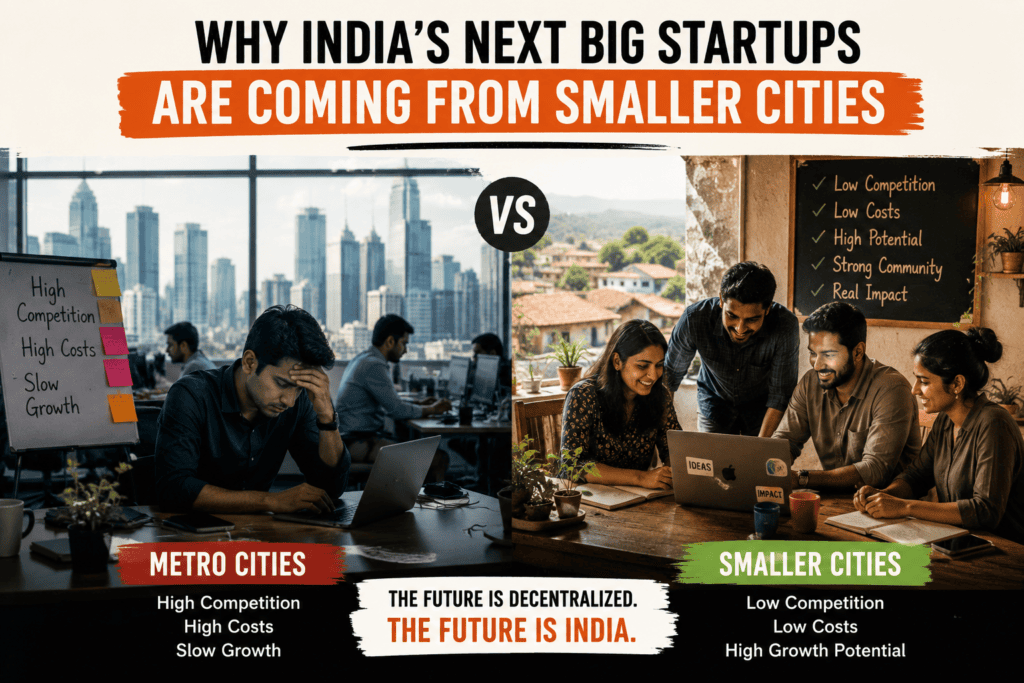
Financial planning is critical when it comes to running a startup. The costs of renting office space, salaries of employees and operations expenses are much lower in Tier 2 and Tier 3 cities as opposed to metros. This enables startups to concentrate more on product growth, technology, and customer acquisition, which will help them save on overheads.
Untapped markets
Smaller cities are home to millions of consumers who are now digital users. Need may vary for those living outside the city; this may be a great opportunity for startups to cater to these expanding target markets with products and services.
Knowing the challenges in the region, entrepreneurs are able to create solutions which larger companies might not think of.
Growing Talent Pool
The Indian educational system is churning out skilled engineers, management professionals, healthcare professionals, and technocrats. In the past, many professionals have also been relocating to the metros for employment. With the advent of telecommuting and local startup communities, they are opting for a career nearer to home.
This pool of talent is booming and is assisting startups in finding good employees without the fierce competition for talent.
How to create solutions to local problems that draw on global needs
The one thing that the entrepreneurs of smaller cities have, is their knowledge of the challenges that exist in their hometown. Do not create products that already have a lot of competition, but instead try to address day-to-day issues that directly impact their communities. From strengthening food supply chains to creating more convenient health care services, to digitizing local businesses, these startups are finding very real solutions that could expand to a national and global scale.
Past history has demonstrated that numerous enterprises that prosper began by fulfilling a basic local need. If the solution is successful, it may then be modified to be used in other parts of the world with similar problems. This method helps start-ups in smaller cities have a distinct competitive advantage.
Government assistance is helping the growth flourish
The Indian government has implemented various schemes for encouraging entrepreneurship out of metros. The programs for startup incubation, development of digital infrastructure, funding opportunities, and skill development have created an environment conducive to the growth of innovation throughout the country.
Incubation centers, state startup missions and university-based innovation programs are also assisting new entrepreneurs to overcome the hurdle of getting their ideas off the ground.
Education and Skill Development Are Driving Entrepreneurship
Tier 2/ Tier 3 cities' educational institutes are contributing significantly in the development of future entrepreneurs. Universities and colleges are creating entrepreneurship courses, startup incubation centers, hackathons and innovation competitions to promote students' thinking out of the box.
More young graduates are confident of starting their own business rather than pursuing employment in a business. This cultural change is helping to produce a new generation of business leaders prepared to innovate in their own communities.
Success Stories Inspiring a New Generation
The success stories will be shared as a means to inspire the next generation.
But there is nothing to stop many successful start-ups from functioning in small towns too, as some have demonstrated in India. The companies that started outside the “Big Four” startup ecosystems have all gone on to grow into businesses on a national and global scale, having solved real-life issues and prioritized the customer experience.
Their success has encouraged young entrepreneurs to think that they can establish a promising business without moving to the high-cost metros.
The emergence of Startup Communities outside of Metro Cities
Working as an entrepreneur is often a lonely journey, particularly during the inception of developing a business. Luckily, there are start-up ecosystems sprouting in smaller cities, spaces for working together, networking, and hubs for innovation, bringing together founders, mentors, investors, and other entrepreneurs.
Such communities are based on collaboration, not competition. Young entrepreneurs can get ideas, valuable feedback, and learn from an expert. As they grow these ecosystems are providing a context for startups to flourish without having to move to big cities.

The Advantages of Building a Startup in Smaller Cities
Being outside a metro area presents several viable advantages when it comes to starting a business.
These benefits allow startups to expand without the hustle and bustle of big cities.
Impact on local economies
Small cities are the birthplace of a lot more than just successful business startups. It's creating jobs, incentivizing local suppliers, adding to real estate demand, and creating a demand for professional services. With the growth of new companies, the economy of the regions is being developed.
This positive cycle works for entrepreneurs, students, skilled folks, small business owners and communities in general. A strong startup ecosystem can attract, and keep, talent in the city, while providing more sustainable opportunities in and around the city that are less likely to lead to migration to metropolitan areas.
Challenges Still Exist
Despite the momentum, founders in smaller cities continue to face certain challenges.
Access to venture capital is still more concentrated in metropolitan regions. Networking opportunities with investors and experienced mentors may also be less frequent. Some specialized industries require talent that remains concentrated in larger cities.
Fortunately, virtual meetings, online investor networks, startup accelerators, and remote collaboration tools are reducing these barriers every year.
Investors Are Looking Beyond Traditional Startup Hubs
Venture capital firms and angel investors are no longer limiting their search to Bengaluru, Mumbai, or Delhi. They understand that innovation can emerge from any corner of the country, especially when founders have a strong understanding of underserved markets.
The increasing availability of virtual pitching events, online demo days, and startup accelerators has made it easier for entrepreneurs from smaller cities to present their ideas to investors. As a result, funding opportunities are becoming more accessible than ever before.
The Role of Technology in This Transformation
Digital Infrastructure
High-speed internet and cloud-based software have made location less important than ever before. Teams can collaborate, serve customers, and scale operations from virtually any city.
Remote Work Culture
The widespread adoption of remote work has allowed startups to hire skilled professionals from across India without requiring everyone to work from a central office.
Digital Payments and E-commerce
Platforms supporting digital transactions and online commerce have enabled businesses from smaller cities to reach customers nationwide without establishing a physical presence in major metropolitan markets.

What Aspiring Entrepreneurs Can Learn
The success of startups in smaller cities proves that building a business is no longer dependent on location. What matters most is identifying a real problem, understanding your target audience, and consistently delivering value. With digital tools, online learning platforms, and remote collaboration becoming more accessible, entrepreneurs have everything they need to start and grow a business from virtually anywhere.
For aspiring founders, this shift is an opportunity to think differently. Instead of waiting for the perfect city or the perfect time, they can focus on solving meaningful problems within their own communities. Many of tomorrow's successful startups will likely begin with simple ideas backed by determination, innovation, and a willingness to take the first step.
What This Means for India's Future
India's startup story is becoming more inclusive. Innovation is no longer concentrated in a handful of cities. Instead, entrepreneurship is spreading across the country, bringing economic development, employment, and technological progress to regions that were once overlooked.
As infrastructure continues to improve and investment reaches new markets, smaller cities are likely to produce many of India's next generation of successful startups.
Why This Trend Is Only Getting Stronger
The rise of startups in smaller cities is not a temporary trend—it reflects a long-term transformation in India's entrepreneurial landscape. Better digital infrastructure, affordable technology, supportive government initiatives, and increasing investor interest have created a strong foundation for sustained growth.
As more success stories emerge from Tier 2 and Tier 3 cities, they inspire countless aspiring entrepreneurs to believe that location is no longer a limitation. Over the coming years, these cities are expected to become major contributors to India's innovation economy, proving that great businesses can be built wherever talent, determination, and opportunity come together.
Conclusion
The future of India's startup ecosystem won't be defined solely by Bengaluru or Mumbai. It will be shaped by ambitious entrepreneurs building businesses in cities where opportunity meets local insight.
Smaller cities offer affordability, talent, expanding markets, and supportive ecosystems that allow startups to grow sustainably. As digital transformation continues and government support strengthens, these emerging startup hubs will play an even bigger role in India's economic growth.
Sometimes, the next big idea doesn't begin in the country's busiest streets—it begins in a city where someone simply sees a problem worth solving.
 Ready to turn your idea into a successful startup? Start building today—because the future of Indian entrepreneurship is being written in small towns, and your story could be next.
Faq's
Lower operational costs, improved digital infrastructure, skilled local talent, and expanding consumer markets make Tier 2 and Tier 3 cities attractive locations for startups.
Cities such as Jaipur, Indore, Coimbatore, Kochi, Surat, Bhubaneswar, Lucknow, Chandigarh, and Ahmedabad are witnessing rapid startup growth.
Yes. Many investors now actively explore startups across India, especially those solving unique regional problems with scalable business models.
Technology, healthcare, education, agriculture, fintech, logistics, manufacturing, e-commerce, and software services are among the fastest-growing sectors.
They benefit from lower costs, stronger local networks, better understanding of customer needs, and improved work-life balance while contributing to regional economic development.
Absolutely. Remote work enables startups to hire talent from anywhere while operating efficiently from smaller cities.
Lower operational costs, improved digital infrastructure, skilled local talent, and expanding consumer markets make Tier 2 and Tier 3 cities attractive locations for startups.
Cities such as Jaipur, Indore, Coimbatore, Kochi, Surat, Bhubaneswar, Lucknow, Chandigarh, and Ahmedabad are witnessing rapid startup growth.
Yes. Many investors now actively explore startups across India, especially those solving unique regional problems with scalable business models.
Technology, healthcare, education, agriculture, fintech, logistics, manufacturing, e-commerce, and software services are among the fastest-growing sectors.
They benefit from lower costs, stronger local networks, better understanding of customer needs, and improved work-life balance while contributing to regional economic development.
Absolutely. Remote work enables startups to hire talent from anywhere while operating efficiently from smaller cities.


