Categories
Recent Posts



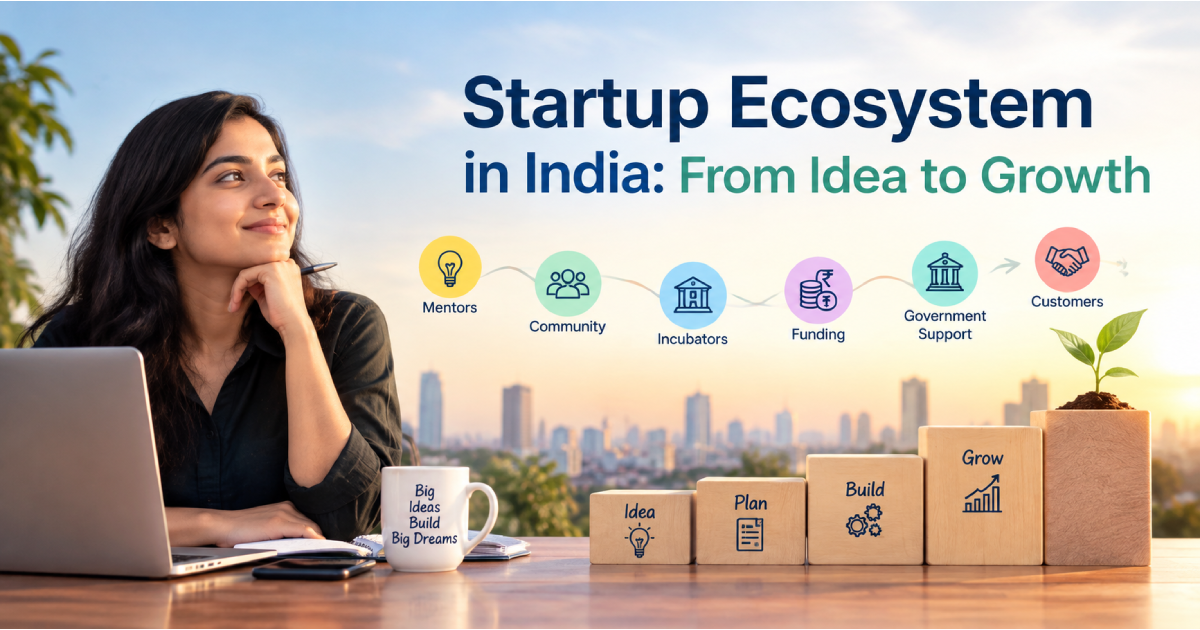
Table of Contents
Startup Ecosystem in India: From Idea to Growth
A start-up company starts at an unknown place and time.
Perhaps it's the fact that there's a problem that nobody's solved right. Perhaps it starts with a founder who realizes there's something they are missing in the market. Maybe it begins with a chat between two people that think they can make something better.
Initially perhaps it is just a concept, a notebook, a laptop and a ton of questions.
How to make this? Who can guide me? What are the ways to discover customers? Do I need funding? What are the ways to connect with the suitable people?
That's where the Startup Ecosystem comes into the picture.
A start-up is not an isolated entity. There are a number of people behind businesses who can support entrepreneurs at the various stages of growth—founders and mentors, investors, incubators, accelerators, universities, government programmes, customers and communities.
India's Startup Ecosystem is a collection of many such people and resources.
What is a Startup Ecosystem?
In other words, the Startup Ecosystem is a collection of individuals, groups, institutions and opportunities that facilitate startups.
A startup ecosystem is a combination of entrepreneurs, startups in various stages, supporting, funding, research and knowledge hubs, according to Startup India.
Imagine that it's like a team.
The Founder has the idea. Have a mentor give you guidance. There is a crying need for an incubator that can help at the early stages of the business. The investor can put in the capital. A community has the ability to develop linkages. Opportunities for customers to give suggestions. Some support and resources can be accessed via government programmes.
They can be used for different purposes in each part.
For the first-time founder, it helps knowing where to find them that can help you better understand the startup journey.
The Journey Starts With an Idea
Suppose that there was a founder named Riya.
Riya observes that small businesses around her are not able to reach out to their customers online. She thinks she can create a basic digital tool which would help them.
Her initial efforts are devoted to research.
She meets with store owners, observes other businesses and develops a simple concept of her idea.
Riya doesn't need a large team to handle projects, and doesn't need a big office.
She needs knowledge.
This is where the early part of the Startup Ecosystem can come in handy.
Start up India even offers inputs for various phases from ideation to validation, early traction and scaling. Resources available consist of market research, online courses, mentorship and information on funding and government programs.
The moral of the story is: the first step isn't necessarily fund-raising. Sometimes it's the correct comprehension of the problem.
Also Read : How to Register a Startup in India: Step-by-Step Guide
From Idea to First Product
Once Riya is able to communicate with the prospective customers, she decides to create the simplest version of her platform.
But, she has new issues.
What needs to be achieved through the use of this product? What is the first one she should make? What is the optimum price for her to charge? What type of legal entity should she take?
This is where a mentor, an incubator and a startup community can be helpful.
According to Startup India, incubators are those organisations that provide the startups with infrastructure, management training, mentorship and technology services in the initial stages of their development. Intensive education, mentorship, and investments could be provided by accelerators to help startups comply with their acceleration.
Riya will not attempt to address all problems on her own, but she will be able to learn from those that have encountered similar issues in the past.
This doesn't mean you will be successful.
However, it can assist her with asking the right questions and making fewer of the typical errors.

Why Mentors Matter
A founder can work for weeks on some piece of functionality which customers don't need at all.
This can be first recognised by the mentor.
Riya could have the impression that companies desire 10 various features. She meets with an expert mentor, and finds that only two features are required for most customers.
This is a discussion that could save time and money.
Mentorship isn't just giving someone some advice. Can also be about getting a different point of view.
The MAARG platform of Startup India aims to bring in mentorship and guidance to startups on various sectors, functions, stages and locations.
Where Does Funding Fit In?
After Riya has a product, and some initial users, another question arises:
What can I do to develop this business?
She might require funds for product development, recruitment, marketing, technology/expansion.
There are various sources to get funding such as from the founders themselves, from investors and from particular startup funding programmes.
Funding doesn't always begin for all startups.
Some businesses receive funding from its founders and when it expands some funding is tapped from outside the startup, notes Startup India. It also brings to the forefront the various funding requirements including product development, website or app development and hiring.
It's a crucial element in knowing the Startup Ecosystem.
Funding is not a measure of a successful startup, it's a means to growth.
The first step in being a founder is to have a clear grasp on the need of money and the way it can benefit the business.
The Role of Startup Communities
Riya is also a part of an online start-up community.
She gets to know another founding party who is experiencing a similar issue.
They exchange ideas.
Afterwards, they present each other to a freelancer, a potential business partner and a customer.
One of the less-known components of the Startup Ecosystem: connections.
Not all good opportunities will be found via a round of funding.
At times it's through a conversation.
Networking opportunities are provided by Startup India between Startups and Investors, Mentors, Incubators & Accelerators and other stakeholders.
Digital Startup India also aims at networking and collaboration between the founders, MSMEs, investors and mentors amongst the business community.
Also Read : How Startup Networking Opportunities Helped One Founder Grow
Government Support Is Also Part of the Ecosystem
When Riya's start-up gets going, she begins to investigate government help.
India's Startup India initiative encompasses a range of programs and resources focused on the recognition, funding, mentorship, networking, policies and startup support. It has several initiatives for its ecosystem like MAARG, BHASKAR, Startup India Investor Connect and Seed Fund Scheme.
For instance, the Startup India Seed Fund Scheme has been created for the proof of concept, prototype development, product trial, market entry and commercialisation activities.
But, it is always advisable to always verify the eligibility criteria and the official guidelines before applying to any government scheme as the criteria may change from time to time.
From First Customers to Growth
After some time, Riya acquires her initial few clients.
This changes everything.
Now she's getting feedback!
There are some customers who are fond of the product. Some others request to improve. Some discontinue use of it.
Riya doesn't look at this as a failure, but as information.
She designs and enhances the product.
She comes up with a new way to get to customers.
She collects some associates.
She begins to monitor sales and keep customers.
This is the preliminary stage of the pulling of the trains.
The environment of a startup can evolve alongside as it expands. The founder might require various kinds of mentors, increased funding, industry connections, talent and market opportunities.
The Startup India toolkit categorizes the journey into three steps: Ideation, Validation, Early traction and Scaling and provides resources for each step.
The Startup Ecosystem is larger than Funding.
When speaking about startup ecosystems, investors and big rounds typically come to mind.
However, it's a far greater ecosystem.
It includes:
- Founders and entrepreneurs
- Mentors and advisors
- Incubators and accelerators
- Investors
- The University and research institutes.
- Details on government departments & programmes.
- Startup communities
- Service providers
- The Company's customers and business partners
Start up India's ecosystem framework explicitly defines the role of startups, supporting organisations, funding organisations and knowledge resources as a part of the ecosystem.
That means that a founder can join the ecosystem even prior to raising funds.
The path is filled with learning, networking and finding the right people for an idea to be validated.
How New Founders Can Use the Startup Ecosystem
As you're launching your first startup, you don't need to participate in all programmes or events.
Start small.
First, state the problem that you want to solve.
Afterwards, do some research on your customers and competitors.
Seek out mentors and individuals who are knowledgeable in your field.
Learn about the incubators and startup communities.
Understand the government's schemes and funding available that is suitable to your stage.
Most importantly, establish relationships prior to their needs.
The Startup Ecosystem is a people and connection-based ecosystem. The more precisely you have your requirements the simpler it's going to be to look for the proper resource.
Developing an idea into a business.
It's not exactly one founder's story, it's Riya's story.
It's a process that many entrepreneurs go through.
An idea is converted to a product.
The product is sold to its first customer.First customer sale of a product.
Founder and mentor.
The community makes a connection.
A business is able to discover the proper resources.
Gradually, something that began with a thought evolves into a reality – a company.
It is this that makes the Startup Ecosystem in India important.
It doesn't take away the difficulties of being an entrepreneur. It's not a sure bet that all startups will be successful.
However, it can provide the founders with access to people, knowledge, resources and opportunities that can assist in helping them move forward.
It can be an important starting point for one who is standing at the start of the journey.
Your start up can start off with just one idea. However, growth is seldom without partners.