Categories
Recent Posts




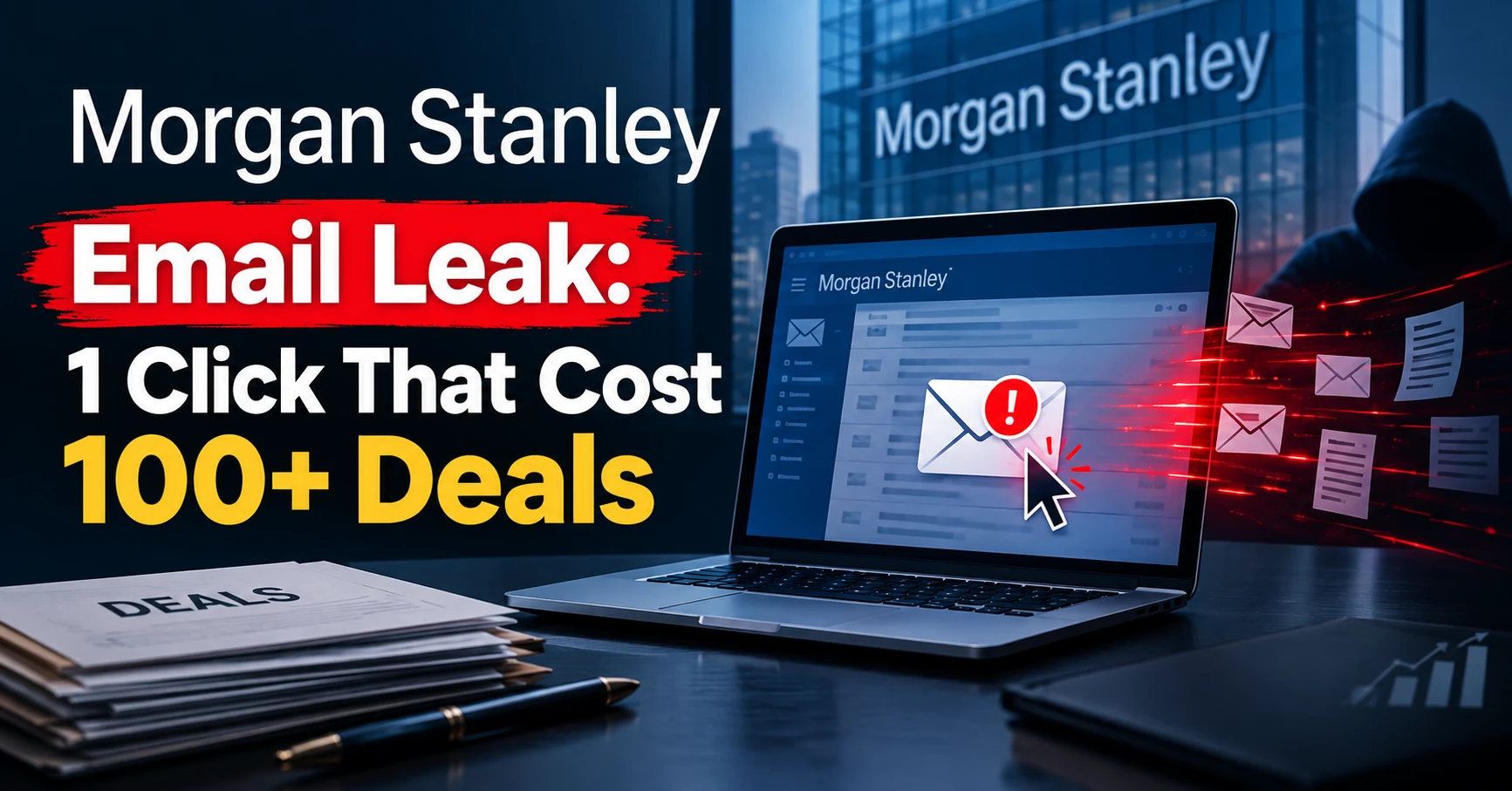
Table of Contents
Morgan Stanley Email Leak: 1 Click That Cost 100+ Deals
Last updated: 24 September 2026 | Reading time: 9 minutes
Imagine this for a second.
You are a founder. You have spent eight months preparing your company for an IPO. Only five people in the world know about it — you, your CFO, your lawyer, and two bankers.
Then one morning, your secret shows up in a WhatsApp forward.
That is almost exactly what happened this week. The Morgan Stanley email leak exposed an internal list of more than 100 investment banking deals across Asia — including IPO candidates from India, China and South Korea — because one senior banker attached the wrong version of a file and pressed send.
No hacker. No ransomware. No dark web gang.
Just a human being, a keyboard, and one bad second.
And if you run a business, this story is not about Wall Street. It is about you.
What Actually Happened in the Morgan Stanley Email Leak
Here is the story in plain English.
According to a Bloomberg report published on 23 September 2026, a Morgan Stanley staffer emailed clients an internal document listing over 100 investment banking deals the bank was pitching and tracking across Asia.
The email was sent by Mohamed Atmani, the bank's Asia-Pacific head of financial sponsors in the investment banking division. He is a managing director based in Hong Kong who joined Morgan Stanley in 2018.
His intention was simple and completely normal. He wanted to send clients a client-facing version of the file — the polished one with general updates about the private equity sector and recent transactions. Harmless stuff.
Instead, the internal version went out. The one with the real pipeline. The one with price-sensitive information that banks guard like gold.
He tried to recall the message afterwards. By then it was already too late. A blurred copy of the document had been posted on an Instagram account.
You cannot un-ring a bell.
What Was Inside the Leaked Document
This is the part that makes bankers lose sleep.
| What Leaked | Why It Is Sensitive |
|---|---|
| 100+ investment banking deals | Reveals the bank's entire Asia pipeline to rivals |
| IPO candidates across India, China, South Korea | Companies planning to list, before any public announcement |
| Private equity and pension fund backers | Exposes who is funding which company |
| Deals put on hold | Signals which companies are struggling or stalled |
| Coverage of Europe, Middle East and Africa | Widens the damage beyond Asia |
Read that table again slowly.
A competitor bank now knows which companies Morgan Stanley is chasing. A rival PE fund now knows which deals are in trouble. A journalist now knows which Indian company is quietly preparing to list.
That is not a data breach in the technical sense. It is a strategy breach.
What Morgan Stanley Said About the Leak
The bank responded quickly. In a statement to Bloomberg, the New York-based firm said it takes client confidentiality extremely seriously.
"We promptly took steps to address this inadvertent sharing of information and we continue to engage with relevant parties," the firm said.
Mohamed Atmani declined to comment and could not be reached for further comment.
It is still not clear how many clients and related parties have contacted Morgan Stanley, or what the firm is doing to repair the relationships involved.
To be fair, this kind of mistake is rare at this level. But that is exactly why it stings. Morgan Stanley has been among the top underwriters of Hong Kong stock sales and Asia mergers for years. This is a bank that handles some of the most guarded information on earth.
And it still happened.
Why Indian Founders Should Care About This
Let me connect the dots for you.
India is in the middle of one of the biggest IPO waves in its history. Startups that were burning cash three years ago are now sitting in bankers' pipelines. If you are a founder raising Series B or above, your company name is sitting inside somebody's spreadsheet right now.
That spreadsheet is stored on a laptop. It travels through email. It passes through five inboxes before lunch.
The American Bazaar report confirmed that Indian IPO candidates were part of the leaked list. Business Today also covered the India angle in detail.
So the honest question is not "how did this happen to them?"
The honest question is: how many of your secrets are sitting in somebody else's outbox right now?
The Uncomfortable Truth: Most Leaks Are Not Hacks
We have been trained by movies to imagine a hooded hacker in a dark room.
Reality is boring and far more dangerous.
Most business information leaks happen because of:
- The wrong file attached to the right email
- Autocomplete picking the wrong contact name
- "Reply All" instead of "Reply"
- Forwarding a thread without scrolling down to check what is below
- Sharing a Google Drive link set to "anyone with the link"
- Screenshots sent on WhatsApp groups
- An employee's email account getting compromised — like the Bank of Baroda incident in July 2026, where a staffer's email account was compromised and led to unauthorised access to certain data
Not one of those needs a hacker. All of them need only a distracted human at 11 PM.
And here is the psychological trap: we all believe we are the careful one. Every person who has ever sent a wrong email believed that right up until the moment they sent it.
9 Lessons Every Founder Must Take From the Morgan Stanley Email Leak
This is the part you should screenshot.
1. Separate your internal and external files from day one
Morgan Stanley's disaster happened because two versions of the same document lived in the same folder with similar names.
Do this instead: Use a hard naming rule. INTERNAL_pipeline_Sept.xlsx and CLIENT_update_Sept.xlsx. Better still, keep internal files in a completely different folder that is never open when you are writing emails.
2. Turn on "Undo Send" and set it to the maximum
Gmail allows up to 30 seconds. Outlook allows delayed delivery. Most people leave it at 5 seconds, which is useless.
Thirty seconds has saved more careers than any firewall ever has.
3. Attach the file before you type the recipient
This one habit alone removes 80% of the risk.
Type the body. Attach the file. Check the file. Then enter the email address. If the address field is empty, you physically cannot send it by mistake.
4. Kill email autocomplete for sensitive accounts
Autocomplete is the silent villain. You type "Raj" and it picks Rajesh from a vendor company instead of Raj your co-founder.
Clear your autocomplete suggestions every quarter. It takes two minutes.
5. Use password-protected or expiring links, not attachments
If you had shared a link instead of a file, you could revoke access the moment you realised the mistake.
An attachment is permanent. A link is reversible. Always prefer reversible.
6. Apply the "front page" test before hitting send
Before you send anything sensitive, ask yourself one question:
"Would I be comfortable if this appeared on the front page of a newspaper tomorrow?"
If the answer is no, slow down for ten seconds. Ten seconds is cheaper than ten lawyers.
7. Limit who can see the full picture
Very few people in your company need the complete list of clients, deals or investors. Give people the slice they need, not the whole cake.
Role-based access is not corporate paranoia. It is damage control planned in advance.
8. Write your leak response plan before you need it
Morgan Stanley responded within hours because a plan already existed.
Your plan needs only four lines: who gets informed first, who talks to clients, who talks to media, and who documents everything. Write it today while nothing is on fire.
9. Build a culture where people report mistakes fast
The worst outcome is not a mistake. The worst outcome is an employee hiding a mistake for six hours because they are scared of you.
Say it out loud in your next team meeting: "If you send something wrong, tell me in the first minute. You will not be punished for the report. You will be judged on the delay."
Email Safety Checklist for Your Team
Share this with your team on Slack or WhatsApp today.
BEFORE YOU HIT SEND — 60 SECOND CHECK

□ Is this the CLIENT version or the INTERNAL version?
□ Did I open the attachment and actually look inside it?
□ Is there anything below the forwarded thread I have not read?
□ Are all recipients supposed to see each other's names? (Use BCC)
□ Did autocomplete choose this contact, or did I choose it?
□ Would I be okay if this was screenshotted and shared?
□ Is "Undo Send" enabled on my account?

If any box is unchecked — STOP. Do not send.
The Cost Nobody Puts on a Balance Sheet
Financial institutions have leaked sensitive documents before. Some paid regulatory penalties. Some faced lawsuits. All of them lost something harder to measure.
Trust.
A client who discovers their confidential plan was emailed to strangers does not send you an angry letter. They simply do not call you for the next deal. And they tell three friends why.
For a startup, this damage is even more brutal, because you do not have a 90-year-old brand to absorb the hit. Your reputation is your balance sheet.
One leaked investor list. One leaked salary sheet. One leaked customer database. Any one of them can undo two years of work.
What You Should Do in the Next 30 Minutes
Do not bookmark this and forget it. Do these four things now.
- Open your email settings and turn Undo Send to the maximum. Two minutes.
- Check your Google Drive for files set to "Anyone with the link". You will be shocked.
- Rename your most sensitive file with an INTERNAL prefix. One minute.
- Paste the checklist above into your team group. Thirty seconds.
That is it. Four small actions that cost nothing and protect everything.
Final Thoughts
The Morgan Stanley email leak is not a story about a careless banker. It is a story about how thin the line is between a normal Tuesday and a career-defining disaster.
A managing director at one of the world's most respected banks, with every compliance system money can buy, still attached the wrong file.
If it can happen there, it can absolutely happen in your two-room office with six laptops and no IT team.
The good news? The fixes are free. They are habits, not software. You do not need a security budget. You need thirty seconds of discipline before you press send.
Your competitors are one careless email away from knowing everything about your business.
Make sure that careless email is not yours.
Found this useful? Share it with your co-founder and your operations team — they send more emails than you do.
Read next: 1980s AI Photo Trend: The Hidden Risk Founders Ignore | Data Breach Protection: 6 Powerful Ways to Secure Your Business in 2026