Categories
Recent Posts


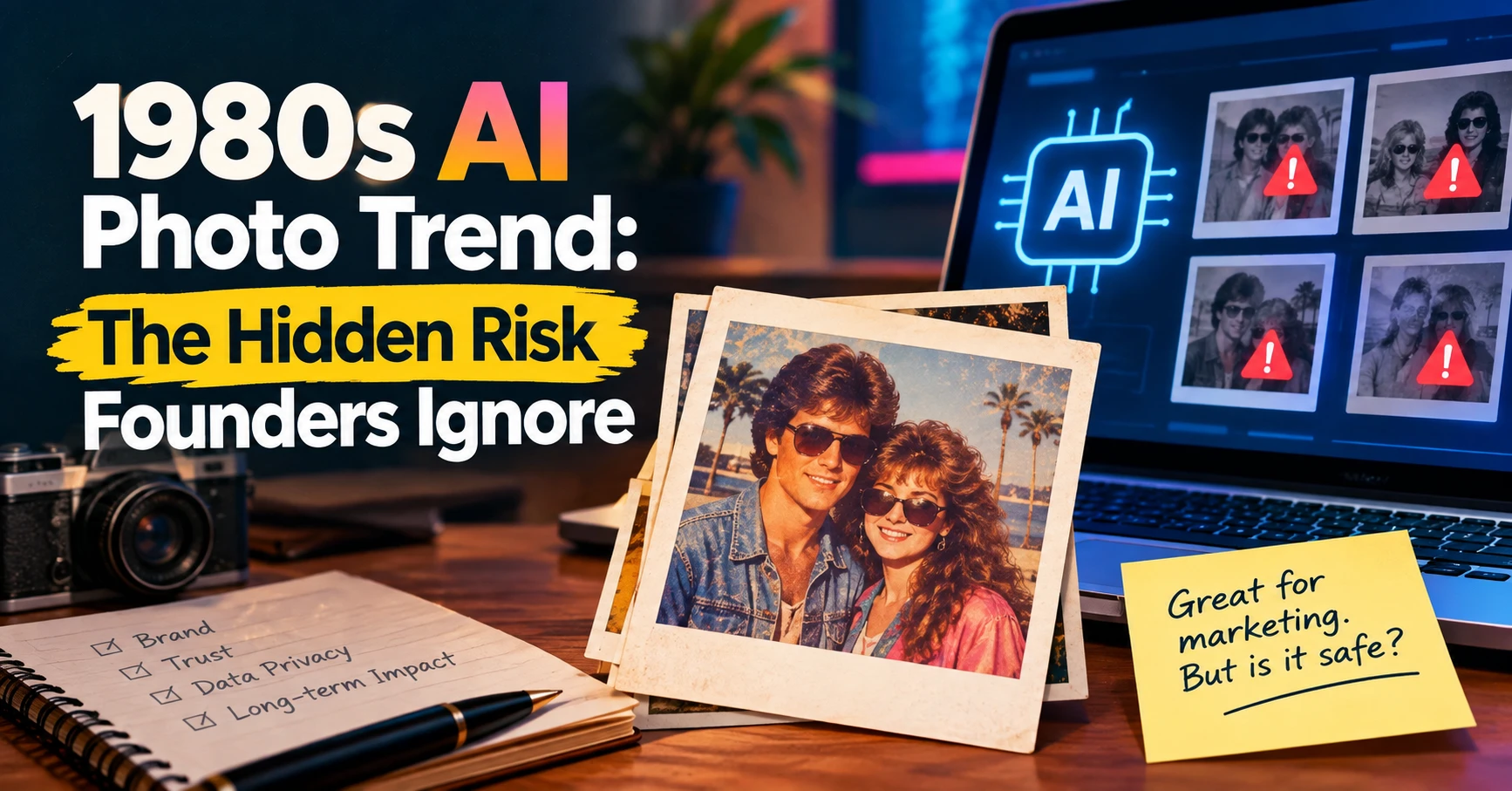
Table of Contents
1980s AI Photo Trend: The Hidden Risk Founders Ignore
Your LinkedIn feed is probably full of them right now — old-school hairstyles, film-grain textures, that unmistakable 80s glow. Everyone from your college friends to your co-founder has posted an AI-generated throwback photo this week.
It's fun. It's nostalgic. It's everywhere.
But here's a question almost nobody is asking before they hit upload: what happens to your face after you send it to an AI chatbot?
If you're a founder, business owner, or entrepreneur, this isn't just a fun-and-games question. It's a data question. And in 2026, data questions are business questions.
Let's break down what's really going on behind this viral trend — and how you can enjoy it without handing over more than you meant to.
What Is the 1980s AI Photo Trend, Exactly?
The trend is simple on the surface: you upload a personal photo to an AI chatbot, describe the retro look you want, and the tool generates a version of you styled like it's straight out of a 1980s photo album — vintage outfits, old film textures, faded colours, that "found in a family drawer" feel.
It's the latest in a string of viral AI image trends — remember the Ghibli-style avatars, or the AI caricature wave before that? Same idea, new aesthetic.
But every one of these trends shares one thing in common: you're not just asking for a filter. You're feeding an AI system your face, your details, and often your personal context — voluntarily.
Why This Matters More If You Run a Business
Here's the part most articles skip.
When you're an entrepreneur, your face isn't just your face — it's part of your brand. It shows up on your website, your pitch deck, your investor calls, your company's social media. It's tied to your professional identity in a way that's harder to separate from "just a personal photo."
So when a viral trend encourages you — and your entire team — to casually upload clear, high-quality photos to a third-party AI platform, the risk isn't only personal. It's reputational and operational too.
Ask yourself:
- Would you be comfortable if that photo, or your likeness, showed up somewhere you didn't expect?
- Do you know what your company's AI tool usage policy actually says — or if you even have one?
- Have you thought about what "training data" really means for the photos your team uploads every day?
If you paused on any of those, you're not alone. Most founders haven't thought about it either — because trends are designed to feel harmless.
GPT-6 Astra Launch Chaos: Lessons for Startups
The Privacy Risk Nobody's Talking About Loudly Enough
Cybersecurity professionals have flagged this exact pattern with every recent AI photo trend: people get so focused on getting the "perfect" result that they keep feeding the AI more personal details to improve it.
Uploading one photo? Low risk.
Uploading multiple angles, adding personal descriptions, layering in context about your life to "help the AI get it right"? That's a much bigger footprint than most people realise they're leaving behind.
Here's the thing — a clear photo of your face is biometric data. Once it leaves your device and enters a company's servers, you generally lose control over where it goes, how long it's stored, and whether it gets used to train future models. Most users never even check the privacy policy of the tool they're feeding their photos into.
And once you post the AI-generated result publicly? That's a second layer of exposure. Screenshots, reposts, and scraping can carry your image far beyond the platform you originally shared it on.
Where India's Data Law Comes In
This matters even more for founders based in India. The Digital Personal Data Protection (DPDP) Act, 2023 puts real obligations around how personal data — including images — is collected, processed, and consented to.
If you're running a startup and your team is uploading customer or employee photos into random AI tools "just for fun" or for content creation, that's not a grey area anymore — it's a compliance conversation your business should be having. A viral trend is a great moment to ask: does my team actually understand where the data we generate at work is going?
What AI Tools Themselves Admit
Even AI chatbots aren't shy about the trade-offs when asked directly. The general safety guidance boils down to a few honest points:
- Only upload a photo you'd be fully comfortable seeing stored on someone else's server
- Don't include other people in the photo unless they've agreed to it too
- Avoid backgrounds with sensitive details — documents, addresses, kids' school information
- A cropped, simple portrait carries less risk than a full, detail-rich photo
- If a photo feels especially private, a local, offline editing tool is the safer bet
That's a reasonable, balanced take — not a reason to panic, but a reason to pause.
How to Join the Trend Without the Regret
You don't have to sit this one out. You just need to be deliberate about it.
- Crop before you upload. Use a simple headshot instead of a full personal photo with background context.
- Skip anything with other people, kids, or identifying details in the frame.
- Read the privacy policy once — specifically the section on data retention and model training.
- Set a quick team guideline if employees are experimenting with AI tools using company devices or brand photos.
- Separate "fun personal use" from "business use." Your company Instagram account probably shouldn't be the one running these experiments.
None of this takes the fun out of the trend. It just makes sure you're the one in control of the outcome — not an algorithm you've never met.
GPT-6 Astra: What It Means for Indian Startups in 2026
The Bottom Line
Viral AI trends move fast, and it's easy to get swept up without a second thought. But as a founder, the instinct that serves you best in business — pause, evaluate the risk, then decide — is exactly the instinct worth applying here too.
Have fun with the nostalgia. Just make sure you're the one deciding what your face is worth.