Categories
Recent Posts




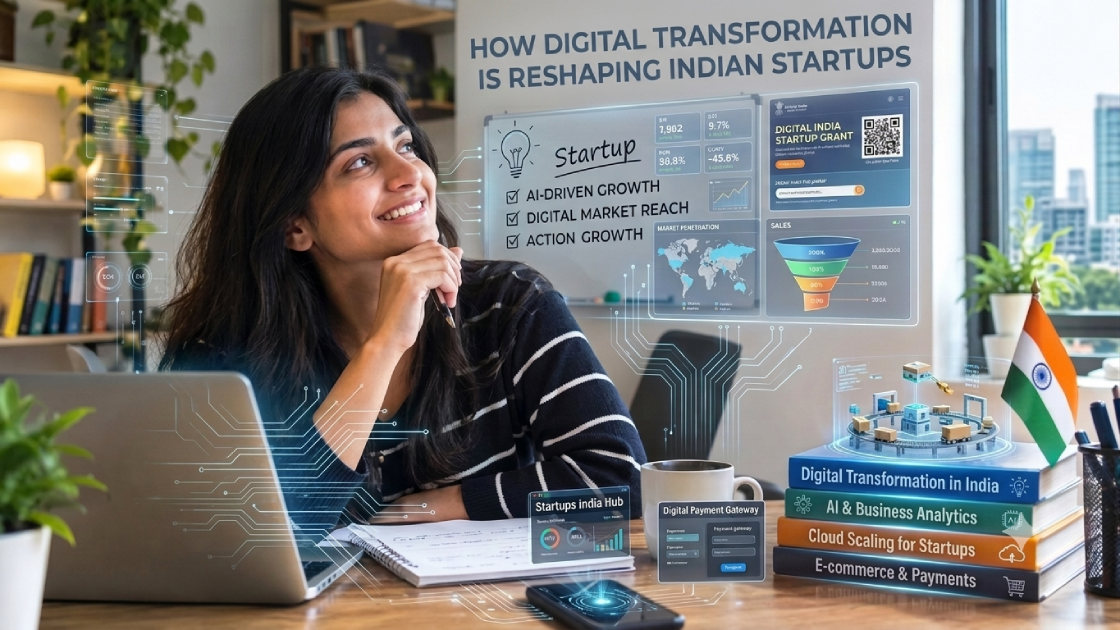
Table of Contents
How Digital Transformation Is Reshaping Indian Startups
All a startup needs is a concept, a laptop and a few hardworking individuals.
However, things get complicated very rapidly as customers come in.
The tracking of orders should be done. Customers need replies. Person to Person Payments must be documented. Marketing needs to be measured. The right information is vital to employees. The founder of course must know what's going on throughout the company.
It's here that digital transformation is transforming the operations of Indian startups.
There's more than just having a website or Instagram page these days. It is the transformation of the daily business activities using software, automation, cloud, data, AI and digital payments for many businesses.
Digital infrastructure has also enabled startups to develop and run digital-first, scaled businesses, something that was not imagined 10 years ago. As per the definition given by National Portal of India, DPI is facilitated to contribute in the area of opportunity expansion, financial inclusion and service access.
What is the meaning of Digital Transformation?
The concept of Digital transformation seems like a complex term in technology, but in simple words, it is nothing but a transformation in the business from traditional to digital.
It means using digital technology to improve how a business works.
Suppose a small startup that used to use notebooks for customer enquiries and send them WhatsApp messages.
As sales increase, a customer is forgotten about by someone when it comes to following up with a lead. There's another customer who's getting a late reply. Information relating to the sales goes astray among various employees.
The startup might set up a CRM that would enable them to keep information regarding their customers in a single central location.
Now the team will know who spoke with the company, what was discussed and who needs follow-up with the company.
The very fundamentals of the start-up's core product remain unchanged.
However, the manner of operation of the business has.
That is what digital transformation is.
Also Read: MSME Growth in India
Indian Startups are going beyond 'Going Online'.
When it comes to the small business website, a time was when it was deemed as a considerable milestone in the digital world.
Now it's just the first day!
A startup could leverage their website to capture leads, their CRM to engage and manage those leads, cloud applications to share with staff, digital payments to collect payments, analytics to learn more about customers and automation to save on repetitive work, using AI.
This translates to a business that has a combination of digital systems that can help different aspects of the same journey.
This trend is taking place in the entire India Startup and MSME ecosystem, but at varying stages. The playbook by the World Economic Forum (WEF) 2025 classifies SMEs in India into five categories – digital awareness, spreadsheets, automation, integrated digital systems, and enterprise digital systems.
Digital transformation is not uniform; that is, it does not appear in the exact same way to all.
For one start-up it may signify going from Excel to Accounting Software.
On the other hand, it may involve developing an artificial intelligence-based customer service system.
It could be linking some or all of a growing e-commerce business' website, inventory, payments, logistics and customer information.
AI Is Taking Digital Transformation Further
The transformation has now been enhanced by the usage of Artificial Intelligence.
Previously, startups typically relied on software to capture information or perform a set procedure.
AI can be used to analyse data, create content, respond to customer queries, aid human workers and facilitate decision-making.
This is especially helpful for a small group.
A founder can leverage AI to assist them in creating marketing materials. An AI assistant can be used by a support team to respond to frequently asked questions. A sales team can use the data from the customers to gain insights and opportunities for follow-up.
It is essential to understand that AI can't just transform a business on its own.
The first step in implementing technology to solve a business problem is to fully grasp what the problem is and where the technology fits into it.
The World Economic Forum's India MSME playbook also states the same – businesses in the initial stages of digital maturity must be equipped with some basic digital tools and skills before they can progress towards more advanced AI use.
So, a startup doesn't have to make use of all of the new AI tools.
Must employ suitable technology to the proper problem.
Also Read: How Online Startup Communities Help Founders Grow
Digital Payments Have Changed the Customer Journey
Take the time to reflect on one's buying process from a startup these days.
They can find the product on social media, go to a website, do a price comparison, pay by digital means, get an auto confirmation email and a follow-up email on their mobile informing them that they ordered the product.
To the customer it may appear to be just one experience!
There may be multiple digital systems operating in the background to accomplish the task.
This is one of the largest transformations of business processes with the advent of digital transformation, where previously these transactions would have taken place one after another, the digital transformation now allows them to be connected.
This is made possible by India's larger digital environment, ranging from digital financial infrastructure to online government services through technology platforms. The National Portal of India points out that India's DPI has enabled the creation of greater access and financial inclusion.

Startups Can Reach Customers Beyond Their City
Digital transformation has also impacted the channels through which a startup can market.
The customers in Delhi are not restricted to attending physical shops located in Jaipur.Not all businesses in Jaipur need to have physical stores in Delhi to attract customers to the stores.
The website can be used to introduce the business.
Awareness can be raised using social media.
Digital ads are able to reach targeted audiences.
Orders can be taken through an ecommerce site.
Online payments can be used to finalise transactions.
The product can be transported to the customer by logistics networks.
This opens up opportunities for start-ups not in traditional technology hubs.
India's startup ecosystem is also growing beyond just the big metros and digital infrastructure has enabled entrepreneurs to create and connect with markets in various parts of the country.
This may be a significant change for a small start-up business.
No longer restricted by the number of people entering a physical door, the market is now a global one.The market is now a global market.
Also Read: Government Schemes for Startups Can Help
Data Is Becoming Part of Everyday Decisions
There is another change that's easy to miss.
The digital transformation provides the startups with additional data.
If it's been a traditional business, they may have been aware that their sales are good this month.
A digitally connected business could potentially find out what product sold most, which marketing push resulted in enquiries, where the customer was when they were checking out and which channel most customers were coming from for added value.
That data will impact the queries that founders ask.
They don't need to state that "I think customers like this product" but rather say, "What does our data tell us about our customers?
This isn't to say that data will always give you the answer you're looking for.
It means that there's more information for founders to have when making decisions.
Digital Transformation is also changing the way startups work.
A lot of the changes that happen are behind the scenes, but the changes on the customers' side are most noticeable.
A startup software can be used by a growing startup for:
- Accounting and invoicing
- Customer relationship management
- Inventory management
- Employee collaboration
- Payroll and HR
- Project management
- Marketing automation
- Business analytics
- Cybersecurity
Such tools can minimize repetitive manual tasks and can also enhance access to the information.
It is important to a small team.
Saving a few hours each week when 5 persons are competing to do the work of 20 persons can make a difference.
But Going Digital Comes With New Challenges
Digital transformation doesn't necessarily work.
Costs can be incurred for software applications that no one is using in the startup.
Staff might have difficulties in handling the new systems.
When you have customer data, you might be responsible for privacy and security issues.
Tools that are not well connected can add to the confusion rather than decreasing it.
But with the increased digitization of business operations, cybersecurity gains significance. For instance, security controls, patching and vulnerability testing of websites and web applications are highlighted in the guidelines of the Government of India's website.
This is why it isn't wise to start digital transformation with the question:
How about technology acquisition – which technology should I purchase?
A more pertinent question is:
What issues are we addressing?
What Should Indian Startups Do Next?
Need not be a large technology endeavour.
A start up can start off with one process.
If you are experiencing a loss of customers in your enquiries, add a CRM.
Make tracking of invoices a breeze by digitising accounting.
If employees are spending hours answering the same questions, consider automating or using AI to help.
Enhance the website and payment process if it is not readily available to the customer to purchase online.
If one process is more successful, the company can go onto the next one.
This step by step approach is crucial as Indian businesses are not all digitally matured. The idea is not for it to be technologically advanced. The objective is to create and develop a business that is better.
The Bigger Shift Is Already Underway
Digital Transformation is making a modern Indian start-up a new definition.Digital Transformation is transforming the definition of a modern Indian Start-up.
A group of people is able to work across cities.
Customers can be found nationally for a local company.
A founder may be able to utilize software that was previously utilized predominantly by big companies.
AI can help workers in their day-to-day work.
Information can be utilized to better comprehend customers.
And digital infrastructure can extend the reach of businesses to their customers, markets and services in new ways.
The Indian Startup India ecosystem has also started gaining and working through digital platforms, for the recognition, resources, mentorship, funding opportunities and ecosystem linkages.
The future of India's startup narrative might, therefore, be about not just building more digital businesses but building transformative ones, too.
It could be related to increasing the digital, connected and efficient nature of traditional businesses.
Today, the founder who sits with his/her notebook filled with orders might start with something that is very small – digital transformation.
One spreadsheet is used to create software.
One repetitive task is made automatic.
One Customer journey will be smoother.
Then gradually, things begin to change in the business.
Digital transformation transforms a startup, not in a single big blow, but in hundreds of little things — all that make the business fit for its next level of growth.