Categories
Recent Posts






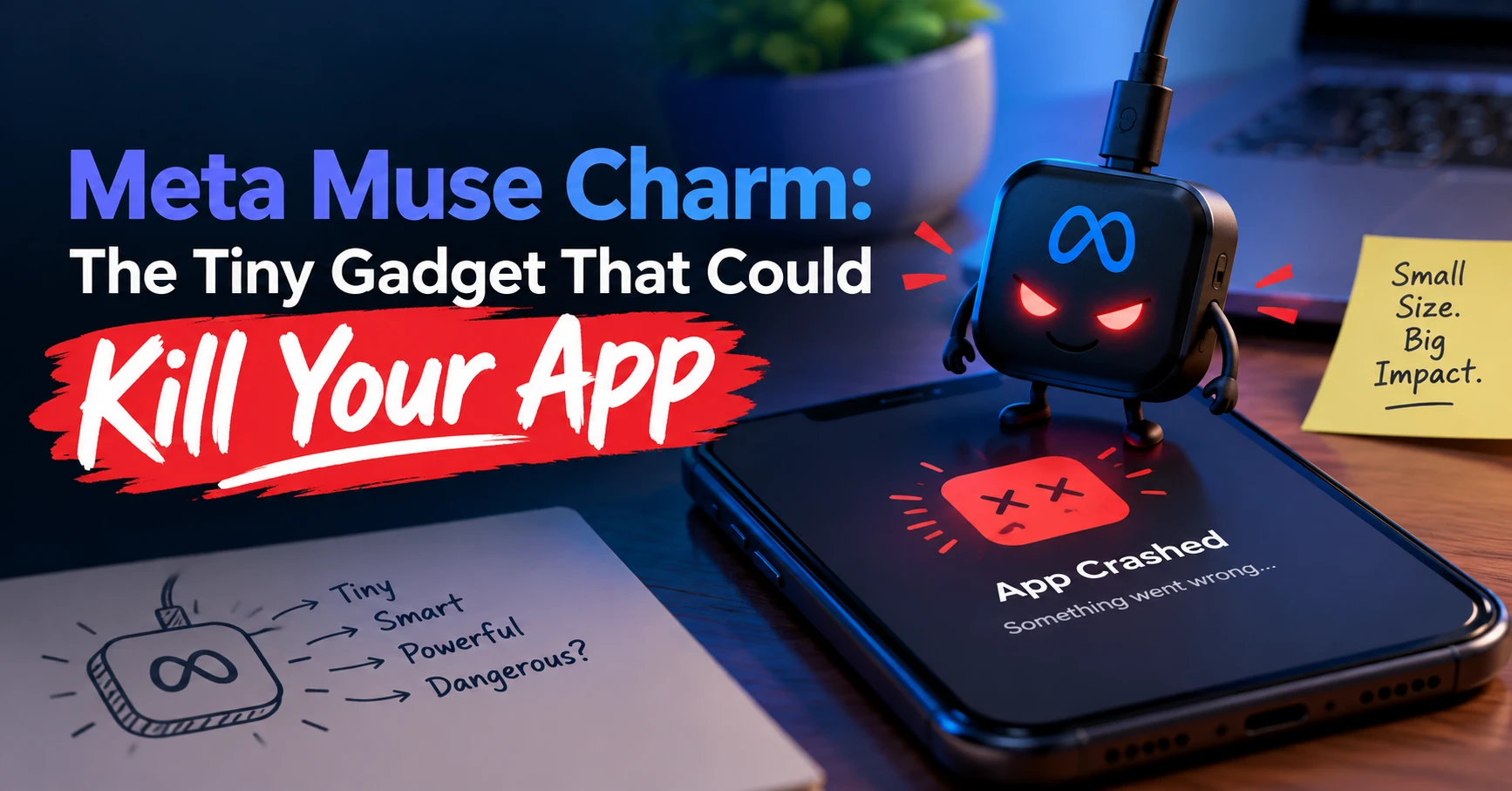
Table of Contents
Meta Muse Charm: The Tiny Gadget That Could Kill Your App
Mark Zuckerberg just held up something the size of a pocket watch and told the world it does not need your phone. If you run an app, a D2C brand, or an agency in India, that one moment should matter to you more than any funding headline this month.
On 23 September 2026, at Meta Connect in Menlo Park, Zuckerberg took a few clean digs at Apple — and then borrowed the oldest Steve Jobs trick in the book. "One more thing." Out came the Muse Charm.
It is small. It has no keyboard. It cannot even make a phone call. And yet analysts spent the next 24 hours arguing about whether it is the beginning of the end for the smartphone app economy that every Indian founder has been building on for the last 15 years.
Let us break it down in plain language — what happened, what is real, what is hype, and what you should actually do about it.
What Exactly Is Meta Muse Charm?
Muse Charm is a small, wearable gadget that gives you direct access to Meta's AI agent, Muse. You tap it. You talk. It acts.
Here is what has been reported so far:
- Roughly 2-inch (5 cm) screen that you scroll with your thumb
- A customisable Muse character sitting at the centre of the screen — think Tamagotchi, but grown up
- A built-in 5G modem, so it works even without Wi-Fi or a phone nearby
- It cannot make calls. That is not a bug. That is the whole point.
- Tap it and you reach Muse directly — no home screen, no app icons, no App Store
Meta has said it will share full details, pricing and availability later this year. So anyone quoting you an exact price today is guessing.
Read the official page here: Meta AI Glasses (India)
Why a Device That Cannot Call Anyone Is a Big Deal
Every app you have ever built lives as a guest in someone else's house. Apple's house, or Google's house. They set the rent — that 15% to 30% cut. They set the rules. They can change the doorbell whenever they feel like it.
Meta has been trying to escape that house for years. The metaverse was the first attempt, and it cost billions. Zuckerberg has now quietly moved on.
"It is actually quite clear personal superintelligence will not only come first; it will be much bigger and more important," Zuckerberg said at Connect. "So we have shifted our focus to building the best devices for personal superintelligence."
Translation for founders: Meta is not trying to win a place on your phone's home screen anymore. It is trying to make the home screen unnecessary.
Wait — What Is Muse, and Why Is Everyone Downloading It?
Muse launched on 8 September 2026 as Meta's personal AI agent. Not a chatbot. An agent — something that actually does the task instead of telling you how to do it.
The numbers moved fast:
- Millions of downloads within days — some analysts called it the biggest US app launch since ChatGPT in November 2022
- Meta's stock rose nearly 24% after the Muse launch, adding hundreds of billions in market value
- Over 1,500 developer connectors were submitted in under a week
- Shopping and payment partners already plugged in: Shopify, Stripe, PayPal, Shop Pay, Walmart, Best Buy, Gap, Sephora, Wayfair, Expedia and Instacart
And here is the part that made investors nervous. When markets realised Muse could book flights and file taxes on its own, shares of Booking.com and Intuit (TurboTax) fell. Meanwhile Shopify — a partner — went up.
That is the new rule in one line: be a connector, or be replaced.
More detail here: Meta's official Muse announcement and TechCrunch's full breakdown.
Ray-Ban Meta Audio: The Smart Glasses That Deliberately Forgot the Camera
The Charm was the surprise. But the bigger commercial story at Connect was the glasses.
Meta launched Ray-Ban Meta Audio — its first audio-only smart glasses. No camera. At all.
- $349 starting price (about ₹31,000 before duties and taxes)
- Ships 13 October 2026
- Just 43 grams — light enough to forget you are wearing them
- 12 hours of battery, plus 48 more from the case
- 23 colour and lens combinations across two styles: Clubmaster and Burbank
- $100 cheaper than the camera version
Why drop the camera? Privacy. Smart glasses have triggered lawsuits and outright bans at some UK venues. Meta is trying to calm that storm.
But critics are not fully convinced. The Audio glasses still record audio — and unlike the camera models, there is no light to warn the person in front of you.
"This is all about consent," said Jitesh Ubrani, director at IDC. "Meta needs to figure out a way to warn users they are being recorded, even though it just might be audio only."
Alongside it, Meta also announced Ray-Ban Meta (Gen 3) at $449 — slimmer body, 9-hour battery, a 6-mic array that cuts over 90% of background noise, a 12 MP camera with 3K video, and a new customisable action button. Plus a LISA-designed collection, a Kylie Jenner colourway, and the most affordable Meta Glasses yet at $249.
Meta says it will offer over 100 glasses options across Ray-Ban, Oakley and Meta Glasses by the end of 2026.
Meta Connect 2026 at a Glance
| Product | Price (USD) | Availability | Key Hook |
|---|---|---|---|
| Muse Charm | Not announced | Details later in 2026 | Tap-to-AI, 5G, no calls |
| Ray-Ban Meta Audio | $349 | 13 October 2026 | No camera, 43g, 12-hr battery |
| Ray-Ban Meta (Gen 3) | $449 | Available now | 12 MP, 3K video, action button |
| Meta Adventurer | $249 | Pre-order, sale 23 Oct | Most affordable Meta Glasses |
| Meta Glasses x LISA | $399 | Announced | Celebrity collab, prescription-ready |
What This Actually Means for Indian Founders and Business Owners
Forget the gadget for a second. Here is the shift underneath it.
1. The "app install" may stop being your growth metric. If a user taps a Charm or speaks to their glasses and the task gets done, your beautifully designed onboarding screen never loads. Your app becomes plumbing. Useful plumbing — but invisible plumbing.
2. Being discoverable now means being connectable. Shopify went up because Muse can transact through it. Booking.com went down because Muse can go around it. Ask yourself honestly: if an AI agent tried to buy from your business right now, could it? Do you have a clean API? Structured product data? A checkout a machine can complete?
3. Voice-first changes your SEO. People do not speak in keywords. They speak in full sentences. Your content needs to answer actual spoken questions — "where can I get custom packaging in Jaipur under 5000 rupees" — not just rank for "custom packaging Jaipur".
4. Gen Z is buying feelings, not features. Analysts think the Charm could land with Gen Z because digital cameras, flip phones and MP3 players are all having a nostalgia moment in India right now. Gen Z treats AI as a companion, not a search box.
"The combination of AI, fashion and personalization could appeal to younger users, especially if it is affordable and easy to use," said Linda Sui, founder of Smart Analytics Global.
5. A whole accessories economy is opening. Over 100 glasses models shipping globally means cases, charms, straps, prescription lenses, cleaning kits, insurance, repair services. Indian D2C brands have built ₹100-crore businesses on less.
The Risk Nobody Wants to Say Out Loud
Let us be fair and honest. We have seen this movie before.
The Rabbit R1 launched in early 2024 with a screen, a button and enormous buzz. It flopped. It promised AI magic and delivered an unreliable experience.
"I would be cautious about its mass-market potential," Sui warned about the Charm. "Unless Muse Charm can offer unique functions that smartphones, watches, earbuds or smart glasses cannot easily replace, it is more likely to remain a nice-to-have device for early adopters than become a mainstream product."
Ubrani sees the appeal differently: "They are appealing to people who might not want to wear glasses or might not trust glasses. Some people might remember Tamagotchi and this might evoke that."
So do not bet your company on the Charm. Bet on the direction. Even if this specific gadget fails, agentic AI is not going backwards.
Is Meta Muse Charm Coming to India?
Not confirmed yet. Meta has not announced Indian pricing or a launch date for the Muse Charm.
The glasses are moving faster. Meta is expanding Meta Glasses into Singapore, South Korea, Mexico and the UAE, with Brazil coming soon. Turkey, Poland, Portugal, Israel, South Africa, Indonesia, Thailand, Hong Kong, New Zealand, Malaysia and the Philippines are listed for later this year. Ray-Ban Meta glasses have been selling in India since May 2025, so India is clearly on the map — just not on the first list.
Realistic expectation: glasses first, Charm much later, if at all.
Your 30-Day Action Plan
- Download Muse and use it for a week. Not to be impressed — to find out exactly where it breaks. That gap is your product idea.
- Audit your API. If an agent cannot read your catalogue and complete a purchase, fix that before you spend one more rupee on ads.
- Rewrite your top 10 pages for spoken questions. Add a real FAQ section with schema. Agents pull from structured answers.
- Add clean product data. Schema markup, accurate pricing, stock status, shipping. Boring work. Highest return.
- Test one voice-first experience. A WhatsApp AI agent for your business costs very little and teaches you how voice customers actually behave.
Final Word
The Muse Charm may or may not sell. That is not really the question.
The question is simpler and harder: in two years, will a customer still open an app to reach you — or will they just ask?
The founders who answer that early will not be fighting for app installs in 2028. They will already be the thing the agent calls.
What do you think — is Muse Charm the next iPod moment or the next Rabbit R1? Tell us in the comments.