Categories
Recent Posts




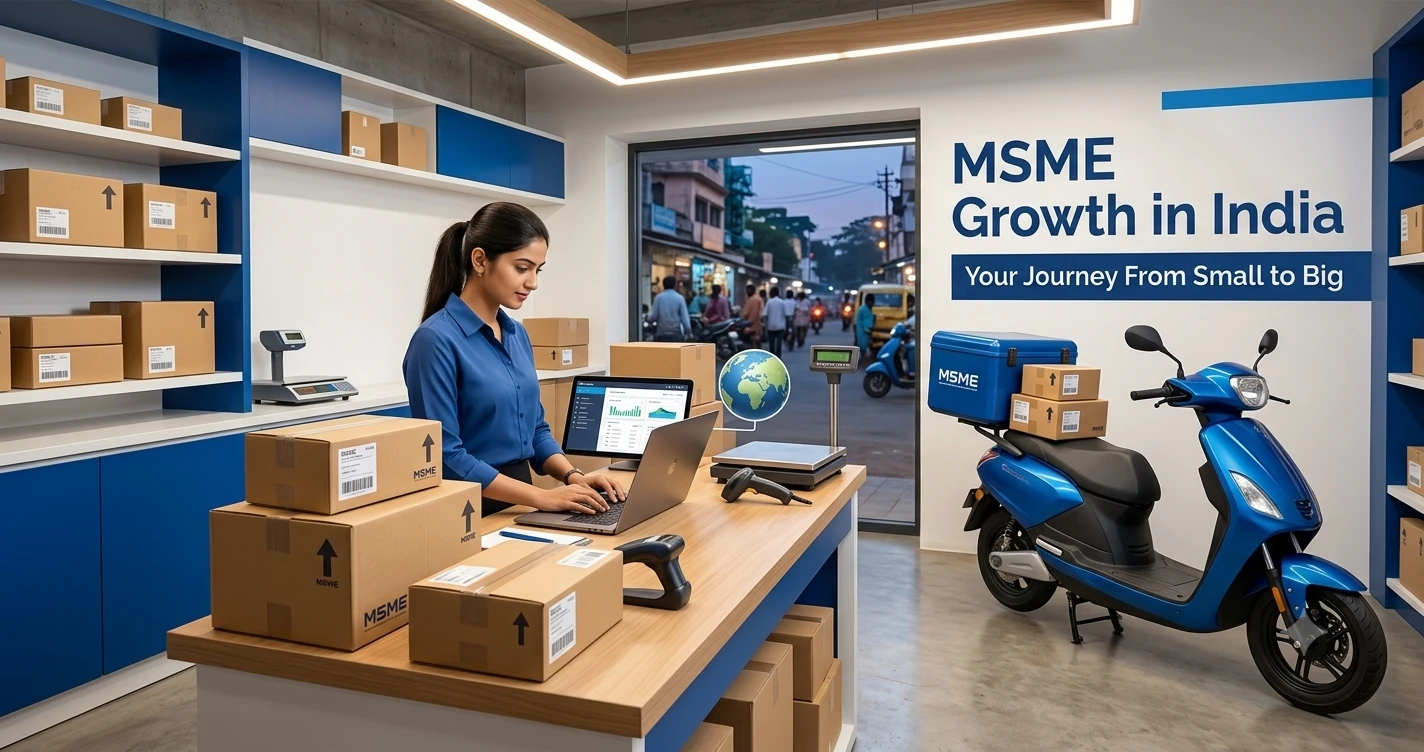
Table of Contents
MSME Growth in India: How Small Businesses Are Turning Into Bigger Brands
A small store is located in a lively market. A small shop is opened to produce products for a family. A person starts to sell handmade products from his home. Yet another person begins a business by simply getting a laptop, a phone and a handful of customers.
At the outset these businesses can be small.
There's a change, however, in something.
The local area is starting to get customers. Online orders begin trickling in. Online orders begin to come in. Hires first employee.Formalizes first job. An ordinary website turns into a virtual store. Social media's the place to find new customers. As the machines are better, the production is improved. Now, slowly, the business which used to be based on a few local customers starts to ponder on larger markets.
This is the reason behind the growth of MSME in India.
Today, there is no limit for micro, small and medium enterprises to be present in the traditional shops and small factories. So many are embracing technology, looking into the online marketplace, enhancing their product lines, and building brands that can connect with customers that go beyond their hometowns.
So, how can a small business get to become a bigger brand? So, how is the MSME growth in today's India?
Follow that journey we shall.
It's always a small idea that begins it all
Suppose there is a small manufacturing company in Ludhiana.
Initially the owner had a few machines, some employees and orders from local companies. Most customers are acquired through personal contacts and local references and have been in business for years.
The business is profitable with a low growth rate.
Then it's the owner's turn to make a basic website.
Nothing fancy.
Only good product shots, business contact details, a couple of details about the company and a means for people to ask questions about the business.
Another client comes across the company via the internet.
There were one to five in a row.
The owner begins to accept electronic payments, electronic communication and use social media. Afterwards, the company expands by introducing more advanced machines and increasing its workforce.
Though the business is still considered as MSME, the business model has changed.
This is one of the significant aspects of MSME expansion story in India. It's not always that a big investment is the first step toward growth. It begins at times when a company discovers a more effective method for communicating with customers.
Also Read: How to Set Up Your First Online Store
India's MSMEs are a big proportion of the economy.
The size of the MSME ecosystem in India is testament to how important it is to its growth.
The ministry of MSME has recorded over 9.65 crore MSMEs and informal micro enterprises on Udyam and Udyam Assist Platform as of 23rd September 2026. It also revealed over 42.7 crore jobs created due to these registrations, on the dashboard.
The above numbers are for businesses engaged in manufacturing, services and trading.
As of 23rd September 2026, the same dashboard included the count of micro enterprises was more than 9.59 crore, small enterprises over 5.43 lakh and medium enterprises over 41,000.
Behind these numbers are very different businesses.
A tailoring unit.
A food manufacturer.
A software company.
A furniture workshop.
A logistics service.
A family-owned factory.
A small e-commerce website.
A local retailer.
They work in various fields but many have the same dilemma:
How can we grow and yet not lose control of the business?
The first big step is out of the local market.
The initial step in growth for many of the small businesses is to expand beyond the immediate neighbourhood.
A customer was once required to go into a shop or factory to acquire the product.
For the first time, the first interaction is possible on the web.
A potential buyer could find a company via Google, Instagram, LinkedIn, an online marketplace or a company website.
This alters the chance to small businesses.
A businessman from Punjab can sell his product to a manufacturer in Maharashtra.
Handicrafts can appeal the customers from other state in Rajasthan.
An IT firm within a smaller town may have the ability to deal with clients in various regions of the nation.
Having an online presence doesn't necessarily lead to growth, but it can help overcome one obstacle: visibility.
Seeing can be as critical as location when it comes to an MSME that is looking to expand.
Technology is revolutionising the working style of MSMEs.
But, technology is more than just a website.
Can transform the business's day to day operations.
Accounting software can help a small business to keep track of payments. Use of digital inventory systems can aid in tracking inventory. Use online payment systems to make collections easier. Enquiry tracking with customer relationship tools can help businesses to monitor enquiries.
Social media also can be used for sales & communication.
Re-visit the previous business involved in manufacturing.
The initial enquiry responses are made from the owner him/herself.
This is challenging to do when orders are going up.
The business brings in a simple customer management solution. Enquiries are recorded. Follow-ups become easier. The employees are able to view pending orders.
The owner no longer has to go through messages to find the right one, instead focusing on what is next in the business growth journey.
It's when technology is more than just a convenience.
It becomes a part of the infrastructure of the business.
The Ministry of MSME also mentions initiatives related to technology, such as the technology centres, training and assistance for enterprises.
From Product to Brand
Building a brand is one of the biggest changes in the growth of MSMEs from the day it began selling a product.
There's a difference.
A typical product is a product sold from one business to another by a small manufacturer.
But, as a growing brand, what questions does it ask?
What are our product's USPs?
What makes us special to the customer?
Are our packaging easily identifiable to our customers?
Is our site a trustworthy site?
Is it possible for people to locate us via the Internet?
Are there any direct sales to customers?
The following questions seem straightforward, but can make a huge difference in businesses.
These companies might only have relied on distributors but may eventually develop their own customer base.
Local food companies can create its branded packaging.
An apparel company can establish its own web based shop.
The social media platform can be utilized by a furniture manufacturer to present finished pieces.
The product is still invaluable, the brand provides the business with another identity.
Also Read: Powerful Branding Strategies
Finance Can Help a Business Take the Next Step
Money also is needed for growth.
A business can have customers and have problems expanding due to the fact that it is unable to afford new machinery, new employees, inventory, and/or technology.
Hence access to finance still is an area of significance in the growth of MSMEs.
There are many mechanisms and schemes that can support various components of the MSME ecosystem which can be taken up by the government. For instance, the MSME dashboard indicates significant transactions in credit guarantees and the Self Reliant India Fund (SRIF) has also invested in MSMEs through equity funds.
However, the financing shouldn't be seen as “more money.”
The bigger the question for a growing business is:
What does the money need to fund the business to do?
Increase of capacity through application of a loan for productive machinery.
Investment in technology can help to increase efficiency.
Working capital can be used to allow a business to be able to accept larger orders.
Maybe better systems that can be handled through training.
Growth can be more sustainable if the capital is used in a proper manner.
Formalisation Can Open New Opportunities
One of the other critical aspects of MSME is getting organised and more formal.
The idea of registration, and keeping proper accounting, documented transactions and clear business records may seem unenthrilling to an entrepreneur.
However, as a company develops they grow in importance.
If the customer is large, he or she might want to have correct invoices.
A bank reserves the right to ask to see financial records.
A business may wish to take advantage of formal procurement opportunities.
A businessman might require dependable information prior to employing workers or investing in devices.
The official Udyam Registration Portal presently categorizes business based on investment and also turnover. The limits have been revised to ₹2.5 crore investment and ₹10 crore turnover for micro enterprises, ₹25 crore and ₹100 crore turnover for small enterprises and ₹125 crore and ₹500 crore turnover for medium enterprises, respectively, from April 1, 2025.
Formalisation thus becomes a part of the growth journey and not just a piece of documentation.
Also Read: How to Register a Startup in India
Bigger Markets Bring Bigger Responsibilities
Acquiring more consumers is the desire of every business.
However, when a company grows, there are new issues that arise.
If your business has 10 orders being placed per month, you can do it all on a manual basis.
What number is the result if it is given 500?
The owner might suddenly require more effective inventory control, quality control, delivery, customer support and financial planning.
It's here that some businesses find the important lesson:
Growth is more than just an increase in sales. It's the concept of being able to carry more. It's the idea of being able to carry more.
A company can't develop a solid reputation if the quality decreases with more orders.
If it becomes unreliable, it will be unable to please customers.
If the money you are spending is increasing faster than your sales, then you're not going to be able to keep up with your finances.
Systems are the next step in the growth of MSMEs.
Machine Skills Become as Important as Skills
With the growth of the business comes a need for people who can grow with it.
The owner may be very knowledgeable about the product, but not know anything about digital marketing.
An employee may have a knowledge of production but may require training as to new machinery.
Better communication skills for a sales team will be needed.
The person could be responsible for placing online orders, keeping and managing data and customer relationships.
That's the reason why skill development can be a major component of the growth story.
The existing MSME's dashboard is focused on the activity of large scale training and technology-centre support for enterprises that will support the development of entrepreneurship.
The Digital Customer Is Changing MSME Growth
Today's market changes every day.
Customer expectations change.
Technology changes.
Competitors change.
For a business that never stops learning, the next challenge is less daunting and they have more tools to use.
The Digital Customer Is Changing and MSME Growth
Someone else is in this story, the customer.
In today's day and age, the customer researches before purchasing.
They can read reviews at Google.
They can go to a web site.
They can check out Instagram.
They can do a price comparison.
These can look for video tutorials about the products.
They can contact the company prior to ordering.
This makes it impossible for a business to rely on their shop, office or factory as the only representation of their business.
The online aspect is also a part of the brand.
When a website is slow, or the information it provides is outdated or the messages are not answered, doubt can set in.
A website that is easy to navigate, informative, and has professional communication and a straightforward enquiry system, on the other hand, can convey a small business a more established vibe.
Digital presence is now a crucial element of customers' trust for MSMEs.
Not all MSME's have to grow to become a big business.
In the discussion about growth there is also a crucial aspect that is seldom addressed.
Growth does not necessarily mean the small business has to grow into a big business.
Success is different for each entrepreneur: maybe 3 stores for one.
In other words, it could involve hiring 50 workers.
For another, it could be in the form of exporting products.
Another person could just want to have a good profit-making enterprise that can sustain his family, and can offer him stable work.
Growth is not exactly defined.
The ultimate aim will be to create a business that is better equipped for the future, more sustainable and stronger.
The future of MSME in India is promising.
MSMEs have a way to grow further, which will require a blend of business acumen and innovation in technology.
Artificial intelligence, digital payment, e-commerce, automation and cloud software and online marketing are providing smaller businesses with the tools they used to only have access to at larger companies.
Meanwhile, the same things that are good are good.
Good products matter.
Reliable service matters.
Customer relationships matter.
Trust matters.
Opening an Instagram account and building a website doesn't make your small business become a bigger brand!
It's only when all of these pieces come together that it grows.
The workshop is better organised.
The product gets better.
The team gets better!
The business is easily found.
This greatly enhances the customer experience.
The owner starts to plan for the next order and so on.
A book for parents of children in elementary school.
From Small Beginnings to Bigger Possibilities
It began with the purchase of some machines and local customers.
Then came the web site.
Then digital payments.
Then new customers.
Then better machinery.
Then employees.
Next a better name for the brand.
It didn't grow in one day to the size it is now.
It never came to a point where anybody could say “Today it's a big company.”
Growth happened through dozens of small decisions.
That is perhaps the most important lesson in the story of MSME growth in India.
A business does not always need to start big to think big.
Sometimes, growth begins when an entrepreneur looks at a small business and asks a simple question:
“What can we do differently to reach the next customer?”
For millions of Indian MSMEs, that question could become the beginning of the next chapter.
Conclusion
India's MSME ecosystem is vast, diverse and constantly changing. From local manufacturers and family businesses to technology companies and online brands, small enterprises are finding new ways to reach customers, improve operations and compete in wider markets.
The journey from a small business to a bigger brand is rarely instant. It usually involves better technology, access to finance, skilled people, formal systems, stronger customer relationships and a willingness to keep learning.
The opportunity is not simply to grow bigger.
It is to build better businesses that can survive change, serve customers well and create opportunities for the people who work in them.
And that is what makes the story of MSME growth in India worth watching.