Categories
Recent Posts






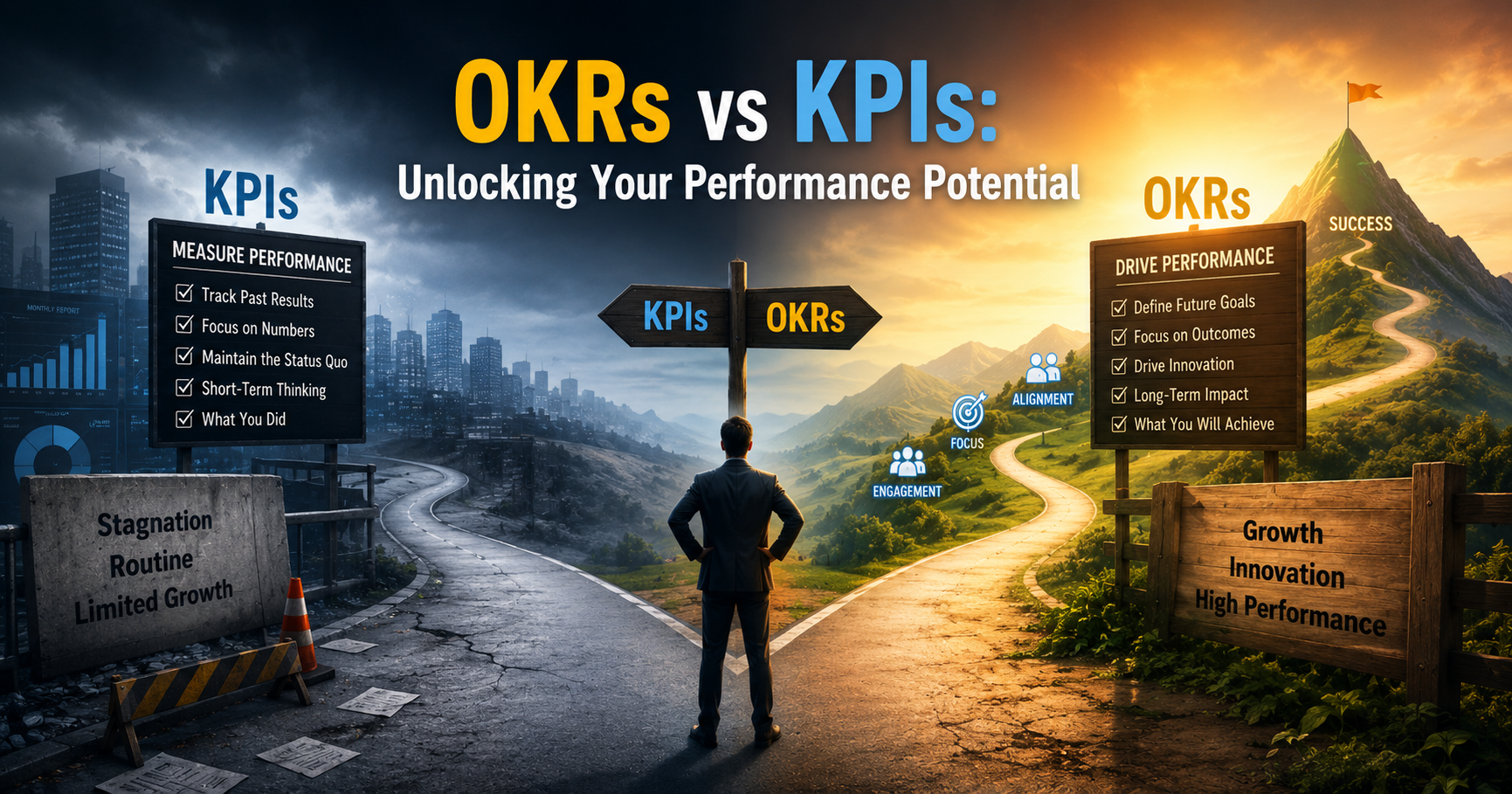
Table of Contents
OKRs vs KPIs: Unlocking Your Performance Potential
Introduction
Many businesses struggle with a common problem. Teams stay busy, projects move forward, reports look impressive, yet leadership still feels uncertain about whether the organization is truly progressing toward its strategic goals.
This challenge often stems from measuring the wrong things or using the right metrics incorrectly. That is where the discussion around OKRs vs KPIs becomes important.
Organizations frequently use these frameworks interchangeably, but they serve very different purposes. Understanding those differences can dramatically improve alignment, accountability, decision-making, and overall business performance.
Whether you manage a startup, lead a growing company, oversee a department, or simply want to improve team performance, understanding how OKRs and KPIs work together can help unlock your organization's full potential.
In today's data-driven business environment, companies that successfully combine strategic direction with measurable performance tracking consistently outperform competitors. The ability to connect ambitious goals with actionable metrics has become one of the most valuable business capabilities in 2026.
What Are OKRs and KPIs?
Understanding OKRs in Modern Business Strategy
OKRs, or Objectives and Key Results, are a goal-setting framework designed to help organizations define ambitious objectives and measure progress toward achieving them.
An objective describes what an organization wants to accomplish. It should be clear, inspiring, and strategically meaningful.
Key results define how success will be measured. These results must be specific, measurable, and time-bound.
For example, a software company may establish an objective to become a market leader in customer experience. The corresponding key results could include increasing customer satisfaction scores, reducing support response times, and improving customer retention rates.
The purpose of OKRs is not merely to track activity. Their purpose is to drive meaningful change and encourage organizational growth.
Understanding KPIs in Performance Measurement
KPIs, or Key Performance Indicators, are measurable metrics used to evaluate ongoing business performance.
Unlike OKRs, which focus on future achievements, KPIs typically monitor current operational health.
Examples include monthly revenue, customer churn rate, website conversion rate, employee retention, average response time, and customer acquisition cost.
These indicators provide visibility into how effectively a business is operating.
If OKRs help organizations determine where they want to go, KPIs help them understand how they are performing right now.

How OKRs vs KPIs Work Within Organizations
The Strategic Role of OKRs
OKRs are designed to create focus and alignment.
Leadership teams establish objectives that support broader organizational priorities. Departments then develop supporting OKRs that contribute to company-wide goals.
This cascading structure helps ensure that every team understands how their work contributes to strategic outcomes.
For example, if a company aims to increase market share, marketing, sales, product development, and customer success teams can all create OKRs aligned with that objective.
The result is greater organizational cohesion and strategic clarity.
The Operational Role of KPIs
KPIs function differently.
Their primary role is monitoring performance and identifying trends.
A sales manager may track lead conversion rates. A customer support manager may monitor ticket resolution times. A finance department may measure profit margins.
These metrics help leaders identify strengths, weaknesses, opportunities, and potential risks before they become major issues.
KPIs provide continuous feedback that supports informed decision-making.
The Five Key Differences Between OKRs vs KPIs
Understanding the distinction between these frameworks is essential because they solve different business challenges.
|
Area |
OKRs |
KPIs |
|
Primary Purpose |
Drive strategic goals |
Measure ongoing performance |
|
Time Horizon |
Future-focused |
Present-focused |
|
Level of Ambition |
Often aspirational |
Usually operational |
|
Frequency of Change |
Quarterly or periodic |
Continuous tracking |
|
Organizational Impact |
Aligns teams around objectives |
Monitors business health |
The first major difference involves purpose. OKRs are designed to drive transformation and progress. KPIs are designed to monitor performance.
The second difference relates to time perspective. OKRs focus on future outcomes and desired achievements. KPIs evaluate current operational effectiveness.
The third difference concerns ambition. Effective OKRs encourage organizations to stretch beyond existing capabilities. KPIs generally establish performance benchmarks that help maintain operational excellence.
The fourth difference involves flexibility. OKRs may change each quarter as priorities evolve. KPIs often remain consistent for extended periods because they track core business functions.
The fifth difference centers on strategic alignment. OKRs connect individual efforts to broader company goals, while KPIs provide insight into whether critical processes are performing effectively.

Benefits of Using OKRs and KPIs Together
Many organizations mistakenly view OKRs and KPIs as competing frameworks.
In reality, they work best together.
OKRs provide direction. KPIs provide visibility.
Imagine a company with an objective to improve customer satisfaction. The objective represents an OKR. Supporting KPIs might include response times, support ticket resolution rates, customer satisfaction scores, and customer retention metrics.
The KPIs provide ongoing performance data while the OKRs define the broader strategic destination.
When combined effectively, organizations gain both strategic focus and operational awareness.
This balance improves accountability, execution, collaboration, and business performance.
Challenges and Limitations of OKRs vs KPIs
Despite their effectiveness, both frameworks present challenges.
One common issue occurs when organizations create too many OKRs. Excessive objectives dilute focus and reduce effectiveness.
Another challenge involves selecting poor key results. If measurements fail to reflect meaningful progress, teams may pursue activities that do not contribute to strategic outcomes.
KPIs present their own risks.
Organizations sometimes become overly focused on metrics while losing sight of broader goals. Teams may optimize individual indicators without improving overall business performance.
Successful implementation requires careful planning, ongoing review, and strategic discipline.
Real-World Examples of OKRs vs KPIs
Consider a SaaS company seeking rapid growth.
Its objective may be to become the preferred software solution for small businesses within a specific market segment.
Supporting key results could include increasing product adoption, improving customer retention, and expanding market penetration.
At the same time, leadership may monitor KPIs such as monthly recurring revenue, churn rate, customer acquisition cost, average contract value, and customer lifetime value.
The OKRs define strategic ambitions.
The KPIs provide operational visibility.
Together they create a comprehensive performance management system.
OKRs vs KPIs vs Other Performance Frameworks
Organizations often compare OKRs and KPIs with alternative frameworks such as SMART goals, balanced scorecards, and performance dashboards.
SMART goals focus on creating specific and measurable objectives. Balanced scorecards provide broader organizational performance perspectives across financial, customer, operational, and learning dimensions.
While these frameworks offer value, OKRs and KPIs remain particularly effective because they balance strategic ambition with measurable performance tracking.
Many modern organizations integrate multiple frameworks to create comprehensive performance management systems.

Best Practices for Implementing OKRs and KPIs
Successful implementation begins with clarity.
Organizations should establish a limited number of meaningful objectives aligned with strategic priorities.
Every key result should directly support the objective it measures.
KPIs should focus on metrics that influence business outcomes rather than vanity metrics that provide little practical value.
Regular review sessions are equally important.
Teams should evaluate progress, identify obstacles, celebrate achievements, and adjust strategies as needed.
Transparency also plays a critical role.
When employees understand organizational objectives and performance indicators, alignment and accountability improve significantly.
Future Trends in OKRs and KPIs for 2026
Performance management continues to evolve rapidly.
Artificial intelligence is increasingly helping organizations identify meaningful metrics, predict outcomes, and automate performance analysis.
Predictive analytics is transforming how leaders evaluate progress. Rather than relying exclusively on historical performance data, organizations can anticipate future trends and make proactive decisions.
Real-time dashboards are also becoming more sophisticated.
Executives now expect immediate visibility into performance metrics across departments, projects, and business units.
As hybrid work environments continue to expand, organizations are placing greater emphasis on outcome-based measurement rather than activity-based tracking.
These developments are making performance management more strategic, dynamic, and data-driven.
Expert Insights on OKRs vs KPIs
After years of observing organizations across technology, finance, healthcare, manufacturing, and professional services sectors, one pattern consistently emerges.
The most successful organizations do not choose between OKRs and KPIs.
They leverage both.
Companies that focus solely on KPIs often become efficient but stagnant. They maintain performance without driving innovation.
Organizations that focus exclusively on OKRs may generate enthusiasm but struggle with execution.
The strongest businesses combine ambitious objectives with disciplined measurement.
This combination creates alignment, accountability, and sustainable growth.
Common Mistakes to Avoid
One frequent mistake involves treating KPIs as objectives.
Metrics alone do not provide strategic direction.
Another common error occurs when organizations establish unrealistic OKRs without sufficient resources or support.
Teams may also create too many objectives, making it difficult to prioritize effectively.
Finally, some companies fail to review progress consistently. Even well-designed frameworks lose effectiveness when leaders neglect ongoing evaluation and communication.
Final Thoughts: Unlocking Performance Through Strategic Measurement
The conversation around OKRs vs KPIs is not about choosing one framework over the other.
It is about understanding how each contributes to organizational success.
OKRs help businesses define ambitious goals and align teams around meaningful outcomes. KPIs provide the visibility needed to monitor performance and guide decision-making.
Together, they create a powerful system for managing growth, improving accountability, and achieving strategic objectives.
Organizations that successfully integrate both frameworks are better equipped to navigate change, drive innovation, and sustain long-term success in an increasingly competitive business environment.
The future belongs to organizations that measure what matters and align every effort with a clear strategic purpose.

Want to improve business performance and align your team around meaningful goals
Faq's
What is the main difference between OKRs vs KPIs?
OKRs focus on achieving strategic goals, while KPIs measure ongoing business performance. OKRs define where you want to go. KPIs show how you are performing today.
Can OKRs and KPIs be used together?
Yes. Many successful organizations use OKRs to define strategic priorities and KPIs to monitor operational performance.
Which is better, OKRs or KPIs?
Neither framework is inherently better. They serve different purposes and are most effective when used together.
Are OKRs suitable for small businesses?
Absolutely. Small businesses often benefit significantly from the clarity and focus that OKRs provide.
How often should OKRs be reviewed?
Most organizations review OKRs quarterly, although monthly progress reviews are also common.
OKRs focus on achieving strategic goals, while KPIs measure ongoing business performance. OKRs define where you want to go. KPIs show how you are performing today.
Yes. Many successful organizations use OKRs to define strategic priorities and KPIs to monitor operational performance.
Neither framework is inherently better. They serve different purposes and are most effective when used together.
Absolutely. Small businesses often benefit significantly from the clarity and focus that OKRs provide.
Most organizations review OKRs quarterly, although monthly progress reviews are also common.