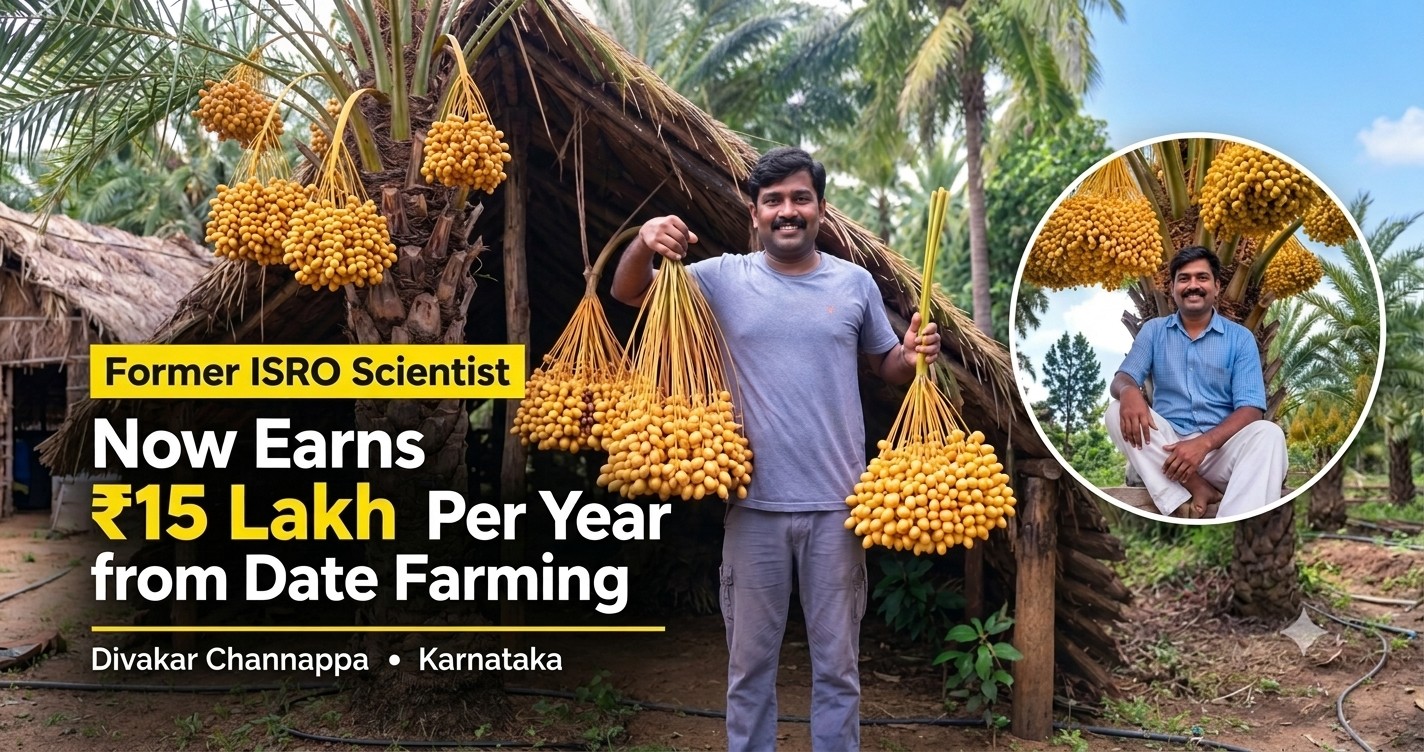
From ISRO to Organic Dates: How Divakar Channappa Built a Unique Farm in Karnataka
From ISRO to Organic Dates
What if one were to give up science in Bengaluru and opt for date palms in Karnataka?
To many that would seem a perilous choice. It was the start of a whole new life for Divakar Channappa.
After being involved in scientific and academic activities, Divakar switched to agriculture and started growing a fruit crop that many wouldn't expect to find in Karnataka: dates.
His experience demonstrates how farming can evolve with the adoption of traditional knowledge and experimentation, patience and a willingness to try something new.
A Career in the City, But a Pull Towards the Village
The involvement of Divakar Channappa in agriculture was in Karnataka. He was not supposed to be a farmer, since his family originally did have a farming background, but farming didn't always pay off.
Divakar continued his education in social work and then began working in various professions. He was also a visiting faculty at Tumkur University, and a project scientist at Indian Space Research Organisation (ISRO) in Bengaluru.
He was on a completely different track in his career from farming, when viewed from the outside.
After some time, however, he really started to seriously consider going back to the land.
One of the biggest influences was Japanese farmer and writer Masanobu Fukuoka's book, One Straw Revolution. Its concepts of natural farming changed the perspective of Divakar towards agriculture.
He didn't consider farming to be just a traditional way of life, but rather he looked at farming as a way to experiment and approach it in a new business model.
Also Read: From Banana Waste to Business
His First Attempt Did Not Bring Big Returns
The comeback to farming was not an instant success.
Initially, Divakar grew crops like ragi, maize and pulses which were more familiar to him. His returns were paltry and he realised that just going back to agriculture would not necessarily make the farm viable.
He had to discover something which could cope with the land, the weather and the market.
He then went on a search that led him to a strange idea.
Why not dates?
The Unusual Idea: Growing Dates in Karnataka
Dates are typically linked to warm and arid areas like in the Middle East.
Hence the concept of their cultivation in Karnataka immediately came up with queries.
Divakar had acquired knowledge about growing dates at an agricultural fair in Bengaluru. He later went to Tamil Nadu to get insights on date farming in the state.
The experience made him realize that the crop needed testing in his area.
He has cultivated around 150 Barhi date trees in 2.5 acres with an estimated cost of about ?4.5 lakh in 2009.
He christened the farm as “Marali Mannige” (Kannada for “back to the soil”).
However, the toughest days were yet to come.
Years of Waiting Before the First Harvest
Farming requires a lot of patience, compared to many other businesses, which can see results within months.
The date palms did not bear fruit in a timely manner.
Rumored to take about four years to produce its first substantial crop, the farm is said to have produced its first meaningful harvest. An early harvest was reported at around 650 kg harvested in 2013 with a selling price of around ?375 per kg.
It was more than a sale that first harvest was.
It was a demonstration that the experiment had the potential to be successful.
Over the years, the farm evolved from an experimental farm to a business operation.
From Experiment to Organic Date Farm
Also, Divakar decided to practice natural and organic farming.
He prepared natural inputs like Panchagavya and Jeevamrit on his farm as opposed to depending on synthetic agricultural inputs. Other materials used include neem-based inputs, composition and natural soil supporting techniques.
The dates were not all that the farm was limited to. His farming model has also been linked to other crops such as sugarcane, the indigenous rice varieties, ragi, pulse, millets, and more.
This transformed the farm to be more than a date plantation.
It was an illustration of farmers' ability to try new crops and farming methods, instead of relying solely on the traditional method.
Also Read: Built a Business Around Saving Water
The Numbers Began to Change
According to the published reports, the farm had approximately 102 productive date palms with each palm yielding about 45-50 kg of Barhi dates during a season by 2023.
Around 4.2 tonnes was reported as the production in the season and the sales were made directly from the farm and by deliveries to the customers in Bengaluru.
In some reports, it has been found that the earnings are about ?6 lakh per acre and the annual income is around ?15 lakh as per the year, yield and selling model. All of the following figures are reported farm results, not a guarantee to other farmers.
That's a distinction that counts.
Soil fertility, crop health, expenses, manpower and market prices are among the many factors that influence agriculture.
He didn't stop at selling dates!
The fact that the farm was a venue where people could experience agriculture firsthand is another interesting aspect of Divakar's model.
The farm has organized events related to the harvest, providing an opportunity to the visitors to see the date cultivation process and get to know more about natural farming.
He has also had the opportunity to work with the students and have a better understanding of farming and soil with the younger generation.
That adds another value.
The farm is not just a producer of food. It is also developing a linkage between consumers, students and agriculture.
What is the special aspect of this farming story?
Divakar's transition is not just from one profession to another, it's from a career to farming.
The larger takeaway is that there's a new opportunity in an old industry.
He didn't ask "What do all the other people grow here?," he asked another question.
“So, what else could there be?”
This attitude got him to investigate a different part of the world, try a new crop and be patient for several years before the payoff began.
It also reveals the factors behind the necessity of agricultural entrepreneurship to go beyond investment.
Requires research, patience, experimentation and customer knowledge.
Farming isn't a quick way to make quick money.
There's another aspect to this story.
Just because a farm is successful, it doesn't imply that all farms can invest in date growing and immediately earn lakhs.
The process of establishing a successful farm wasn't easy for Divakar either – it took years of waiting, experimenting and lots of money to make it work. His experience is also reported upon, with the focus on the inherent dangers, and the non-immediate rewards, of the farming profession.
Perhaps one of the best things he learned along the way.
Innovation in the agricultural sector does not mean pursuing the next big money crop. It's about knowing the ground, learning the market and being patient to create a lasting product.
A boy's perspective on the natural and social sciences, and how they connect to his everyday life as a farmer.
From Scientist to Farmer, With a Different Kind of Experiment
It all started with science, education and the city with Divakar Channappa's tale.
It eventually brought him back to soil, farming and an unconventional crop.
His date farm in Karnataka is a prime example that a farmer can challenge traditional beliefs, try out a different crop and start a direct link with customers.
It didn't happen overnight for them to switch from a career to agriculture.
It took years.
Which is maybe the reason why the story is interesting.
The most significant of change can sometimes be found in the beginning of a new thing.
It is a result of considering something as old as agriculture – and a new question.
Sources & Disclaimer
This article is independently written for informational and educational purposes using publicly available information about Divakar Channappa and his journey from ISRO project scientist to organic date farmer in Karnataka. Reported figures and farming details may change over time and should be independently verified.
This article is not affiliated with, sponsored by, or officially endorsed by Divakar Channappa, ISRO, or any organisation mentioned. All names and trademarks belong to their respective owners.
Send Us Your Enquiry
Send a message and the team will get back to you.
Featured Stories