He Saw Water Being Wasted and Built a Business Around Saving It: The Story of GoWaterless

He Saw Water Being Wasted and Built a Business Around Saving It: The Story of GoWaterless
The majority of people wash their cars as a routine.
Typically, just water, soap, a hose and a few minutes are required.
However, for Nitin Sharma, who was engaged in his family's auto business and car washing business, water was a lot more important. The old fashioned method of washing cars began to seem like it might be a problem that required a different solution when water supply became increasingly an issue.
Instead of taking it as it is, Sharma put up a question:
What if it was possible to clean a car without needing to use a significant quantity of water?
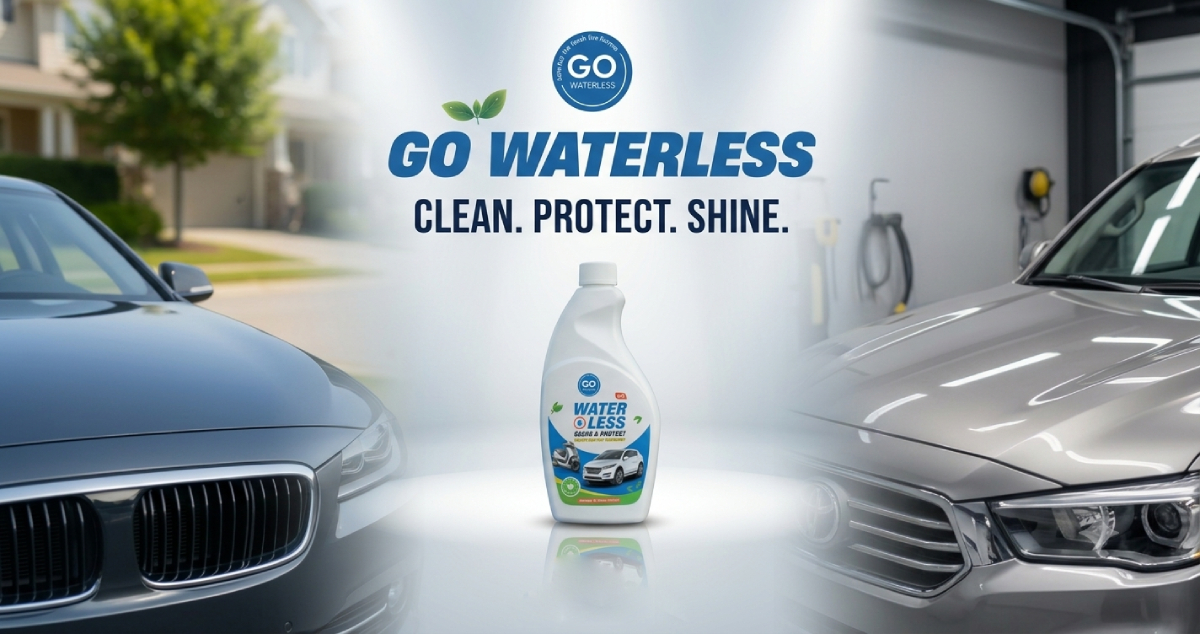
That question eventually resulted in a waterless car cleaning service and a more sustainable way to perform an all-too-common service: GoWaterless.
When a Common Business Faced an Uncommon Problem
Sharma's entrepreneurial journey didn't start with the intention of creating a big-sized start-up.
He came into the automotive field previously because of his family. The traditional car washing process however became difficult since the beginning of 2016 due to water shortages.
Regular washing of the car can consume a lot of water. There are recent reports suggesting between 20–25 litres of water are used for a standard wash, but this will vary depending on process and equipment.
That posed an intriguing query for a car wash operator.
Can the process be altered if water is becoming scarce?
So instead of searching for water, Sharma started searching for ways to conserve a lot less water.
The Idea Was Simple. Making It Work Was Not.
The idea for GoWaterless was simple: to come up with a cleaning product that could get rid of dirt from a car without the need for a lot of water used in a wash.
However, it took time to turn it into a product that can be relied upon.
According to reports Sharma took some two years to research and develop the solution and the team did experiments on about 600 different formulations before coming up with a solution that worked.
Financial risk was also a factor in the way.
In the initial days of the business, around ?10 lakh was invested, and it is reported that Sharma's wife contributed her savings and took loans from various jewellery items.
The experiment was not a sure bet to become a successful business.
Even if there were no assurance that customers would trust a car wash that wasn't using the standard amount of water.
However, Sharma worked on it for a while.
Finding a Different Way to Clean Cars
The group went through years of trials and testing, and ultimately came up with a plant-based cleaning formulation.
The formula's ingredients consist of extracts from five plant species and it is said to be intended for vehicle cleaning and to help preserve the surfaces of vehicles.
This was a whole new experience from a traditional car wash.
The waterless cleaning method does not require any water or much water, only a small amount of cleaning solution and suitable cleaning materials are used.
Approximately 100ml of solution used in the process, compared with approximately 25l of water normally used in a traditional car wash have been reported.
It was no longer a mere experiment.
It was now a viable business idea.
From Experiment to Business
Based on published reports, the waterless cleaning solution was commercially released in 2019.
However, Sharma wasn't just looking to sell a cleaning product.
The grander concept was to develop a service that would incorporate water conservation into the normal maintenance of the car.
This provided the business with a definite proposition:
Save lots of water and keep the car clean!
This message may resonate with your customers and your business if water availability is a big concern in your region.
The Business Started Growing
This started with an investment of approximately ?10 lakh that grew into a bigger enterprise.
According to recent reports in the media, GoWaterless is now a company with a turnover of about ?10 crores, with an annual turnover of around ?4 crores.
The company has also been reported to have grown to over 200 franchises in 22 states in India.
They are business statistics and may alter as the business grows on.
However, the number that is probably the most impressive is related to the initial problem the business was solving.
As per the latest reports, the GoWaterless network is expected to save almost 12 lakh litres of water daily.
That is, when Sharma saw a problem in one business, it was the cornerstone for a solution that could impact a larger business.
Why the Business Model Stands Out
The GoWaterless business interestingly was not initiated with the intent to embark on a new industry.
There was already a business of getting cars washed.
The innovation was based on challenging one aspect of a current process.
Why do it take so much water to clean a car?
That is the question that opened up the opportunity for a new approach.
A principle lesson that entrepreneurs need to learn. Innovation doesn't necessarily involve the invention of something that's never been seen before.
It can also be finding a new way to do an activity you know.
Turning a Problem Into an Opportunity
Oftentimes, ideas for startups come from a problem that is prevalent in everyday life.
For Sharma, it was drought.In Sharma's case, it was lack of water.
For some others, it might be costly packaging, slow delivery times, payment hassles or the absence of a certain service.
It's important to identify that sometimes a problem can lead to a business opportunity.
Sharma could have just seen the issue of water scarcity as a problem for his business only.
Instead, he wondered if the challenge could be overcome by innovation itself.
It was a shift in mindset that was key.
The Importance of Experimentation
But another crucial element of the GoWaterless story is the development process.
More than 600 formulations were tested and the first idea is not the last.
When entrepreneurs finally see the desired product, they tend to overlook all the things that went wrong.
However, experimentation is a crucial process to creating something new.
Until the customer adopts a product it may have to be tested, altered, and retested before it will be accepted.
The process took Sharma's team about two years, it is reported.
The lesson is the following:
Patience and testing and improvement of the good idea is required before it becomes a good business.
Can Sustainability and Business Grow Together?
GoWaterless also demonstrates that this awareness of the environment can open doors for entrepreneurs.
It is not always necessary for a business to be money-making and a social or environmental problem-solving organization at the same time.
In some instances, the answer to the environmental issue can turn into the company.
In this instance, water savings became the focus of the company's service.
The business can be able to provide an alternative method of car washing for the customers, and provide an alternative business model for water conservation.
The pairing allowed the concept to have a distinct focus that goes beyond just another car-care business.
What Entrepreneurs Can Learn From GoWaterless
This trek has a number of lessons embedded within it.
Observe problems in the surrounding. The challenge, which Sharma used to come up with the idea, is related to his business.
Secondly, don't assume the initial version will be flawless. In the hundreds of formulation tests reported, it is evident that a good deal of experimentation exists in product development.
Thirdly, address a practical issue. There was now a practical purpose for the concept to exist: water.
Lastly, don't forget to consider the product beyond. GoWaterless was more than just a cleaning solution, it was also a service and a franchise development platform to reach more customers.
From a Water Problem to a Larger Mission
The story of Nitin Sharma and GoWaterless is an example of how simple and yet meaningful questions can make for successful businesses.
He witnessed a way of doing things which was dependent upon water.
He wondered if there were other ways of doing it.
Years of research, testing and financial risk ensued.
The outcome was a car-cleaning enterprise without water, which as of lately, as per the media reports, has grown throughout multiple states and is assisting to lower water consumption via its operations.
The key to it is probably the simplest:
It's not always necessary to look for a billion dollar idea. At times, it is essential to address the issue which individuals encounter on a day-to-day basis.
Water was the issue for Sharma.
He was able to come up with a solution to the problem, which led to him creating a business based on that solution that he could make more sustainable than something that people previously needed.
This is where many great startup stories start, with a problem, a question and a determination to find a new answer.
Sources
Disclaimer
This article is for informational and educational purposes only. The information is based on publicly available sources and published reports and may change over time. Business figures, revenue, franchise numbers, water-saving estimates and other company-related information are reported figures and have not necessarily been independently audited. Digital Startup India is an independent private platform and is not affiliated with, sponsored by, endorsed by, or operated by GoWaterless, Rewowlution Ventures Pvt. Ltd., Nitin Sharma, or any other individuals or organisations mentioned in this article.
Send Us Your Enquiry
Send a message and the team will get back to you.
Featured Stories