SolarSure Success Story: Turning Sunlight Into Income
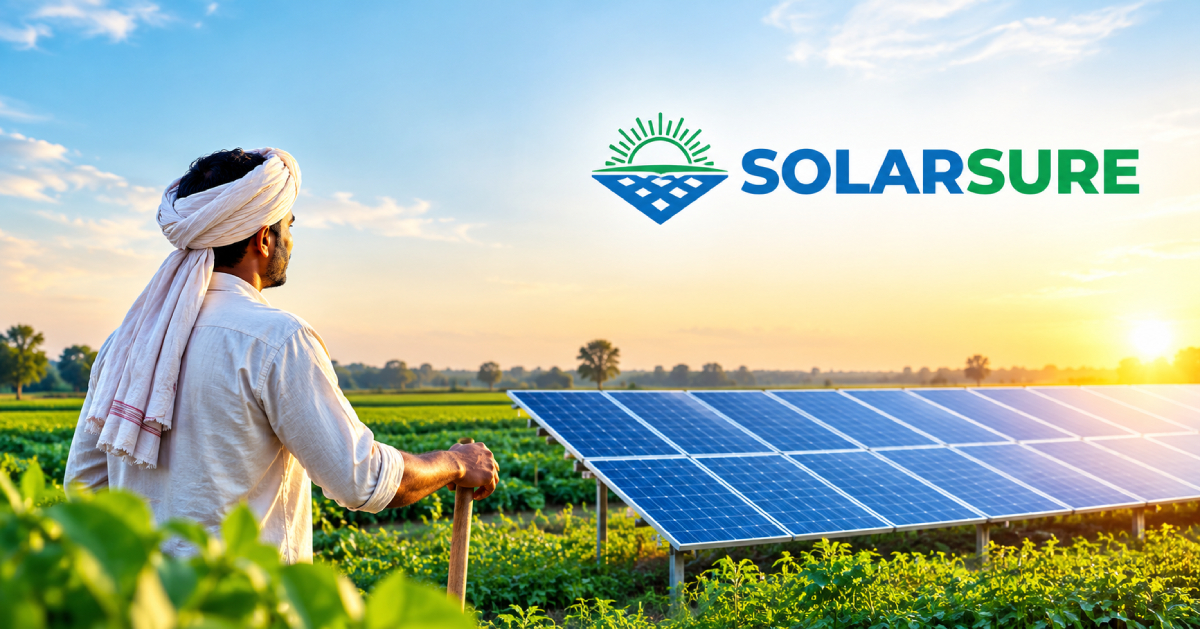
SolarSure Success Story: Turning Sunlight Into Income
The Indian farming community has been reliant on factors beyond their control for generations: weather, the price of their crops, electricity supply and increasing input costs. What if the ground that can also produce food can also provide energy and additional income?
That is the question that lies at the core of SolarSure's success story.
The concept of the company is a simple one: farmers must not only eat energy; if appropriate and allowed, they can become producers of energy.
The vision behind it is Bhavesh Patidar, who himself is a peasant from Madhya Pradesh and experienced the financial insecurity of agriculture for himself. He was a technology and agritech entrepreneur who eventually moved to renewable energy and so SolarSure was born.
The Problem Started at Home
Bhavesh didn't learn what the issues are with farming by reading a market report.
He had lived amongst them.
His family was farming and he realized that it can be quite difficult to be successful and have financial stability out of your years of work as a farmer. This experience lasted with him even after leaving the village and going for higher studies.
He attended IIT-BHU and held several positions in the technology and climate areas. He had previously also been a part of agritech through Neurafarms prior to SolarSure.
However, one question persisted: What about a farmer's land as another source of income?
It all began to fall into place when Bhavesh started considering solar energy.
Also Read : Zomato Success Story
From Farming Land to Solar Power
The PM-KUSUM scheme in India provided an opportunity to farmers and eligible people to be part of decentralised renewable energy projects.
Eligible farmers, farmer groups, cooperatives, FPOs etc can prepare the grid connected renewable energy projects under the scheme guidelines which are usually in the range of 500 kW to 2 MW. DISCOMs can buy the electricity at a tariff, which is fixed by the relevant State Electricity Regulatory Commission.
It was for Bhavesh more than just a government scheme.
This was one of the solutions he came up with for a problem he encountered all his life.
He was interested in how the concept would work on his own land and chose to install a solar plant of 2 MW and connect to the grid. The experience highlighted some of the potential of establishing a more regular income stream for the farmer in addition to agricultural income, using solar.
But something happened that wasn't supposed to.
Other farmers began to ask questions.
They wanted to know how the project worked, if they could use their own land and if solar power could provide an additional source of income to their families.
The curiosity turned into the start of SolarSure.
How SolarSure Was Born
SolarSure was established in the form of an EPC for renewable energy in November 2024.
It helps farmers and landowners consider solar projects, such as those on underused or less fertile land. The company claims it's not only designed projects for farmers, but is also available for their funding, installation and maintenance and integration with the grid as well.
The company's own website says it's a combination of renewable-energy engineering and project execution, and works on solar EPC, green-energy consulting, hybrid energy and battery-energy-storage solutions.
The concept is not just to place solar panels on farming land.
To create a complete system around the opportunity.
Also Read : Physics Wallah Success Story
From One Family's Experiment to a Larger Mission
SolarSure reports commissioning over 300 MW of solar power capacity and hitting over 50,000 farmers with projects in Madhya Pradesh, Rajasthan, Chhattisgarh, Telangana, Uttar Pradesh and Odisha. The company also claims that it has pushed through over 1.5 GW of its project queue.
These are company reports but it reflects the size of the ambition behind the business.
SolarSure's website also frames the company based on its ability to assist farmers/landowners to utilise land for solar projects and claims that its team comprises professionals with an IIT and IIM background.
The bigger picture, though, is not simply megawatts.
It's a shift in land perspectives.
What is Solar Power for a Farmer?
Solar is not a substitute for agriculture and each project requires land, capital, grid, regulations, tariffs and conditions to be met.
However, there are a number of ways through which farmers can join the process of solarisation under PM-KUSUM.
For instance, under Component A, suitable land has been made available to build eligible renewable-energy plants and under Component C solarization of existing grid connected agricultural pumps. Excess electricity produced by individual pump solarisation also can be sold to DISCOMs under applicable arrangements under the scheme.
This opens up a completely new opportunity for agricultural families.
Some farmers may be able to have an extra income stream based on energy, rather than relying on the income from crop production.
And that is the opportunity Bhavesh wants to expand.
Technology Behind the Solar Projects
SolarSure's approach doesn't stop at the installation of panels, either.
The company analyzes factors like wind conditions, site suitability, and climate risks, before developing projects, using AI and satellite data.
It is an interesting part of the story as it ties two worlds together that are usually mentioned in isolation:
Traditional agriculture and technology.
Satellite information can aid in the evaluation of a site. The design of a plant is determined by the engineering. Solar technology is the technology used to transform sunlight into electricity. And Grid infrastructure would provide that electricity to the power system.
Ultimately, for farmers, there is a simple goal behind all of this technical effort: making the project 'workable' in the long run.
A Farmer's Story Makes the Idea Real
The experience of farmers described in the original report helps to connect the dots on the concept.
One farmer Mr Nikhil Patel got introduced to the concept of solar projects under PM-KUSUM and later got linked with SolarSure. With the extra income he was able to handle his EMIs and make plans for his family's finances with more confidence, he said.
Another farmer quoted in the report had put in a 5kW solar system and reported that his domestic electricity bill had significantly reduced.
The individual experiences should not be assumed to be representative of all farmers. Depending on the location, project size, financing, tariffs, land conditions and the grid conditions, solar project economics can be quite different.
They illustrate however, why this concept has caught on.
Why is the SolarSure Story relevant?
The story behind SolarSure is fascinating as it started from a personal problem instead of just a business opportunity.
Bhavesh identified with the problems of the farmers in his family, shifted his focus to technology and entrepreneurship and eventually went back to the issue that had been with him since childhood.
He didn't give up on farming.
It was to inquire if farmers would be able to utilize yet another resource already available to them — sunlight.
According to India's official PM-KUSUM portal, significant progress has been made in implementing the scheme, with over 1,592 MW installed under the PM-KUSUM scheme as of August 31, 2026.
This indicates a greater shift in the rural landscape of India—agriculture and renewables are becoming linked.
Also Read: Go Waterless Success Story
The Lesson From SolarSure.
Breaking the story of SolarSure down to its core elements, there is perhaps one lesson that can be taken.
The best business idea can be found right in the midst of a problem that you've had yourself.
Bhavesh didn't start out with the purpose of creating a huge renewable firm. He started his career with a message much closer to home, as he saw his family's struggle to make a living on the farm.
He had this experience and decided to try something else.
One solar plant started with The beginning was one solar plant. Questions from neighbouring farmers became demanded. And it was a demand that eventually turned to a company.
The story is still unfolding, but its main premise is established: You don't only get light from the sun above a farm. If configured properly, the project and technology and policy can contribute to a farmer's energy and income narrative as well.
Sources
Disclaimer
This article is for informational and educational purposes only. Information is based on publicly available sources and published reports and may change over time. Business figures, project numbers, farmer experiences and other company-related claims are reported information and have not necessarily been independently verified by Digital Startup India. Digital Startup India is an independent private platform and is not affiliated with, sponsored by, endorsed by, or operated by SolarSure, Bhavesh Patidar, or any other individuals or organisations mentioned in this article.
Send Us Your Enquiry
Send a message and the team will get back to you.
Featured Stories