Categories
Recent Posts






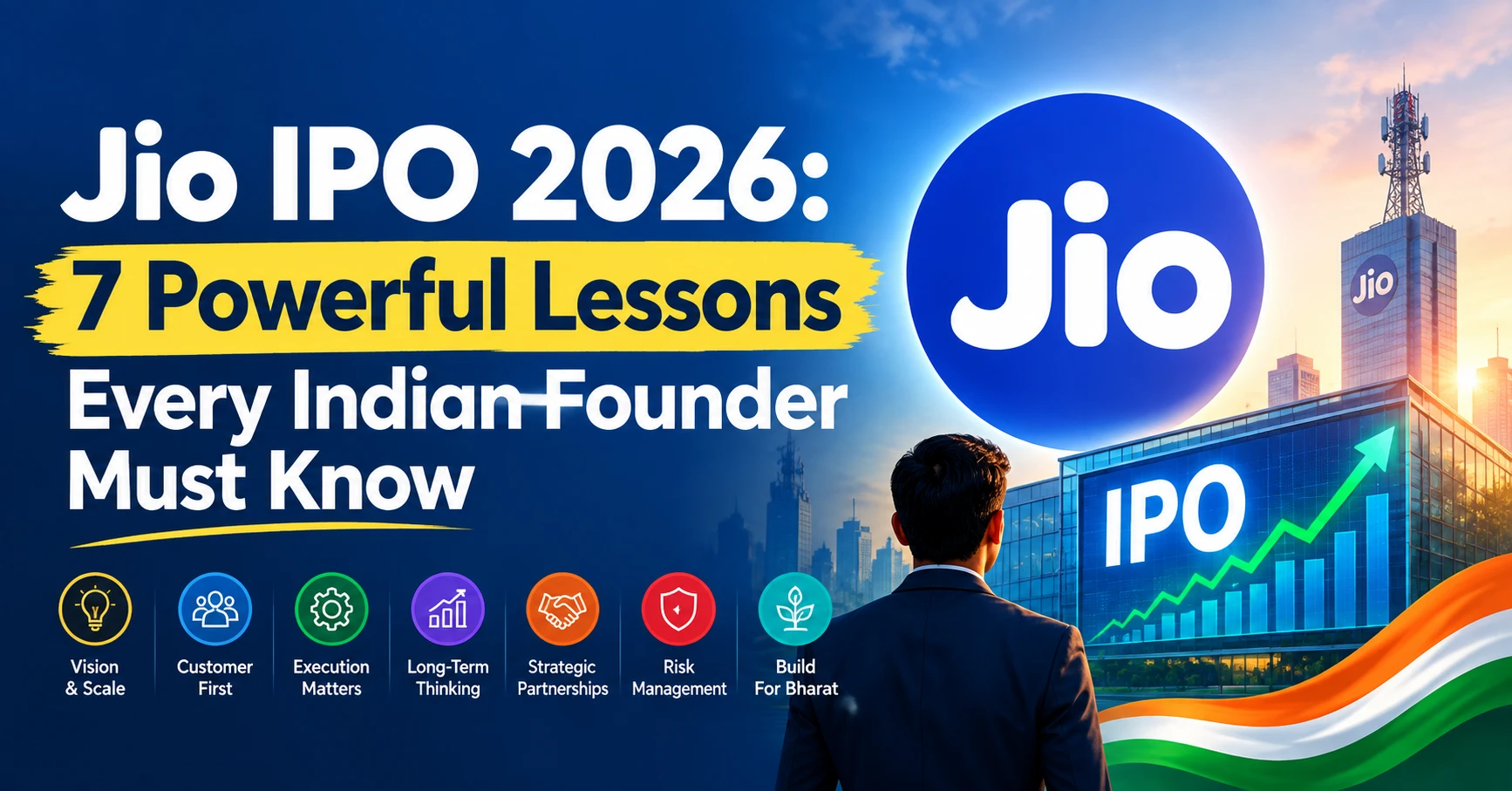
Table of Contents
Jio IPO 2026: 7 Powerful Lessons Every Indian Founder Must Know
The Jio IPO is almost here. It could become the biggest IPO in India's history.
Most people are asking one question: "Should I invest?"
As a founder or business owner, you should ask a better question: "What can I learn from this?"
Jio went from a new telecom brand in 2016 to a company that may be valued at over ₹12 lakh crore. That growth was planned step by step. In this article, you'll get the key Jio IPO details in simple words. You'll also learn 7 practical lessons you can use in your own startup, whatever its size.
Note: All dates and numbers below are based on media reports (PTI, Moneycontrol and others) quoting banking sources. Jio Platforms has not officially announced final details yet. This article is for education only and is not investment advice.
What Is the Jio IPO? (Quick Summary)
Jio Platforms Limited is the digital arm of Mukesh Ambani's Reliance Industries. It owns Reliance Jio Infocomm, India's largest telecom company, along with several digital businesses.
The company is now going public. That means ordinary investors like you will be able to buy its shares on the stock market for the first time.
Here is why this Jio Platforms IPO matters:
- It could be India's largest IPO ever.
- It is the first consumer-facing business from the Reliance group to go public.
- It is Reliance group's first IPO in nearly two decades.
Jio IPO Date: Expected Timeline
According to media reports, here is the expected Jio IPO schedule:
| Event | Expected Date |
|---|---|
| DRHP (draft papers) filed with SEBI | June 2026 |
| SEBI final approval | 28 August 2026 |
| Final documents to SEBI | Week starting 12 October |
| Anchor investor book opens | 19 October |
| IPO opens for public | 21 October |
| IPO closes | 23 October |
| Expected Jio IPO listing date | 28 October |
These dates may change based on market conditions and global events.
Also check : https://www.sebi.gov.in/
Jio IPO Size and Valuation: The Big Numbers
Here are the key numbers in simple words:
- Valuation: Around $143–146 billion, which is more than ₹12 lakh crore.
- Issue size: Around $3.8 billion, or about ₹37,700 crore (market estimate).
- New shares: Up to 27 crore fresh equity shares.
- Type of issue: 100% fresh issue. No existing shareholder is selling.
If the issue size stays near ₹37,700 crore, it will be bigger than Hyundai Motor India's ₹27,858.75 crore IPO, which is currently the largest in India.
Who Owns Jio Platforms Today?
- Reliance Industries: about 66.4%
- Meta (Facebook) and Google together: about 17.7%
- Other investors: the rest
Jio IPO GMP: What Is the Grey Market Saying?
Reports say Jio shares are trading at a ₹125 premium in the unlisted or grey market, even before the IPO opens.
What is GMP? GMP (Grey Market Premium) is the extra price some people are willing to pay for IPO shares before they officially list. It shows market excitement.
Important: GMP is unofficial and unregulated. It can change quickly. Never treat it as a guarantee of listing gains.
Jio IPO Share Reservation: Who Gets How Much?
As per the papers filed with SEBI, the issue is divided like this:
- 50% for Qualified Institutional Buyers (QIBs), such as mutual funds and big institutions
- 35% for Retail Individual Investors (RIIs), the common investors
- 15% for Non-Institutional Investors (NIIs), the high-net-worth individuals
Where Will Jio Use the IPO Money?
According to the DRHP:
- About ₹27,500 crore will be used to fully or partly repay debt of Reliance Jio Infocomm.
- The remaining money will go to general business purposes.
In simple words, Jio is using public money to reduce its loans and become financially lighter.
Global Roadshows: How Jio Pitched to the World
Before the IPO, Jio held investor roadshows in the USA, UK, Dubai, Hong Kong and Singapore. These were led by Akash Ambani (Chairman, Reliance Jio) and Isha Ambani (Executive Director, Reliance Retail Ventures).
Reports say foreign institutional investors (FIIs) and domestic investors both showed strong interest. Indian roadshows are expected in the week starting 12 October.
Also Read : Anthropic IPO: 7 Shocking Lessons From Its $2 Trillion Bet | Daylight Saving Time 2026: 7 Hidden Risks for Indian Startups
7 Powerful Lessons for Indian Founders from the Jio IPO
This is the part that matters most for entrepreneurs, business owners and founders.
Lesson 1: Build Scale First, Then Profit
When Jio launched in 2016, it offered free calls and very cheap data. Many people thought it was a crazy idea. But Jio was buying something more valuable than early profit: users and habits.
Your takeaway: In the early stage, focus on getting loyal customers. Profit becomes easier once people depend on your product.
(Caution: Jio had Reliance's deep pockets. A small startup must plan its cash runway carefully before offering heavy discounts.)
Lesson 2: Strategic Investors Bring More Than Money
Jio raised money from Meta and Google in 2020. These partners brought trust, technology and global credibility, not just cash.
Your takeaway: When you raise funds, choose investors who can open doors, share knowledge or bring customers. The right partner can be worth more than a higher valuation.
Lesson 3: Timing Is Everything
Jio did not rush to the stock market. It waited until the business was strong, the market was ready, and investor interest was high.
Your takeaway: Don't raise money or launch just because others are doing it. Wait for the moment when your numbers and the market both support you.
Lesson 4: Clean Up Your Balance Sheet
Jio plans to use ₹27,500 crore of IPO money to repay debt. A company with less debt looks safer to investors.
Your takeaway: Keep your accounts clean and your debts under control. When you go for funding or a bank loan, a clean balance sheet builds instant trust.
Lesson 5: Your Story Sells Your Business
The global roadshows prove one thing: even a giant like Jio has to pitch its story to investors in person.
Your takeaway: Practise your pitch. Explain clearly what problem you solve, how big the market is, and why your team will win. Numbers matter, but the story makes people remember them.
Lesson 6: Build an Ecosystem, Not Just a Product
Jio is no longer just a SIM card company. It has JioCinema, JioMart, JioSaavn, JioFiber, cloud services and more. Each product keeps the customer inside the Jio world.
Your takeaway: Once your first product works, think about what else your customers need. Related products increase customer lifetime value and make you harder to replace.
Lesson 7: Long-Term Thinking Wins
From launch in 2016 to IPO in 2026 is about 10 years. Real value takes time.
Your takeaway: Don't chase overnight success. Build steadily, keep learning and stay patient. Most "overnight successes" are 10 years in the making.
Should You Invest in the Jio IPO?
That depends on your goals, risk appetite and financial situation. Before you apply:
- Read the final RHP (Red Herring Prospectus) once it is released.
- Check the price band, which has not been announced yet.
- Don't invest only because of GMP or hype.
- Speak to a SEBI-registered financial advisor if you are unsure.
Final Thoughts
The Jio IPO is more than a big stock market event. It's a live case study of how an Indian company planned growth, raised smart money and built trust over a decade.
Whether you run a small business in a Tier-2 city or a funded startup in Bengaluru, these lessons apply to you: scale smartly, choose partners wisely, keep your finances clean, and think long-term.
Your startup may not be the next Jio. But it can grow with the same thinking.
👉 Found this useful? Share it with a founder friend and subscribe to Digital Startup India for more startup insights.