Categories
Recent Posts




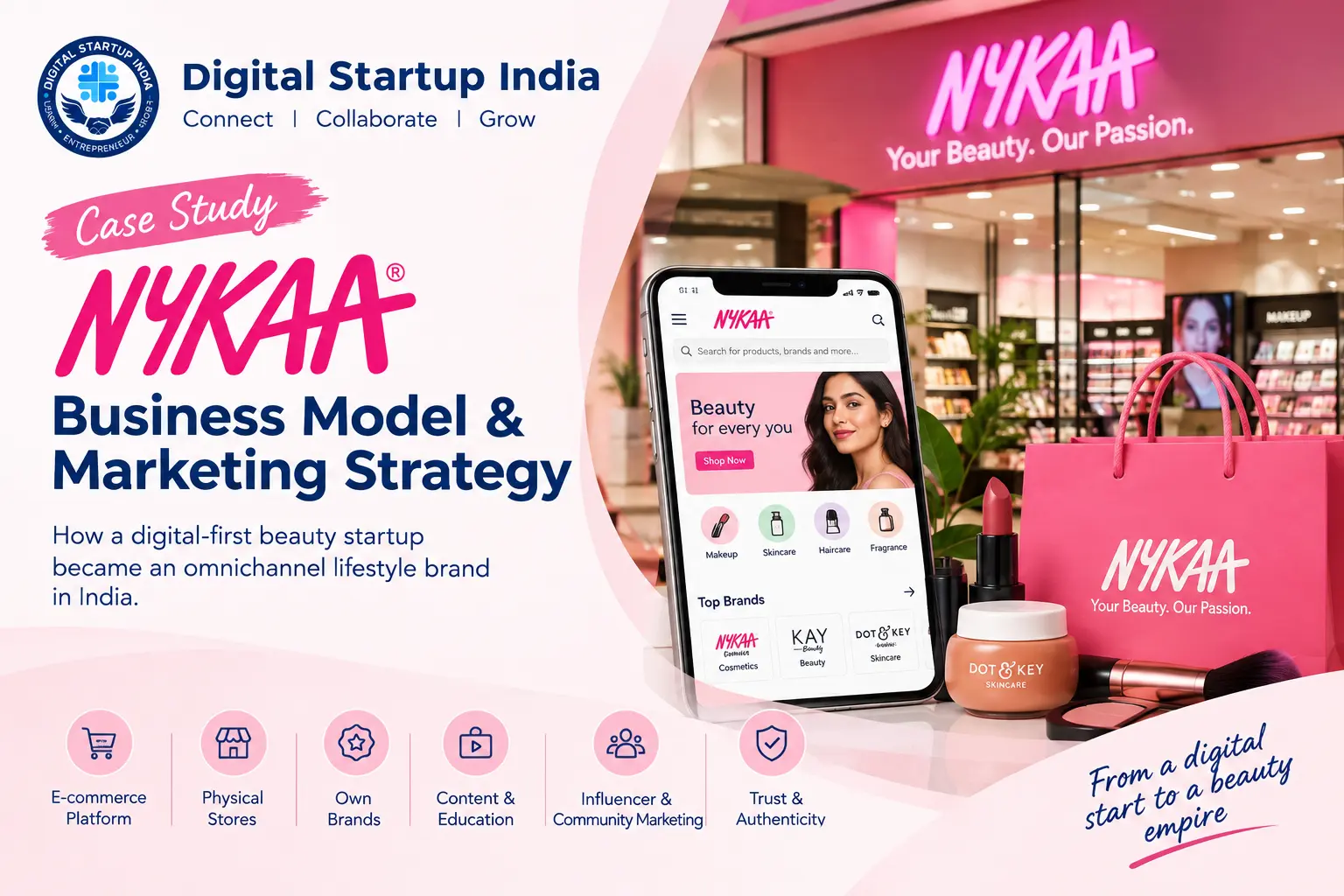
Table of Contents
Nykaa Case Study: How a Digital-First Beauty Startup Built an Omnichannel Brand in India
Introduction
India's beauty and personal-care market was once dominated by traditional retail stores and established brands. For consumers, discovering authentic products, understanding which products suited their needs, and accessing a wide range of beauty brands could be difficult.
In 2012, Falguni Nayar founded Nykaa with a digital-first approach and a vision to make beauty more accessible to Indian consumers. What began as an online beauty platform gradually developed into an omnichannel beauty and lifestyle business combining e-commerce, physical stores, content, owned brands, and technology.
Today, Nykaa provides an interesting Indian startup case study because its growth was not based only on selling products online. Its strategy combined content, trust, brand partnerships, technology, customer experience, and offline expansion.
The Problem Nykaa Identified
When Nykaa entered the market, Indian consumers had limited access to a specialised online destination for beauty products.
The company identified several opportunities:
-
Growing interest in beauty and personal care
-
Increasing internet and smartphone adoption
-
Demand for authentic products
-
Limited discovery options for niche and international brands
-
Increasing consumer interest in beauty education
-
Opportunity to build a specialised online beauty community
Instead of creating a general e-commerce marketplace, Nykaa focused specifically on beauty and later expanded into fashion and other lifestyle categories.
The Business Model
Nykaa's business model evolved beyond simple online retail.
The company combines:
1. E-commerce
Customers can discover and purchase beauty, personal-care and fashion products through its digital platforms.
2. Physical Retail
Nykaa expanded its presence through physical stores, creating an omnichannel business model where customers can interact with products offline while also using the company's digital platforms.
According to Nykaa's FY2024-25 annual report, its beauty business had 237 stores across 79 cities as of March 31, 2025.
3. Owned Brands
Nykaa developed its own portfolio of brands, including Nykaa Cosmetics, Kay Beauty, Nykaa Naturals, Dot & Key, Wanderlust and others.
This allowed the company to participate not only in retail distribution but also in brand creation.
4. Content and Education
One of the important parts of Nykaa's strategy has been content.
Instead of simply showing products, the platform has invested in tutorials, product information, beauty education and digital communities to help consumers make purchasing decisions.
Nykaa itself describes content-led education and discoverability as an integral part of its business model.
Nykaa's Marketing Strategy
1. Content Marketing
Beauty products often require education.
A customer may want to know:
-
How to use a product
-
Which product suits their skin type
-
How a particular makeup technique works
-
Which ingredients are suitable for them
-
How different products compare
Nykaa used content to answer these questions and create product discovery opportunities.
This is an important lesson for startups: content can be used not only to generate traffic but also to educate customers and support purchasing decisions.
2. Influencer and Community Marketing
Beauty is highly visual and social.
Nykaa's digital strategy benefited from the growth of beauty creators, influencers and online communities. Product demonstrations, tutorials and creator-led content helped consumers discover products in a more engaging format.
This created a connection between content → discovery → product → purchase.
3. Trust and Authenticity
Authenticity is particularly important in beauty and personal care.
Nykaa states that products on its platform are sourced directly from brands or authorised distributors under its authenticity approach.
Building this trust helped address one of the key concerns consumers can have when purchasing beauty products online.
From Online Startup to Omnichannel Business
One of Nykaa's major strategic developments was its move from being primarily digital to building an omnichannel retail network.
The company opened its first store in 2014 and subsequently expanded its physical presence. Its stores provide customers with opportunities to see, experience and purchase products in person.
This created a two-way relationship between online and offline channels.
A customer could:
Discover online → Research → Visit store → Experience product → Purchase
Or:
Visit store → Discover product → Research online → Purchase digitally
For an e-commerce startup, this illustrates how offline expansion can complement rather than replace digital channels.
Building Its Own Brands
Another important part of Nykaa's strategy was moving beyond third-party products.
The company developed and acquired/expanded several owned brands across beauty and fashion.
According to its FY2024-25 annual report, Nykaa's owned beauty brands generated 55% year-on-year GMV growth in FY2025 and represented 14.4% of beauty-business GMV, compared with 12.1% in FY2024.
This strategy allowed Nykaa to participate in multiple stages of the value chain:
Brand discovery → Retail → Customer data → Brand development → Distribution
The IPO Milestone
Nykaa became a publicly listed company in 2021, marking an important milestone in its growth journey.
The company was founded in 2012, and its public listing came less than a decade later. Nykaa's own corporate materials describe the company as having grown from a digital-first beauty platform into a broader consumer technology and lifestyle business.
The IPO also demonstrated how a consumer-focused startup could develop from a specialised digital platform into a large-scale omnichannel business.
What Makes the Nykaa Case Study Interesting?
Nykaa's growth provides several lessons for startups and entrepreneurs.
1. Solve a Specific Problem
Instead of initially trying to become everything for everyone, Nykaa focused on a specific category: beauty.
2. Build Trust
In categories where authenticity matters, trust can become a major competitive factor.
3. Use Content to Educate
Content can help customers understand products and make informed decisions.
4. Build a Community
Consumers can become more engaged when a brand provides education and useful information rather than focusing only on transactions.
5. Think Beyond One Channel
Nykaa combined digital commerce with physical retail to create an omnichannel experience.
6. Develop Your Own Brand
Creating owned products can give a company opportunities beyond third-party distribution.
Key Takeaways for Indian Startups
The Nykaa case study demonstrates that startup growth does not necessarily come from one marketing channel or one product.
A business can build a stronger ecosystem by combining:
Product + Content + Technology + Community + Trust + Distribution
For Indian startups, one of the biggest lessons is to understand the customer problem deeply before deciding how to scale.
Nykaa's journey also demonstrates how a startup can evolve over time. What began as a digital-first beauty platform expanded into physical retail, owned brands, fashion, B2B offerings and international opportunities. Nykaa currently describes itself as a broader lifestyle platform serving millions of customers.
Conclusion
The Nykaa case study is an example of how a focused business idea can evolve into a larger consumer ecosystem.
Falguni Nayar identified an opportunity in India's beauty market and built a digital-first company around product discovery, authenticity, content and customer experience. Over time, Nykaa expanded its business model through physical stores, owned brands and additional lifestyle categories.
For entrepreneurs, the most useful lesson is not simply that Nykaa became a large company. It is that the business continuously expanded around its understanding of the customer.
Find a real problem. Build trust. Educate your audience. Create a strong customer experience. Then scale carefully.
Digital Startup India shares startup case studies, founder stories and business insights to help entrepreneurs understand the strategies and decisions behind growing businesses in India.
Primary Source: Nykaa – Who Are We / The Nykaa Story
Disclaimer: This case study is for educational and informational purposes only. Information has been compiled from publicly available sources, including Nykaa's official website and reports. Digital Startup India is not affiliated with or endorsed by Nykaa.