Categories
Recent Posts






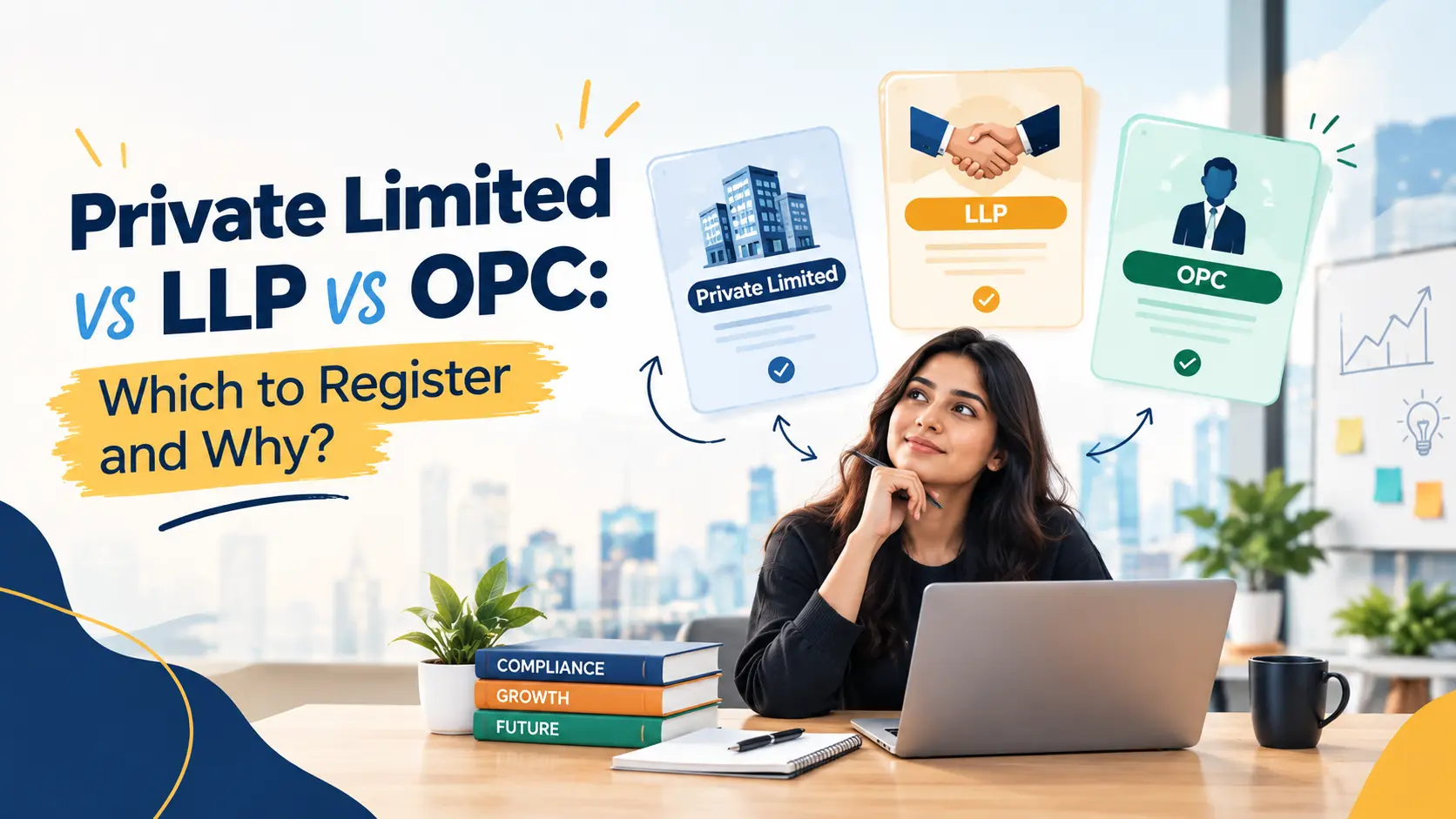
Table of Contents
Private Limited vs LLP vs OPC: Which to Register and Why
You have a business idea, a little traction, maybe even your first customers. Then comes a question that stalls many founders: should I register a Private Limited company, an LLP or an OPC?
It sounds like paperwork, but the answer shapes how you raise money, pay tax, share ownership, handle compliance and protect your personal assets. Switching later is possible, but it costs time, money and effort.
This guide breaks down all three structures in plain language, compares them side by side, and helps you decide which one suits your stage and goals.
Quick Overview of the Three Structures
Private Limited Company (Pvt Ltd): A separate legal entity owned by shareholders and run by directors. It is the most investor-friendly structure in India and the usual choice for startups planning to scale.
Limited Liability Partnership (LLP): A hybrid of a partnership and a company. Partners enjoy limited liability, and the structure is flexible with fewer compliance requirements.
One Person Company (OPC): A company with a single shareholder. It suits solo founders who want a company's legal protection without needing a co-founder.
Key Features of Each Structure
Private Limited Company
-
Requires a minimum of 2 directors and 2 shareholders (a person can be both)
-
Maximum of 200 shareholders
-
Separate legal identity, with shareholders' liability limited to their shares
-
Can issue equity shares, ESOPs and convertible instruments
-
Has perpetual succession, so the company continues regardless of changes in ownership
-
Preferred by angel investors, VCs and banks
LLP
-
Requires a minimum of 2 partners (and at least 2 designated partners)
-
No upper limit on the number of partners
-
Separate legal entity, with limited liability for partners
-
Governed by an LLP agreement, which gives high flexibility
-
Cannot issue shares, so raising venture funding is difficult
-
Lower compliance burden than a company
OPC
-
Requires 1 shareholder (director) and 1 nominee
-
Separate legal entity with limited liability
-
The sole owner keeps full control
-
Subject to conditions on eligibility, such as the owner being a resident Indian citizen, and rules on conversion once thresholds are crossed
-
Cannot raise equity funding from outside investors without converting to a Private Limited company
Private Limited vs LLP vs OPC: Side-by-Side Comparison
|
Factor |
Private Limited |
LLP |
OPC |
|
Minimum members |
2 directors, 2 shareholders |
2 partners |
1 shareholder + 1 nominee |
|
Legal status |
Separate legal entity |
Separate legal entity |
Separate legal entity |
|
Liability |
Limited to shares |
Limited to contribution |
Limited to shares |
|
Raising equity funding |
Easy |
Very difficult |
Not possible without conversion |
|
Compliance level |
High |
Moderate |
Moderate to high |
|
Ownership flexibility |
Through shares and ESOPs |
Through LLP agreement |
Single owner |
|
Taxation |
Corporate tax rates |
Flat LLP rate |
Corporate tax rates |
|
Best suited for |
Scalable, funded startups |
Professional services, small partnerships |
Solo founders |
Tax rates, thresholds and compliance rules change often. Always verify the current position before registering.
Taxation: How Each Structure Is Taxed
Taxation differs mainly in how profits are treated and how they reach the owner:
-
Private Limited and OPC are taxed as companies. The company pays corporate tax on profits, and when profits are distributed as dividends, shareholders may be taxed on them as well.
-
LLP is taxed as a firm at a flat rate, and the partners' share of profit is generally not taxed again in their hands. LLPs are not subject to Dividend Distribution-type taxes, which can make the overall structure tax-efficient for profit-sharing professional businesses.
Because surcharges, cess and concessional regimes keep changing, speak to a chartered accountant to compare the actual tax outcome for your expected profit level.
Compliance Requirements Compared
Compliance is the hidden cost many founders overlook.
Private Limited typically requires annual filings with the Registrar of Companies, board meetings, maintaining statutory registers and books, statutory audit and income tax returns. It also needs regular director KYC and other filings.
LLP requires an annual return and statement of accounts and solvency, an income tax return, and an audit only when turnover or contribution crosses prescribed limits. Overall, it is lighter.
OPC requires annual filings, audit and income tax returns, though some exemptions apply, such as relaxed board-meeting requirements.
Missing deadlines can lead to heavy late fees and, in serious cases, disqualification of directors or striking off of the entity. If you register a company, plan for ongoing compliance support from day one.
Funding and Scalability
If you plan to raise money from investors, this is where the decision matters most.
-
Private Limited is the default choice. Investors want to buy equity, negotiate shareholder rights and use standard agreements, and a Pvt Ltd supports all of that. It is also the structure most commonly used for startup recognition programs and government schemes.
-
LLP has no concept of shares, so equity investment doesn't work the same way. Most VCs avoid investing in LLPs. You can convert later, but conversions take effort.
-
OPC is limited to one owner, so bringing in a co-founder or investor requires converting to a Private Limited company first.
If outside funding is even a possibility within the next two to three years, starting as a Private Limited company usually saves you a painful conversion.
Which Structure Should You Register?
Choose a Private Limited company if:
-
You plan to raise venture capital or angel funding
-
You want to offer ESOPs to attract talent
-
You are building a product or tech startup meant to scale
-
You want maximum credibility with banks, clients and large enterprises
Choose an LLP if:
-
You run a professional service business such as consulting, design, law or accounting
-
You have partners and want flexibility with fewer compliances
-
You don't plan to raise equity funding
-
You want a simple structure with lower running costs
Choose an OPC if:
-
You are a solo founder who wants limited liability and a company's credibility
-
You aren't ready for co-founders or investors yet
-
You want full control while keeping a formal structure
-
You are comfortable converting to a Private Limited company when you grow
Common Mistakes Founders Make
-
Choosing based only on registration cost and ignoring long-term compliance
-
Registering an LLP and later discovering investors won't back it
-
Picking an OPC without understanding the conversion rules
-
Not documenting co-founder roles, equity splits and exit terms
-
Ignoring GST, trademark and licence requirements after registration
-
Treating registration as a one-time task instead of an ongoing obligation
Steps to Register (General Process)
While exact steps vary, registration generally follows this path:
-
Decide on the structure after consulting a CA or company secretary
-
Obtain digital signatures for directors or partners
-
Obtain a Director Identification Number where required
-
Check and reserve your business name
-
File incorporation documents with the Ministry of Corporate Affairs
-
Receive your Certificate of Incorporation along with PAN and TAN
-
Open a business bank account and set up accounting
-
Register for GST and other licences if applicable
After Registration: Build Your Visibility and Network
Registering is only the first milestone. Next, you need customers, talent and credibility.
-
Get discovered. List your newly registered company in the Digital Startup India business directory so founders, buyers and partners can find you.
-
Build your team. When you're ready to hire, post or explore roles on the Digital Startup India jobs page.
-
Learn from real journeys. Read how other founders chose their path and grew in the startup stories section.
-
Network with the community. Meet fellow entrepreneurs and professionals through the members area.
-
Secure your business. Once you're incorporated, your data and reputation become assets worth protecting. Read about how a Gemini AI vulnerability affected companies and why the 1980s AI photo trend is a privacy risk for founders.
-
Have questions or need guidance? Get in touch through the Digital Startup India contact page.
Final Thoughts
There is no single "best" structure, only the best fit for your situation.
If you're building a startup you want to scale and fund, Private Limited is usually the safest long-term choice. If you're running a professional practice with partners and don't need investors, an LLP keeps things simple and economical. If you're a solo founder testing and growing on your own, an OPC gives you protection and control until you're ready to expand.
Take time to think about where your business will be in three to five years, not just today. A short consultation with a qualified CA or company secretary now can save you months of restructuring later.
Disclaimer: The information in this article is for general informational and educational purposes only and does not constitute legal, tax or financial advice. Company law, taxation rules, thresholds, fees and compliance requirements in India change from time to time, and eligibility conditions may vary based on your circumstances. Please consult a qualified chartered accountant, company secretary or legal professional, and refer to the Ministry of Corporate Affairs and other official sources, before making any registration decision. Digital Startup India does not guarantee any specific outcome from following this guide. Links to internal or third-party pages are provided for convenience and reference.