Categories
Recent Posts






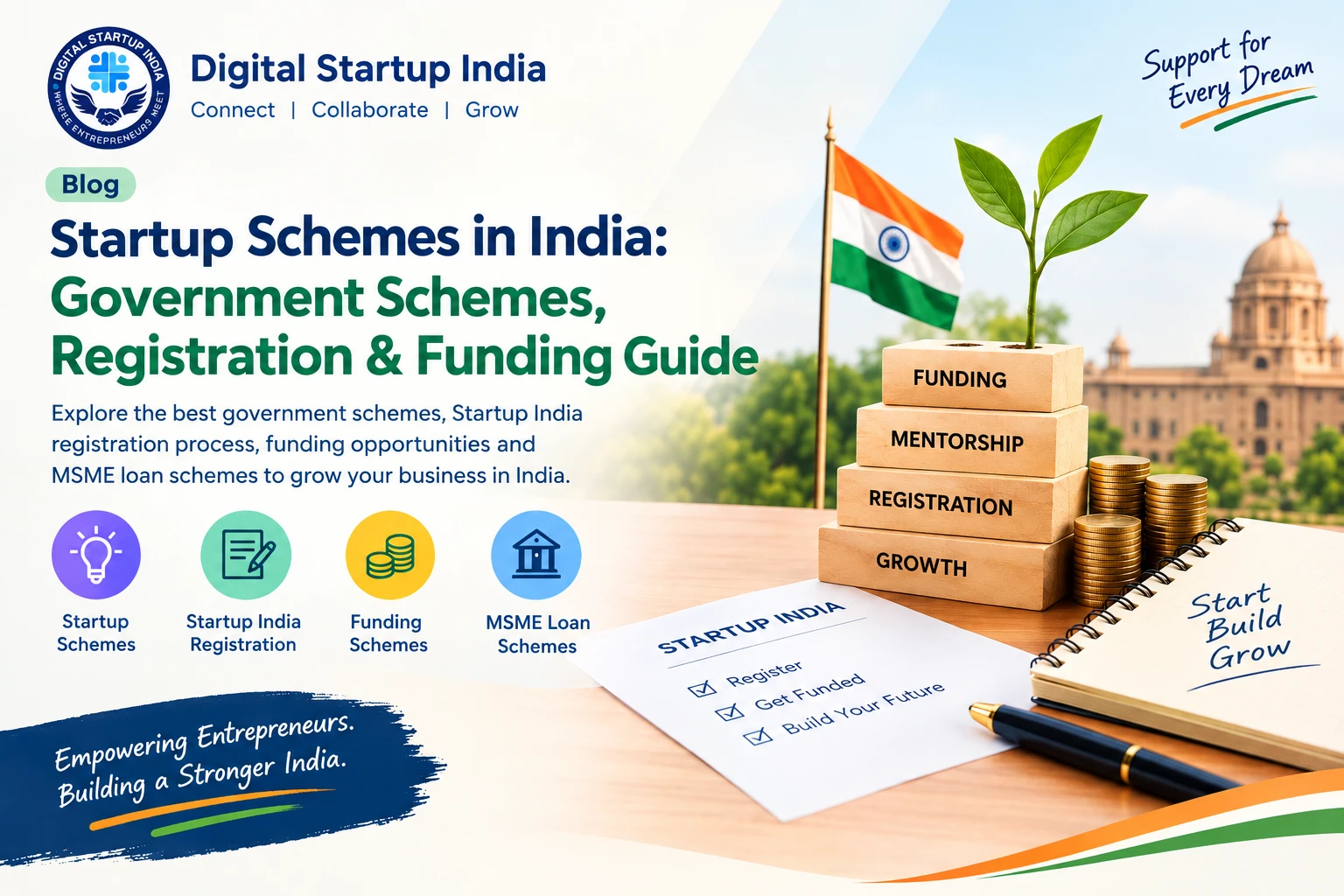
Table of Contents
Startup Schemes in India: A Guide for Entrepreneurs and MSMEs
Starting and growing a business in India can require access to funding, credit, mentorship, infrastructure, market opportunities, and regulatory support. The Government of India and various ministries provide different programs and schemes designed to support startups, entrepreneurs, and MSMEs.
Digital Startup India helps entrepreneurs discover useful information about the Indian startup ecosystem, including Startup Schemes, government initiatives, funding opportunities, MSME resources, business growth, and entrepreneurship.
If you are searching for government schemes for startups, information about Startup India registration, Startup India funding schemes, or MSME loan schemes India, understanding the available options can help you identify programs relevant to your business stage and requirements.
What Are Startup Schemes?
Startup Schemes are government-backed programs and initiatives designed to support entrepreneurs and startups through different forms of assistance. Depending on the program, support may include funding, credit, incubation, mentoring, intellectual-property support, market access, or other assistance.
The official Startup India portal maintains information about central government schemes for startups and explains that these programs cover areas including financial, infrastructure, and regulatory support.
However, every scheme has its own eligibility criteria, application process, and terms. Entrepreneurs should always verify the latest requirements on the official scheme website before applying.
Government Schemes for Startups in India
There are several types of government schemes for startups in India. The appropriate program depends on factors such as the startup's stage, sector, funding requirement, and eligibility.
Some major categories include:
1. Startup Funding Schemes
Funding-related initiatives can support startups at different stages of development. The Startup India portal currently highlights initiatives such as the Startup India Seed Fund Scheme (SISFS), Fund of Funds for Startups, and Credit Guarantee Scheme for Startups.
The Startup India Seed Fund Scheme, for example, is intended to provide financial assistance for activities such as proof of concept, prototype development, product trials, market entry, and commercialisation.
2. Credit and Loan Support
Not every business requirement involves equity funding. Some entrepreneurs may require loans or credit support for working capital, equipment, expansion, or other business activities.
Government-supported credit programs can help eligible businesses access financing under specific conditions. The Startup India government's 2026 schemes playbook includes programs such as CGTMSE, PMMY and the Credit Guarantee Scheme for Startups under loan or credit support.
3. Incubation and Mentorship
Startups can also require guidance, infrastructure, technical support, and mentoring. Government initiatives include various incubation and entrepreneurship-support programs aimed at helping businesses develop and scale.
What Is Startup India Registration?
Startup India registration generally refers to obtaining DPIIT Startup Recognition for an eligible entity under the Startup India initiative.
According to the official Startup India portal, eligible entities can apply for recognition through the National Single Window System (NSWS). The official guidance also states that eligible entities may include private limited companies, LLPs, registered partnership firms, and cooperative societies, subject to the applicable criteria.
DPIIT-recognised startups may receive access to certain benefits and initiatives, including eligible tax-related benefits, easier compliance, intellectual-property support, and other Startup India programs, subject to applicable conditions.
Basic Startup India Registration Process
The general process involves:
-
Creating an account on the relevant government platform.
-
Accessing the Startup Recognition application.
-
Providing the required business and incorporation details.
-
Submitting supporting information and documents.
-
Completing the application for DPIIT recognition.
-
Checking the recognition status through the official portal.
The official Startup India website states that applications for DPIIT recognition should be submitted by the startup itself and that the government does not charge a fee for the DPIIT Certificate of Recognition application.
Startup India Funding Schemes
Funding is one of the most common requirements for early-stage businesses. Startup India funding schemes cover different types of government-supported mechanisms rather than one single funding program.
For example, the official Startup India portal identifies:
-
Startup India Seed Fund Scheme (SISFS) – support for eligible early-stage activities.
-
Fund of Funds for Startups (FFS) – a mechanism involving venture capital funds.
-
Credit Guarantee Scheme for Startups (CGSS) – credit support backed by a government guarantee, subject to applicable conditions.
The Startup India schemes playbook also groups startup support according to requirements such as grants, equity investment, loans or credit, incubation, IP protection, and market access.
Therefore, entrepreneurs should identify their actual requirement before selecting a funding-related scheme.
MSME Loan Schemes India
Startups are not the only businesses that can access government-supported programs. Micro, Small and Medium Enterprises can also explore various schemes related to credit, technology, market access, training, and business development.
The Ministry of MSME's current schemes information includes programs covering areas such as credit guarantees, employment generation, technology support, market development, innovation, infrastructure, and training.
The official MyMSME portal also lists schemes and resources including Udyam Registration, Credit Linked Capital Subsidy Scheme, Cluster Development Programme, Procurement and Marketing Support, and other MSME initiatives.
If you are researching MSME loan schemes India, check the eligibility, loan conditions, guarantee requirements, participating institutions, and application process for the specific program rather than assuming every MSME scheme provides direct loans.
How to Choose the Right Startup or MSME Scheme?
Before applying for any government scheme, consider:
-
Business stage: idea, early-stage, growth, or established business
-
Business structure: company, LLP, partnership, cooperative, or other eligible structure
-
Sector: technology, manufacturing, agriculture, healthcare, services, etc.
-
Funding requirement: grant, equity, loan, credit guarantee, or other support
-
Eligibility: turnover, incorporation period, innovation criteria, registrations, and other requirements
-
Documentation: PAN, incorporation documents, financial information, business plan, and other required documents
-
Application process: understand whether the application is through a government portal, financial institution, incubator, or another authorised channel
Always verify current scheme information because eligibility criteria, guidelines, deadlines, and program details can change.
Explore Startup Schemes with Digital Startup India
Finding relevant government support can be challenging when information is spread across multiple departments and programs. Digital Startup India provides startup and business-related resources to help entrepreneurs in India discover information about Startup Schemes, government initiatives, funding, MSME support, business opportunities, and the wider startup ecosystem.
Whether you are researching government schemes for startups, planning Startup India registration, exploring Startup India funding schemes, or looking for MSME loan schemes India, Digital Startup India can help you discover relevant resources and information for your entrepreneurial journey.
Also read: Startup India Seed Fund Scheme 2026: Get Up to ₹70 Lakh?
Conclusion
Government initiatives can provide different forms of support to eligible startups and MSMEs in India. From startup recognition and funding to credit, incubation, technology, and market access, there are programs designed for different business requirements.
Before applying, carefully check the latest eligibility criteria and guidelines from the relevant official government source. For more startup resources, business information, and opportunities, explore Digital Startup India and stay connected with India's growing entrepreneurial ecosystem.