From Rs.36 to Mushroom Success: Santosh Mishra’s Kalinga Mushroom Centre Story
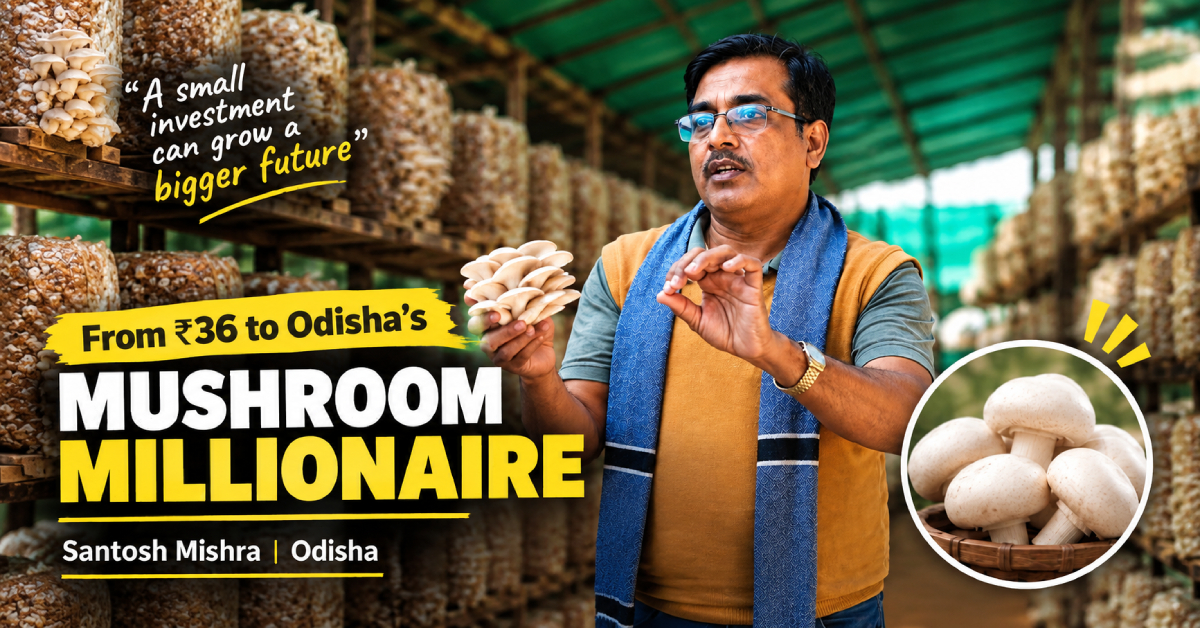
Sometimes, ₹36 Is Enough to Start a Bigger Journey
How much money do you consider to be required if you are going to start a business?
For a great many people the answer could be thousands or even lakhs of rupees.
But the story of Santosh Mishra from Odisha began with something quite different—just ₹36.
In 1989 Santosh was experiencing financial difficulties and yet he was unable to go on with his higher studies even though he had done well at school. Rather than let this situation prevent him, he chose to acquire a skill which would enable him to earn his living.
It caused him to move in the direction of mushroom farming.
Having only Rs 36 in savings, he enrolled in a mushroom cultivation training programme at the Odisha University of Agriculture & Technology (OUAT) in Bhubaneswar in order to gain an understanding of a field which was still relatively unknown to many of the people around him.
What began as a small experiment ultimately developed into the basis of the Kalinga Mushroom Centre, a mushroom production and training centre linked with Santosh's activities in Pipli, Odisha.
His journey is not only concerned with earning money from farming, but also involves acquiring a new skill, solving problems, making gradual progress and in the end assisting thousands of other people who want to learn how to cultivate mushrooms.
The Beginning: A ₹36 Investment
Santosh Mishra was from Dandamukundapur village in the Puri district of Odisha and obtained his degree from BJB College in Bhubaneswar.
Even though he did well in his studies, financial difficulties made it hard for him to go on with his education.
In 1989 he chose to go on mushroom farming training at OUAT.
At that time, he had saved only thirty-six rupees.
He spent the money to buy four bottles of oyster mushroom spawn, which are also known as mushroom seeds, and thus started a journey that would eventually develop into a much larger agricultural business.
That was only the first step when it came to buying the spawn.
To grow mushrooms successfully it was necessary to have practical knowledge, and Santosh quickly found that there were a number of problems to be solved.
Also Read: The Indian Startup Changing How We Buy Mangoes
Learning Before Expanding
Although mushroom farming may appear to be simple from the outside, it can be difficult to keep the proper growing conditions.
Santosh encountered problems including too much moisture, fungal contamination and insufficient lighting.
Rather than quitting, he got advice from the scientists at OUAT and kept on learning the technical aspects of mushroom farming.
That played a significant role in his journey.
Instead of considering his first difficulties as failures, he treated them as lessons.
Santosh managed to get money for starting large-scale cultivation with the help of his father; he began by setting up 100 mushroom beds in a shed.
By May 1989 he had gathered about 150 kg of mushrooms.
However, the thing about producing mushrooms was only half the problem.
He also had to get customers.
His First Sale Was Worth Just ₹120
The fact is that growing a product doesn't automatically lead to a business being successful.
The product also has to get into the hands of buyers.
At first Santosh had trouble getting his mushrooms sold, but later on he did find some customers around his college.
He sold 5.2 kg of oyster mushrooms to the corporate offices in the area for ₹120.
It might sound as though it's a rather minor transaction nowadays.
For Santosh, this showed that there was a market for the things he was producing.
The first sale encouraged him to think on a larger scale.
Rather than ending things after a modest start, he sought out ways to boost production and reach a larger number of customers.
Also Read: Yash Dayal Sharma’s Fertile Beeghas Success Story
From 100 Beds to 3,000 Beds
Having gained some experience from his first attempt at growing mushrooms, Santosh expanded the business.
A loan of about ₹60,000 obtained later enabled him to expand his operation to around 3,000 mushroom beds. It is reported that by the 1990s his daily income had gone above ₹2,500, which in turn earned him the reputation of being a "mushroom millionaire".
The key aspect of this growth was that it wasn't something that occurred all at once.
The journey moved through several stages:
-
Learning mushroom cultivation
-
Starting with a very small amount of money
-
Beginning with 100 beds
-
Understanding production problems
-
Finding customers
-
Making the first sale
-
Reinvesting and expanding
-
Building a larger mushroom business
The fact that his story illustrates how a small agricultural experiment can turn into a business when the entrepreneur keeps on learning and adapting.
Building Kalinga Mushroom Centre
The more experience Santosh gained in growing mushrooms, the wider his work became.
He set up the Kalinga Mushroom Centre in his village, making it a centre for the production of mushroom spawn and for training.
The centre deals with various types of mushroom such as oyster and paddy straw mushrooms and supplies mushroom spawn to growers. It has been reported that the centre has produced thousands of bottles of spawn and has supplied growers in many areas of India.
The nature of the business was thereby altered.
Santosh was not merely a mushroom grower any longer.
He was at the same time acting as a trainer, a supplier and a promoter in the field of mushroom cultivation.
Turning Experience Into Training
A highly interesting aspect of Santosh Mishra's success story is the fact that he has trained a large number of people.
As reported in the published accounts, the centre has given free training in mushroom farming to over one lakh people, with a special focus on women and individuals coming from economically disadvantaged backgrounds.
It is reported that his paid training programmes have benefited over nine lakh people in various states.
This is an important lesson for business owners.
The knowledge acquired during the process of setting up a business may well become part of the business itself.
Santosh took up mushroom cultivation as he needed an opportunity.
He then applied that experience to assist other people in finding opportunities in the same field.
Also Read: Jharkhand Farmer Chaitanya Ganjhu’s Cactus Farming Success Story
From Fresh Mushrooms to Value-Added Products
There are difficulties involved in selling fresh agricultural products.
The fact that mushrooms are perishable means that farmers have to have appropriate markets as well as methods of preserving or processing their crops.
Santosh also directed his efforts towards producing mushroom products that add value.
The centre is known for products including mushroom pickles, papads, vadis, soup powder and mushroom flour.
The idea is simple.
Rather than rely completely on selling fresh mushrooms, part of the produce can be turned into products which have a longer shelf life.
This could thus lead to the creation of new business opportunities at the same time as decreasing reliance on a single product.
A Bigger Plan for Mushroom Processing
Santosh's ambitions have also extended beyond cultivation and training.
Reports have spoken of plans for a food processing unit costing ₹2 crore, the aim of which is to produce items such as mushroom flour, pickles, snacks and other value-added foods.
This illustrates the various stages which his business has gradually gone through.
It all started with a small sum of money.
Then came cultivation.
Then production and sales.
Next was training, then the production of spawn and that of value-added products.
The following stage involves large-scale food processing.
What is so special about Santosh Mishra's story?
In India there are a great many stories of farming success.
What is interesting about Santosh Mishra's journey is the extent to which the position he started from differed from the place where his work ultimately got to.
He started with ₹36.
His project started with a small shed and 100 beds.
The first time he obtained a notable sale it was for only ₹120.
Rather than viewing those numbers as limitations, he regarded them as a starting point.
For many years the business developed into the Kalinga Mushroom Centre, mushroom production, spawn development and training becoming essential elements of it.
It also demonstrates that people engaged in agriculture do not have to own large quantities of land.
Knowledge, training, technology, an understanding of the market, and the capacity to solve problems can also be of great importance.
Lessons Small Entrepreneurs Can Learn From Santosh Mishra
Santosh's experience provides a number of helpful lessons for those who are considering setting up a small business.
Start With What You Have
Santosh didn't wait until he had a lot of capital.
He began with a sum of ₹36 and concentrated on learning first.
Just because one starts on a small scale doesn't mean that success is certain, but likewise it is also possible for people to fail to begin if they wait on forever for ideal conditions.
Learn Before You Scale
The difficulties he experienced at the beginning of his mushroom cultivation led him to look for technical advice.
This point is relevant to every business.
Before deciding to expand, entrepreneurs should have a good understanding of their product, their customers, their costs and the problems they face.
Your First Customer Matters
The first sale of ₹120 might seem insignificant when compared to a big business nowadays.
The first customer showed that somebody was willing to pay for the product.
A new entrepreneur can gain useful information about demand and customer behaviour from their first sale.
Turn Knowledge Into Another Opportunity
Santosh eventually went beyond cultivation and started to train other people.
It set up another section of his business at the same time as enabling his experience to reach a wider audience.
Think Beyond One Product
One part of the opportunity were fresh mushrooms.
The processing of mushrooms into flour, pickles, snacks and other products made it possible to generate extra sources of income.
From ₹36 to a Bigger Vision
Santosh Mishra's journey never started with a large farm, expensive machinery or a big investment.
It all started with some savings, a training programme and a readiness to learn.
The fact that he started by buying mushroom spawn for ₹36 and went on to begin cultivation, secure his first customers, increase production and establish the Kalinga Mushroom Centre shows how a small idea can grow over a number of years.
At present, his work involves not just the production of mushrooms but also training and assisting people in their exploration of mushroom cultivation.
The most important lesson for people who want to become farmers or start businesses in rural areas might not be the amount of money Santosh ultimately earned.
It is the fact that he started small, learned from problems and kept building on each step.
A ₹36 beginning may look insignificant.
But with knowledge, patience and consistent effort, even a very small beginning can become the foundation for a much bigger business.
Source & Disclaimer
This article is independently written using publicly available reports about Santosh Mishra, Kalinga Mushroom Centre and his mushroom farming journey. Business figures and results are based on published reports and may change over time.
Digital Startup India is an independent private platform and is not affiliated with or endorsed by Santosh Mishra, Kalinga Mushroom Centre, or any organisation mentioned in this article.
Send Us Your Enquiry
Send a message and the team will get back to you.
Featured Stories