Yash Dayal Sharma’s Fertile Beeghas Success Story
What if the waste from farms could be a solution to the betterment of the soil?
Yash Dayal Sharma's simple idea is what is the base of Fertile Beeghas. He did not consider agricultural waste as a material for burning or waste, but he recognized the potential to use it as rich in nutrients and to empower farmers to utilize the resources that are already present around them.
His story is the development of a small ag experiment into a business with a bigger mission.
History of a graduate who became an agripreneur.
Yash Dayal Sharma is a graduate of Zakir Husain Delhi College, University of Delhi, 2020. His education was in history but he had a family tie to farming.
He had been introduced to the life of the farm and agriculture from his great grandfather and grandfather who were farmers.
Yash began his exploration of farming in greater detail, and fell in love with the concept of organic and natural farming. He started to engage in conversations with farmers and understand some of their problems.
Soil health was one concern that came to the fore.
Meanwhile, agricultural waste was piling up on the farms in the form of crop residue and cattle dung. Much of this information was either not utilized or discarded as waste.
Yash started searching for a method to link these two issues.
Also Read: Cactus Farming Success Story
The Idea Behind Fertile Beeghas
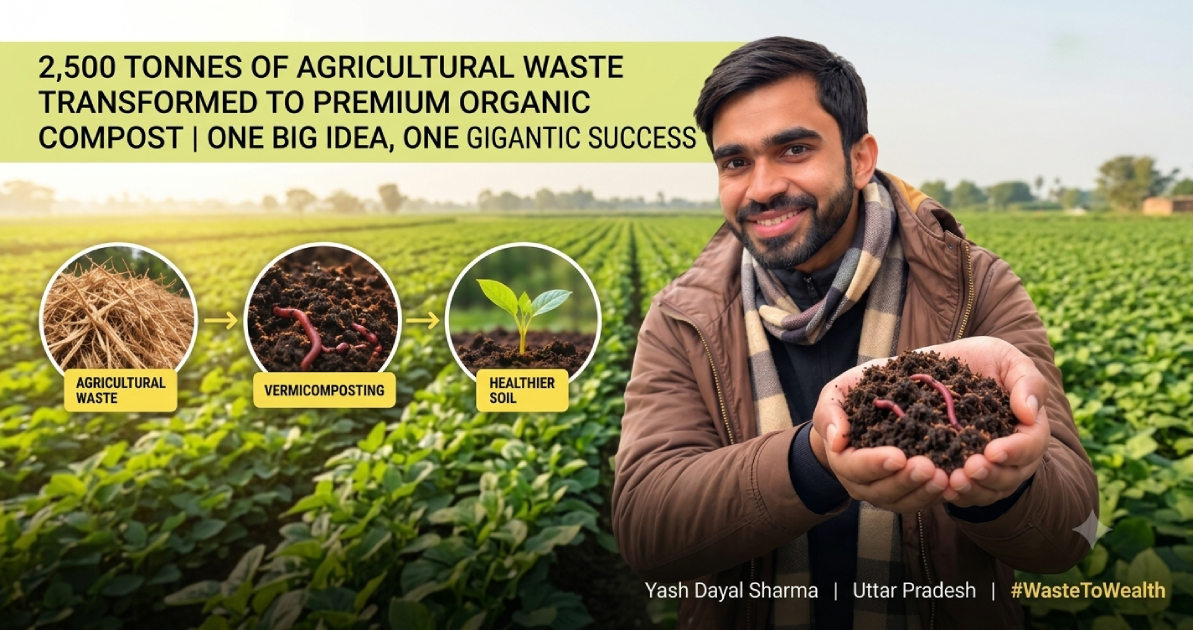
The answer was vermicomposting.
Vermicomposting is a method of composting using earthworms to break down organic material and produce nutrient-rich compost. It can provide a valuable second life for agricultural waste and provide an input for agriculture.
Yash started experimenting with vermicomposting on around one acre of land in Saharanpur, Uttar Pradesh.
Instead of rushing to establish a big company, he concentrated on the process and its outcomes. He tried to use vermicompost and gave some samples to surrounding farms in 2021 to 2022.
This experience prompted him to further pursue the idea.
He started Fertile Beeghas with his family and other farmers in June 2021.
What started out as a simple project became an enterprise on Vermicompost, organic waste management and farmer education.
The process of converting organic wastes into vermicompost.
Fertile Beeghas is using cattle dung and agricultural waste to make vermicompost.
The process involves the use of organic material and earthworms, composting, curing and preparation before the use of the final product.
However, the aim of Yash was not just to create compost.
He wished farmers to realize that there's waste on the farm which can actually be useful for their farming.
The 2024 reported data showed over 2,500 tonnes of organic waste had been transformed into vermicompost at Fertile Beeghas.
This was quite a departure from the one acre experiment where it all started.
Also Read: How Alakh Pandey Built Physics Wallah
Training Farmers Is Part of the Mission
Farmer education is one of the important aspects of Yash's work.
Fertile Beeghas has organised training in vermicomposting and organic farming and educated farmers about taking care of what is available on their farms.
Over 2500 farmers had been trained as a result of his work.
The method can be used to lower reliance on external resources. Farmers can make compost using cow dung and other organic waste, while receiving instruction on creating compost themselves.
A few farmers initiated small-scale vermicomposting and later scaled up and also provided earthworms to other farmers.
This means an easy sequence:
One farmer learns → starts vermicomposting → expands production → helps another farmer start.
Finding a Use for Agricultural Waste
Yash's work also relates to the bigger issue of agricultural residue.
Crop residues can be problematic post harvest in many farm areas. Some of it may be burned if there are no viable alternatives for farmers.
One way of doing this is vermicomposting which is a process to incorporate certain kinds of organic material into the farming system.
Fertile Beeghas has claimed that it has helped to stop the burning of hundreds of tonnes of rice straw and turned organic waste into useful compost.
The concept is straightforward: look at what is being discarded at the farm and find another way of using it.
Making Sustainability a way of life in a business.
The Fertile Beeghas story is interesting in that it does not rely on an elaborate technical device.
It is based on a relatively simple agricultural process.
Organic waste → Vermi Composting → Useful Soil Inputs → Farmer Training → Better Resource Management.
But making that process a profitable business is not all that can be done.
Yash had to do some trial and error, get to know what the farmers need, make the product and connect with the farmers.
It has also brought in women in the vermicomposting activities and facilitated the involvement of rural people.
This is more than a compost business as they say. It's a work that connects waste management, agriculture and farmer education and rural entrepreneurship.
Also Read: Turning Sunlight Into Income
Yash Dayal Sharma’s Bigger Vision
Yash's vision goes beyond producing vermicompost.
He has been working on educating farmers about the value of soil and promoting sustainable farming practices.
Among his goals has been to teach 10,000 farmers and to promote the use of sustainable agriculture.
The bigger point to be made here is that solutions don't always have to be found outside of the farm. The crop residue, cattle dung and other organic resources may be available in some useful forms.
With correct management, farmers may be able to use waste for their own advantage in farming.
A lesson from the fertile Beeghas to the entrepreneurs.
The experience of Yash Dayal Sharma is a valuable one for entrepreneurs.
Business opportunities may lie in the midst of common issues.
The issues for Yash were obvious: underutilization of agricultural waste, and underreported soil health.
He tied these two together in his mind rather than seeing them as two separate things.
This concept turned into Fertile Beeghas.
From an experiment of one acre to a business reportedly processing thousands of tonnes of organic waste each year, the transformation of a small idea into something that has a real solution to a real problem.
It also demonstrates that entrepreneurship is not necessarily a phenomenon of high-tech and high-cost. Sometimes, it starts with a fresh perspective on a problem.
The Story Continues
Yash Dayal Sharma started with a simple question: Can farm waste become something valuable?
Through Fertile Beeghas, he turned that question into an agricultural venture built around vermicomposting, farmer training and sustainable resource use.
His story is a reminder that waste does not always have to be the end of the journey.
With the right idea, it can become the beginning of something new.
Sources & Disclaimer
This article is independently written for informational and educational purposes using publicly available information about Yash Dayal Sharma and Fertile Beeghas. Production figures, farmer numbers, business activities and other details may change over time and should not be treated as guaranteed results.
This article is not affiliated with, sponsored by, or officially endorsed by Yash Dayal Sharma or Fertile Beeghas. All names, trademarks and business names belong to their respective owners.
Send Us Your Enquiry
Send a message and the team will get back to you.
Featured Stories