Jharkhand Farmer Chaitanya Ganjhu’s Cactus Farming Success Story
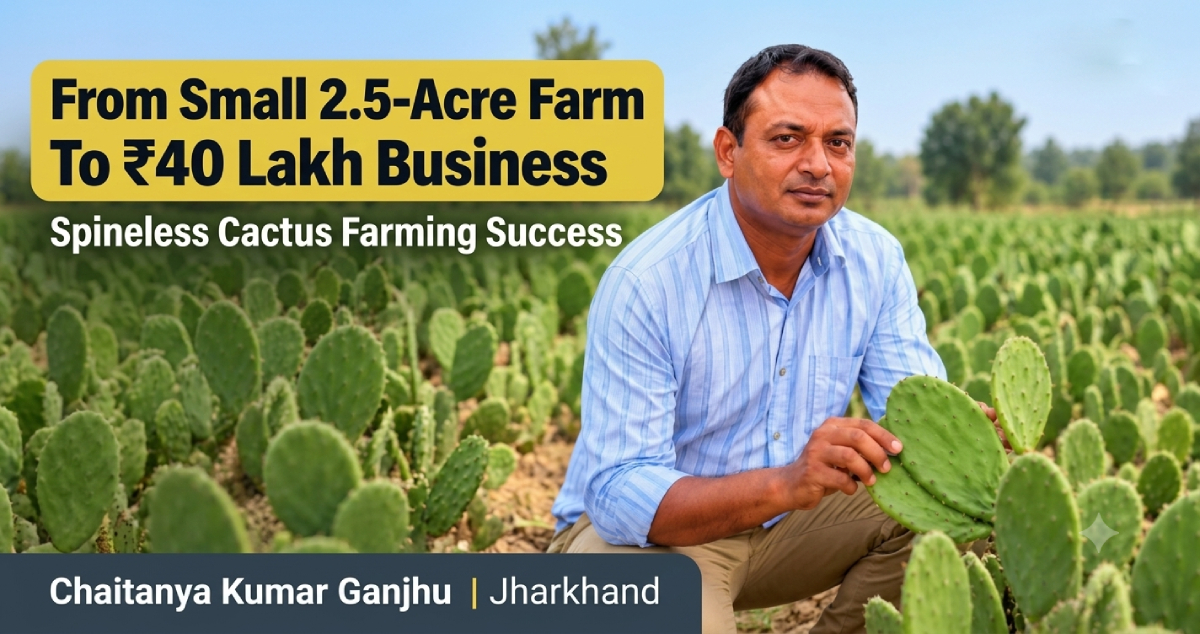
Chaitanya Ganjhu’s Cactus Farming Success Story
Sometimes, a new beginning does not start off without any plan. It begins when things go haywire.
The turning point for Jharkhand farmer Chaitanya Kumar Ganjhu was when a fire raged through the orchard that he had been developing for several years. What ensued was no return to the old farming system, but rather an effort to cultivate a new crop—Spineless Cactus.
In today's scenario, his Nursery is able to produce approximately 2 lac cactus plants per year, which is a tough setback to a new business opportunity in the field of Agriculture.
A 36-Acre Orchard Was Destroyed
In 2020, Ganjhu took 36 acres of land on lease in Bichara village, Jharkhand and started developing an orchard there.
There were approximately 100 litchi trees, 300 mahogany, 900 mango and 1200 ber trees on the farm.
This was an investment that was made in the long run. Fruit trees only begin to mature after many years of investment; the farm is not just a business investment, it is also a business "return" that Ganjhu could potentially reap in the future.
In 2023, a fire then ravaged the orchard.
Much industry went up in smoke.
When he lost a leg, Ganjhu was in a difficult position: either give up his plot of land or come up with another plan.
So, he opted for the second choice.
Also Read: From ISRO to Organic Dates
Searching for a Different Farming Opportunity
Ganjhu instead started to look into crops that would survive challenging conditions and could provide a new line of business.
During his research in 2024, he came across spineless cactus.
The plant was of significant interest to him for several reasons.
While traditional thorny cactus cannot be used for agriculture, spineless ones can be used, especially in livestock feed. They are also known for their ability to grow with relatively low water requirements and in challenging soil conditions.
The crop was also being cultivated as a part of India's overall farming activities. The government and agricultural organisations have been looking for a chance to use spineless cactus as fodder, food, fertiliser, fuel and for producing various bio products.
This was no ordinary chance for Ganjhu, however, to grow cactus.
He noticed that there was a business opportunity in the production of cactus planting material for other farmers.
Starting With 10,000 Cactus Cladodes
Ganjhu did some research on the crop and he went to an agricultural research centre in Madhya Pradesh and got 10,000 cactus cladodes.
The flat, fleshy part of a cactus that can be used to make a new plant is called a cladode.
He bought the planting material at about ₹10 cladode and planted it over about 2.5 acres in November 2024.
A completely different course from the one of his orchards he had lost.
Ganjhu decided to create a nursery to propagate and sell cactus planting material, rather than waiting several years for the fruit trees to grow.
From 10,000 Cladodes to a Large Nursery
The cost of propagating cacti became a significant consideration in his model.
In Ganjhu's nursery system, he claims to get 6-8 new plants from a single cladode which costs about ₹10.
He claims to have sold cactus cladodes and plants at ₹10 per piece, the economic implications will vary depending on cost of production etc. He also said that after deducting the expenses, the estimated profit will be around ₹25 per original cladode.
These figures are his expected nursery economics and do not constitute a guaranteed income to every farmer.
It is now a much larger operation, however.
Now his nursery is reported to be able to grow about 2 lakh plants a year and 25 varieties of spineless cactus are grown there.
Also Read: From Banana Waste to Business
The Business is Not Just about Selling Cactus
Ganjhu's strategy is novel as he is relying on income from selling mature agricultural produce, rather than relying solely on that income.
Rather, the business is the nursery itself.
The farmer who is interested in the cultivation of spineless cactus must get planting material. Ganjhu creates and markets healthy plants and cladodes, and thus can be a part of the agriculture value chain.
This is a lesson in agriculture entrepreneurship.
Occasionally the opportunity is not only in growing a crop.
Creating Work for Local Women
This is about creating Work for Local Women.It's about creating Work for Local Women.
As the orders came in, the nursery also started to provide jobs around the farm.
When Ganjhu was given an order of about 30,000 plants, he recruited about 60 women from nearby villages to do nursery related work.
The duties they performed were to prepare polybags, provide care for plants and nursery operations.
This is an added dimension for the business.
In an experiment by one farmer with an unknown crop, he began creating jobs for the people living in the surrounding communities.
Cactus Can Also Help With Livestock Feed
Ganjhu is not only interested in the nursery value of spineless cactus, but also its medicinal value.
He also feeds his goats with this plant.
This may be important in dry, hot weather when green feed may be less available.
The use of spineless cactus as a fodder crop and other applications in India is under investigation. ICARDA and Indian partners have been pushing cactus as an F5 crop as a potential food, fodder, fuel, fertiliser and fashion crop.
It's for this variety of potential uses that the agricultural researchers and policy makers have been interested in the crop.
Why Spineless Cactus Is Getting Attention in Jharkhand
In the past, Jharkhand has been looking into the spineless cactus as a viable crop where other traditional crops can be problematic.
The potential planting of spineless cactus with the objective of promoting its cultivation on the watershed projects has been included in the governmental guidelines and a tentative target of 4000 hectares has been set for 2025–26 under the relevant project.
It is an interesting crop for some regions because of its relatively low water and can be grown under some difficult conditions.
That doesn't necessarily mean that cactus is the right crop for every farm, however.
The condition of the land, variety selection, management, and access to planting material and most importantly, the market are all important.
Ganjhu's experience is thus an illustration of agricultural entrepreneurship, and not an indication that all farmers can attain the same success.
Also Read : Turning Sunlight Into Income
Other Farmers Are Taking Notice
Other farmers have also now been interested in Ganjhu's experiment.
Farmers from other regions have come to his nursery to learn about spineless cactus and to get the planting material, reports say.
Some have since begun to plant the crop.
This is the way a new agricultural concept can become gradually accepted.
One farmer experiments.
The rest of the farmers watch the outcome.
Planting material is available.
The knowledge is transferred from farm to farm.
Then, a small experiment may be able to integrate into a broader agricultural system.
The ₹40 Lakh Figure Needs Context
The amount of ₹40 lakh is one figure related to the story of Ganjhu's cactus.
One needs to have an understanding of what this number is.
The figure is merely a business potential based on the future production and sales, and it is not a proof that Ganjhu already has a turnover of ₹40 lakh from the cactus business.
It's an important factor in agricultural success stories.
The business value of a projected business depends on several things (how many plants are produced, how many are sold, the selling price, operating expenses and future demand).
The more correct way to look at it is that Ganjhu thinks that the opportunity is to scale the nursery into a business of around ₹40 lakh, and not that he has already made ₹40 lakh of guaranteed money.
A journey from Burnt Orchard to a New Agricultural Business
Chaitanya Kumar Ganjhu's story is an adaptation.
The orchard he had destroyed by fire may have put his farming plans to an end.
Rather it forced him to look for something else.
A change from fruit trees to Cactus. He started to grow plants for a future crop and transferred to developing a nursery. With his own farm, he started to employ people from the nearby villages in his expanding business.
It's also a fascinating look at the modern farm.
Today, agriculture is also concerned with incomes and consumption.With agriculture, today we are not just still concerned about the production, but also with income and consumption. Farmers have the opportunity to try out nurseries, value added planting material, climate-smart crops and new value chains in agriculture.
Ganjhu had 10,000 cactus cladodes.
The capacity of his nursery is now increased to about 2 lakh plants per year.
The land of the lost past has become the base of a new business in farming.
Chaitanya Ganjhu's cactus was more than just a crop.
It came to be a means of rebirth.
Source & Disclaimer
This article has been independently written for informational and educational purposes using publicly available reports about Chaitanya Kumar Ganjhu’s cactus farming journey. Nursery capacity, production, income, business estimates and farming results can vary over time and should not be treated as guaranteed returns.
Send Us Your Enquiry
Send a message and the team will get back to you.
Featured Stories