Categories
Recent Posts






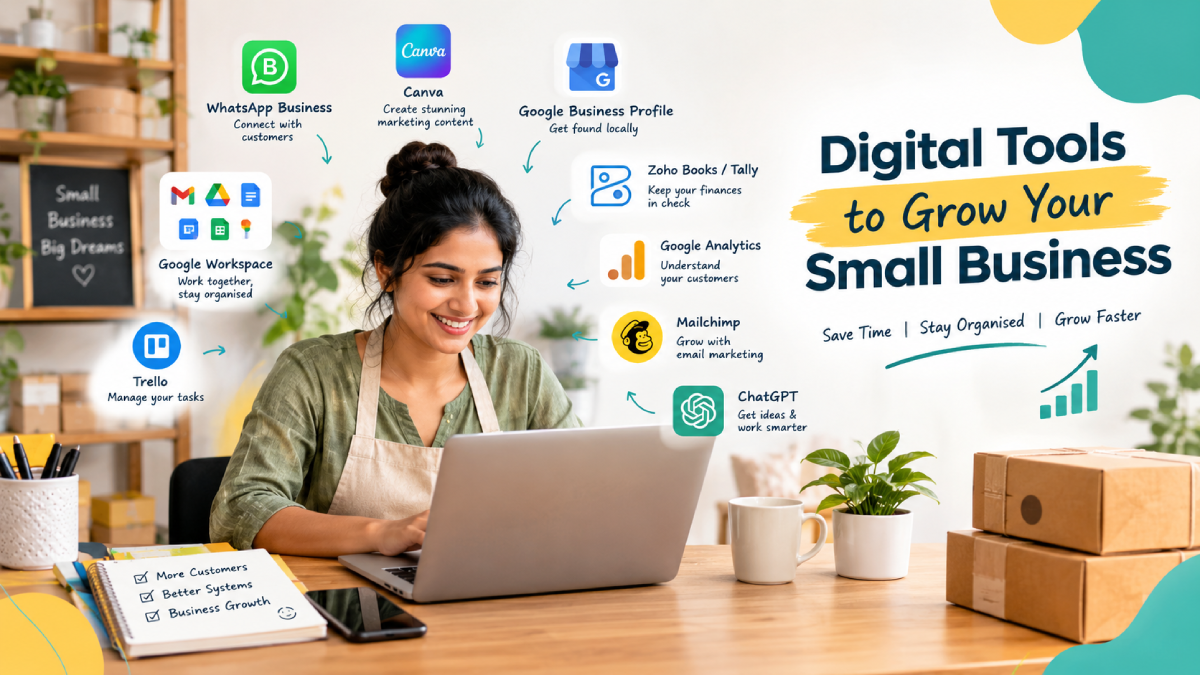
Table of Contents
Digital Tools to Grow Your Small Business
Pretend you have a small business with one person replying to customers via messages, another one making the invoices, another one posting on social media and you're trying to keep track of everything on paper and on WhatsApp.
At first, it worked.
Next comes the orders, then more orders.
Increase in the number of customers who begin to message. There is a longer lag time in preparing invoices. Social media posts are slow. Old chats lose important customer information. You waste more time on business management than you do growing the business.
That's where the power of digital tools for small businesses can come in handy.
It's not always necessary to use high technology, or a big team of technology professionals. There are numerous efficient digital tools at your disposal that are either free or affordable, and can be used to keep your small business running more efficiently, from managing customers and marketing to accounting, communications and tasks.
When it comes to technology, a small business owner will know that the best one to use isn't simply one that is available. It's all about saving time, minimizing repetitive tasks and providing more room for growth.
Also Read: MSME Funding: Loans and Schemes in India
Why Digital Tools Matter for Small Businesses
People, budgets and time are limited resources that small businesses may have.
It may be necessary for the business owner to wear multiple hats. One day could be spent answering customer inquiries, verifying payments, creating an invoice, updating Instagram, and talking to suppliers and dealing with former customers.
All this can be a challenge to do manually as the business expands.
Digital tools can be used to help plan these activities in a single location or be used to automate some of these repetitive activities.
For instance, a business may utilize a customer management tool instead of having to write down the customer information over and over. It doesn't have to create each social media post from scratch, but can use Canva templates. It doesn't need to keep a paper register for accounting purposes, as it can use accounting software.
It's as easy as it sounds: eliminating repetitive tasks to focus more on customers and business growth with digital tools.
1. WhatsApp Business for Customer Communication
In many small businesses in India, WhatsApp has become an essential communication tool with their customers by now.
That's where WhatsApp Business comes in, with features that are tailored for businesses.
It can be used by a local clothing store, salon, home baker or service to create a business profile, showcase products or services and have conversations with the customers more professionally.
Suppose a house bakery receives a dozen or so messages each week asking:
Have you got some chocolate cake?
“How much is it?”
Is it possible to place an order on Sunday?
The business could use tools like quick replies, a product catalogue for easier communication with customers rather than replying to each customer from scratch.
It is NOT a substitute for personal communication. Rather, it assists in organizing it.
2. Canva for Marketing and Social Media
It's not always necessary to have a professional design team to create a good marketing campaign.
It offers pre-designed templates for social media posts, posters, presentations, flyers, business cards and more marketing content; Canva has become a popular digital design tool for small businesses.
Assume that a small cafe would like to market a weekend offer.
The owner can select a design template he/she likes, input the information of the café, modify the colours, and then publish.
This can be applied to salons, clothes stores, restaurants, consultants, and local service providers and start-ups.
It's important to be consistent.
If a business regularly provides beneficial and pertinent information, they can stay in their customer's line of sight rather than just when there's a special promotion.
Also Read: Government Schemes & Funding for Startups in India
3. Google Business Profile for Local Visibility
Suppose that someone types into the Internet:
“Top stationery store in my town.”
For stationery businesses, local search results can be a valuable marketing tool, helping potential customers find your business.
Businesses can use Google Business Profile to control key details like their business name, location, phone number, hours of operation, website, business photos and reviews on Google.
This can be a vital component of local businesses' online reputation.
When a customer is searching for food nearby, they can find a restaurant; when they're searching for a repair service, they can find a repair service; when they're searching for a local store, they can find a local store via Google Maps.
Therefore, it is vital for businesses to ensure their information is accurate and up to date.
Photos, working hours, contact information and customer reviews can also assist customers in figuring out what the company is before they head over to or call them.
4. Google Workspace for Everyday Business Work
Even a small business might require to build documents, work with spreadsheets, send e-mails and store documents nearly every day.
That's where Google Workspace can come in handy.
Gmail, Google Drive, Google Docs and Google Sheets are tools that make it easier for businesses to get along with their daily activities digitally.
For instance, a small group of people may have a single sales spreadsheet that they can share on instead of exchanging different versions of the spreadsheet in excel.
The business owner can store important documents in Google Drive rather than having all these documents on one computer.
Team members can also collaborate on the same document without frequently having to pass around versions of the document.
It will be especially useful if the company has staff at various offices.
5. Zoho Books and Tally for Accounting
One aspect where small businesses can't get too confused is in the way they manage money.
Everything being entered manually can make it challenging to track sales, expenses, invoices, payments and taxes.
Businesses can use accounting software like Zoho Books and Tally to manage their finances.
A business can, for instance, keep its invoices electronically in place instead of going through notebooks to locate an old invoice.
The business owner can also obtain a better understanding of the cash flow.
The accounting software that a company should use is dependent on the size of the company, the requirements and the accounting process that the company uses. Yet, shifting from a fully manual records management can help to make financial management more organized.
Also Read: How Digital Transformation Is Reshaping Indian Startups
6. Trello for Managing Business Tasks
Businesses that are in the process of growing tend to have one simple issue – too much to keep track of.
“Call the customer.”
“Update the website.”
“Send the quotation.”
Produce the Instagram post.
Follow up with the supplier.”
Tasking that is only remembered in the mind of one person or in someone's WhatsApp chats can easily be forgotten.
Businesses can use tools like Trello, which consist of boards, lists and cards, to have tasks organised.
Consider using columns like:
To Do → In Progress → Review → Completed
The process could then be taken on a project or task at a time.
This provides a clear visual representation of the project to the team - what is done and what is not yet done.
7. Google Analytics for Understanding Website Visitors
It's not enough to just create a website.
A business also ought to know if individuals are going to their organization in addition to what they are doing.
Google Analytics can be beneficial in knowing the information regarding the traffic of a website and how the visitors are going around.
For instance, it could find that there are a lot of people visiting their service page, but very few people contacting the company.
With that information, comes another question:
Do you have to look for the contact button?
Is the web page loading slowly?
Do you find the information difficult to understand?
Businesses should not make all these decisions based on assumptions—they can use the data that the website generates to know what is going on.
8. Mailchimp for Email Marketing
If he purchases from you, then he will return.
However, when there is no communication after the initial sale, then customers will lose track of a business.
Businesses can use email marketing automation solutions like Mailchimp to send out newsletters, product updates, offers and more to their readers.
For instance, an ecommerce business might send an e-mail to its clients concerning a new collection.
A service business may be able to offer its clients some helpful information.
A start-up might send out newsletters on their products every month.
The key to the success of email marketing is for a business to give something back to the recipient instead of just sending out emails and emails of promotional information.
9. ChatGPT and AI Tools for Everyday Work
AI is also becoming a part of everyday business tasks.
AI tools like ChatGPT can assist small businesses in brainstorming content ideas, writing captions for social media posts, drafting an email, summarising information and creating first drafts for marketing content, among other things.
For instance, a small business owner might be familiar with the information they want to convey to their customers, and one problem is simply the ability to put their information in writing.
AI can generate a first cut draft that then can be reviewed and customized by the owner.
But AI must not be viewed as a replacement for human judgment, rather it is a tool to help humans make decisions.
Even though there is no way to be 100 percent certain of the accuracy of information, business information, communication with customers and important decisions should be carefully reviewed before using.
Digital Tools don't have to be costly!
It's a widespread misconception that digital transformation is just for large businesses.
It is not.
Simple tools can be used to get simple solutions for current problems for a small business.
The local shop could start off with WhatsApp Business and Google Business Profile.
Google Workspace and Canva can be used by a freelancer.
For a company that is expanding, project management and accounting software can be added on.
Analytics and email marketing tools could be added to an online business.
The objectives are not to have dozens of applications.
In fact, an overabundance of tools can present another conundrum.
The more correct way to do it is to determine the most time-consuming issue(s) your business is experiencing and then look for a tool that can solve that specific problem.
Start Small and Build Your Digital System
A business does not require to overhaul everything at once and all the time.
It's best to begin with some basic queries.
What is the most time consuming activity that you're doing?
What activities do you do each day?
How are customers' information being lost?
What's the current way to track sales and expenses?
What are some of the ways customers discover us on the internet?
What could be done if it was organised or automated?
The responses can illustrate where digital tools can add the most value.
If, for instance, communicating with customers is growing challenging, take the first step with WhatsApp Business.
If it's the marketing that's the issue, then use Canva.
If it's not possible to find the business locally, enhance its Google Business Profile.
If tasks are being overlooked – introduce a project management tool.
Use accounting software if it's hard to deal with finances.
This will be easier for a small business to implement than a total digitization of the system.
The Real Value of Digital Tools
This is not the case with digital tools, they can only be called successful when a business actually uses them.
They actually have value to the business in the things they enable it to accomplish.
It might be a few minutes of repetitive work that isn't significant on one particular day. The additional time gained each day can add up to extra time each month for a business.
Properly communicating with customers can help minimize false leads.
The information of finance can be simplified with organised accounting.
Having a more robust online presence can help to attract more customers to the company.
Having better task management in place can help keep teams organised.
Useful data can aid the business owners in making informed decisions.
These improvements can slowly start to make a difference when it comes to a small business.
Final Thoughts
Putting your small business into immediate growth isn't generally concerning one massive change.
Typically a series of incremental changes that are done regularly.
The correct digital instruments for small businesses can assist with these enhancements, ensuring that everyday work is completed more quickly, organised and manageable.
Whether businesses have a small team and tight budgets or not, there are several options available from WhatsApp Business and Canva to Google Workspace, accounting software, project management platforms, analytics and AI tools.
The most important thing is NOT the TOOLS to use...
Use one problem to begin.
Identify 1 solution that works.
Understand its correct use.
After each challenge, go to the next one.
You don't need to start digital transformation with a large investment in technology. At times, it starts with changing a notebook, an out-of-sync WhatsApp chat or a repetitive activity to a more efficient digital solution.