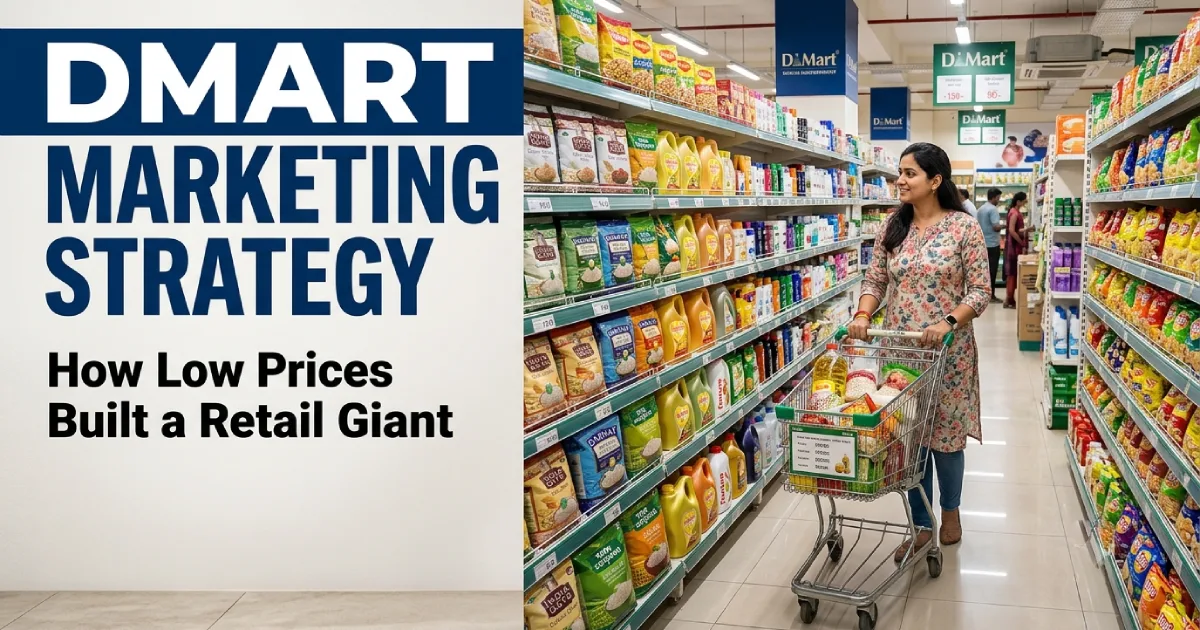
DMart Marketing Strategy: Business Case Study
Suppose you went to a supermarket to purchase some items such as milk, rice, cooking oil, etc., and some household items. You have ₹1,000 to spend, but you find that you can save some money by buying all of your items from the same store.
Now think about coming back to that store each month knowing that you can count on the prices!
DMart's marketing revolves around this simple customer behaviour.
DMart has focused on the concept of offering good quality products at low prices without relying on celebrities for publicity, elaborate campaigns or discounted prices.
The supermarket chain, DMart was founded by investor and entrepreneur Radhakishan Damani in 2002 in Powai, Mumbai and is now considered one of the leading supermarket chains in India. Its parent company Avenue Supermarts Limited reported 500 outlets by 31st March 2026. It provides an important lesson to retailers, startups and small business owners.
The Latest Numbers of DMart's Business Growth
When analyzing DMart's business performance, it is easy to understand the marketing strategy.
Avenue Supermarts' FY 2025–26 annual report shows the following figures:
- Revenue from operations: ₹66,968 crore in FY 2025–26, compared with ₹57,790 crore in FY 2024–25.
- Profit after tax: ₹3,224 crore in FY 2025–26, compared with ₹2,927 crore in FY 2024–25.
- Total stores as at 31 March 2026: 500, with a number of stores being added during the financial year of 2025-26.
- Retail business area: 20.58 million SF.
- Geographical presence: 15 states, one Union territory and National Capital Region (NCR).
The figures reveal that DMart continued to grow with growth in its revenue and profit. But, business growth is not wholly due to marketing. Its performance is influenced by the pricing, procurement, store operations, customer demand and decisions regarding expansion.
Also Read: Zepto IPO Case Study
1. Replace Temporary Discounts With Everyday Low Prices
One of the most important strategies of DMart is Everyday Low Cost/ Everyday Low Price (EDLC/ EDLP) model.
Seasonal sales, offer of limited time and festival discounts are some of the ways many retailers draw in the crowd. DMart's main objective is to keep prices competitive, as a part of shopping.
When buying groceries, cleaning supplies, personal care and other household needs, any savings can add up over the course of months.
A family spending ₹5000/- per month on groceries could check the cost of the goods from different stores before deciding which store to go to. If one retailer consistently has a better price on at least a few items there's a good reason for the customer to keep coming back.
This way, price becomes a significant aspect of the brand's image.
Marketing lesson: A business doesn't always have to give the deepest discount! Having a consistent value can provide a reason for customers to come back.
2. Managing Costs to Maintain Competitiveness on Prices
The solution to low prices is cost control by the business.
DMart's strategy is tightly linked with procurement and efficient supply chain, coupled with careful management of operations. According to its annual report, its focus is on bulk purchasing, efficient goods transport and cost reduction of its operations.
Retailers may be able to secure competitive terms from suppliers by purchasing in bulk. Efficient distribution can also help to organize the products from the distribution centres to stores.
DMart's model also helps to shift the customer's mind towards buying more items during a single shopping trip instead of buying small quantities on regular basis.
These are decisions that have been made to comply with the company's value-retailing approach. The goal is not just to make products inexpensive, but to establish a system that will allow competitive pricing in the long-term.
Marketing lesson: Companies should know their costs, inventory, delivery charges and profit margin before selling their products on a discount.
3. Engaging in the Business of Offering Products That Customers Can Buy Regularly
DMart's emphasis is on common items instead of purchasing just occasionally.
It has food and groceries, non-food fast-moving consumer goods (FMCG) and general merchandise and apparel product categories.
Food products accounted for around 57.90% of the revenue of DMart during FY 2025–26. The total value of non-food FMCG products was 19.82% and general merchandise and apparel was 22.28%.
This range of products illustrates why it is a key part of its business model to offer products everyday.
Purchase toiletries, household cleaning supplies, clothing, utensils or other essentials can be done while shopping for groceries here. Having a number of categories brings a variety of shopping uses.
The strategy also affords possibilities for repeat visits as a number of these items must be purchased consistently.
Marketing lesson: Companies need to know what products people are purchasing regularly and develop products based on the true demand.
Also Read: Meesho Case Study
4. A One-Stop Shopping Experience
Consumers will usually choose to make a single trip to a shop where they can buy multiple items that they need.
DMart is a place where grocery items, packaged food items, personal care items, household supplies and some general merchandise are available.
This can minimize the number of times one has to go to different shops for everyday items. Users can compare products, choose various brands and make many purchases all in the same location.
Convenience and value can go hand-in-hand to push a family's shopping habits.
But, a wide product offering is not sufficient. It's also important that products are also available when customers require them and shopping is still convenient.
Convenience is a competitive advantage – If there is a business that has relevant products, reliable availability and reasonable prices.
5. Increase the Number of Stores by Store, Not Everywhere at Once
Its expansion is carried around in a cluster basis. This is not about entering all markets at once, but beefing up their presence in markets where they are already present and working their way in to new ones.
The company added 85 stores during FY 2025–26, taking its total to 500 by 31 March 2026.
It can contribute to a retailer becoming familiar with the operation in a particular area, in terms of distribution and presence.
The location where the store is kept is also important. In order for a supermarket to be successful, it must be located where the people who want to purchase its products will be able to find it, and it must be backed by an efficient supply chain.
It's not just about new outlets, it's also about growing supply of products. Every new outlet should be a part of the larger business plan.
Marketing lesson: Small businesses can also expand slowly by building up a large number of customers in one market and then moving into a new market.
Also Read: Nykaa Case Study
6. Customer Trust and Repeat Purchases
But the marketing process doesn't cease once a customer is in a store. The customer's real-life experience determines if they will come back.
DMart's competitive pricing, everyday essentials and products availability helps in the building of repeat purchases.
If you keep customers coming back time and time again to find products that are priced at a reasonably affordable rate, they may start to connect the retailer with value. This connection can be beneficial in building brand awareness and fostering referrals from family and friends over time.
Here's the key to understand: This is different from what DMart never advertises or never uses promotions. It's overall approach is best seen in its own words, in terms of everyday value, and operating efficiency, not making the assumption that advertising has no place.
Marketing lesson: When a brand keeps its promises; it earns the trust of its customers.
7. Is It a Digital Business?
The ways consumers shop are evolving and so are online grocery deliveries, providing an alternative for a different consumer group to purchase their daily essentials.
DMart's e-commerce grocery aspect is called DMart Ready and enables its customers to place their food orders online in the cities where it operates.
The company, which runs DMart Ready, made a revenue of ₹4,094 crore in FY 2025-26, against ₹3,502 crore the year before. But its loss also rose with the figure at ₹307 crore as against ₹247 crore in FY 2024-25.
These statistics are important to remember, however: just growing online sales doesn't necessarily mean that an online business is profitable.
Digital expansion is a technology, fulfilment infrastructure, delivery cost and customer service issue for retailers. The challenge is to do it in a convenient way, and yet have a sustainable business model.
Marketing lesson: Don't just look at sales growth when considering digital channels, but customer value and financial performance.
What Small Businesses Can Learn From DMart
There are several learnings in DMart's journey that can help entrepreneurs.
Understand your customers. Determine what they buy on a regular basis, what they can afford and why they buy from one seller rather than another.
Offer clear value. The customer must know the reasons for purchasing your product/service. Value can be obtained from price, quality, durability, convenience/service.
Don't reduce prices until you have under control your control costs. Discuss your costs and profit before providing discount. Low cost may lead to losses and not be profitable.
Encourage repeat business. Good quality, service and pricing will help to develop a long-term relationship.
Expand carefully. Test demands in a smaller market and don't invest too much money into expansion until you know what the market needs.
Be responsible in using digital channels. Websites, online ordering and social media can be effective tools for connecting a business with customers, and each tool should be used to fulfill a specific business goal.
The Power of a Simple Marketing Promise
By focusing on a clear value proposition, DMart's marketing strategy is a testament to how a focused business proposition can be a powerful business advantage.
The company has developed a retail concept based on a strategy of everyday low prices, essential products, operational efficiency, and disciplined growth, which resonates with their customers in search of value.
It does not imply that all business should do the super market thing. The needs, costs and competitive factors vary from industry to industry.
What's more useful is to know: The formula of DMart's approach is to offer a promise that customers value and then consistently deliver on it, developing the business systems necessary to sustain it.
For startups and small businesses, that may not be as much of a leap to begin with as investing in promoting themselves first, to build a reason for customers to pick them up.
Sources & Fact-Checking
The latest financial and store figures used in this article are based on Avenue Supermarts Limited's FY 2025–26 annual report and published company information.
This article is an independent educational case study. It is not affiliated with or endorsed by DMart or Avenue Supermarts Limited. Financial figures refer to the stated financial year and should not be interpreted as live market data or investment advice.