Categories
Recent Posts





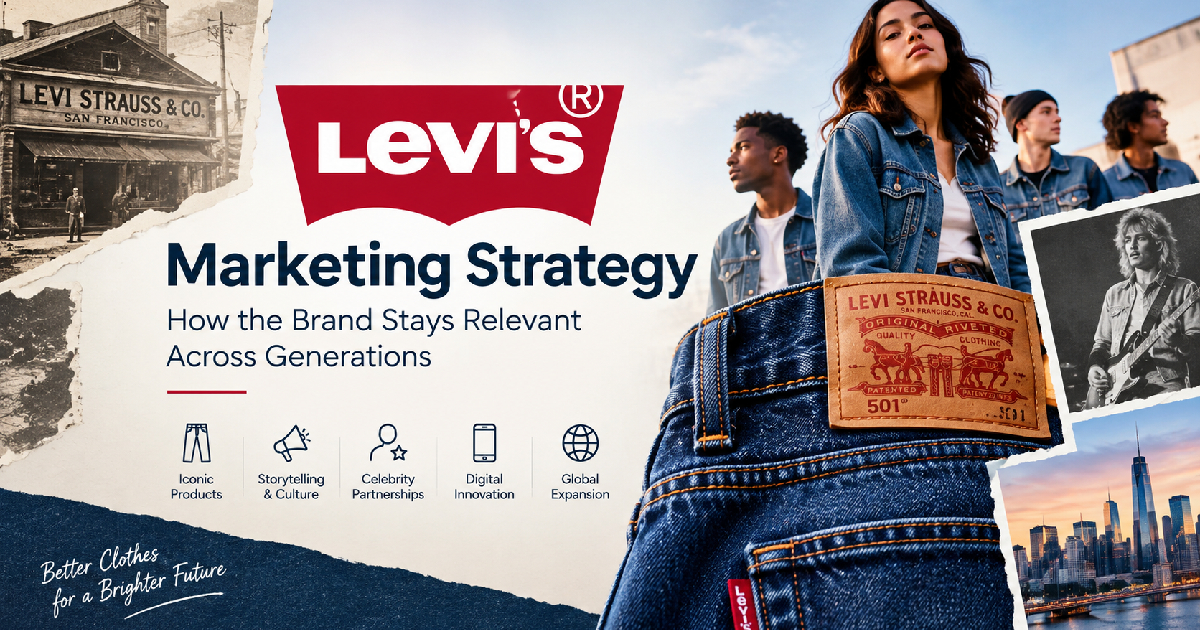
Table of Contents
Levi’s Marketing Strategy: How the Brand Stays Relevant Across Generations
Levi's is one brand that always springs to mind when it comes to jeans.
It's not just about denim shirts being sold at Levi's. The company has been over 100 years at the forefront, changing a simple piece of clothing into a symbol of style, individuality and culture.
However, there's a surprising business secret to this triumph: How will a brand that helped establish the modern blue jean still appeal to new generations decades later?
The solution is how Levi's merges old with new marketing.
It isn't just jeans that it's about anymore. It's about establishing a lifestyle brand, with iconic products, story telling, celebrity connections, digital experiences, retail stores, communities and cultural relevance.
The marketing strategy of Levi's is an interesting case which can be studied by both the big companies and the small or growing companies.
Workwear to a Global Fashion Icon
Levi's history dates back to 1853 when it was founded in San Francisco. Levi Strauss and tailor Jacob Davis were awarded a U.S. patent for riveted work pants in 1873.
These pants were later known as blue jeans.
The 501® was one of the most iconic products in the company's history. Once functional and utilitarian, workwear has transformed into a fashion staple and now a cultural icon.
This shift is one of the most important things to get at Levi's.
The company didn't just continue to sell jeans as work-wearing articles. With the changing tastes of customers, the definition of jeans also shifted.
Levi's brands became linked to youth culture, music, fashion, individuality and self-expression.
This enabled the reinvigorating of an old product category for new generations.
What is the marketing strategy of Levi's?
These are a number of inter-related concepts that explain Levi's marketing strategy:
It's all about strong brand identity, iconic products, cultural marketing, celebrity partnerships, digital experiences and direct customer relationships.
Levi's never relies on a single advertising campaign or product; it continues to create the brand based on familiar products and cultural narratives.
It is a well-known brand for its 501® jeans, Red Tab™ and the characteristic stitching on the back-pockets, among others, which allow consumers to identify it.
Meanwhile, the company is working to update presentations of those products.
The strategy is all about maintaining consistency and change.
1. Product is more than just Jeans
One of the most frequent fashion marketing errors is to only think about the actual product.
Levi's does things differently.
Its products are related to concepts of authenticity, individuality and self-expression.
The 501® is the most obvious, for example.
The original riveted jeans were patented in 1873, but the 501® has progressed through a variety of fits, styles and customer preferences over the years.
In addition to straight fit denim, Levi's has branched out into various fits, silhouettes, jackets, shirts and casual clothing.
The company has recently shifted its brand focus from just being a jeans maker to a denim lifestyle brand.
This allows for increased chances of selling to the same consumer.
The brand could be introduced via a pair of denims, then a jacket, shirt, accessories, or something else.
Lesson for businesses
A good product can be the cornerstone of a much more extensive brand.
But rather than continually generating new product offerings, companies should ask:
How do we optimize our best product to be more useful, more relevant and more desirable to a variety of customers?
2. The 501® Is a Marketing Asset
Levi's key asset is its marketing from its history.
The 501® isn't just another pair of jeans.
It has a story.
It goes back to the start of the riveted blue jeans in 1873 and Levi's still rely on this legacy in current campaigns.
In 2023, the company celebrated the 150th anniversary of the 501®.
Levi's has designed contemporary user experience around their product as well as conventional advertisements.
This is key, as products are not sold by history alone.
Levi's makes history tangible, for people to be involved in.
That's a whole lot stronger.
Despite being a start-up with no 150 years of history, a startup or company can still tell a story about their product: why it was developed, who uses it, what problem it is solving and what sets it apart.
3. Product cost reduction: Levi's Marketing Mix - Price
Levi's does not attempt to compete just on price, as the world's most inexpensive denim brand.
Rather, its pricing is directly tied to the brand, the product design, the fit, the quality and the customer experience.
The needs of consumers are different for various products and collections.
The company is also present in various channels such as its stores, its online channels and wholesale partners.
This allows Levi's to cater to consumers seeking other styles and price points without compromising on the overall quality of the brand.
What is important is that the customer is NOT paying for fabric.
They also have to cover the price of the brand, design, fit, trust and identity of Levi's.
This is a great message of perception of value in branding.
4. Distribution: Going Where Customers Shop
Levi's now has a wide distribution network all over the world.
The company's products are for sale in around 120 countries via retailers, department stores, online and thousands of retail stores and shop-in-shops.
The company has been beefing up its direct-to-consumer (DTC) business too.
This is important as today's retail isn't just about being able to put products in stores.
A customer could see a product on Instagram, learn more about it online, go to a physical shop to try it out and end up buying it via an app or website.
Levi's is thus striving to achieve an "omnichannel" shopping experience where in-store and online shopping complement one another.
In 2025, the DTC generated approximately $3.08 billion in revenue, which accounted for nearly 50% of the company's total revenue.
The DTC revenue grew 11% YOY in Q2 of 2026 and the e-commerce revenue rose by 19% YOY.
The numbers are testaments to the fact that having direct contact with customers has become an important part of the company's strategy.
5. Celebrity Marketing That Fits the Brand
There's no doubt that Levi's knows the importance of cultural influence.
The interesting thing is that, most of the time, its partnerships are linked to the brand's identity.
One notable brand that has teamed up with it is the brand of Beyonder.
In 2024, Levi’s teamed up with Beyonder to give new life to iconic Levi's ads today.
The campaign went through till 2025, and Beyonce was featured in various ads like “Pool Hall,” “Refrigerator” and “The Denim Cowboy”.
Rather than just pairing a celebrity with a product, Levi's took a different approach and made it sound like it had a new advertising campaign of its own.
That helped the campaign to feel like a true endorsement of the brand, as opposed to a random celebrity endorsement.
Levi's also released its global Icons campaign in 2025, which includes a 501® Original, Trucker Jacket and Western Shirt collection, to include Shaboozey and Matty Matheson.
The theme of the message was still on the individual, confidence and the western spirit.
Why this works
The star takes part in the story of the brand.
That's much more than:
“If this celebrity uses it, you should use it!
The show’s theme is the same: make advertising more entertaining.
6. Levi’s Turns Advertising Into Entertainment
It was a well-known practice in the 95 commercials for the 501® with Clayman using Clay animation to tell a humorous story.
The company has followed the trend to generate campaigns that go beyond the product in the people's memories.
Its recent efforts are in the film, music, fashion, social, digital and outdoor brand experience formats.
The aim isn't to only display any pair of jeans.
The aim is to make something that people want to view, talk about and share.
It's a significant shift in today's marketing.
As an advertisement gets more and more successful, it's necessary that it functions more like content, rather than an advertisement.
7. Social Media and Personalisation
Digital technology is also contributing to higher engagement with consumers at Levi's.
A focus on data and analytics has been one of the company's priorities to become more consumer-focused and as a result, is an omnichannel retailer.
One of its digital strategies is to communicate to customers in a personal way, by taking into consideration their interests and shopping habits.
In Levi's case, for instance, they have been sending personalised emails, push notifications and in-app messages to the interested customers regarding the product launches and limited collections.
This way the company and the customer's relationship will change.
The brand can send a different message to each of different individuals in accordance with their interests rather than sending a message to all.
This is a valuable lesson that a modern business needs to learn:
Personalisation can help the marketing to be more relevant without having to change the products offered to each customer.
8. Levi’s and Cultural Marketing
But perhaps the most compelling aspect of the Levi's marketing plan is that it ties into culture.
In the past few decades, denim has made a presence in the music, film, sport, fashion and youth culture.
Levi's has capitalized on these cultural ties many times in order to remain relevant.
The company says that Levi's is a brand that is linked to self-expression and those who break the rules, question the norms.
This bestows an emotional value on the product.
But it doesn't seem that a customer is necessarily thinking:
I am purchasing some cotton denim trousers.
They might be using the following thought process:
“It's what I like.”
The difference is very significant.
Product may be duplicated.
It is much difficult to replicate emotional connections.
9. Sustainability as Part of the Brand Story
It is not only in the product that sustainability is a part of Levi's business communication.
The company has launched programs like Water<Less™ for decreasing the amount of water used for a portion of the denim-finishing process.
Levi's also shares the information about product durability, responsible production and extending the life of clothing.
As more and more customers value the product's manufacturing, this is becoming more significant.
The best way for brands to be sustainable is to link it to their products and processes—more than just a marketing statement.
10. What the Numbers Say.
It becomes interesting, considering the marketing strategy of the company, if we take a peek at the company's past performance.
The net revenue for fiscal 2025 was $6.28 billion, a decrease from fiscal 2024's $6.03 billion.
In fiscal 2025, the revenues of the Levi's brand amounted to around $5.88 billion.
Direct-to-consumer revenue stood at about $3.08 billion as opposed to $2.81 billion the year before.
This trend carried on in 2026. Total revenue was approximately $1.6 billion in fiscal 2026 Q2, which was an increase of 8% on a reported basis. The DTC revenue rose by 11% and e-commerce revenue rose by 19%.
The numbers indicate that this is not only a strategy to sustain an old fashion brand, but also a strategy that focuses on the brand's future.
It's also about developing and growing a more contemporary and digital retail and digital business around that brand.
11. What Makes the Levi’s Strategy Different?
There are many campaigns of celebrities run by many fashion companies.
There are a lot of people with social media profiles.
A lot sell products via websites and bodily stores.
There are lots of people who speak about sustainability.
But why is Levi's so special?
The solution is there's a single brand identity that ties these activities together.
It is a unified concept that is reinforced by the product, history, advertising, celebrity marketing, retail experience, and digital marketing.
Levi's is a brand of individuality, authenticity and self-expression—denim.
It's hard to create this uniformity.
It takes a number of years to get the message across and allow the brand to develop.
Key Business Lessons From Levi’s
The following are a few lessons that businesses can learn from Levi's marketing strategy.
First, it's not about a product, it's about an identity.
Once consumers are drawn to a product, they can only be impressed by it once. Branding can create a reason for customers to return to the product/service.
Secondly, make use of your past wisely.
If your business has a story, then don't hide it! Use your trip, the troubles you've faced and the successes you've achieved as content.
Thirdly, make your best product a hero.
Levi's is continuing to make use of the 501® as a potent brand asset, rather than a thing of the past.
Fourth, pick partnerships judiciously.
Beyoncé is working with Levi's because it's a partnership that involves music, fashion, culture and reinvention, and ties in with their identity.
Fifth, integrate digital with physical experiences.
Customers have no awareness of "online customer" and "offline customer. All they want is an easy brand experience.
Lastly, grow and transform without becoming a new person.
This could be the number one lesson to learn. Levi's has undergone a number of changes in their products, advertising and technology over the years, but the essence of their brand remains the same.
Final Thoughts
In the end, it's a good marketing strategy that has kept the old brand as a relevant brand in a fast-evolving market such as this one, and that's the case in the Levi's example.
The company was not the first to invent jeans and not for that reason it was successful.
The strength that it had in the long run was its ability to keep on giving it new meaning.
The 501® went through the transformation from workwear to fashion. Denim got linked with the youngsters' culture. Advertising became entertainment. The celebrities became cultural partners. Stores integrated into an omnichannel experience. Digital technology was used to gain insight into customers and communicate with them.
Today, Levi Strauss & Co. is living on with that evolution.
Although its heritage roots are solid, it doesn't mean the company has to stand still, given its recent growth, continued investment in direct-to-consumer and its growing digital footprint.
But the key to the real lesson that businesses should learn is:
A good brand doesn't forget its history, knows its customers now and continues to find ways to make its customers care more about it in the future.
It's what makes the Levi's story more than just a fashion case study. It's a lesson in the building of a brand that will endure changing trends, generations and technology.
Sources & Disclaimer
This article is independently written for informational and educational purposes using publicly available information from Levi Strauss & Co. and other reliable sources. Facts, figures, financial results, products, campaigns, and company information may change over time. Readers should verify the latest information through official company sources and current industry reports.
Primary Source: Levi Strauss & Co. official website
This article is not affiliated with, sponsored by, endorsed by, or officially associated with Levi Strauss & Co., Levi’s®, or any of its subsidiaries, employees, or representatives. All trademarks, logos, product names, and brand names mentioned belong to their respective owners. The article is intended solely as an independent business and marketing case study.