Categories
Recent Posts






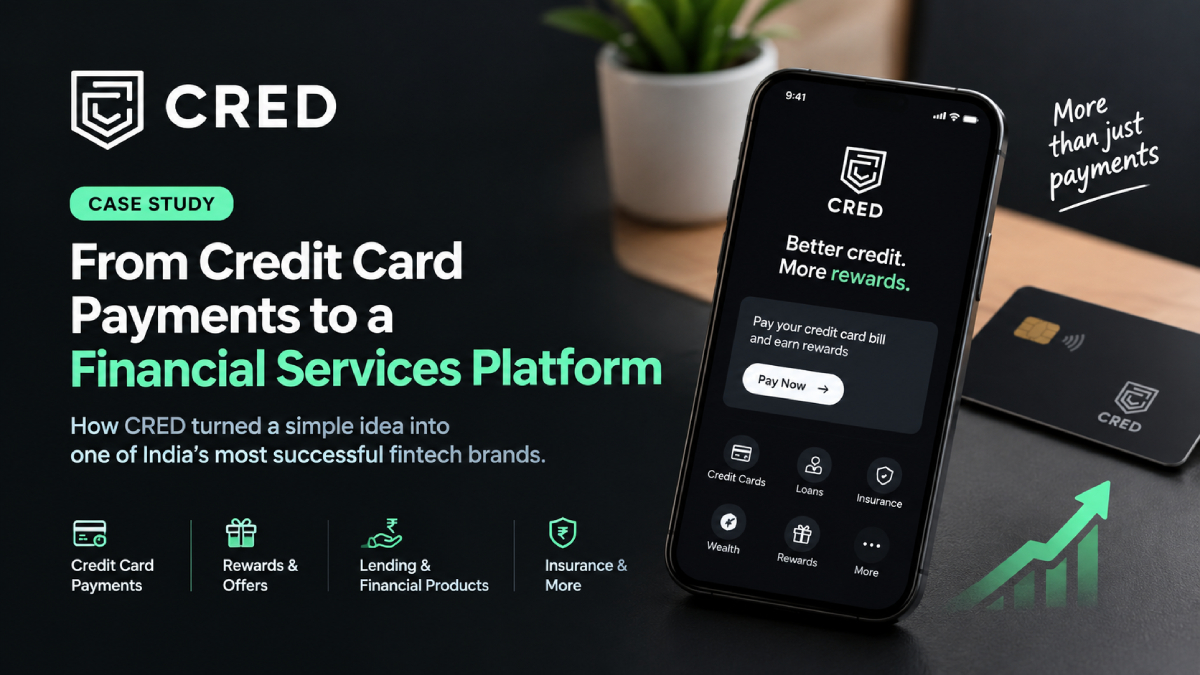
Table of Contents
How a Credit Card App Became a Fintech Platform
If it's possible to feel rewarded when you pay your credit card bill on time, what could be better?
This simple idea laid the foundation of one of the most popular Fintech startups in India-CRED.
The time CRED was started in 2018, repayment of a credit card bill was already a regular practice. Individuals could pay their bills with their bank's app, websites and other payment platforms.
Well, why not?
The solution that CRED came up with was simple: make responsible credit behaviour more rewarding.
To begin with, CRED targeted those with a good credit score and rewarded them for paying their credit card bills on time instead of courting all clients.
The concept was novel, the market was a niche segment and the industry was crowded with fintech companies. However, CRED was able to create a massive user base and slowly grow beyond credit card payments to loans, insurance, personal finance and other financial products.
This is the history of how CRED built its business, and what entrepreneurs can learn from this journey.
CRED Company Overview
Kunal Shah, who was one of the co-founders of FreeCharge, is the founder of CRED.
The concept of CRED was not like many startups which aimed to disrupt the largest customer base possible in India.
Instead, CRED worked with a subset of consumers with already good credit behaviour.
It provided eligible users with the ability to manage their credit card bills, pay and earn rewards and offers.
Eventually, CRED increased their product line and got out of the realm of credit card payments.
Also Read: Policybazaar Case Study
The Problem CRED Wanted to Solve
Even though credit cards are convenient, it could become difficult to keep several cards and remember when to pay them.
When a payment is missed, then one might be charged with unpaid interest and it can influence an individual's credit score as well.
The problem was approached differently by CRED.
What if there was a positive incentive for people to have good financial habits instead of them being reminded to pay a bill?
This was an important element of the early pitch of CRED.
Users could pay their credit card bills on the platform and earn CRED that would enable them to avail various offers and benefits.
The company was thus attempting to bring together three things:
-
Plus responsible payment behaviour and rewards and financial services.
Why is CRED Targeted on High Credit Score Users?
The one thing that was interesting in CRED's strategy was that it was selective.
Initially, CRED wasn't even attempting to get financial apps into every Indian.
The platform had a minimum credit score requirement, allowing them to attract customers with good credit scores. It is typically reported to be around 750.
This gave a unique approach to the start-up.
Instead of saying:
We'd like to have millions of users,
The concept was more along the lines of:
The rationale behind this is “we want the right users first.”
This opened up a market to CRED for existing customers who may have been interested in more sophisticated financial products and services within the formal financial system.
The Business Model of CRED is explained below:
Since its inception, CRED has evolved its business model in a great extent.
The initial experience was of paying credit card bills and earning rewards.
The platform expanded, and started to work with brands and financial institutions.
The platform might be leveraged by businesses to connect with CRED's users via offers and collaborations.
CRED also made a venture in financial products and services.
More recently, it's made loans, financial tools, tracking of credit scores, insurance and other financial services available.
This provided several opportunities for revenue generation as opposed to credit card transactions.
There is no simple fee for customers to pay with a credit card to CRED. Rather, its big business plan is to generate revenue from its platform via financial products, partnerships and other services.
Also Read: Zepto IPO Case Study
How CRED Makes Money
As CRED continues to roll out more products, so has its earnings structure.
Areas of importance are:
Financial Products
CRED links the eligible users to various financial products, such as loan related services and others.
The company is able to generate revenue from such financial relationships.
Brand Partnerships
For its members CRED has developed a marketplace of offers and products.
The platform will allow brands to target an audience and will provide another business opportunity for CRED.
Lending
As CRED has grown beyond the payments sphere, lending has become an integral part of the business.
In FY25, CRED's total assets under management were approximately ₹22,000 crore, and lending was now a significant contributor to the company's revenue.
Insurance and Other Services
Furthermore, CRED has expanded its financial services offerings, including insurance and personal finance, to diversify its offerings.Moreover, CRED has ventured into other financial services, including insurance and personal finance, to diversify its offering.
This is crucial because it enables the company to make more money from their current customers than new customers.
CRED's Growth
Since its inception, CRED has been growing at a rapid pace.
It was a unicorn in 2021 when it raised $215 million at a valuation of approximately $2.2 billion.
Later it was valued around $6.4 Billion in 2022.
But that has changed the startup landscape, and CRED's valuation was lowered in a subsequent funding round. The firm raised new funds in 2025 valued at approximately $3.5 billion.
The CRED story is significant as the growth of startups does not necessarily follow a straight path.
Overvalued companies don't necessarily have all the business problems solved.
The emphasis, for CRED, started to gradually change, to monetisation and to develop a wider financial-services business.
Also Read: Levi’s Marketing Strategy
CRED's FY25 Performance
CRED's business continued to increase in FY25.
Its consolidated operating revenue grew by 16% to ₹2,735 crore, the company said in the report.
In tandem, the operating losses also reduced by ~51%, to ₹298 crore.
It has seen its monthly transacting user base grow by 14.5 per cent to about 1.26 crore and the payment value processed on the platform hit ₹8.5 lakh crore over the past year.
About 45% of the company's active members used three or more CRED products, it added.
This is an important change in the business as indicated by these numbers.
CRED isn't just pushing for credit card bill payments to be made via an app. It is making an effort to create a wider financial connection with its users.
What is so different about CRED?
There are a number of interesting aspects of CRED's strategy.
1. Development of a Specific Audience
The first phase was to develop a specific audience.Development of a specific audience was the first phase.
To begin with, CRED took a different approach than catering to everyone, concentrating on individuals who had existing credit histories.
2. Made a Dull Task More Exciting
Making a payment is no pleasant experience.
CRED packaged the activity with rewards, offers and added a premium user experience.
3. It was Strongly Design oriented
The luxury branding and advertising and the user experience of the app was the hallmark of CRED.
For a fintech organization, the area of financial products may seem complicated, making it easier and all the more appealing may lead to forming a better relationship with the users.
4. To begin with, it has grown out of one product.
Initially, it began with credit card payments, since then it has expanded to include financial products.
This enabled them to make the most of what they could get from their current customers.
Challenges along the way
CRED's story is one of funding and growth, but it's not all.
It's not unlike many fintech startups in that it's been asked about profitability, valuation and how they can create a sustainable business.
Changing market conditions can even impact a highly valued startup, as evidenced by the company's valuation, which fell from its peak level in 2022 in a subsequent fundraising.
However, CRED's operating losses were still negative in FY25, but reduced significantly.
This is an interesting example of a company because it illustrates that user growth, funding and valuation are just some of the many steps in the startup journey.
At some point in a business's life cycle, it must create solid revenue streams and enhance its economics.
Business owners can learn from CRED's experience.
Business owners can take a lesson from CRED.
From CRED's journey, there are a few lessons which are useful for entrepreneurs.
Solve a particular problem.
It's not like CRED was looking to fix all these financial issues from the beginning. It started with payments on credit cards and good credit habits.
You don't have to go after everyone.
A focused customer segment can sometimes help a startup to develop a better product and brand identity.
Make everyday tasks easier to do.
Rewards, design and convenience were the keys to creating a better experience of a simple activity for CRED.
Carefully develop several sources of income.
Knowing a company's customers enables him or her to find products related to the customer's needs.
Growth and profitability are different.
It is possible for a startup to grow quickly and secure a substantial number of investments, but at the same time, it must focus on its way to profitability.
The CRED Story: A journey from bills to financial services.
The idea behind CRED was extremely basic – incentivize people to pay their credit card bills on time.
However, the company didn't end there.
It developed a powerful brand image that focused on a niche market, and began to diversify into financial services, such as lending and insurance, and personal financial services.
It also demonstrates the difficulties of creating a modern fintech business. Raising money and valuing assets is possible and so is the competition and monetisation through sustainability slowly gets more crucial as the startup progresses.
Today, CRED's story is a payment story; a way to pay without a delay, without an inconvenience.
It is a customer segmentation, product design, brand building and business model expansion case study.
One lesson for entrepreneurs, though, is an easy one: You need not always go with the big idea.
The answer to one particular problem, and the way the problem is solved, sometimes can lead to a much larger solution.
Digital Startup India shares startup case studies, founder stories and business insights to help entrepreneurs understand the strategies and decisions behind growing businesses in India.
Primary Sources: CRED and publicly available reports and news coverage about CRED's business, growth and financial performance.
Disclaimer: This case study is for educational and informational purposes only. Information has been compiled from publicly available sources, including CRED's official website and reports. Digital Startup India is an independent private platform and is not affiliated with or endorsed by CRED.