Categories
Recent Posts


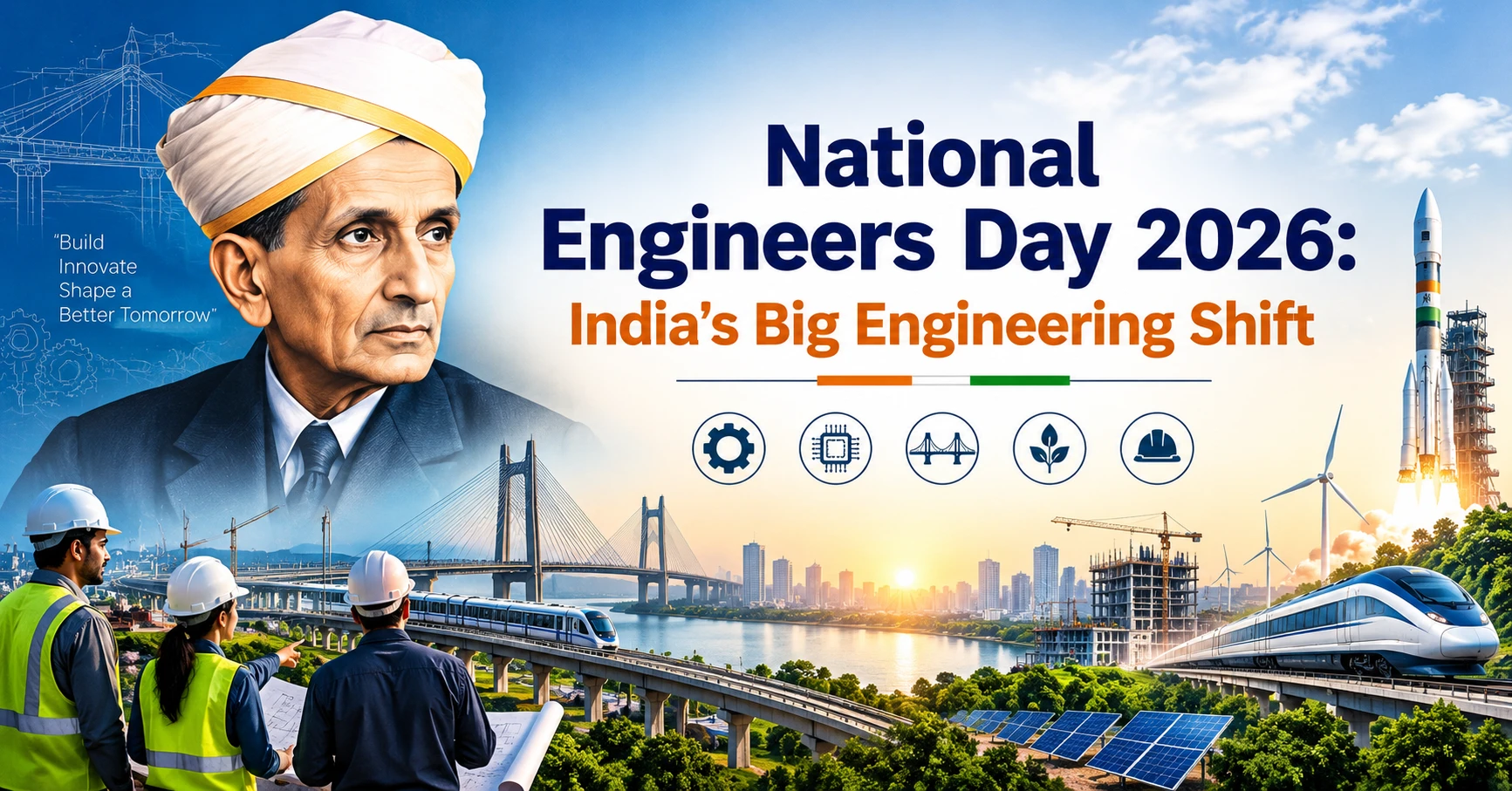
National Engineers Day 2026: How India's Engineering Shift Is Opening the Biggest Business Window Since 1991
Every year on 15 September, India celebrates National Engineers Day 2026 with posters, LinkedIn posts and a quick "thank you" to engineers. Then everyone goes back to work.
This year, that would be a mistake.
Because something bigger is happening quietly under those celebration posts. India's engineering is changing at its root — and if you are a founder, a business owner, or someone planning your next venture, this change will decide whether the next 20 years make you money or leave you behind.
Let me explain it in simple words.
What is National Engineers Day, and why should a business owner care?
National Engineers Day is celebrated on 15 September to mark the birth anniversary of Sir M. Visvesvaraya — the engineer behind India's early dams, irrigation systems and city planning. He did not just build structures. He built systems that worked for the next 100 years.
That is the whole point.
Today India has set a target: become a fully developed nation by 2047, when the country completes 100 years of independence. This goal is called Viksit Bharat 2047.
And here is the honest truth — Viksit Bharat 2047 is not a political slogan for founders. It is a demand forecast. It tells you which sectors will get money, policy support and customers for the next two decades.
Smart founders do not read it as a speech. They read it as a map.
The real question India is answering right now
By 2047, India will not be judged only by how fast it grows.
It will be judged by what it builds.
The world is watching one question: Will India stay a consumer of technology, or will it become the architect of systems the world depends on?
For 30 years, India was the world's back office. We wrote the code, ran the support desk, managed the process. Good business. Safe business. But somebody else owned the chip, the platform, the patent and the profit.
That is changing now. And this change is where your opportunity sits.
Also Read : How MSME Business Automation Saves Time Every Day
India's engineering is shifting from "service provider" to "system builder"
Here is what is actually happening on the ground, in plain language.
1. From IT services to deep tech
India is moving away from basic software services and IT outsourcing. The new focus is deep tech, semiconductor manufacturing and artificial intelligence.
The country is now building:
- Domestic data centres — so Indian data stays and processes in India
- Sovereign AI systems — Indian models, trained on Indian languages and Indian problems
- Semiconductor fabrication — chips made here, not just designed here
Why this matters to you: when a country decides to own its technology stack, it needs thousands of small suppliers, testing labs, tooling companies, component makers and software layers. Big fabs get the headlines. The ecosystem around them is where most founders will actually earn.
2. Civil engineering has quietly gone digital
Construction in India is no longer only cement and steel.
Large projects now run on:
- LiDAR scanning for accurate site mapping
- Drone surveys instead of weeks of manual measurement
- BIM (Building Information Modelling) to plan a building digitally before laying a single brick
- 3D terrain modelling for highways, metros and industrial corridors
A founder-friendly way to read this: every highway, metro line and airport being built today needs a digital twin. Most Indian contractors still do not have this capability in-house. That gap is a business.
3. The focus has become "full-stack"
India is no longer separating physical infrastructure from computing. The new model combines:
- Physical assets (roads, grids, plants)
- Advanced computing and quantum research
- Green manufacturing — green hydrogen, advanced battery R&D
This is what "full-stack engineering" means for a country. It also means the old boundary between a "hardware company" and a "software company" is disappearing.
4. Education is being rebuilt around outcomes
Engineering education and workforce training are shifting towards outcome-based learning, automation, robotics and AI. The goal is simple — close India's technical skill gap.
For edtech founders and training businesses, this is the clearest signal in the entire story. India does not have a shortage of engineering degrees. It has a shortage of job-ready engineers. Whoever solves that at scale, at Indian prices, builds a very large company.
5. ISRO is handing over routine work to private players
This one deserves its own paragraph.
ISRO is moving routine rocket and satellite manufacturing to the private sector, so it can focus on advanced research, human spaceflight and deep-space exploration.
Read that again as a founder. A government agency is deliberately creating a private supply chain. That is exactly how the US space economy was born. India is at the same starting line — 20 years earlier than most people realise.
What industry leaders are saying about India's engineering change
This is not one person's theory. Leaders across finance, semiconductors, energy and industrial automation are describing the same shift.
Shishir Saxena, Head of Solution Architecture – Record Keeping Platforms, Fidelity International, says the role of the engineer itself is changing:
"It is increasingly not just about solving technical challenges, but about working closely with business teams to build solutions that create meaningful client outcomes."
He adds a point every founder hiring in 2026 should note — as AI writes more and more code, the ability to read, review and validate code becomes as valuable as writing it:
"The engineers of the future will need to excel not only at creation, but also at understanding, validating and integrating work across human and AI contributors."
Ponni Carlin, Co-founder & COO, iVP Semi, puts the hardware reality bluntly:
"The prototype is the easy part. Getting from a board that works on a bench to a product that can be built, tested and shipped the same way ten thousand times — that is where engineering in India is genuinely changing."
And then the line that should be printed in every hardware startup's office:
"Viksit Bharat 2047 will not be built on prototypes. It will be built by engineers who can carry a design all the way to volume production and keep it there."
Simarpreet Singh, Executive Director and CEO, Hartek Power, points to the energy side:
"The engineering challenge is no longer simply about adding generation capacity. It is about ensuring that this capacity can be integrated into the grid efficiently, reliably and sustainably."
In simple words: India is good at making clean power now. The money in the next decade is in moving, storing and balancing it — smart grids, substations, battery storage, grid connectivity.
Sriram Lakshminarayanan, President, Honeywell Technology & Connected Solutions, adds the global angle:
"What is particularly exciting today is that many of these innovations are being engineered in India for global impact."
That is the sentence that should change how Indian founders price themselves. You are not competing for Indian budgets alone anymore.
Also Read : Why India's Best Founders Still Answer Support Tickets
7 real business opportunities inside the Viksit Bharat 2047 shift
Enough context. Here is where a founder can actually build.
1. Semiconductor support ecosystem
Not the fab — the layers around it. Testing and packaging services, cleanroom supplies, precision tooling, EDA support, quality and compliance consulting, specialist staffing.
2. Design-to-production consulting for hardware
As Ponni Carlin said, India has prototypes but struggles with volume production. A firm that takes a working board and makes it manufacturable — test coverage, documentation, sourcing, qualification — has a long queue of clients.
3. Digital construction services
Drone surveying, LiDAR scanning, BIM modelling, 3D terrain mapping as a service. Sell to contractors and EPC firms who cannot build these teams in-house.
4. Grid, storage and energy software
Battery energy storage systems, smart grid software, grid connectivity services, predictive maintenance for substations, energy data analytics.
5. AI code review and engineering quality tools
As AI writes more code, companies need tools and services that review, test and validate it. This is a brand-new category — and it is barely two years old globally.
6. Outcome-based engineering training
Robotics, automation, embedded systems, AI deployment. Placement-linked, industry-certified, affordable. Partner with colleges rather than competing with them.
7. Private space supply chain
Components, ground systems, satellite data applications in agriculture, logistics, insurance and disaster management. ISRO's step back is your step forward.
The engineer you need to hire in 2026 is not the one you hired in 2016
Across every quote above, the same skill list keeps appearing. If you are building a team, look for these:
- Systems thinking — sees the whole ecosystem, not one project
- Business understanding — knows why the feature exists, not just how to build it
- AI fluency — can direct, review and validate AI-generated work
- Domain depth — real expertise in energy, health, chips, finance or construction
- Ownership of outcomes — measured by results, not output
- Production mindset — thinks about testing, sourcing and documentation from day one
Here is the founder-level insight: technical skill has become the entry ticket, not the differentiator. Judgement is the differentiator now. Automation absorbed the repetitive work. What is left is deciding what to build, how to qualify it and whether it will survive in a customer's system.
Hire for judgement. Train for tools.
5 risks nobody mentions in the Engineers Day posts
A fair article gives you both sides.
1. Long gestation cycles. Deep tech and hardware take 5–8 years to profitability. Do not enter with 18-month capital.
2. Policy dependency. Much of this demand is policy-driven. Policies change. Build a business that survives a scheme ending.
3. Talent cost inflation. Everyone wants the same 5,000 senior engineers. Budget for it, or build a training pipeline of your own.
4. Import dependency. Even "Made in India" hardware often uses imported equipment and materials. Map your supply chain before you promise delivery timelines.
5. Execution gap. India's weakness has never been ideas. It is going from pilot to scale. Assume this will be your hardest problem, because it usually is.
A 90-day action plan for founders
If this article convinced you, do not just bookmark it. Do this:
Days 1–30 — Map
Pick one sector above. Read its policy documents, PLI scheme details and the last four quarterly reports of three listed players in it. Learn the vocabulary.
Days 31–60 — Talk
Speak to 15 people who work inside that sector. Not founders — engineers, procurement heads and project managers. Ask one question: "What takes too long or costs too much in your work right now?"
Days 61–90 — Test
Take the most repeated answer and build the smallest paid solution you can deliver in 30 days. One paying customer beats one perfect deck.
Final thought
Sir M. Visvesvaraya did not become famous because he was the best engineer of his time. He became famous because he built things that were still useful 100 years later.
That is the standard National Engineers Day 2026 is really asking us to meet.
India is at a rare point where the country's ambition, capital, policy and talent are pointed in the same direction at the same time. That does not happen often. It happened in 1991. It is happening again now.
The founders who understand this in 2026 will be the case studies of 2047.
The ones who wait for the opportunity to become obvious will be reading about them.
Which side do you want to be on?