Categories
Recent Posts






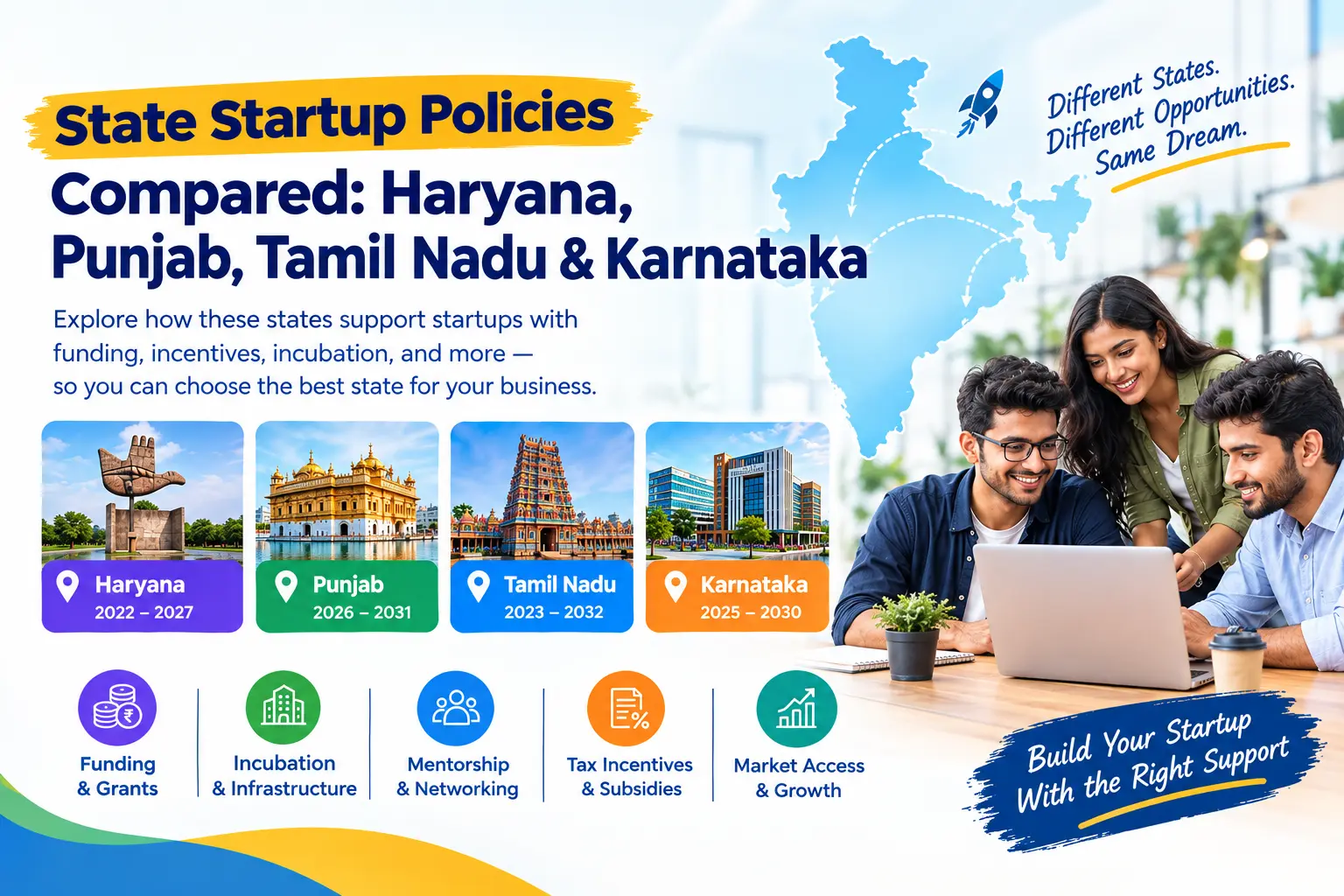
Table of Contents
State Startup Policies Compared: Haryana, Punjab, Tamil Nadu & Karnataka
India's startup ecosystem is no longer concentrated in just a few major cities. States are increasingly developing their own startup policies to provide entrepreneurs with access to funding, incubation, mentorship, infrastructure, market opportunities and other forms of support.
However, state startup policies are not identical.
The eligibility conditions, financial incentives, incubation support, funding mechanisms and focus areas can vary significantly from one state to another.
This guide compares the current startup-policy frameworks for Haryana, Punjab, Tamil Nadu and Karnataka and highlights the key areas founders should examine before deciding where to establish or expand a startup.
Important: Startup policies and individual schemes can change through government notifications. Always verify the latest eligibility and application conditions with the relevant state authority before applying.
What Are State Startup Policies?
A state startup policy is a government framework designed to support entrepreneurship and innovation within a particular state.
Depending on the state, support can include:
-
Grants
-
Interest subsidies
-
Lease or rental support
-
Patent reimbursement
-
Incubation facilities
-
Mentorship
-
Market access
-
Government procurement opportunities
-
Startup competitions
-
Technology and infrastructure support
-
Investor connections
-
Support for women entrepreneurs
Startup India's current policy overview notes that state startup policies are important for providing funding, mentorship and market-access support and that states also use them to develop incubators and other ecosystem institutions.
For founders, this means that choosing a startup location can involve more than office costs and talent availability. Government support and ecosystem infrastructure can also be relevant factors.
Current Policies at a Glance
As of July 2026, Startup India's TEJAS dashboard lists the following policy periods: Haryana State Startup Policy 2022–2027, Punjab Startup Policy 2026–2031, Tamil Nadu Startup and Innovation Policy 2023–2032, and Karnataka Startup Policy 2025–2030.
|
State |
Current Policy |
Policy Period |
Key Areas |
|
Haryana |
Haryana State Startup Policy |
2022–2027 |
Seed funding, patents, SGST, cloud, acceleration |
|
Punjab |
Punjab Startup Policy |
2026–2031 |
Seed support, startup ecosystem, funding and incubation |
|
Tamil Nadu |
Tamil Nadu Startup and Innovation Policy |
2023–2032 |
Funding, procurement, IP, ease of doing business |
|
Karnataka |
Karnataka Startup Policy |
2025–2030 |
Deep tech, funding, incubation, market access, global expansion |
The policy names and periods above are from Startup India's July 2026 state-policy listing.
Haryana Startup Policy
Haryana State Startup Policy 2022
Haryana's current startup framework runs from 2022 to 2027. The policy is administered through the Department of Industries and Commerce, with Startup Haryana serving as the state's startup ecosystem platform.
Haryana's policy is sector-agnostic and provides several direct fiscal incentives to eligible startups.
Key Benefits
Eligible startups can receive:
Seed Funding
Haryana provides seed funding of up to ₹10 lakh per startup for eligible Haryana-based startups. The support can be used for areas such as idea validation, proof of concept, prototype development and market research.
Lease Rental Subsidy
General startups can receive reimbursement of 30% of lease rental, while startups with only women founders can receive 45%, subject to a maximum reimbursement of ₹5 lakh for one year.
Patent Support
The policy provides reimbursement of eligible patent expenses, with support of up to ₹3 lakh per domestic patent and up to ₹10 lakh per international patent, subject to the overall policy limits.
SGST Reimbursement
Eligible startups can receive reimbursement of 50% of net SGST for seven years, subject to a cap linked to fixed capital investment.
Cloud Storage Support
Eligible startups can receive reimbursement of 75% of cloud-computing/storage expenses, subject to the specified annual and policy limits, where the qualifying data-centre conditions are met.
Who May Benefit Most?
Haryana's framework may be particularly relevant for founders looking for a combination of:
-
Direct seed support
-
Tax-related reimbursement
-
Patent assistance
-
Cloud infrastructure support
-
Incubation and acceleration opportunities
Haryana also has a strong connection to the Delhi-NCR business ecosystem through Gurugram.
Punjab Startup Policy
Punjab Startup Policy 2026
Punjab's current policy framework is listed by Startup India as the Punjab Startup Policy 2026, covering 2026–2031.
The current framework is especially relevant because Punjab is moving from its earlier startup-support structure toward a newer policy cycle.
The available 2026 scheme information indicates support for startups through seed grants and other ecosystem mechanisms.
A current scheme summary for the Punjab Startup Policy 2026 states that eligible startups can receive a seed grant of up to ₹5 lakh, subject to the applicable conditions and approval process.
Key Areas of Support
Punjab's startup ecosystem focuses on areas including:
-
Seed funding
-
Incubation
-
Startup registration
-
Mentorship
-
Investor connections
-
Innovation
-
Entrepreneurship development
Punjab also has startup infrastructure around Mohali and the Chandigarh region, providing access to incubators, educational institutions and technology-oriented businesses.
Important for Founders
Punjab's policy should be considered separately from the older policy information still visible on some government webpages.
For example, an older Startup India state-policy page still shows Punjab's Industrial & Business Development Policy 2017–2022, including an earlier ₹3 lakh seed grant.
For a 2026 article, the newer Punjab Startup Policy 2026 should be referenced instead.
Tamil Nadu Startup Policy
Tamil Nadu Startup and Innovation Policy 2023
Tamil Nadu's current startup policy is the Tamil Nadu Startup and Innovation Policy 2023, with a policy period of 2023–2032 according to Startup India's current state-policy table.
The policy was designed to strengthen entrepreneurship, innovation, funding, procurement and the broader startup ecosystem.
The official policy document identifies areas including:
-
Ease of doing business
-
Startup registration
-
Resource centres
-
Mentorship
-
Intellectual property support
-
Government procurement
-
Funding
-
Grants
-
Startup parks
-
Incubation
The policy also provides for a Tamil Nadu Startup Fund of Funds of ₹250 crore, to be managed through a professional financial agency such as SIDBI.
Government Procurement
One notable feature is support for startup participation in government procurement.
The policy provides for measures such as relaxation of certain prior-experience and turnover requirements, EMD-related support and facilitation of startup procurement for suitable opportunities.
IP & Innovation Support
Tamil Nadu's policy also includes support mechanisms around intellectual property and innovation.
TANSIM is positioned as a central ecosystem organisation for startup registration, support, mentoring and access to resources.
Who May Benefit?
Tamil Nadu may be particularly relevant for startups looking for:
-
Innovation ecosystem support
-
Government procurement opportunities
-
IP assistance
-
Funding ecosystem
-
Incubation
-
Startup infrastructure
-
Long-term policy support
The official Tamil Nadu policy document is the best source for detailed eligibility and implementation conditions.
Karnataka Startup Policy
Karnataka Startup Policy 2025–2030
Karnataka's current policy is the Karnataka Startup Policy 2025–2030, according to Startup India's current July 2026 policy table.
The policy has a particularly broad structure, covering the startup journey from early-stage innovation through commercialisation, scaling and market expansion.
Karnataka's policy is built around several pillars, including:
-
Funding and grants
-
Incubation and infrastructure
-
Mentoring and skill development
-
Market access and expansion
-
International collaboration
-
Inclusion and sustainability
-
Regulatory facilitation
The Karnataka policy document identifies flagship initiatives including ELEVATE, ELEVATE X, Beyond Bengaluru programmes, venture funding, incubation support, market-access programmes and deep-tech initiatives.
ELEVATE
The ELEVATE programme provides grant-in-aid support for early-stage startups moving from ideas toward proof of concept.
The 2025–2030 policy provides for grants of up to ₹50 lakh under the ELEVATE programme.
Deep-Tech Focus
Karnataka's new policy places significant emphasis on emerging and deep technologies.
Areas include:
-
Artificial intelligence
-
Biotechnology
-
Robotics
-
Electric vehicles
-
MedTech
-
Drones
-
Sustainability
-
Other emerging technologies
Beyond Bengaluru
Another important element is the attempt to expand startup opportunities outside Bengaluru.
The policy includes:
-
Beyond Bengaluru Cluster Seed Fund
-
Incubation hubs
-
Regional startup programmes
-
Market access
-
Entrepreneurship development
Women Entrepreneurship
The policy also contains dedicated support for women-led startups through programmes such as WEscalate, including incubation and acceleration support.
State Startup Policies Compared
The four policies differ considerably in their approach.
|
Area |
Haryana |
Punjab |
Tamil Nadu |
Karnataka |
|
Current policy |
2022–2027 |
2026–2031 |
2023–2032 |
2025–2030 |
|
Seed/grant support |
Up to ₹10 lakh seed grant |
Up to ₹5 lakh under current policy scheme |
Multiple funding mechanisms |
ELEVATE grants up to ₹50 lakh |
|
Patent/IP support |
Strong patent reimbursement |
Policy/support mechanisms |
Dedicated IP support |
Patent subsidy/support |
|
Incubation |
Yes |
Yes |
Yes |
Extensive |
|
Market access |
Acceleration/event support |
Ecosystem/investor support |
Government procurement |
Strong market-access pillar |
|
Deep-tech emphasis |
Selected areas |
Emerging focus |
Innovation-focused |
Strong |
|
Women entrepreneurship |
Enhanced rental subsidy |
Dedicated support mechanisms |
Startup ecosystem support |
Dedicated WEscalate programme |
|
Regional expansion |
Haryana ecosystem |
Punjab/Mohali ecosystem |
State-wide ecosystem |
Strong Beyond Bengaluru focus |
Important: The amounts and benefits in this table are headline policy provisions, not guaranteed payments. Actual eligibility, application windows, caps and implementation conditions vary by scheme.
What Should Founders Compare Before Choosing a State?
State startup policy should not be the only factor when choosing where to incorporate or operate.
Consider these factors together:
1. Funding Availability
Check:
-
Seed grants
-
Venture funds
-
Fund-of-funds
-
Angel ecosystem
-
Private VC presence
-
Debt support
2. Incubation Infrastructure
Look at:
-
Government incubators
-
University incubators
-
Accelerators
-
Co-working infrastructure
-
Labs
-
Mentorship
3. Market Access
Some policies provide support for:
-
Government procurement
-
Pilot projects
-
Trade events
-
International expansion
-
Investor networking
4. Talent Availability
Consider access to:
-
Engineers
-
Product managers
-
Sales professionals
-
Researchers
-
Skilled workers
5. Cost of Operations
Compare:
-
Office costs
-
Employee costs
-
Infrastructure
-
Compliance
-
Logistics
6. Industry Ecosystem
A state with a strong ecosystem around your sector can provide opportunities beyond government incentives.
For example, a deep-tech startup may value research institutions and technology infrastructure, while a consumer startup may prioritise market access and distribution.
How State Startup Policies Work With Central Government Schemes
State incentives are not necessarily a replacement for central government startup support.
Founders should also examine central programmes available through Startup India, DPIIT, SIDBI and other government institutions.
Digital Startup India's Government Schemes Directory can be used as a starting point to explore central startup and MSME schemes.
You can also read our guide:
Startup Schemes in India: Registration & Funding Guide
For founders who are still at the recognition stage, our DPIIT Recognition 2026 guide explains the recognition process, eligibility and benefits.
For businesses operating as MSMEs, see our MSME Schemes in India 2026 guide.
Which State Startup Policy Should a Founder Consider?
There is no single policy that will fit every startup.
The right policy depends on:
-
Startup stage
-
Industry
-
Funding requirements
-
Location
-
Technology requirements
-
Team size
-
Intellectual property needs
-
Market-access requirements
-
Incubation requirements
For example, a startup primarily looking for early seed support may examine the relevant seed-grant provisions first.
A deep-tech startup may pay greater attention to Karnataka's funding and technology programmes.
A startup focused on government procurement and innovation may examine Tamil Nadu's policy provisions.
A startup operating in the Delhi-NCR ecosystem may consider Haryana's combination of startup incentives and proximity to Gurugram.
The important point is to compare the actual eligibility and implementation rules, rather than choosing a state based only on the headline incentive.
Key Takeaways
State startup policies are becoming an increasingly important part of India's entrepreneurial ecosystem.
Haryana
Focuses on direct startup incentives including seed funding, SGST reimbursement, patent support, rental assistance and cloud support.
Punjab
The new 2026–2031 policy cycle provides a refreshed framework for startup support, including seed funding and ecosystem development.
Tamil Nadu
Combines startup funding, innovation, procurement, IP support and ecosystem infrastructure under its 2023–2032 policy.
Karnataka
Has a broad 2025–2030 framework covering funding, deep tech, incubation, market access, international collaboration and regional startup development.
For founders, the best approach is to compare policy eligibility + actual ecosystem + funding access + market opportunities + operating costs before making a location decision.
Disclaimer: This article is intended for educational and informational purposes only. Startup policies, eligibility criteria, funding amounts, application procedures and government notifications may change over time. The information has been compiled from publicly available government and official startup-policy sources available at the time of publication. Digital Startup India does not provide legal, financial or government-application advice and does not guarantee eligibility or approval under any scheme. Founders should verify the latest policy documents, eligibility requirements, application deadlines and implementation guidelines with the relevant state government or official agency before applying.